How to Negotiate a Domain Purchase With the Owner
A step-by-step guide to negotiating a domain purchase: finding the owner, setting your walk-away price, writing the first offer, handling counteroffers and closing with escrow.
Most good domain names are already registered, so buying the one you want often means negotiating with its owner. Some owners have a fixed price and a listing; others have never thought about selling until your message arrives. Either way, a calm, well-prepared approach gets better results than an eager one. This guide explains how to negotiate domain purchase prices and terms step by step: research, setting your limit, the first offer, counteroffers and a safe close.
If you haven’t found the owner yet, start with our guide to finding a domain owner. For the bigger picture, read about buying a domain name that is taken.
Key takeaways
- Research comparable sales and decide your walk-away price before you contact anyone.
- Have alternative names you’d be happy with; they keep you calm.
- Make a clear, polite first offer and explain it briefly.
- Move in small, reasoned steps; don’t bid against yourself.
- Agree terms in writing and pay through escrow.
Why negotiation matters for domains
Domain prices aren’t set by a price list. The same name might be offered for very different amounts depending on who owns it, how they value it and how much they want to sell. That’s why it pays to negotiate domain purchase terms carefully. A good negotiation finds a price both sides can accept and a process both can trust. A bad one can push the price up, sour the relationship or end with no deal at all.
Buyers who do well usually share three habits: they know what the name is worth to them, they’re prepared to walk away, and they’re polite and clear throughout.
Find out who owns it and how they sell
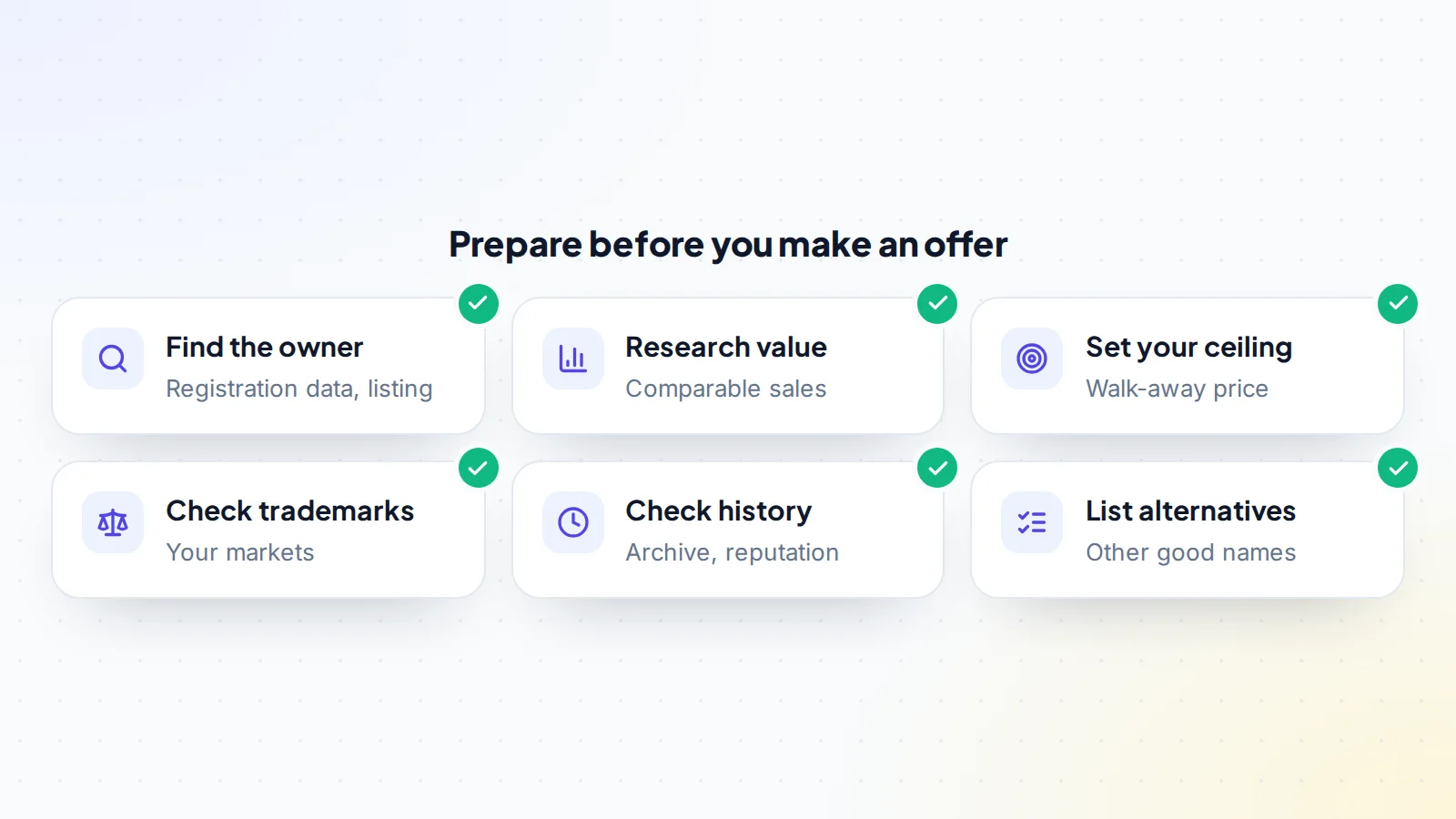
Start by visiting the domain. Many names show a “for sale” page with a price or an offer form. Some are listed on domain marketplaces. If there’s nothing, look up the registration data through an RDAP lookup tool, such as ICANN’s. Many owners use privacy services, but registrars often provide a way to contact the registrant without revealing their details.
Try to learn what kind of owner you’re dealing with. A domain investor with hundreds of names usually has a pricing method and expects negotiation. A business using the name for a live website may not want to sell at all, or may only sell for a price that covers rebranding. Someone who registered the name years ago and forgot about it may be open to a reasonable offer.
Research what the name is worth
Before you make any offer, look at what similar names have sold for. Domain marketplaces and industry sites publish sales reports. Compare names of similar length, structure, extension and topic. This gives you a range rather than a single number, which is what you need to judge whether an asking price is reasonable.
Then think about what the name is worth to you. A name that will be your main brand for years may justify more than market comparisons suggest. A name that’s only slightly better than an alternative is worth less. Our guide to brandable domain names explains the qualities that drive value, and our guide to domain extensions covers how the ending affects price.
Set your walk-away price
Decide the most you’ll pay before you send the first message, and write it down. This is your walk-away price, or ceiling. It should reflect the name’s market range, its value to you and your budget. Having it fixed in advance protects you from the most common mistake in any negotiation: getting caught up in the moment and paying more than you meant to.
List two or three alternative names you’d be happy with. Alternatives make walking away a real option, and owners can usually tell when a buyer is calm because they have choices.
Check the name before you commit
Search trademark databases in the countries where you’ll use the name, look through its history in the Internet Archive’s Wayback Machine, and check Google’s Safe Browsing status for warnings. If there’s a trademark conflict or a troubled history, it’s better to know before you agree a price. Our guide to domain trademarks and UDRP explains the risks of names that match someone else’s brand.
The first message
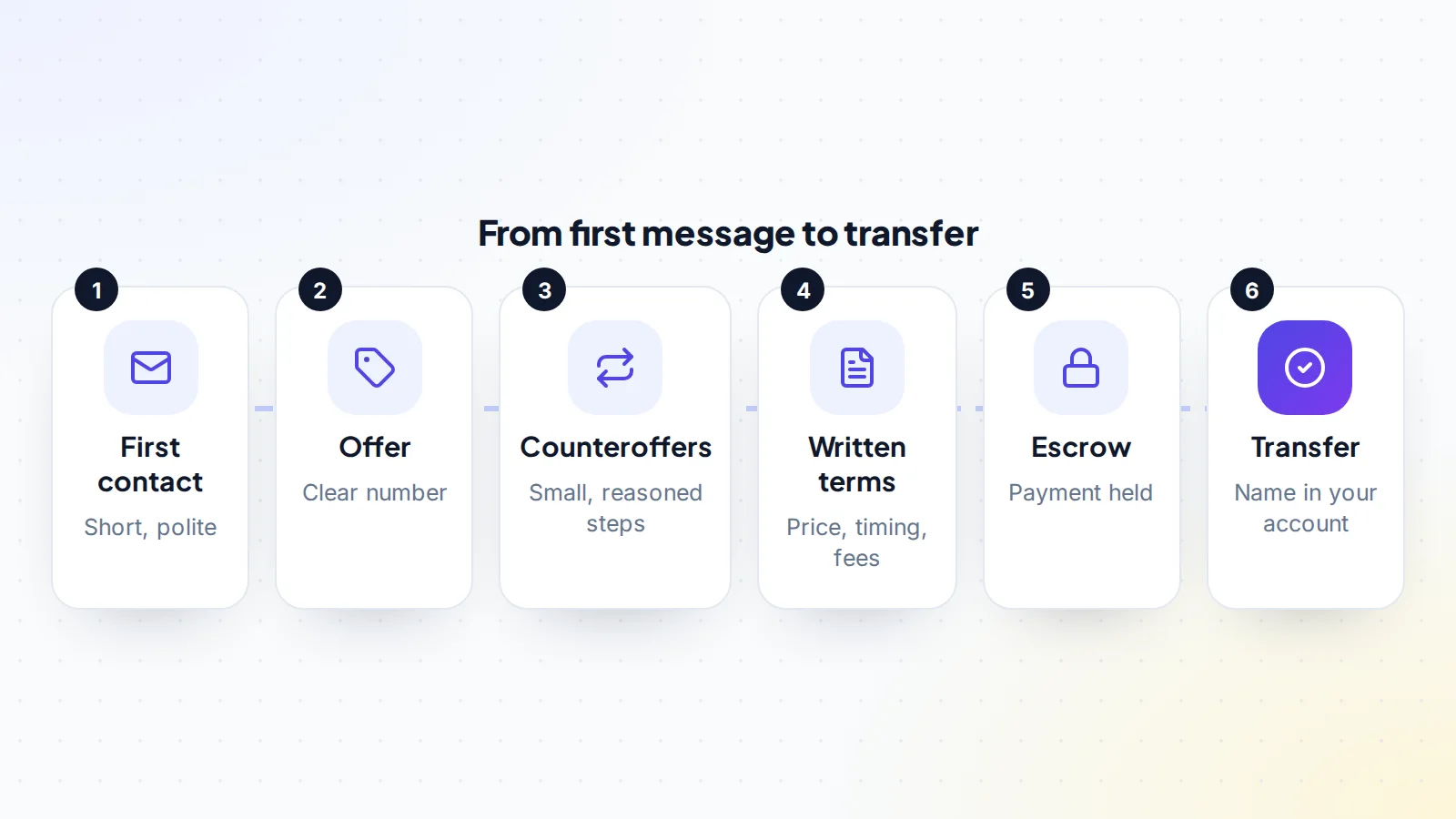
Keep the first message short and polite. Introduce yourself, say you’re interested in buying the domain, and either ask whether they’d consider selling or make an opening offer. Don’t explain how much the name means to you, and don’t mention a big company or investor behind you; both can raise the price. Don’t threaten legal action or claim rights you don’t have.
If the owner has a listing with an offer form, use it. If you’re contacting them directly, use a professional email address. Our guide to finding domain owners includes tips on reaching owners who use privacy services.
Making the first offer
Your first offer should be credible: low enough to leave room to move, but not so low that the owner dismisses you. An offer well below the comparable range is fine if you can explain it briefly, for example by mentioning that similar names have sold in a certain range. An offer that seems random or insulting can end the conversation.
Give a specific number rather than asking “what’s your price?” if the owner hasn’t set one. Specific numbers anchor the conversation and show you’re serious. Some buyers prefer to ask for the owner’s price first; both approaches work, as long as you’ve done your research.
Handling counteroffers
Expect the owner to counter. When they do, move in small, reasoned steps. Each time you increase your offer, give a short reason: perhaps you’ve reconsidered your budget, or you can close quickly. Don’t increase your offer twice in a row without a counteroffer from the owner, which is sometimes called bidding against yourself.
If the gap stays large, say so politely and mention your limit. Sometimes that brings the owner closer; sometimes it ends the talks. Both outcomes are fine when you have alternatives. If the owner’s final price is above your ceiling, thank them and walk away. Many owners come back weeks or months later.
Negotiating more than the price
Price isn’t the only thing you can negotiate. Payment terms, such as instalments for larger amounts, can help both sides. Who pays the escrow fee is often negotiable. Timing matters too: a seller who wants a quick sale may accept a lower price for a fast close. If the domain comes with a website, email or social handles, decide whether you want them included.
Agreeing these details early prevents surprises later and can bridge a small gap in price.
Put the terms in writing
Once you agree, write down the terms and get both sides to confirm them: the domain name, the price and currency, who pays which fees, the payment method, the transfer method and the timeline. If anything else is included, such as a website or handles, list it. Clear terms make the close smooth and give both sides something to refer to if questions come up.
Close safely with escrow
Use escrow so neither side has to trust the other with money or the domain first. The buyer pays into escrow, the seller transfers the domain, the buyer confirms it’s in their registrar account, and the escrow company releases the funds. This protects buyers from paying for a domain that never arrives, and sellers from transferring a name and not being paid.
On digiflippers.com, the ways to pay in a deal are: directly to the seller, through escrow, and the platform never holds the money itself. Sellers can verify ownership, and buyers can see that before making an offer. Read how it works for the full process.
The transfer itself
Domains move in one of two ways. If both sides use the same registrar, the seller can often push the domain to the buyer’s account. If not, the seller unlocks the domain and gives the buyer the authorisation code, and the buyer starts the transfer at their registrar. ICANN’s rules require registrars to provide the authorisation code to the registrant within five calendar days of a request. Some recent changes, such as a new registration or a change of registrant, can restrict transfers for a period, so check the domain’s status before you agree a timeline.
Once the domain arrives, change the contact details, turn on the registrar lock and two-factor authentication, and set up auto-renewal.
When to use a broker
Some buyers hire a domain broker to negotiate for them. A broker can approach the owner without revealing who the buyer is, which helps when a well-known company is behind the purchase. Brokers also know typical prices and how particular owners tend to negotiate. They charge for this, usually as a fee or commission agreed in advance, so a broker makes most sense for valuable names or when you’d rather not negotiate yourself.
If you use a broker, agree the fee, your ceiling and what the broker may say about you in writing. Keep the final payment going through escrow, just as you would in a direct deal.
Patience as a tactic
Time often works in the buyer’s favour. Owners who refuse today may reconsider in a few months, when a renewal is due or their plans change. If talks stall, leave a polite note with your best offer and your contact details, and check back later. Meanwhile, keep your alternatives warm. Buyers who are willing to wait often negotiate domain purchase deals on better terms than those in a hurry.
Common mistakes
- Contacting the owner before deciding your ceiling.
- Telling the owner how much you need the name.
- Making an offer so low it ends the conversation.
- Raising your offer twice without a counteroffer.
- Threatening legal action without real grounds.
- Paying directly before the domain is in your account.
A worked example
The details below are made up to show the method.
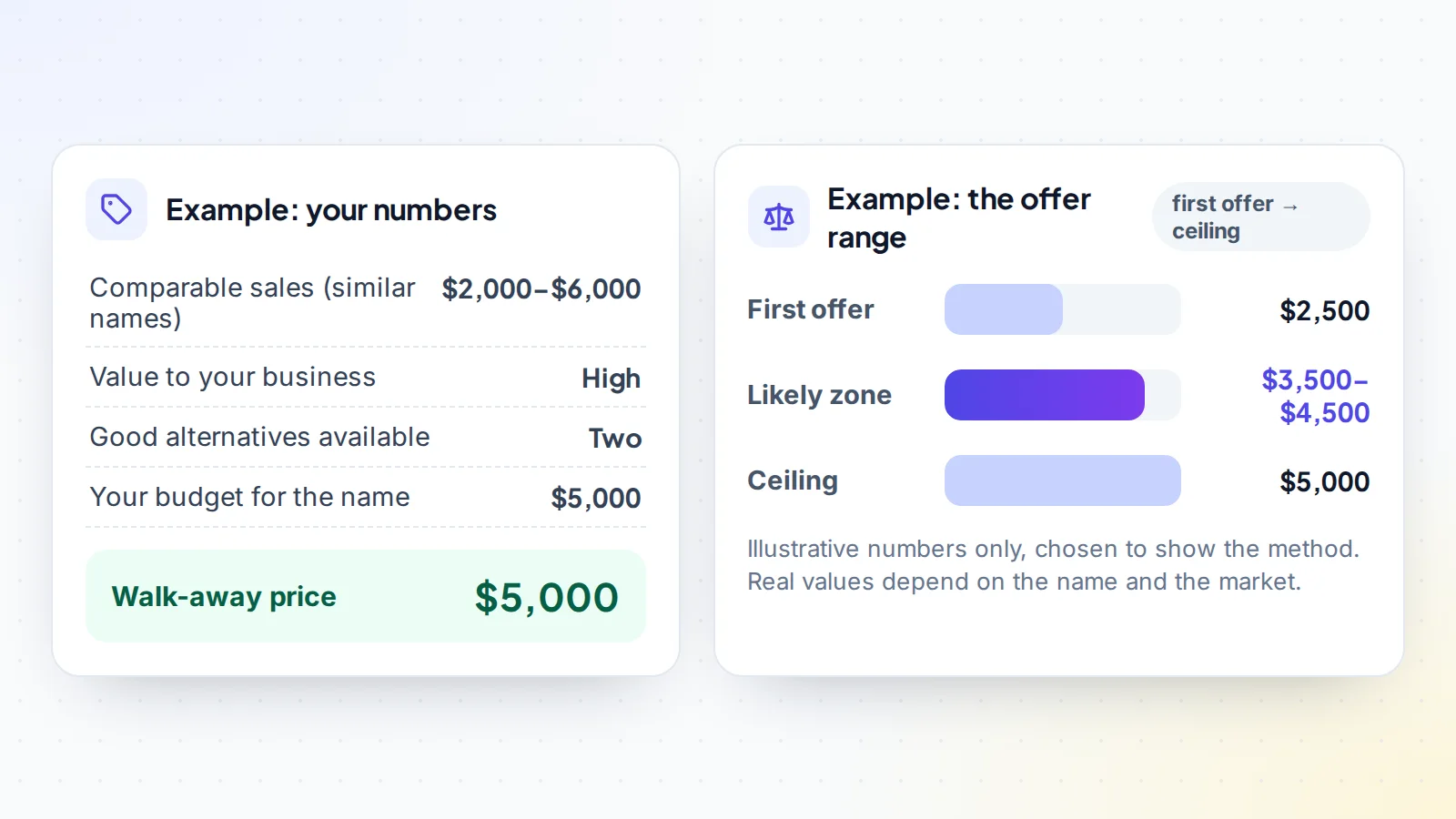
Leo wants a short .com name for a new coaching business. The domain shows a parked page with an offer form. Comparable sales of similar names range from about $2,000 to $6,000. Leo decides the name is worth up to $5,000, with two alternatives in mind, and checks that the name has no trademark conflicts or troubled history.
Leo offers $2,500, mentioning the range of similar sales. The owner, an investor, counters at $7,500. Leo moves to $3,200 and explains the budget. The owner comes down to $5,500. Leo replies that $4,200 is close to the limit and offers to close within a week. The owner agrees at $4,400, with the escrow fee split in half. Terms go in writing, the payment goes into escrow, the domain is pushed to Leo’s registrar account, and the funds are released.
Negotiate domain purchase terms: the checklist
- Owner identified and their likely approach to selling understood.
- Comparable sales researched and a value range noted.
- Walk-away price set and written down.
- Two or three alternative names listed.
- Trademarks, history and Safe Browsing status checked.
- First message short, polite and specific.
- Counteroffers handled in small, reasoned steps.
- Terms agreed in writing, including fees and timing.
- Payment through escrow; released after transfer.
Browse domains for sale on digiflippers.com to see names with clear prices.
Ready to find your next asset?
Browse listings with verified numbers, ask sellers your questions before you offer, and agree every step in a free Deal Room.
Frequently asked questions
How much should I offer for a domain?
Base it on comparable sales and the name’s value to you. Start below your ceiling, with room to move, and explain your offer briefly.
Should I say what the name is for?
Keep it general. Saying how much you need the name or naming a large backer can raise the price.
What if the owner doesn’t reply?
Follow up once or twice over a few weeks. If there’s still no reply, move to an alternative; some owners respond much later.
What if the owner’s price is too high?
Explain your limit politely and walk away if needed. Many owners come back after time to think.
Can I negotiate who pays the escrow fee?
Yes. Fees, timing and payment terms are all part of the negotiation.
How long does a domain transfer take?
A push between accounts at the same registrar can be quick. A transfer between registrars takes longer, and some recent changes can restrict transfers for a period.
Is it safe to pay the seller directly?
It’s safer to use escrow, which releases payment only once the domain is in your account.