Domains and Trademarks: How to Avoid a UDRP Dispute
How the UDRP works, what a trademark owner must prove to win a domain, what counts as bad faith, and practical steps to buy and sell domains without disputes.

A great domain can be worth a lot, and so can a brand. When the two overlap, there’s a fast, low-cost process trademark owners can use to claim a domain: the Uniform Domain-Name Dispute-Resolution Policy, or UDRP. Understanding domain trademark UDRP basics protects buyers from paying for a name they may lose, and helps sellers price and describe names honestly. This guide explains how the policy works, what a complainant has to prove, and the practical steps that keep you out of disputes.
This is general information, not legal advice. If a name you own or want is close to a trademark, speak to a lawyer who handles domain disputes. For the buying process itself, see our guide to buying a domain name that’s taken.
Key takeaways
- The UDRP is an ICANN policy that lets trademark owners bring complaints about domain names to approved dispute providers.
- A complainant must prove three things: a confusingly similar mark, no legitimate interest, and registration and use in bad faith.
- Most disputes involve names that target a brand, such as a brand plus a word or a misspelling.
- Generic words and invented names used for their own purpose are far lower risk.
- Check trademarks and past use before you buy, and keep records of why you chose a name.
What the UDRP is
The UDRP is a policy adopted by ICANN, the organisation that coordinates domain names. Every registrar for generic top-level domains, such as .com, .net and .org, requires its customers to agree to it. It gives trademark owners a way to complain about a domain name without going to court. Complaints are decided by approved dispute-resolution providers; WIPO, the World Intellectual Property Organization, is the best known. If a complaint succeeds, the remedy is that the domain is cancelled or transferred to the complainant. Many country-code domains have their own, similar policies.
The three things a complainant must prove
Under the UDRP, the complainant has to prove all three of these:
- The domain is identical or confusingly similar to a trademark or service mark in which the complainant has rights.
- The domain holder has no rights or legitimate interests in the name.
- The domain was registered and is being used in bad faith.
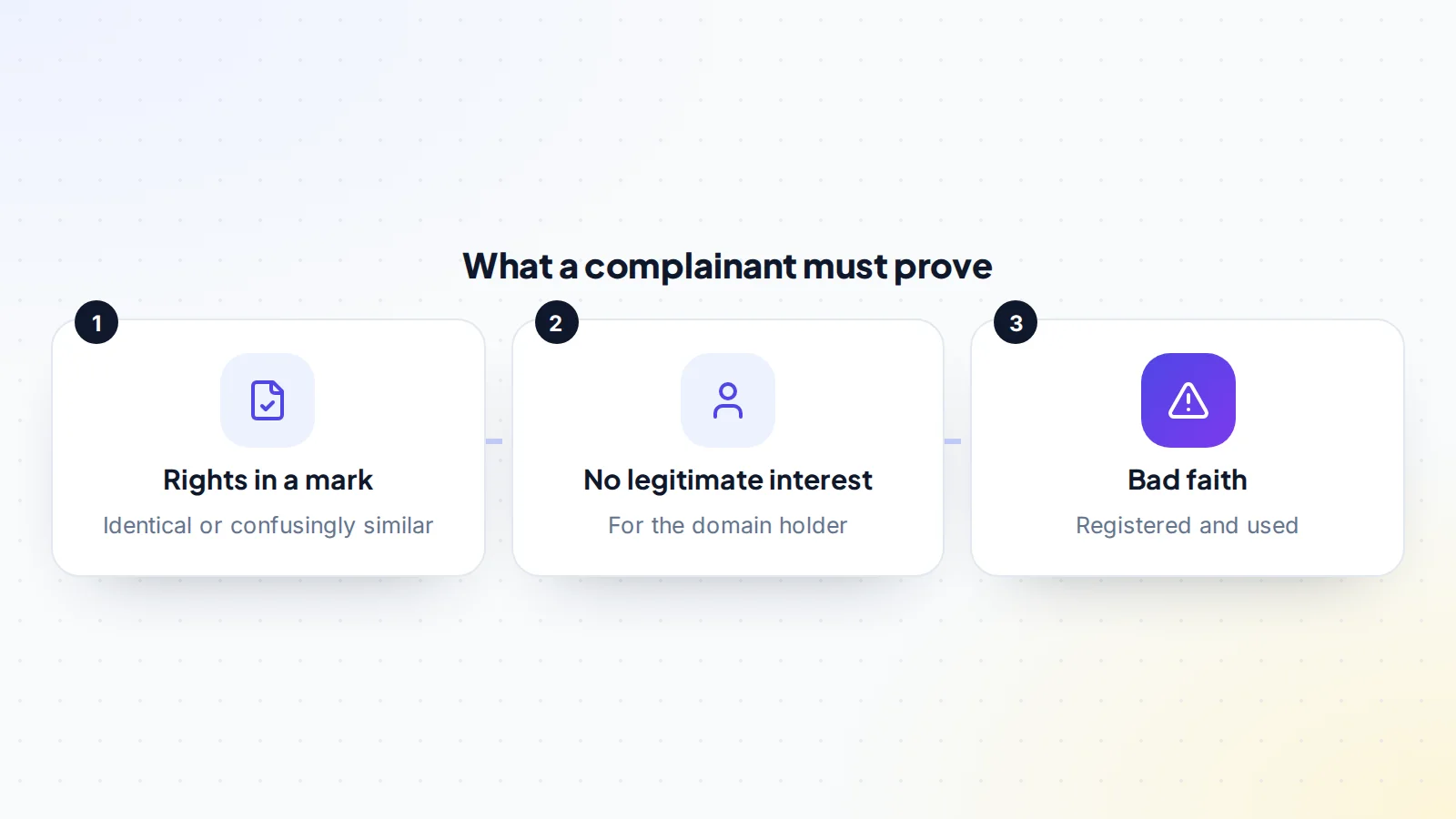
WIPO’s overview of panel decisions explains how panels have interpreted each element over many cases. The key point for buyers and sellers is that a matching or similar trademark alone isn’t enough: the other two elements must also be shown.
What counts as a legitimate interest
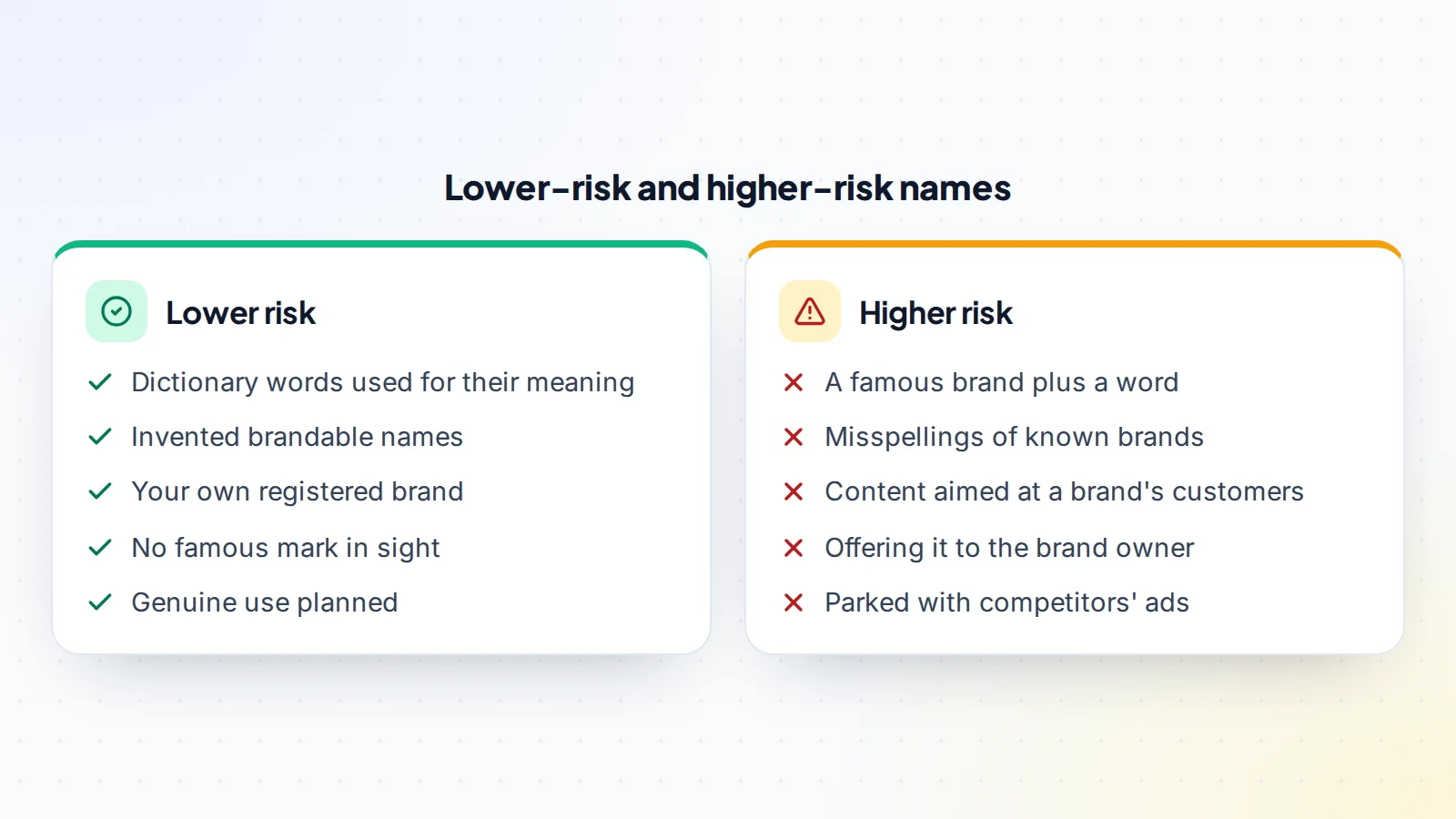
The policy gives examples of circumstances that can show rights or legitimate interests, such as using the name, or preparing to use it, for a genuine offering of goods or services before any notice of a dispute, being commonly known by the name, or making legitimate non-commercial or fair use of it without intent to mislead consumers. A dictionary word used for its ordinary meaning, such as a site about apples on a domain containing “apple”, is a very different case from the same word used to target a famous company’s customers.
What bad faith looks like
The policy lists examples of evidence of bad faith, including:
- Registering a name mainly to sell it to the trademark owner or a competitor for more than the costs of registration.
- Registering names to stop trademark owners from using them, as a pattern.
- Registering a name mainly to disrupt a competitor’s business.
- Using the name to attract visitors for commercial gain by creating confusion with a trademark.
Practical warning signs include parking a brand-like domain with ads for the brand’s competitors, or approaching the brand owner with an offer to sell. Panels look at the whole picture, so a single fact rarely decides a case on its own; the pattern of behaviour usually does.
UDRP or court?
The UDRP is designed to be quicker and cheaper than a lawsuit, and it’s decided on written submissions rather than hearings. It only deals with the domain name itself: the outcome is cancellation or transfer, not damages. Trademark owners can also go to court under national laws, sometimes alongside or instead of a UDRP complaint, and the policy allows either side to take the matter to court. For most buyers and sellers, the practical lesson is the same: the UDRP is the route a brand owner is most likely to use, so it’s the one to plan around.
Typos and look-alike names
Misspellings of well-known brands, extra letters, swapped characters and brand names with extra words like “login”, “support” or “official” are among the riskiest names to own. They’re also used in phishing, which makes brand owners and registrars quick to act. Avoid buying or listing them, however much traffic they seem to get.
Timing matters
Panels look at when a domain was registered or acquired compared with when the trademark existed. A name registered long before a brand appeared is rarely in bad faith, because the holder couldn’t have been targeting a brand that didn’t exist yet. But buying a domain counts as a new registration for this purpose in many panels’ view, so the relevant date can be when you acquired it, not when it was first created. That’s why checking trademarks at the time you buy matters, even for an old domain with a long, clean history.
Think about where you’ll operate
Trademarks are national or regional. A word registered by a company in one country may be free to use in another, and the same word can be registered by different companies for different goods. Search the trademark offices for the markets you’ll actually sell into, and look at the classes of goods and services each mark covers. A lawyer can help interpret close cases, especially where a mark is well known across many countries.
For buyers: avoiding a name you could lose
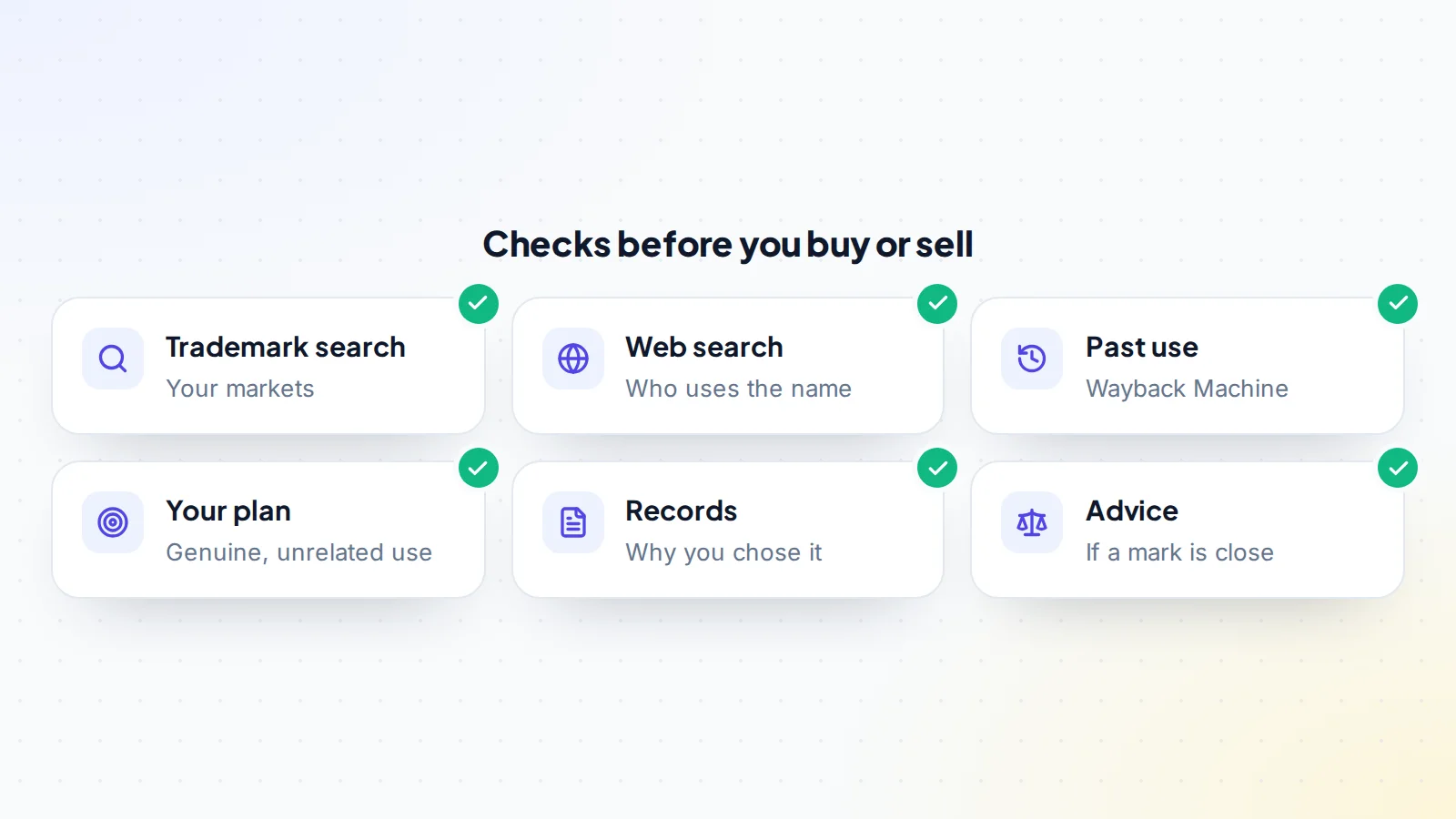
A domain lost through a UDRP complaint is usually lost along with what you paid for it. Before buying:
- Search trademark databases in the countries you’ll operate in, such as the USPTO’s trademark search in the US.
- Search the web for the name in quotes to see who uses it and how.
- Check the domain’s history in the Wayback Machine; our guide to a domain history check shows how.
- Think about your own use: a genuine business in an unrelated field is much safer than anything that could be seen as targeting a brand.
- Take advice if a mark is close, especially a well-known one.
For sellers: describing names honestly
Sellers can reduce risk for everyone by avoiding listings that point at someone else’s brand. Don’t describe a name as “perfect for” a famous company, don’t contact brand owners offering to sell names that match their marks, and don’t price a name on the basis of a brand’s value. Brandable and generic names are what buyers mostly want anyway. Our guide to brandable domain names explains what makes them valuable on their own.
Expired and aged domains
Names that expire can carry history, including a former company’s brand. If you buy an expired name that once belonged to a business, check whether that business or its trademark still exists, especially in the same field. Our guides to expired domains and aged domains cover the other checks.
When a complaint is brought in bad faith
The process protects domain holders too. If a panel finds that a complaint was brought in bad faith, for example to pressure a legitimate owner into giving up a name the complainant couldn’t otherwise get, it can say so in its decision; this is known as reverse domain name hijacking. It’s one reason clear records of a genuine, independent use matter: they’re your evidence that you registered the name for your own purposes.
Domain sale agreements
When you buy a domain, ask the seller to state in writing that, to their knowledge, the name doesn’t infringe anyone’s trademark and that they haven’t received any complaints or legal notices about it. It won’t stop a trademark owner from acting, but it gives you a record of what you were told and a basis for a claim against the seller if it turns out to be untrue. Use domain escrow so the payment is held until the domain is in your account.
Using a name you already own
How you use a domain affects its risk over time. Building a genuine business or project that’s unrelated to any brand strengthens your position; parking a brand-like name with ads, or redirecting it to a competitor, weakens it. If a brand with a similar name appears after you registered yours, keep using the name for your own purpose and avoid anything that could look like you’re trading on their reputation. Good domain trademark UDRP practice is mostly common sense applied consistently.
If you receive a complaint
Don’t ignore it, and don’t transfer or change the domain in a hurry. UDRP proceedings have deadlines, and a domain holder who doesn’t respond can lose by default. Gather your records: when and why you registered or bought the name, how you’ve used it, and any evidence of your plans. Then take advice from a lawyer who handles domain disputes, who can help you prepare a response. The provider’s website, such as WIPO’s domain dispute pages, explains the process and timelines.
How trademark risk affects price
A name with a clear path to a dispute is worth far less, often nothing, to a careful buyer. A name with no trademark issues in its likely markets can be priced on its own merits: length, words, extension and demand. When there’s some overlap, such as a dictionary word that’s also a brand in an unrelated field, buyers usually price in the uncertainty and want a clean history and a legitimate plan. Our guide on pricing a listing covers the wider picture.
A worked example
The details below are made up to show the method.
Sofia wants to buy a short .com made of two dictionary words for a garden furniture shop. A trademark search finds the same words registered by a software company in an unrelated field, and a web search shows no confusion between them. The Wayback Machine shows the domain was a gardening blog for years. Sofia’s lawyer says the risk is low for the planned use, and Sofia keeps a note of each check. Sofia buys through escrow and launches the shop on the name.
A second name on Sofia’s list combined a well-known furniture brand with “outlet”. Sofia doesn’t bid, however cheap it looks: it points straight at someone else’s trademark.
Domain trademark UDRP: the checklist
- Trademark databases searched in your markets.
- Web searched for current uses of the name.
- Past use checked in the Wayback Machine.
- Your planned use is genuine and doesn’t target a brand.
- No offers made to brand owners or competitors.
- Records kept of why and when you chose the name.
- Advice taken if a mark is close.
- Payment protected with escrow.
Ready to find your next asset?
Browse listings with verified numbers, ask sellers your questions before you offer, and agree every step in a free Deal Room.
Frequently asked questions
What is the UDRP?
An ICANN policy that lets trademark owners bring complaints about domain names to approved providers, such as WIPO, without going to court.
What must a complainant prove?
That the domain is identical or confusingly similar to their mark, that the holder has no rights or legitimate interests, and that the domain was registered and is being used in bad faith.
Can I lose a domain I paid for?
Yes, if a complaint succeeds. That’s why checking trademarks and past use before buying matters.
Are dictionary words safe?
Generally lower risk when used for their ordinary meaning, but a dictionary word can also be a brand. How you use the name matters.
What should I do if I get a complaint?
Respond within the deadline, gather records of how and why you acquired and used the name, and take advice from a domain dispute lawyer.
Does the UDRP apply to country-code domains?
Not always. Many country-code registries have their own dispute policies; check the registry’s rules.
How do I keep my domain trademark UDRP risk low?
Choose generic or invented names, check trademarks and past use before buying, use the name for a genuine purpose unrelated to any brand, and keep records of your choices.