Online Business Trends to Watch This Year
A grounded look at the online business trends shaping how websites, apps, newsletters, channels and digital products are built, valued and sold: AI tools and content quality, search updates and spam policies, stricter email sender rules, creator monetization, privacy and consent, the move from WHOIS to RDAP, verified data and what it all means for buyers and sellers.

Online businesses change constantly: platforms update their rules, search engines adjust how they rank pages, email providers tighten requirements and buyers learn to ask better questions. Keeping up with online business trends isn’t about chasing every new idea; it’s about understanding the shifts that change what a website, app, newsletter, channel or digital product is worth. This guide looks at the trends with clear, published evidence behind them: AI and content quality, search updates, email sender rules, creator platforms, privacy, domain data and buyers’ growing demand for verified numbers, and what each means for owners, buyers and sellers.
For the basics, read what is a digital asset and online business models.
Key takeaways
- The strongest online business trends reward quality, originality and trust.
- Search engines judge content on helpfulness, not on whether AI was used.
- Large email providers now require authentication and easy unsubscribes from bulk senders.
- Creator platforms increasingly reward longer, original content.
- Buyers expect verified data and clean records, and price businesses accordingly.
Why trends matter for value
An online business is valued on what it earns and how likely that income is to continue. Trends change that likelihood. A rule change that hurts a business’s main traffic or income source makes it riskier and less valuable; a shift that favours its strengths makes it more attractive. Owners who understand the trends can adapt early. Buyers who understand them can spot risks and opportunities that others miss. Read how growth trends affect value.
AI tools and content quality
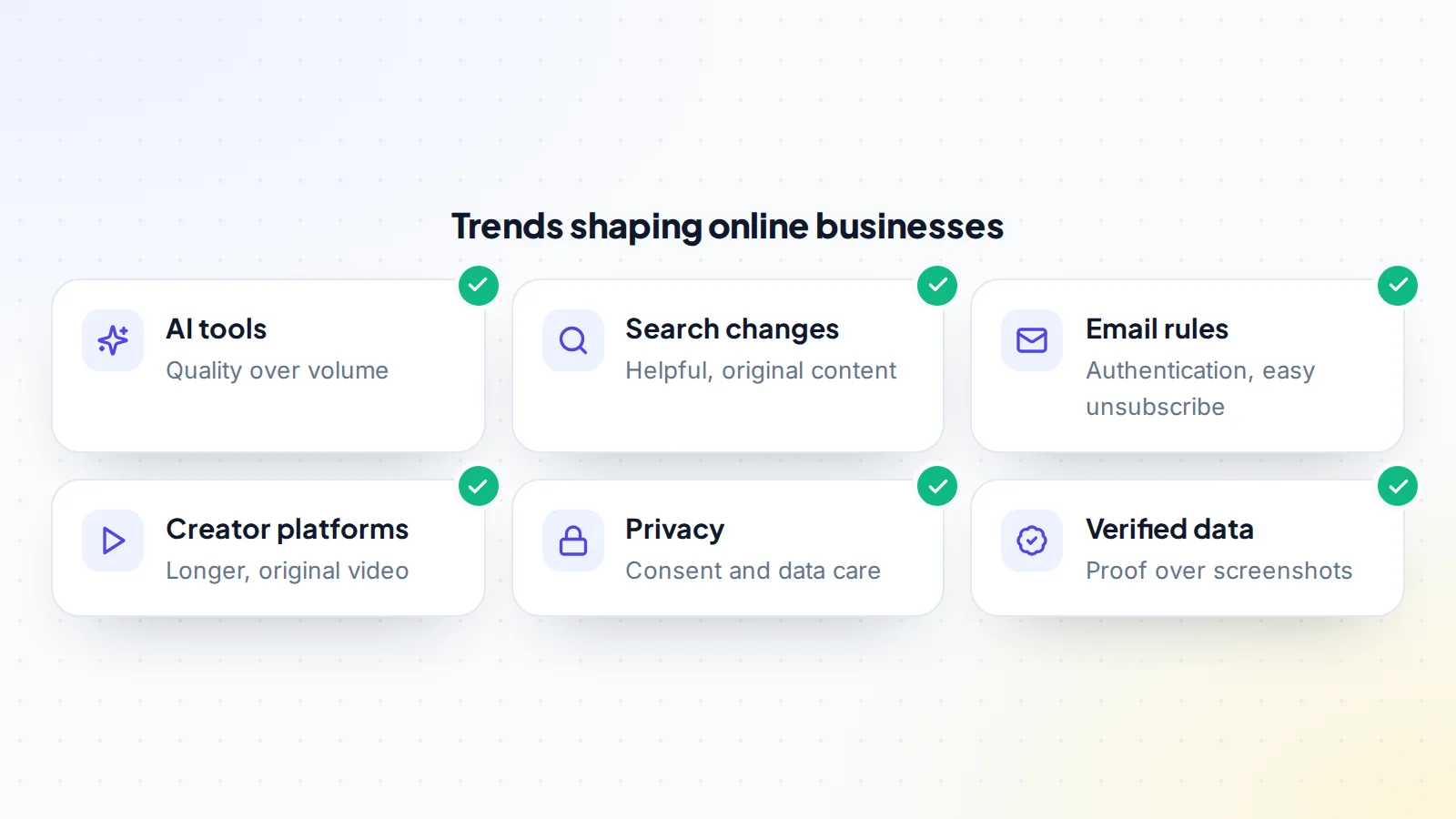
AI writing and image tools have made it far cheaper to produce content. That cuts both ways. Used well, they help small teams research, draft, edit and publish more efficiently. Used badly, they flood the web with thin, repetitive pages. Google has said in its guidance on using generative AI content that it focuses on the quality of content rather than how it was produced, and that using automation mainly to manipulate rankings breaks its spam policies. The trend favours businesses that use AI to make better content, not just more of it. Read how AI content affects website value.
Search updates and spam policies
Search engines regularly update how they rank pages. Google publishes information about its core updates and, in 2024, announced new spam policies covering scaled content abuse, expired domain abuse and site reputation abuse. For content businesses, the direction is consistent: original, helpful content written for people tends to hold up better, while sites built on volume or shortcuts face more risk. For buyers, a site’s history through past updates is now an essential part of due diligence. Read SEO due diligence.
Stricter email sender rules
Email remains one of the most valuable channels an online business can own, but sending has become stricter. Google’s sender guidelines require bulk senders to authenticate their email with SPF, DKIM and DMARC and to offer one-click unsubscribe, and Yahoo publishes similar sender best practices. Lists built with clear permission, sent from properly set-up domains, keep reaching inboxes; old, bought or poorly managed lists struggle. For buyers, an email list is only as valuable as its deliverability.
Creator platforms reward original, longer content
Video and social platforms keep adjusting how creators earn. TikTok’s Creator Rewards Program, for example, pays eligible creators for qualified views on original videos longer than one minute. YouTube’s Partner Program continues to share revenue from long-form videos and Shorts. The broad direction is towards original content that holds attention, and towards creators earning from several sources: platform revenue, sponsors, products and memberships. Read YouTube income streams.
Owned audiences
Because platform rules and reach change, more businesses are building audiences they own: email lists, communities and customer accounts. An owned audience can be reached directly, without depending on an algorithm, and it’s easier to transfer when a business is sold. Buyers increasingly value businesses that combine platform reach with an owned audience over those that rely on a single platform.
Privacy and consent
Privacy rules and expectations continue to tighten. In the UK and EU, data protection law sets rules on consent and how personal data is used and shared, and platforms add their own requirements; Google’s EU user consent policy applies to sites using its advertising products for visitors in those regions. For online businesses, the trend means clear privacy notices, proper consent tools and careful handling of customer data, especially when a business changes hands.
Domain data and RDAP
The way domain registration data is published has changed. ICANN announced that the Registration Data Access Protocol, RDAP, became the definitive source for generic top-level domain registration data from January 2025, replacing the older WHOIS service; see its announcement. Much personal data is now redacted, so buyers checking a domain’s history rely more on registrar records, transfer evidence and the seller’s documentation.
Verified data over screenshots
Buyers of online businesses have become more cautious about screenshots, which are easy to edit. Marketplaces increasingly connect directly to analytics, payment and platform accounts so figures come from the source, and verification of identity and ownership is becoming standard. Sellers who offer verified data sell faster and with fewer questions. Read verified metrics.
Location-independent ownership
More people run online businesses from anywhere, and more buyers look for businesses that need little owner time and no fixed location. That favours businesses with documented processes, remote contractors and online delivery. Read location-independent businesses.
Consumer protection
Regulators have focused on misleading practices online, from fake reviews to impersonation. The FTC’s rule against government and business impersonation took effect in 2024, as it explained in a press release. For online businesses, the trend reinforces honest marketing: clear disclosures, genuine reviews and truthful pricing claims.
Security expectations
Account takeovers are one of the biggest risks for online businesses, and expectations around security have risen accordingly. Multi-factor authentication is now standard advice; the US Cybersecurity and Infrastructure Security Agency calls it one of the simplest steps to protect accounts in its guidance on multi-factor authentication. Platforms increasingly require two-step verification for monetization or ownership changes. For buyers, a business with secured accounts and clear access records is easier and safer to take over.
Recurring revenue
Across software, content and digital products, more businesses are moving towards recurring revenue: subscriptions, memberships and paid newsletters. Recurring income is easier to forecast, and buyers tend to value it more than one-off sales, especially when churn is low and existing customers spend more over time. Even content and product businesses are adding memberships or subscription tiers to smooth income.
Non-competes in business sales
Rules on non-compete agreements have been in flux in the US. The FTC adopted a rule largely banning non-competes in 2024, but courts blocked it, and in September 2025 the FTC acceded to its vacatur. Notably, the rule had excluded non-competes made as part of a genuine sale of a business. State laws still vary, so buyers and sellers should take advice on any non-compete in a purchase agreement.
Mobile-first audiences
Most online audiences now browse on phones, and businesses designed for small screens tend to perform better. Google’s documentation on page experience encourages site owners to provide a good experience across devices. For content sites and shops, fast, readable mobile pages are no longer an extra; they’re the baseline buyers expect when reviewing a site.
Safer ways to buy and sell
As more people buy and sell online businesses, the tools around deals have matured. Escrow, verified identities, ownership checks, connected data and structured transfer steps are increasingly expected rather than optional. At the same time, scammers have become more sophisticated, impersonating marketplaces, escrow services and sellers. The trend for buyers and sellers alike is to keep deals on platforms that record conversations, protect payments and check what’s being sold. Read how trust and safety works on digiflippers.com.
Documentation as an asset
A quieter trend is the value of good documentation. Businesses with written processes, clean financial records, a list of accounts and a history of key changes are faster to check, easier to run and easier to sell. As buyers become more careful, documentation has turned from a nice extra into something that directly supports the price.
What this means for buyers
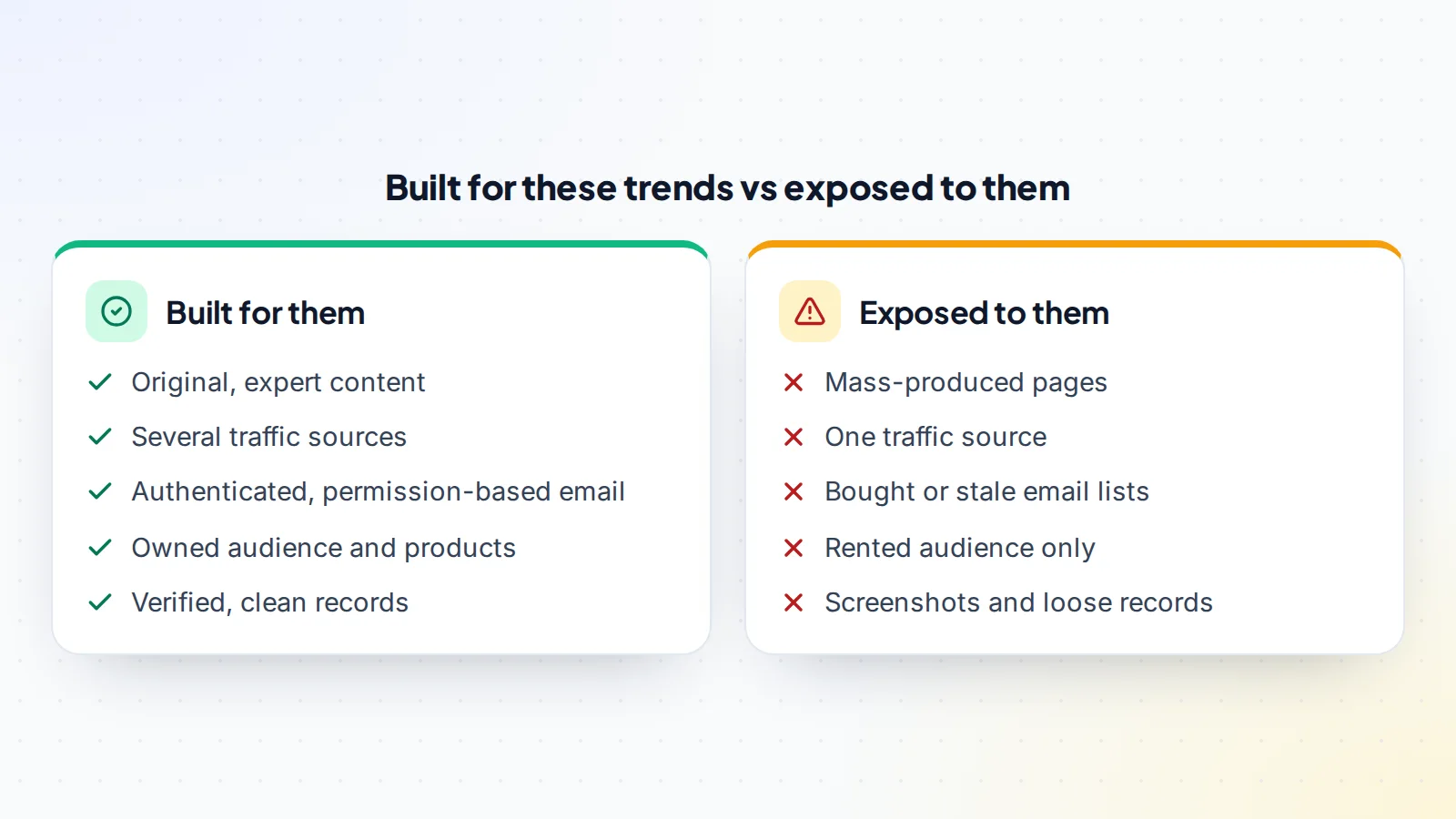
Buyers should check how a business has fared through recent search updates, whether its content would meet current quality standards, whether its email is authenticated and permission-based, how dependent it is on a single platform, and whether its data handling meets privacy rules. A business that’s well placed for these trends deserves more confidence; one that’s exposed to them should be priced accordingly.
What this means for sellers
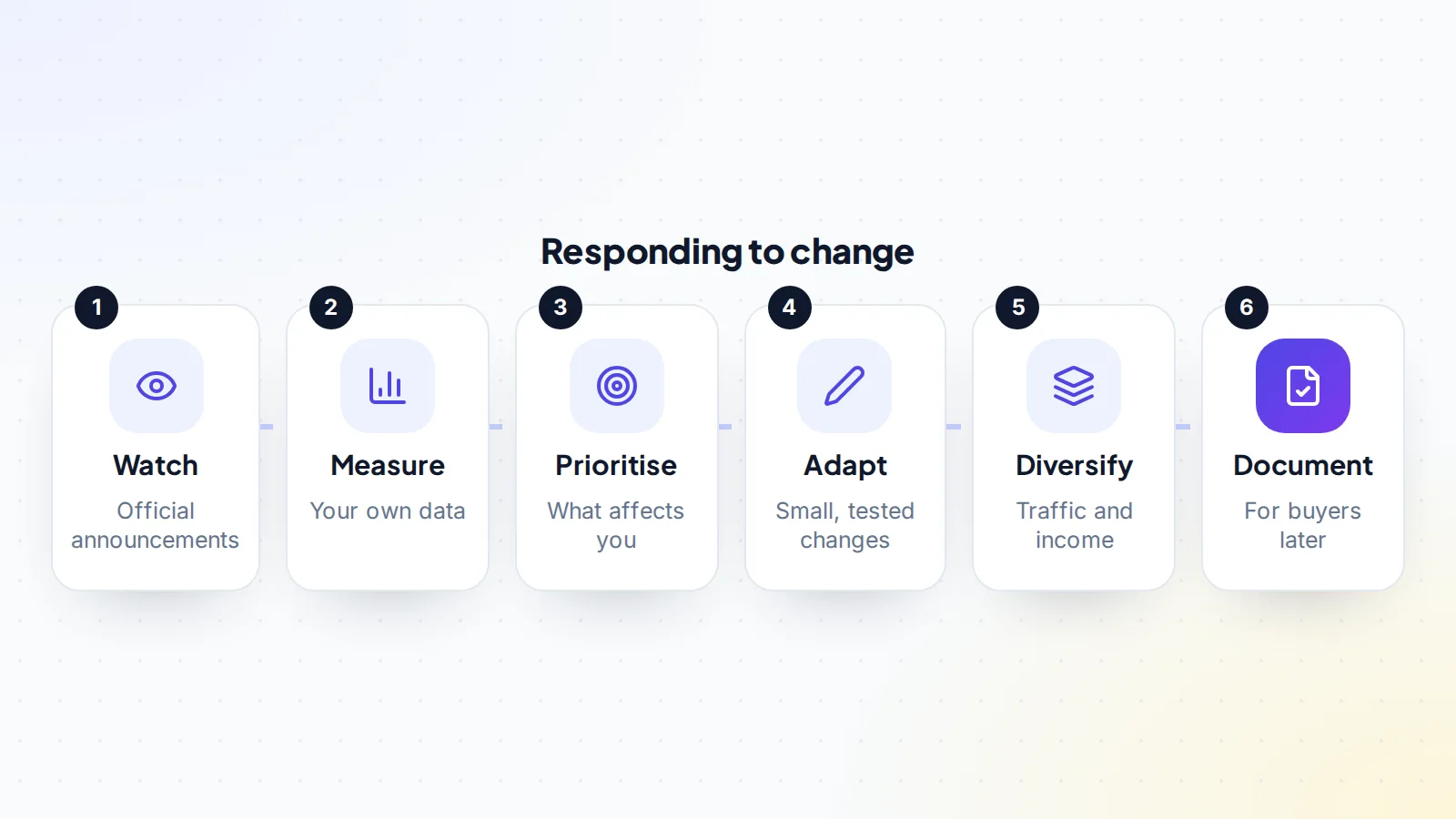
Sellers can prepare by improving content quality, diversifying traffic and income, setting up email authentication, tidying privacy notices and consent, and offering verified data. These steps reduce risk in buyers’ eyes and often raise the price. Document what you’ve done, with dates, so buyers can see it and connect each change to the results in your data.
Separating trends from hype
Not every new idea is a trend. Before acting, check whether a change is backed by official announcements or clear data, whether it affects your kind of business, and whether it’s lasting rather than a passing fad. React to evidence in your own numbers rather than headlines, and give each change time to show its effect before judging it. The online business glossary can help with unfamiliar terms; read the glossary.
Taken together, these online business trends point the same way. Businesses that earn trust, through original content, permission-based email, careful data handling, secure accounts and verified numbers, are better placed to keep their income and to command a good price when they’re sold. Those that rely on shortcuts face more risk with each change.
Common mistakes
- Chasing every new idea without checking the evidence.
- Scaling content volume without improving quality.
- Ignoring email authentication and list hygiene.
- Relying on a single platform for traffic and income.
- Treating privacy as an afterthought.
- Buying without checking how a business fared through recent changes.
A worked example
The details below are made up to show the method.
Charlie owns a cooking website earning from ads and affiliates, plus a newsletter. Reviewing the trends, Charlie updates older articles with tested recipes and original photos, stops publishing quick filler pages, sets up email authentication on the newsletter domain and adds one-click unsubscribe, and starts a short video series to bring traffic from a second platform.
Over the next year, the site holds steady through a search update, the newsletter’s open rates improve, and video brings a new stream of visitors. When Charlie lists the business, verified data shows diversified traffic and income, and buyers treat it as lower risk than similar sites.
Online business trends: the checklist
- Official announcements followed for your main platforms.
- Content quality reviewed and improved.
- Email authentication and easy unsubscribe in place.
- More than one traffic and income source.
- An owned audience such as an email list.
- Privacy notices and consent up to date.
- Verified data ready for buyers.
- Changes documented with dates.
See what’s selling now on the digiflippers.com marketplace, or value your business with the valuation tool.
Ready to find your next asset?
Browse listings with verified numbers, ask sellers your questions before you offer, and agree every step in a free Deal Room.
Frequently asked questions
What are the main online business trends?
AI and content quality, search updates, stricter email rules, creator platform changes, privacy, domain data changes and demand for verified data.
Does Google penalise AI content?
Google says it focuses on quality, not how content is made, but using automation mainly to manipulate rankings breaks its policies.
What changed for email?
Large providers require bulk senders to authenticate email and offer easy unsubscribes.
Why do buyers want verified data?
Screenshots are easy to fake; data from the source is more reliable.
What is RDAP?
The protocol that replaced WHOIS as the definitive source of gTLD registration data from January 2025.
How should sellers respond to trends?
Improve quality, diversify, set up email authentication, tidy privacy and offer verified data.
Are all trends worth following?
No. Act on changes backed by evidence that affect your business.
Do trends change a business’s value?
Yes. They change how likely income is to continue, which drives value.