How to Pay for a SaaS Acquisition: Cash, Earn-Outs and Seller Financing
How buyers fund SaaS acquisitions: savings, SBA-backed loans, seller notes, earn-outs, partners and investors, and revenue-based financing, plus how lenders look at SaaS and how to structure a deal both sides accept.
Good SaaS businesses rarely come cheap. A product with steady recurring revenue, low churn and a loyal customer base often sells for a multiple of its annual profit, and few buyers have that amount sitting in cash. That’s where SaaS acquisition financing comes in: loans, seller financing, earn-outs, partners and other ways of paying for a business over time. This guide explains the main options, how lenders look at software businesses, how to combine sources, and how to structure a deal that works for buyer and seller alike.
For the buying process itself, see our guide to buying a SaaS business. For one of the most common tools, read about the earn-out.
This guide gives general information, not financial or legal advice. Lending rules change; check current terms with lenders and advisers.
Key takeaways
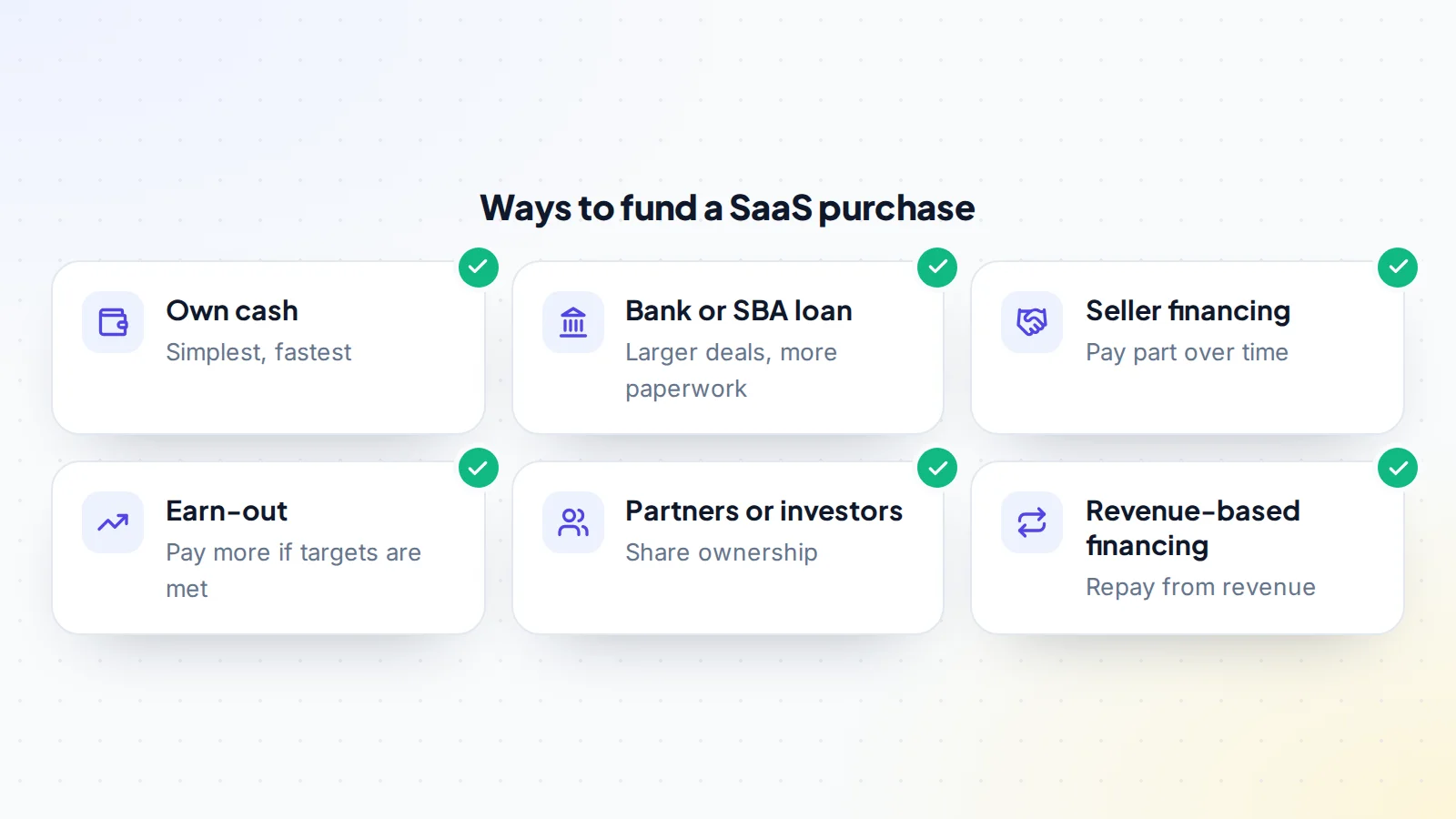
- Common sources: own cash, bank or SBA-backed loans, seller financing, earn-outs, investors and revenue-based financing.
- SBA 7(a) loans can be used to buy an existing business, with an equity injection required for a complete change of ownership.
- Lenders look at cash flow, history and the buyer’s experience as much as the business.
- Seller financing and earn-outs share risk and can bridge valuation gaps.
- Make sure the business’s cash flow can cover every repayment, with room to spare.
Why financing matters for SaaS deals
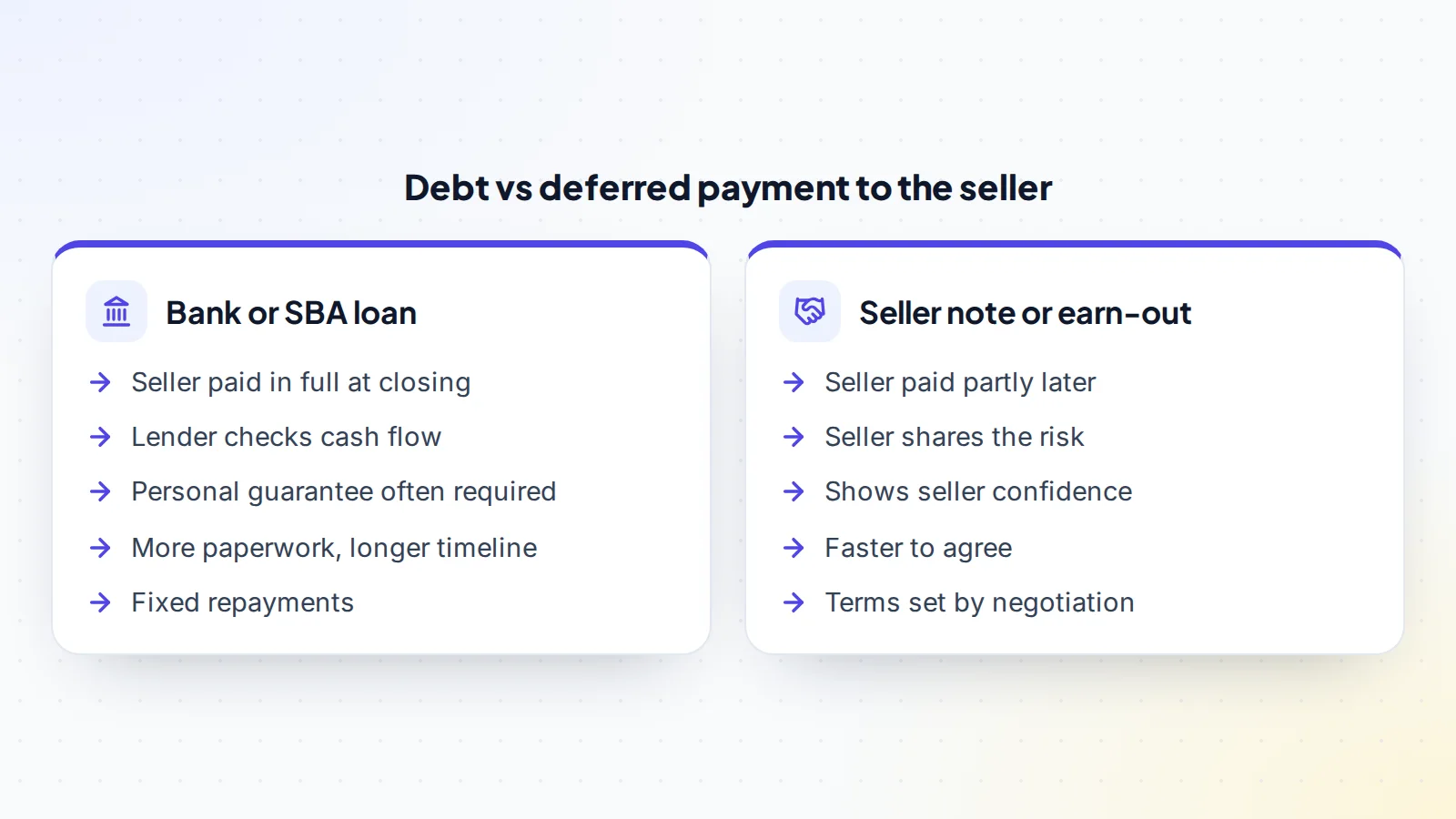
SaaS businesses are attractive because of their recurring revenue, but that same predictability pushes prices up. Financing lets buyers acquire larger, more established products than their savings alone would allow, and spreads the cost over time. It also changes the risk: debt must be repaid whatever happens, while seller financing and earn-outs tie part of the price to how the business performs.
Choosing the right mix isn’t just about getting the deal done. It affects your monthly cash flow, your personal risk and your relationship with the seller after closing.
Preparing to finance a purchase
Good SaaS acquisition financing starts before you find the business. Lenders and sellers both want to know you’re a credible buyer, so prepare:
- A clear summary of your own finances and how much you can contribute.
- Your experience running software, online businesses or teams.
- The kind of business you’re looking for, its size and price range.
- Conversations with one or two lenders, so you know what they’d consider.
- Advisers lined up: an accountant and a lawyer familiar with acquisitions.
Buyers who arrive with financing already explored can move faster when the right business appears, and sellers take their offers more seriously.
Paying with your own cash
Cash is the simplest option: no lender approval, fewer conditions and a faster close. Sellers often prefer cash buyers for exactly that reason, and may accept a slightly lower price in return. The downside is concentration: putting a large share of your savings into one business leaves less cushion if things go wrong. Many buyers use cash for part of the price and finance the rest, keeping a reserve for running costs and improvements.
Bank and SBA-backed loans
In the United States, the Small Business Administration’s 7(a) loan program guarantees loans made by approved lenders, and the SBA lists buying an existing business, including a change of ownership, among the uses of 7(a) loans. SBA rules require a buyer equity injection for a complete change of ownership, set out in its standard operating procedures; recent rules set this at 10% of project costs, and the procedures are updated from time to time, so check the current version with your lender.
Lenders look at the business’s cash flow, its history, the buyer’s experience and the buyer’s own finances. They usually want to see that the business can cover loan repayments comfortably, and many require a personal guarantee. SaaS businesses can be harder for some lenders to assess, because they have few physical assets, so lenders with experience of software or online businesses are often easier to work with. Expect more paperwork and a longer timeline than a cash deal.
Outside the US, similar government-backed or bank lending schemes exist in many countries. The principles are much the same: lenders want proof of steady cash flow and a buyer who can run the business.
What lenders look at in a SaaS business
- Revenue history: usually several years of financial statements and tax returns.
- Recurring revenue quality: monthly recurring revenue, churn and customer concentration.
- Cash flow: profit after all costs, and how it compares with loan repayments.
- Owner dependence: how much the business relies on the seller, and the transition plan.
- Buyer’s experience: whether you can run the business, or have a team who can.
Our guide to seller’s discretionary earnings explains how profit is often presented for small businesses, which lenders also use.
Seller financing
With seller financing, the seller agrees to receive part of the price later, usually through a promissory note repaid in instalments with interest. It reduces the cash and debt the buyer needs at closing, and it signals the seller’s confidence in the business: a seller willing to be paid over time is betting the business will keep performing.
Terms are negotiated: the amount, interest rate, repayment period and what happens if payments are missed. Many deals combine a bank loan with a smaller seller note, and lenders often have rules about how a seller note fits alongside their loan. Our guide to checking an online seller is useful here too, because seller financing means a longer relationship.
Earn-outs
An earn-out pays part of the price later, but only if the business hits agreed targets, such as revenue, profit or customer numbers. It’s useful when buyer and seller disagree about the future: the seller believes growth will continue, the buyer isn’t sure, and the earn-out lets both be right. The key is clear, measurable targets and agreement on how the business will be run during the earn-out period. Our guide to the earn-out covers how to structure one fairly.
Partners and investors
Some buyers bring in partners or investors who contribute part of the price in exchange for a share of ownership. This reduces personal risk and debt, but means sharing profits and decisions. Agree in writing who does what, how decisions are made, how profits are shared and what happens if someone wants to exit. For larger deals, specialist funds and holding companies also buy SaaS businesses, sometimes in partnership with operators.
Revenue-based financing
Revenue-based financing providers lend against a business’s recurring revenue, with repayments tied to a share of monthly revenue rather than a fixed amount. It’s used by some SaaS businesses to fund growth, and some buyers use it to fund part of an acquisition or to provide working capital after closing. Costs can be higher than bank debt, and terms vary widely, so read them carefully and model repayments against realistic revenue.
Combining sources
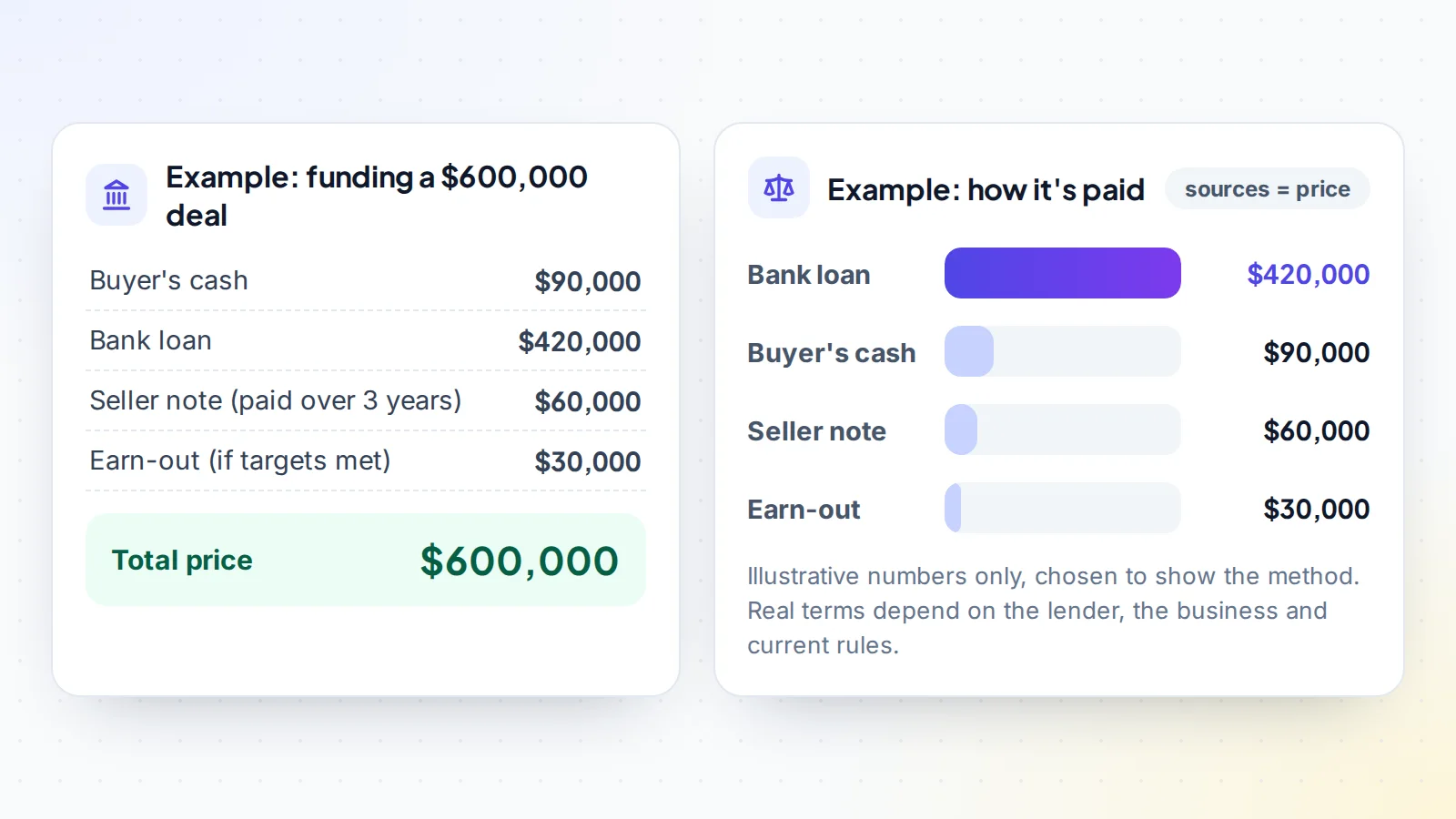
Most financed SaaS deals use a combination: the buyer’s cash, a loan, and some seller financing or an earn-out. Each source has different terms and priorities, so they need to fit together. Lenders may require that their loan is repaid before the seller note, or that seller payments pause if the business struggles. Map out every repayment month by month, and check the business’s expected cash flow covers all of them with a buffer for slower months.
How financing affects the timeline
Financing adds steps. A cash deal can close in a few weeks once due diligence is done. A bank or SBA-backed loan usually takes longer, because the lender reviews the business, the buyer and the deal documents, and may require a valuation. Seller financing and earn-outs mainly add negotiation and legal drafting. Tell the seller your expected timeline early, and build it into the letter of intent, so nobody is surprised. Keep the seller updated as the lender works through its checks.
Due diligence matters more with debt
When you borrow to buy, mistakes cost more, because repayments continue even if revenue falls. Verify revenue at the source, review churn and customer concentration, check the code and infrastructure, and understand how much the business depends on the seller. On digiflippers.com, sellers can verify key figures, and you can read how verification works. Our guide to the SaaS transition period explains how to plan the handover so revenue holds up while you take over.
Smaller deals
For smaller SaaS products, micro-SaaS tools and plugin businesses, bank loans may not be practical. Cash, seller financing and earn-outs are more common, and deals close faster. Our guide to WordPress plugin businesses for sale covers a type of software business where this is often the case.
The seller’s view
Sellers usually prefer to be paid in full at closing. Financing asks them to accept some risk, so expect to offer something in return: a higher headline price, security for the note, regular reporting during an earn-out, or a shorter repayment period. Sellers who understand a buyer’s financing plan, and see that it’s realistic, are more willing to agree. Be open about your funding from the first serious conversation, and explain how the seller will be protected if anything goes wrong.
After closing: managing the repayments
Once the deal closes, treat repayments as a fixed cost of the business. Keep a cash reserve covering several months of loan and seller-note payments, track revenue and churn weekly in the early months, and avoid large new spending until you’ve seen how the business performs under your ownership. If an earn-out is running, share the agreed reports with the seller on time. Good communication with lenders and sellers keeps options open if a month comes in lower than expected. The goal of SaaS acquisition financing is to own a business that pays for itself, not one that strains to meet its debts.
Common mistakes
- Borrowing so much that repayments leave no room for a slow month.
- Agreeing earn-out targets that are vague or that the buyer controls entirely.
- Assuming any lender will understand a software business.
- Leaving financing until after agreeing a price and timeline.
- Skipping due diligence because a lender is also reviewing the deal.
A worked example
The details below are made up to show the method.
Taylor wants to buy a project-management SaaS for $600,000, earning around $150,000 a year in profit with steady churn. Taylor has $120,000 in savings but wants to keep a reserve. A lender experienced with software businesses offers $420,000, subject to an equity injection and a review of three years of financials. Taylor contributes $90,000.
The seller agrees to a $60,000 note repaid over three years and a $30,000 earn-out tied to keeping annual revenue above an agreed level in the first year. Taylor models monthly repayments against conservative revenue and finds a comfortable buffer. Due diligence confirms the numbers, the lender approves, and the deal closes with escrow holding the funds until the transfer is complete.
SaaS acquisition financing: the checklist
- Your cash contribution and reserve decided.
- Lenders with software experience contacted early.
- Current equity injection and lender rules confirmed.
- Seller financing or earn-out discussed with the seller.
- Every repayment mapped month by month against conservative cash flow.
- Earn-out targets clear and measurable.
- Investor or partner terms agreed in writing.
- Full due diligence completed, regardless of lender review.
- Advisers consulted on legal, tax and financing terms.
Browse SaaS businesses for sale on digiflippers.com.
Ready to find your next asset?
Browse listings with verified numbers, ask sellers your questions before you offer, and agree every step in a free Deal Room.
Frequently asked questions
Can I get a loan to buy a SaaS business?
Often, yes. In the US, SBA 7(a) loans can be used to buy an existing business. Lenders look at cash flow, history and the buyer’s experience.
How much do I need to put in myself?
SBA rules require an equity injection for a complete change of ownership, recently 10% of project costs. Check current rules with your lender.
What is seller financing?
The seller accepts part of the price later, usually through a note repaid in instalments with interest.
What’s the difference between seller financing and an earn-out?
A seller note is owed regardless of performance; an earn-out is paid only if agreed targets are met.
Is revenue-based financing a good idea?
It can be useful, but costs and terms vary. Model repayments against realistic revenue before agreeing.
Do lenders understand SaaS?
Some do better than others. Lenders with software experience are usually easier to work with.
What’s the biggest risk with financing?
Repayments that the business can’t cover in a slow month. Leave a comfortable buffer.