How to Sell an Affiliate Website (and What Buyers Look For)
What buyers check when you sell an affiliate site, how to prepare programme earnings and traffic, how to deal with accounts that don't transfer, and how to price it.

Affiliate sites are popular with buyers because they need no stock and little support. But buyers also know the risks: income depends on search traffic and on programme rules the owner doesn’t control. If you want to sell an affiliate website for a good price, your job is to show that the income is real, spread out and likely to continue, and to make the handover of programmes and links straightforward.
This guide covers the process from the seller’s side: when to sell, what to prepare, how to handle programmes that don’t transfer, how buyers value affiliate sites, how to write the listing, and how to hand over. It’s the companion to our guide for buyers on how to buy an affiliate website.
Key takeaways
- Prepare 12 months of earnings by programme, net of reversed commissions, matched to payouts.
- Check, programme by programme, whether accounts transfer; for those that don’t, plan a link swap.
- Show traffic sources and top pages over 12 to 24 months, including through search updates.
- Price on net profit after every cost, including content you write yourself.
- Have payment secured by escrow or a middleman before the handover starts.
When to sell
The best time to sell an affiliate site is when traffic and earnings have been steady or growing for at least a year, not right after a spike and not during a slide. Buyers examine recent months closely, especially around search updates. Google explains that it makes broad core updates several times a year; a site that has come through recent updates steadily is easier to sell than one that has just dropped.
Keep publishing on your usual schedule while the site is for sale. A pause shows up in the numbers buyers are checking.
Step 1: Prepare the earnings and costs
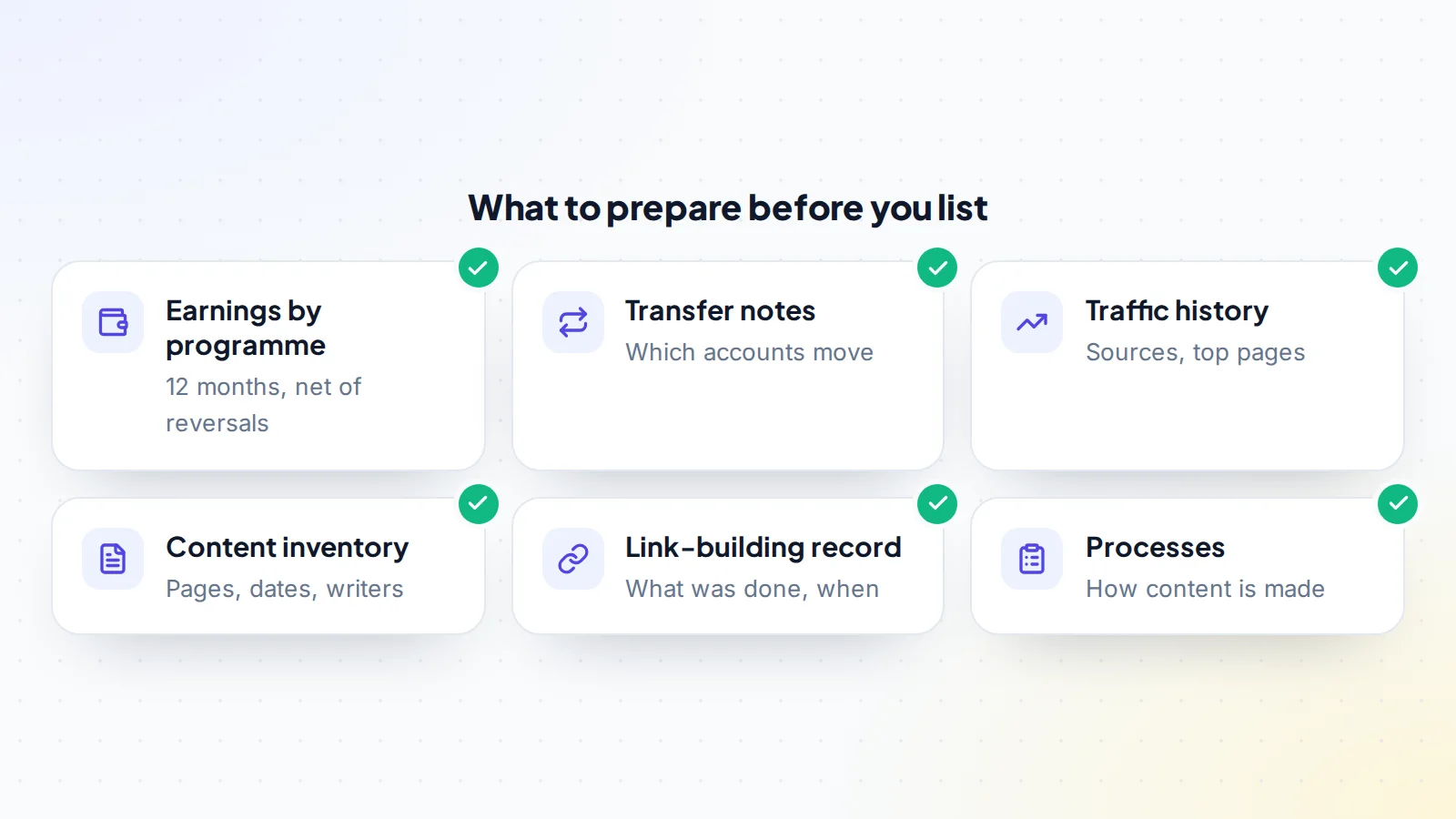
For each affiliate programme and ad network, prepare 12 months of:
- Earnings by month, after reversed or cancelled commissions.
- Clicks, orders and conversion rate, so buyers can see the income comes from steady sales.
- Payouts matching the dashboard figures in bank or payment records.
Then list every cost: hosting, writers and editors, tools, images, link building and your own time. Buyers usually work from trailing twelve months profit, and they’ll check whether your figures are revenue or profit, so present net profit clearly.
Be ready to share dashboards live, in a screen share where the buyer chooses the dates, or through read-only access where the programme offers it. Screenshots alone won’t convince experienced buyers.
Step 2: Check which accounts transfer
Affiliate programmes are agreements between the merchant and the account holder, and many can’t simply be handed over. Amazon’s Associates Program Operating Agreement, for example, says the agreement may not be assigned without Amazon’s express prior written approval. For programmes like that, the usual approach is that the buyer opens or uses their own account and the links are swapped on handover day.
For each programme, write down:
- Whether the account can transfer, and how.
- If not, whether the buyer will need to apply, and how long approval usually takes.
- Any special commission rates you’ve negotiated, and whether they’re likely to carry over.
- How links are added: in the content, through a plugin or through a link-management tool, which affects how easy the swap is.
Buyers value clarity here very highly. A seller who has already answered these questions removes one of the biggest uncertainties in affiliate site deals.
Step 3: Show the traffic
- Sources: search, social, email, direct and referral, by month, for 12 to 24 months.
- Top pages and queries: what share of traffic and income the top pages bring.
- Countries: commissions often depend on where readers are.
- Search updates: how traffic moved around recent updates, with any explanation.
Give the buyer viewer access to analytics and Search Console during due diligence if they ask; Google’s help explains how owners add users with limited permissions. Our guide to traffic concentration risk explains how buyers will read the data.
Step 4: Document the content and links
- Content inventory: each page with its publish and update dates, word count, author and earnings.
- Writers: who wrote what, and whether contracts assign the rights to you.
- Link-building record: what was done to promote the site. Google’s spam policies describe link schemes as spam, and buyers will ask; honest answers protect the deal.
- Disclosures: in the United States, the FTC’s Endorsement Guides say readers should be told clearly when a site earns from links. Make sure every page has a clear disclosure.
- Processes: how topics are chosen, how articles are written, edited and updated.
Step 5: Price it
Affiliate sites are usually valued as a multiple of average monthly net profit. The multiple rises with a long, steady record, several programmes, many earning pages, helpful content, documented processes and accounts that transfer easily. It falls with recent drops, one dominant programme or page, unclear link-building history and programmes that won’t carry over.
Read about the online business valuation multiple and try the free valuation tool for a quick range.
Step 6: Raise the value before listing
- Update top pages: fresh, accurate content protects rankings and conversions.
- Add a second or third programme where it genuinely helps readers.
- Start an email list, which gives a buyer a channel that doesn’t depend on search.
- Hand writing to freelancers and document the process, so the site doesn’t depend on you.
- Fix disclosures, broken links and slow pages.
Where to sell
Affiliate sites can be sold through marketplaces, through brokers, or privately to someone you already know. Marketplaces suit most small and mid-size sites: you keep control of the price and talk to buyers directly. Brokers suit larger sites where a full service is worth the commission. Private sales can be quick but still need the same preparation, verification and protected payment. Compare the options with our guide to marketplace vs broker, and check what each would cost before deciding.
How long it takes
Preparation usually takes a few weeks if your records are in order. Finding the right buyer can take anything from days to a few months, depending on the price, the niche and how clear the listing is. Due diligence and negotiation often take one to three weeks, and the handover itself about a week, mostly waiting for the domain transfer and the buyer’s own affiliate approvals. Starting the transfer checks early is the single best way to keep the whole process short and predictable for both sides.
A worked example
The numbers below are made up to show the method, not market data.
Taylor owns a camping gear review site earning $3,600 a month in commissions and ads, with $900 a month of costs for hosting, two freelance writers and tools. Net profit is $2,700 a month.
Before listing, Taylor prepares 12 months of earnings by programme matched to payouts, a content inventory of 210 pages and a list of the four programmes used. Two programmes transfer; two don’t. For those, Taylor confirms the buyer will need their own accounts and that all links run through a link-management plugin, so swapping them takes minutes. One programme pays Taylor a negotiated rate; the listing says so plainly and estimates profit at the public rate as well.
The listing attracts several serious buyers, because the answers to their usual questions are already there. The agreed price is based on the profit at public rates, with a small additional payment if the buyer secures the negotiated rate within three months. Both sides understand exactly what’s being paid for, and the deal closes without renegotiation.
Questions buyers will ask
Buyers of affiliate sites tend to ask the same things. Prepare short, evidence-backed answers to each:
- Which programmes and ad networks earn the income, and how much does each bring?
- Which accounts transfer, and what happens with the others?
- How did traffic change around recent search updates?
- How much income comes from the top five pages?
- Who writes the content, and do you own the rights?
- Has the site ever bought links or used link networks?
- How many hours a week does it take, and what exactly do you do?
- What would you do next if you kept it?
Putting these answers in a short document you can share saves days of back-and-forth, and shows buyers you’ve nothing to hide. It’s one of the simplest ways to sell an affiliate website faster.
Step 7: Write the listing
- The niche and type of content.
- Revenue, costs and net profit over 12 months, by programme.
- Traffic by source and trend, with top pages.
- Which programmes transfer, and the plan for those that don’t.
- Content inventory summary and writers.
- Hours a week the site takes, and what you do.
- What’s included: domain, content, email list, social accounts, tools.
- Why you’re selling.
Be honest about weaknesses: buyers forgive what they’re told and heavily discount what they discover for themselves. When you’re ready, you can list your site on digiflippers.com with 0% success fee up to $10,000, then 5% (max $5,000).
Step 8: Get paid and hand over
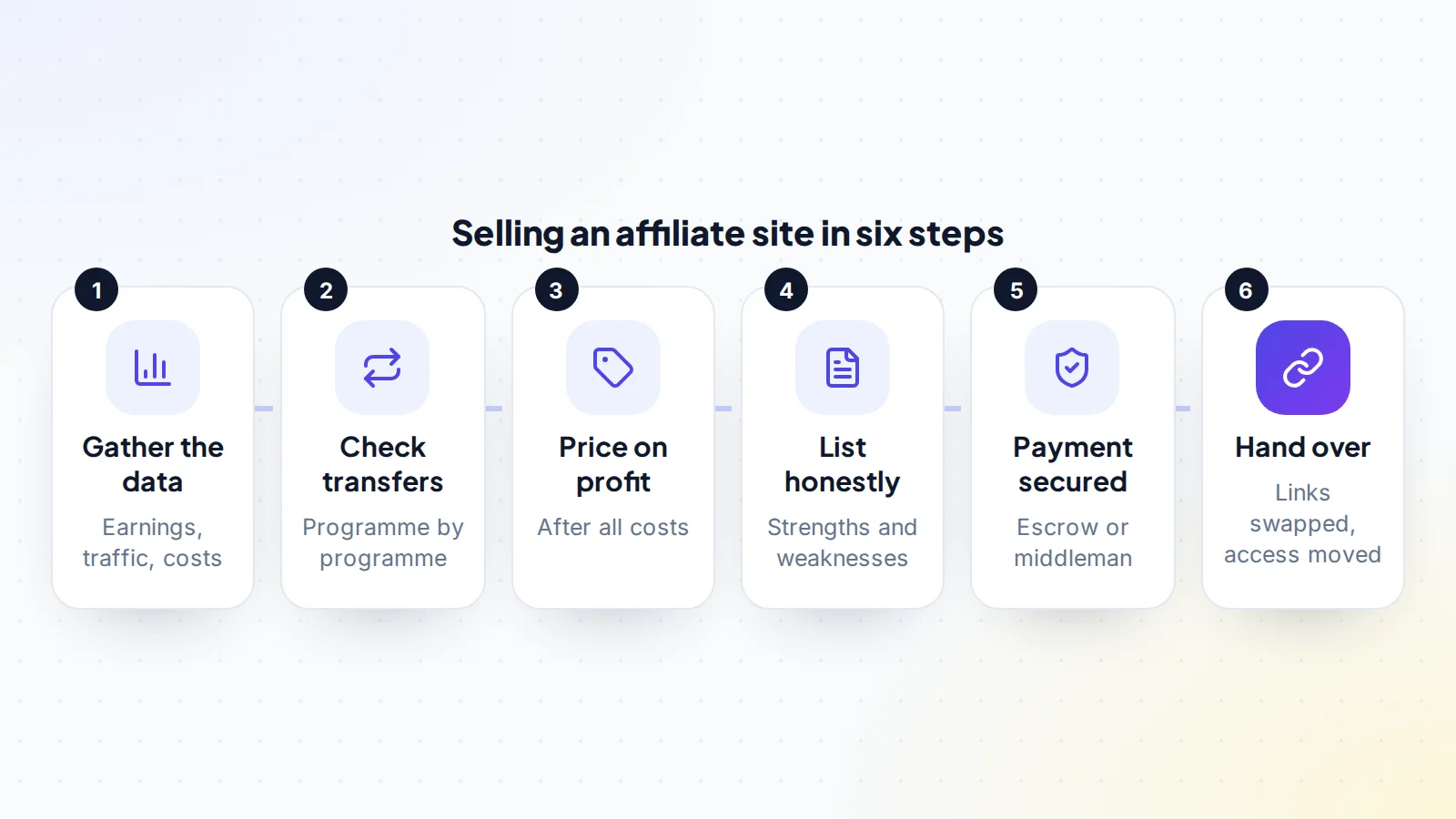
- Payment secured by escrow or a trusted middleman. On digiflippers.com, the ways to pay in a deal are: directly to the seller, through escrow, and the platform never holds the money itself.
- Domain and hosting transferred; see the domain transfer process.
- Analytics and Search Console ownership added for the buyer.
- Affiliate accounts transferred where allowed; links swapped to the buyer’s accounts where not.
- Email list, social accounts and writers handed over as agreed.
- Tracking checked together: test clicks recorded under the buyer’s accounts.
- Your access removed and the payment released.
Agree in writing how pending commissions earned before the handover are paid. They normally stay with the seller.
After the sale
Offer a short support period, often a few weeks, to answer questions about the content process, tools, writers and programmes. Introduce the buyer to writers and any affiliate managers you work with. Keep the signed agreement and payment records, and speak to an accountant about any tax on the sale. If you agreed not to start a competing site, keep to the scope you agreed.
Selling several affiliate sites
If you own a portfolio, you can sell sites one by one or together. Selling together can attract buyers looking for scale, but each site still needs its own earnings, traffic and transfer details, and buyers will value the weakest sites lower. Selling separately often gets better prices for the strongest sites. Either way, prepare each site as if it were sold alone, then decide how to package them.
Common mistakes
- Showing earnings before reversals.
- Leaving transfer questions for the buyer to discover.
- Hiding link-building history.
- Stopping publishing while the site is listed.
- Counting your own writing as free.
How to sell an affiliate website: the checklist
- 12 months of earnings by programme, net, matched to payouts.
- All costs listed, including your own work.
- Transfer status of every programme documented.
- Link-swap plan for programmes that don’t transfer.
- 12–24 months of traffic with sources and top pages.
- Content inventory, writer agreements and disclosures in order.
- Honest listing with strengths, weaknesses and reason for selling.
- Payment secured before the handover.
Ready to sell?
List it on digiflippers.com with verified numbers, answer buyers in one place and agree every step in a free Deal Room. 0% success fee up to $10,000, then 5% (max $5,000).
Frequently asked questions
Can I transfer my Amazon Associates account to the buyer?
Amazon’s operating agreement says it can’t be assigned without Amazon’s express written approval. Buyers normally use their own account and swap the links during the handover.
How much is my affiliate site worth?
Usually a multiple of average monthly net profit, adjusted for traffic stability, concentration, content quality and how easily programmes transfer.
Who gets commissions earned before the sale?
Normally the seller. Agree a cut-off date in writing.
Should I keep publishing while the site is listed?
Yes. Steady publishing protects the numbers buyers are checking.
Do I need to disclose link building?
Be honest about it. Buyers will check backlinks, and surprises found in due diligence usually cost more than honest answers given up front.
What’s the best way to sell an affiliate website quickly?
Prepare everything buyers ask for before listing: earnings by programme, transfer details, traffic and a content inventory. Clear answers shorten due diligence more than anything else.