Ebook and KDP Catalogues: Can You Buy or Sell Them?
Ebook catalogues can be bought and sold, but books don't simply move between publishing accounts. What transfers, how to value royalties and how to hand over.

Self-published ebooks can earn royalties for years: a series that keeps finding readers, a set of practical guides that sell steadily, a catalogue under a pen name that’s grown into a brand. Authors and publishers sell these businesses to fund new projects or step away, and buyers acquire them for the steady income. If you want to sell an ebook business, though, the key fact is that books don’t simply move between publishing accounts like a website moves between hosts. What transfers is the rights, the files and the brand; the listings follow each platform’s own rules.
This guide explains what can move, how rights are assigned, how royalty income is valued, how to prepare a catalogue for sale and how the handover works. It’s written for sellers, with notes for buyers throughout. For the wider category, see how to buy a digital product business.
Key takeaways
- The core of an ebook sale is a written assignment of copyright in the books and covers, plus the source files.
- Publishing accounts follow their own rules. Amazon’s KDP help, for example, says it can’t move specific books from one account to another.
- Value is based on royalty income after costs, adjusted for how spread out it is across titles, series and formats.
- Owned assets (a website, an email list, a pen name with followers) often decide how much income survives the move.
- Plan the move of each title carefully, and agree how royalties earned before the handover are paid.
What an ebook business is
An ebook business can be a few practical guides or a catalogue of dozens of novels across several series. It usually includes the books themselves, their covers, a pen name or publishing brand, listings on one or more stores, and often a website and email list. Many also earn from paperbacks, audiobooks or translations of the same titles.
Income comes from royalties paid by the stores, and sometimes from direct sales on the author’s own site. Costs include covers, editing, advertising, tools and any contractors who write or produce the books.
What can move, and how
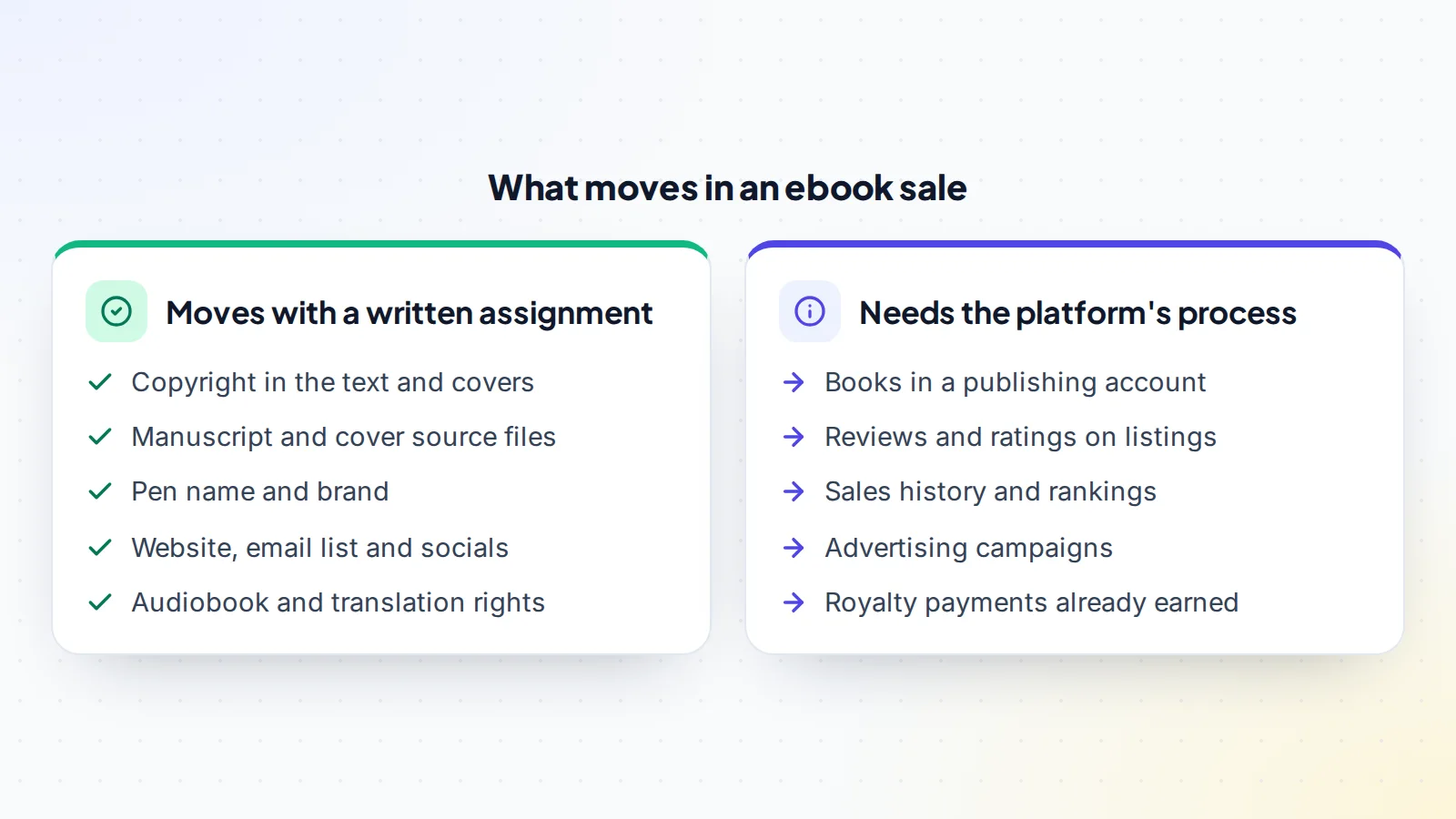
There are two layers in any ebook sale:
- Rights and files: copyright in the text and covers, the manuscript and design files, the pen name and brand, and subsidiary rights such as audio and translation. These move by written agreement.
- Store listings: the books as they appear in publishing accounts, with their reviews, rankings and sales history. These move only as each platform allows.
Amazon’s KDP help says it can’t move specific books from one KDP account to another, and describes merging accounts as a separate process with its own requirements. Other stores have their own rules. Before agreeing a plan, contact each platform the books are published on and ask what’s possible for a change of owner. Where listings can’t move, the usual approach is for the buyer to publish the books under their own account, using the assigned rights and files, and for the seller to unpublish their versions as agreed, which means reviews and rankings may not carry over.
Rights: the heart of the deal
Because the listings may not move, the rights matter most. A buyer needs:
- A written assignment of copyright in each book and cover from the seller.
- Proof the seller owns those rights: if ghostwriters, editors or designers worked on the books, their agreements should assign the rights to the seller. In the United States, the Copyright Office explains when commissioned work counts as “work made for hire”; otherwise a written assignment is needed.
- Licences for any images or fonts on covers, allowing continued commercial use by a new owner.
- Clarity on subsidiary rights: audio, translation, print and other formats, including any already licensed to someone else.
KDP’s own intellectual property FAQ explains that publishers must hold the necessary rights to the content they publish, which is another reason a clean assignment matters. Our guide to intellectual property in digital products explains what to look for.
Print, audio and translations
Many ebook businesses also earn from paperbacks, hardcovers, audiobooks and translations. Each format can have its own platform, contract and rights position:
- Print editions are often published through the same account as the ebook, so the same platform rules apply.
- Audiobooks may involve a narrator, a production company or a distribution contract with its own term and transfer rules. Check whether the narrator was paid outright or shares royalties, because royalty-share arrangements usually continue for a fixed period.
- Translations may be licensed to a publisher or produced by a translator under contract.
List every format and contract in the sale, with who owns what and how each will move. A buyer pays more for formats that are clearly owned and easy to continue.
Ghostwritten catalogues
Some ebook businesses publish books written by freelance writers under a shared pen name. That’s common and perfectly workable, but it puts rights at the centre of the deal. Every writer’s agreement should assign copyright to the business, ideally in writing for each book. If agreements are missing or vague, ask writers to sign confirmations before listing. Without them, a buyer can’t be sure the catalogue is yours to sell.
How an ebook business is valued
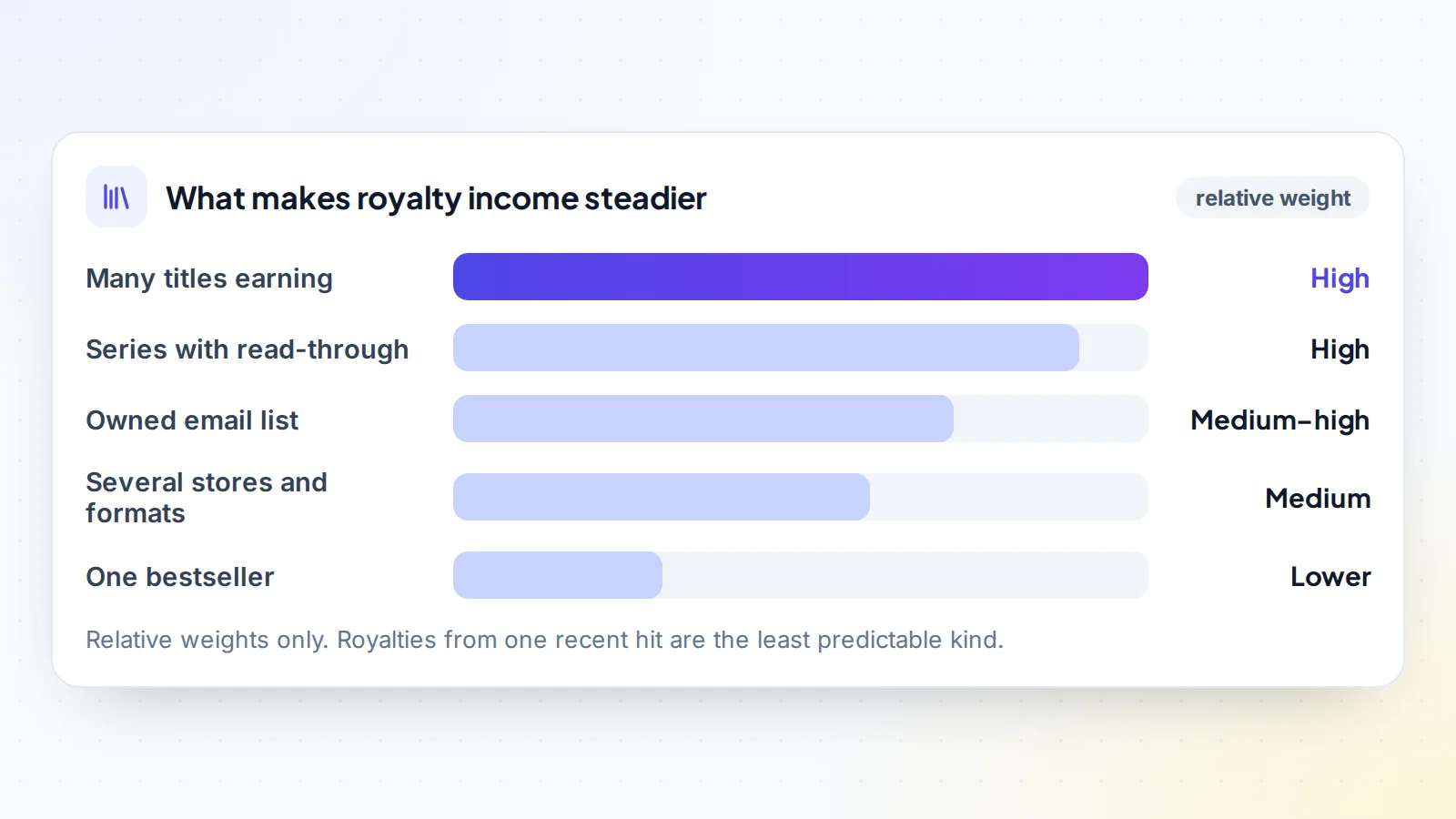
Ebook businesses are usually valued as a multiple of average monthly net royalty income after costs, often over 12 months. What moves the multiple:
- Spread across titles: income from many books is steadier than income from one.
- Series and read-through: readers who finish one book and buy the next make income more predictable.
- Age of sales: books still selling years after release are worth more than a recent spike.
- Owned audience: an email list and website help income survive the move.
- Formats and stores: income from ebooks, print and audio across several stores spreads risk.
- Transfer friction: if listings can’t move and reviews will be lost, buyers lower the multiple or propose an earn-out.
Read about the online business valuation multiple and try the free valuation tool for a quick range.
Preparing to sell an ebook business
- Gather 12 months of royalty reports from every store, by title and format, matched to payouts.
- List every cost: covers, editing, advertising, tools, contractors.
- Collect rights documents: contracts with ghostwriters, editors and designers, and licences for cover assets.
- Organise source files: final manuscripts, cover design files and any audio files.
- Ask each platform what’s possible for a change of owner, and write down the answers.
- Document your process: how books are written or commissioned, edited, published and promoted.
- Build owned channels if you haven’t: an email list and a simple author or publisher site.
Questions buyers will ask
- Which titles earn the most, and how have they trended over 12 months?
- Who wrote and designed each book, and where are the rights agreements?
- Which stores and formats are the books on, and what has each platform said about a change of owner?
- How large and engaged is the email list, and how was it built?
- How much do you spend on advertising, and what does it return?
- How do you plan new releases, and how long does each take?
Having these answers ready is the fastest way to sell an ebook business at a fair price, because buyers don’t have to discount for uncertainty.
A worked example
The numbers below are made up to show the method, not market data.
A publisher owns 24 practical guides on home gardening under a pen name, sold as ebooks and paperbacks, with a 7,000-subscriber email list and a small website. Over 12 months, royalties average $3,100 a month and costs (ads, covers and a freelance editor) average $700, leaving $2,400 of net income a month. No single book earns more than 9% of the total.
The publisher contacts the stores and learns that the listings can’t move to another account. So the deal is structured around rights: the publisher assigns copyright in all 24 books and covers, hands over the source files, the pen name, the website and the email list, and agrees to unpublish their versions as the buyer republishes each title. Because reviews won’t carry over, the buyer offers a lower multiple plus an earn-out tied to royalties in the buyer’s account over the next nine months. The publisher announces the change to the email list, which brings early sales and reviews for the republished books.
Rebuilding momentum after a republish
When books have to be republished under the buyer’s account, the first weeks decide how quickly income recovers. A good plan includes:
- Republishing in order of earnings, so the strongest titles return first.
- Keeping titles, covers and descriptions consistent, so returning readers recognise them.
- Announcing to the email list with links to the new listings, which brings early sales and reviews.
- Coordinating with the seller, so their version is unpublished on the agreed day and readers aren’t confused by duplicates.
- Restarting advertising carefully, beginning with campaigns that worked for the seller.
This is also where earn-outs earn their keep: when part of the price depends on royalties after the move, the seller has every reason to help the books regain their footing.
The handover
- Payment secured by escrow or a trusted middleman. On digiflippers.com, the ways to pay in a deal are: directly to the seller, through escrow, and the platform never holds the money itself.
- Rights assigned in a signed agreement covering every title and format.
- Source files delivered and checked.
- Each title moved using the platform’s process, or republished by the buyer while the seller unpublishes, on an agreed schedule.
- Website, email list and social accounts transferred.
- Royalties earned before the cut-off stay with the seller; agree the date in writing.
Our asset transfer checklist covers the website and list.
For buyers: what to check
- Royalty reports by title, matched to payouts.
- Rights documents for every book and cover.
- Whether any rights are already licensed elsewhere.
- What each platform allows, in writing.
- Reviews and rankings you’d lose, and how you’ll rebuild them.
- Whether the catalogue suits your skills: writing, commissioning or marketing.
Royalties, tax and records
Stores usually pay royalties some time after the sales that earned them, so royalties for the last month or two before the handover may arrive after the sale. Agree a cut-off date and who receives what, and keep records of every royalty report and payment. Selling a catalogue can also have tax consequences for both sides, depending on where you live and how the sale is structured, so speak to an accountant before agreeing the terms.
Red flags
- Books written by contractors with no rights assignments.
- Covers using images without commercial licences.
- Income concentrated in one recent release.
- Content closely resembling other authors’ books.
- A seller unwilling to unpublish or to agree a clear schedule.
How to sell an ebook business: the checklist
- 12 months of royalties by title, format and store.
- All costs listed.
- Rights documents and licences gathered.
- Source files organised.
- Platform rules for each store confirmed in writing.
- Republishing or transfer schedule agreed.
- Royalty cut-off date agreed.
- Payment secured before rights and files are handed over.
Ready to find your next asset?
Browse listings with verified numbers, ask sellers your questions before you offer, and agree every step in a free Deal Room.
Frequently asked questions
Can I transfer my KDP books to a buyer’s account?
KDP’s help says it can’t move specific books from one account to another. Contact KDP about your situation; the usual approach is to assign the rights and have the buyer republish.
Do reviews transfer when books are republished?
Often not, because a republished book is a new listing. Plan to rebuild reviews, for example through the email list.
How is an ebook business valued?
Usually as a multiple of average monthly net royalty income, adjusted for spread across titles, series, owned channels and how easily listings move.
What documents does a buyer need?
A signed copyright assignment, contracts with any writers or designers, licences for cover assets, royalty reports and the source files.
Can I keep writing under the same pen name?
Only if the agreement allows it. Usually the pen name goes with the catalogue, and the seller agrees not to publish similar books under it.
Should an ebook sale use an earn-out?
Often, when listings can’t move and reviews will be lost. Part of the price is paid later based on royalties in the buyer’s account, which shares the rebuild risk fairly.