Steam Libraries and Inventories: How Their Value Is Worked Out
From tradable skins with a price history to game libraries and account history: what gives a Steam account value and how to put a fair number on it.
A Steam account can hold years of a player’s history: a library of games, an inventory of skins and collectibles, badges, levels and progress in favourite titles. Some of that has a clear market price; some is only valuable to the right buyer. Understanding Steam inventory value means separating the parts you can price from real market data from the parts you can only judge by comparison, and then accounting for how completely the account can change hands.
This guide explains each part of a Steam account’s value, how to use market price history, how libraries and account history fit in, a simple pricing method and a worked example. For other titles, see Fortnite account value and ranked account value.
Key takeaways
- Tradable items are the easiest part to value, because the Steam Community Market shows real past sale prices.
- Market prices should be adjusted for fees and how quickly items would actually sell.
- Game libraries and account history add value, but usually far less than their original store prices.
- Full access, including the email and Steam Guard on the buyer’s device, multiplies value.
- Price with an item list, recent sale prices and comparable accounts, then set a range.
What makes up a Steam account’s value
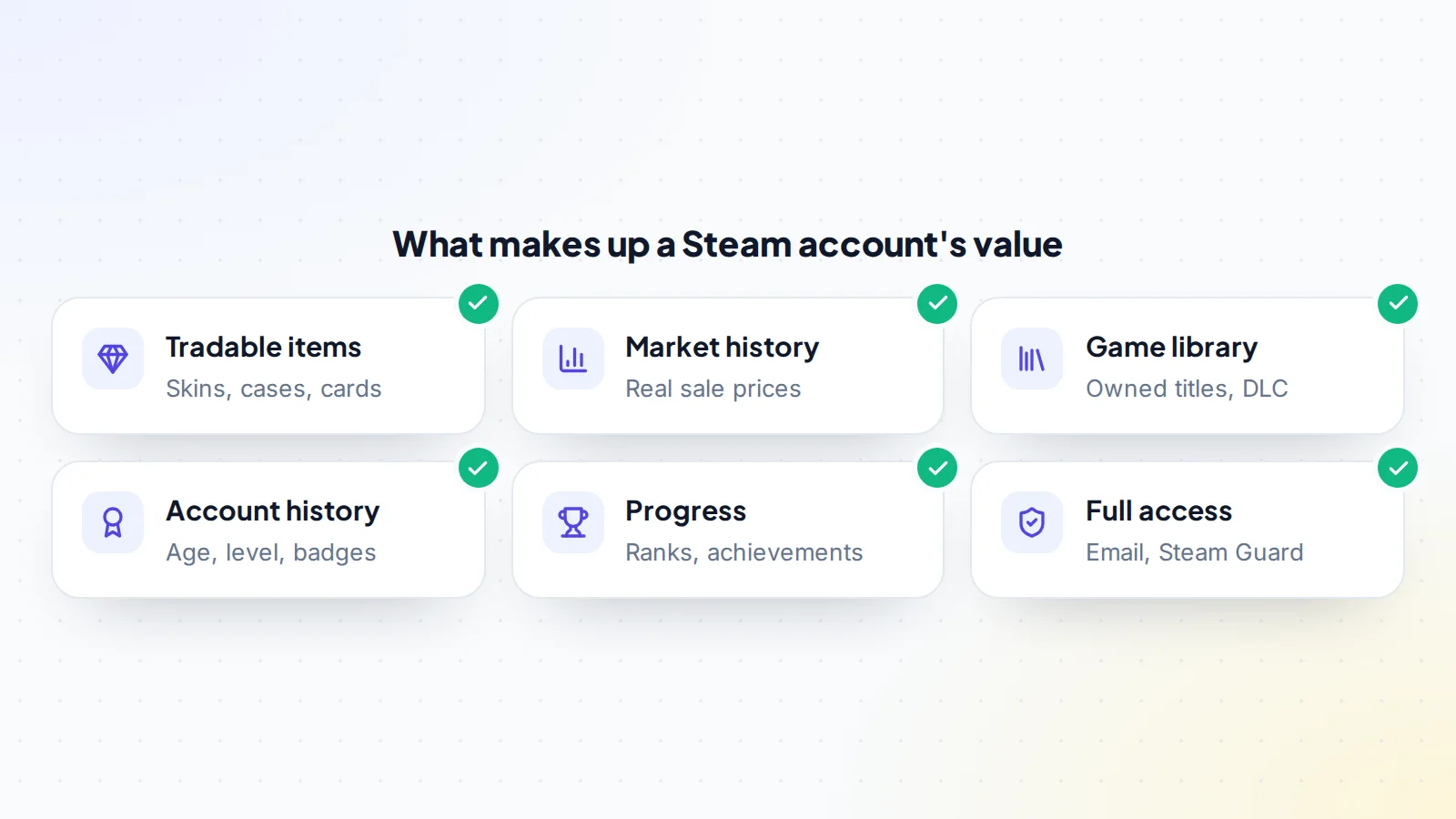
A Steam account combines several kinds of value. Some, like tradable items, have public prices. Others, like an old account with a high level and a rare badge, are valued by enthusiasts in ways a price list can’t capture. Pricing an account well means handling each part separately, then adding them up sensibly.
Tradable items and the Community Market
Many games on Steam have items that can be traded or sold: weapon skins, cosmetic items, cases, trading cards and more. For these, the Steam Community Market is the most useful reference. Its FAQ explains that each item page shows a chart of the prices the item has historically sold for, including the date, price and number sold.
That history is real evidence of value, because it shows what buyers actually paid. When valuing an inventory, look at recent sales rather than the highest listing price, and note how many sales happen each day: an item with frequent sales has a reliable price, while a rare item with few sales may be harder to value.
Adjusting for liquidity
An inventory’s market value isn’t the same as what it’s worth as part of an account sale. Adjust for:
- Fees: market sales include fees, so the amount a seller receives is lower than the listed price.
- Time to sell: a large inventory of slow-selling items can take a long time to turn into money.
- Price movements: item prices can rise and fall with game updates, new releases and player numbers.
- Trading rules: some items have trade or market restrictions for a period after purchase or trading. Steam’s rules have changed over time, so check the current ones.
A buyer will typically value tradable items at somewhat less than their market prices to account for these factors.
Selling items or selling the account
An owner with a valuable inventory has two options: sell tradable items individually through Steam’s own trading and market features, or sell the whole account. Selling items keeps the account and its library, history and progress, and uses Steam’s built-in tools. Selling the account moves everything at once, including the things that can’t be traded separately, such as the library, level and badges.
For many owners, the items alone make up most of the Steam inventory value, and selling them individually is simpler. Whole-account sales make more sense when the non-tradable parts, such as a rare library, an old account with high level and badges, or progress in a particular game, are a large part of the appeal. Our guide to selling in-game items covers the first option.
Which items tend to hold value
- Items from games with large, active player bases, where many people want them.
- Limited or discontinued items, such as those from past events or collections no longer available.
- Items with rare variations, such as unusual patterns or finishes that appear by chance.
- Collectible sets, where completing a set gives an item extra appeal.
Items from games with shrinking player numbers, or items released in large quantities, tend to hold less value over time. Our guide to rare skins value explains what makes items scarce and sought after.
How values change over time
Steam inventory value isn’t fixed. Game updates can change which items are popular, new releases can add supply, and player numbers can rise or fall. Check recent price history before setting a price, and date your evidence, so a buyer knows how current it is. Market history over several months also helps you see whether an item’s price is steady, rising or falling.
The game library
An account’s game library can be large, but its value in a sale is usually far below the total store price of the games. Games are licences tied to the account, store prices change with sales and discounts, and most buyers don’t want every title. What adds value is a library that includes games the buyer wants to play, rare or no-longer-sold titles, and DLC or editions that are hard to get now.
Account history and progress
- Account age: older accounts can appeal to collectors and long-time players.
- Steam level and badges: high levels and rare badges represent effort and history.
- In-game progress: ranks, unlocks and achievements in competitive or long-running games.
- Clean history: an account in good standing, with no trading restrictions, is worth more.
These are valued by comparison with similar accounts, not by a price list.
Access: the multiplier
Everything above depends on the buyer being able to fully control the account. Steam Guard protects sign-ins and trades; Steam’s support pages explain how the Steam Guard Mobile Authenticator works and how to move it to a new phone. Buyers expect:
- The original email, or the ability to change it to theirs.
- Steam Guard moved to the buyer’s own phone.
- Clear answers about any linked payment methods, family sharing or connected accounts.
Our guide to securing a game account covers the handover in detail.
Protecting value while you own it
- Keep Steam Guard on, ideally through the Mobile Authenticator, and keep your recovery details current.
- Use a unique password for Steam and for its email account.
- Check trade offers carefully before accepting, and be wary of links asking you to sign in elsewhere.
- Keep records of how valuable items were obtained.
A simple pricing method
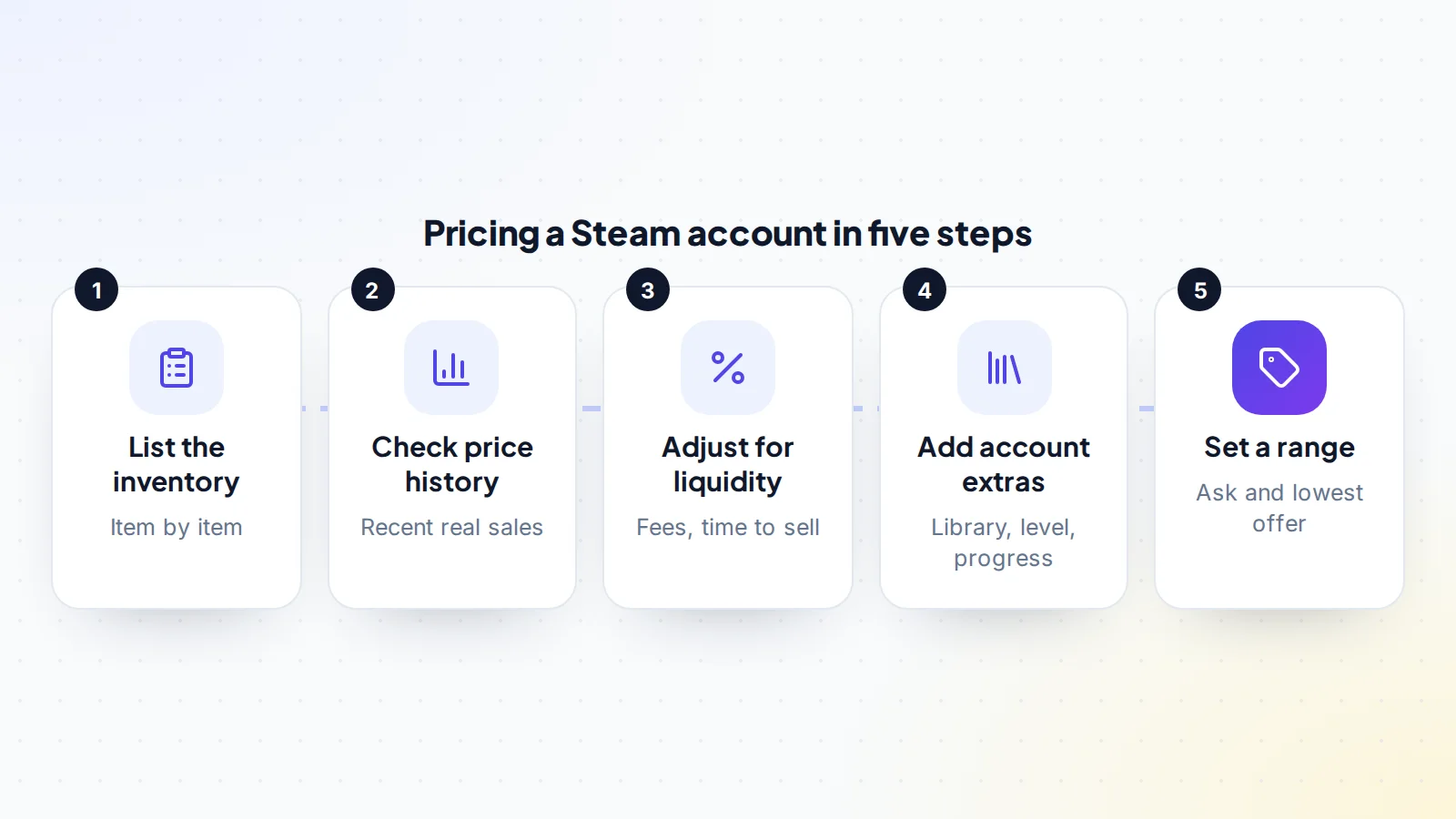
- List the inventory item by item, with the game each belongs to.
- Check recent sale prices on the Community Market for each tradable item.
- Adjust for liquidity: fees, sales volume and recent price trends.
- Add the account extras: library, level, badges and progress, valued by comparison with similar accounts.
- Set a range: an asking price and a lowest acceptable offer, with your evidence attached.
The free valuation tool can give a starting range for the account as a whole.
A worked example
The numbers below are made up to show the method, not market data.
Sam has a Steam account created many years ago, with a high level, several rare badges and around 300 games. The inventory includes weapon skins and other tradable items. Sam lists each item and finds recent market sales totalling about $2,400. Most items sell often; three high-value skins sell only a few times a month, and their prices have moved up and down recently.
Sam values the tradable items a little below market prices, to reflect fees and the time it would take to sell them. The library adds modest value because it includes several titles no longer sold. The account’s age, level and badges appeal to collectors, so Sam compares recent listings of similar accounts and adds a premium within that range. With the original email and Steam Guard ready to move, Sam sets an asking price and a lowest acceptable offer, with the item list and market evidence attached.
Questions buyers usually ask
- Can you show the inventory and profile live on a call?
- Which items are tradable and marketable now, and are any temporarily restricted?
- When were the most valuable items obtained, and how?
- Is the original email included, or can the account email be changed to mine?
- Can Steam Guard move to my phone during the handover?
- Are any payment methods, family sharing or connected accounts still linked?
Having clear answers ready speeds up the sale and supports your price.
Presenting the evidence
A short document makes a big difference: a table of the inventory with each item’s game, recent sale prices from the market and the date you checked them, followed by the account extras (library highlights, level, badges, progress) and a description of exactly what access is included. Add a few screenshots for the listing, then offer a live walkthrough where the buyer can ask to see any item. Evidence that’s organised, dated and checkable earns trust, and usually a better offer.
If you decide to sell
Lead with the inventory and its market evidence, then the account extras, and describe exactly what access is included. Share evidence live, never your login, and hand over only once payment is held by escrow or a trusted middleman. On digiflippers.com, the ways to pay in a deal are: directly to the seller, through escrow, and the platform never holds the money itself. Read how to buy a game account to understand what buyers will check, and see selling in-game items for the alternative of selling items individually.
When to sell
Because item prices move with game updates and player interest, timing can affect what an inventory is worth. Prices for a game’s items often rise when the game is popular and new players are joining, and can soften when attention moves elsewhere. There’s no reliable way to predict the peak, but checking a few months of price history before listing helps you avoid selling during an obvious dip.
If you’re buying
Ask for the item list, check recent market prices yourself, request a live walkthrough of the inventory and profile, and confirm how email and Steam Guard will move. Value tradable items below market prices, value the rest by comparison, and pay through protected payment.
Region, currency and payment details
Steam accounts have a store region and wallet currency, which affect store prices and sometimes which content is available. A buyer in a different country should check how the account’s region and currency fit their situation. Any saved payment methods and wallet balance should be discussed openly: payment methods belong to the seller and should be removed before the handover, and the deal should say whether any wallet balance is included in the price.
Common mistakes
- Using the highest listing price instead of recent sales.
- Adding up store prices of every game in the library.
- Ignoring fees and sales volume.
- Forgetting access: without email and Steam Guard, value drops sharply.
- Relying on screenshots instead of a live walkthrough.
Steam inventory value: the checklist
- Inventory listed item by item.
- Recent Community Market sale prices checked.
- Adjustments made for fees, volume and trends.
- Library, level, badges and progress compared with similar accounts.
- Email and Steam Guard handover confirmed.
- Price range set with evidence.
- Payment held before the handover.
Ready to find your next asset?
Browse listings with verified numbers, ask sellers your questions before you offer, and agree every step in a free Deal Room.
Frequently asked questions
How do I check what my Steam items are worth?
Look at each item’s page on the Steam Community Market, which shows a chart of past sale prices with dates and volumes. Use recent sales rather than listing prices.
Is my game library worth what I paid for it?
Usually not. Libraries add some value, especially rare or no-longer-sold titles, but far less than their original store prices.
Do badges and Steam level add value?
They can, mainly to collectors and long-time players. Value them by comparison with similar accounts.
Why value items below market price?
Because selling them involves fees and time, and prices can move. A buyer takes on that risk.
What matters most for the handover?
Full access: the email and Steam Guard on the buyer’s own device, with the seller’s access removed.
Does the wallet balance count toward value?
It can, if it’s included in the deal. Agree it in writing, and make sure the seller removes their saved payment methods before the handover.