Buying a Theme or Plugin Marketplace Business
How theme and plugin businesses make money, what transfers on each kind of sales channel, the checks that matter, and how to value licence and renewal income.

Themes and plugins power a huge share of websites, and the best of them earn steady income from licences, renewals and add-ons year after year. That makes a theme business for sale an appealing buy: a product that’s already built, customers who already rely on it and a clear path to grow. The checks are different from a content site, though. Code quality, how licences are sold, where customers live and what can legally move to you all decide what you’re really buying.
This guide explains how theme and plugin businesses earn, what transfers on different sales channels, what to check before you buy and how to value licence and renewal income. If you’re new to buying digital products, start with our guide to buying a digital product business.
Key takeaways
- Theme and plugin businesses earn from new licences, renewals, add-ons and services.
- What transfers depends on the channel: your own site, a third-party marketplace or a free directory listing.
- On WordPress.org, a plugin has one official owner, and the directory has its own transfer process.
- Review the code, the licensing system, support load and the rights to everything included.
- Value is usually based on profit, with renewals and support costs shaping the multiple.
How theme and plugin businesses earn
Most businesses in this space combine several income streams:
- New licences: one-off or yearly licences for a theme, plugin or bundle.
- Renewals: yearly licences that renew for updates and support, often the most valuable income because it repeats.
- Add-ons and upgrades: extensions, higher tiers or lifetime plans.
- Services: setup, customisation or priority support.
- Freemium: a free version in a public directory that brings users who upgrade to a paid version.
The mix tells you a lot. A business with a high share of renewals and a free version that brings steady new users is usually more predictable than one that depends on a single launch or a seasonal promotion.
Where the sales happen, and what transfers
The sales channel decides what you can take over and how. Our guide to intellectual property in digital products covers the rights side in depth.
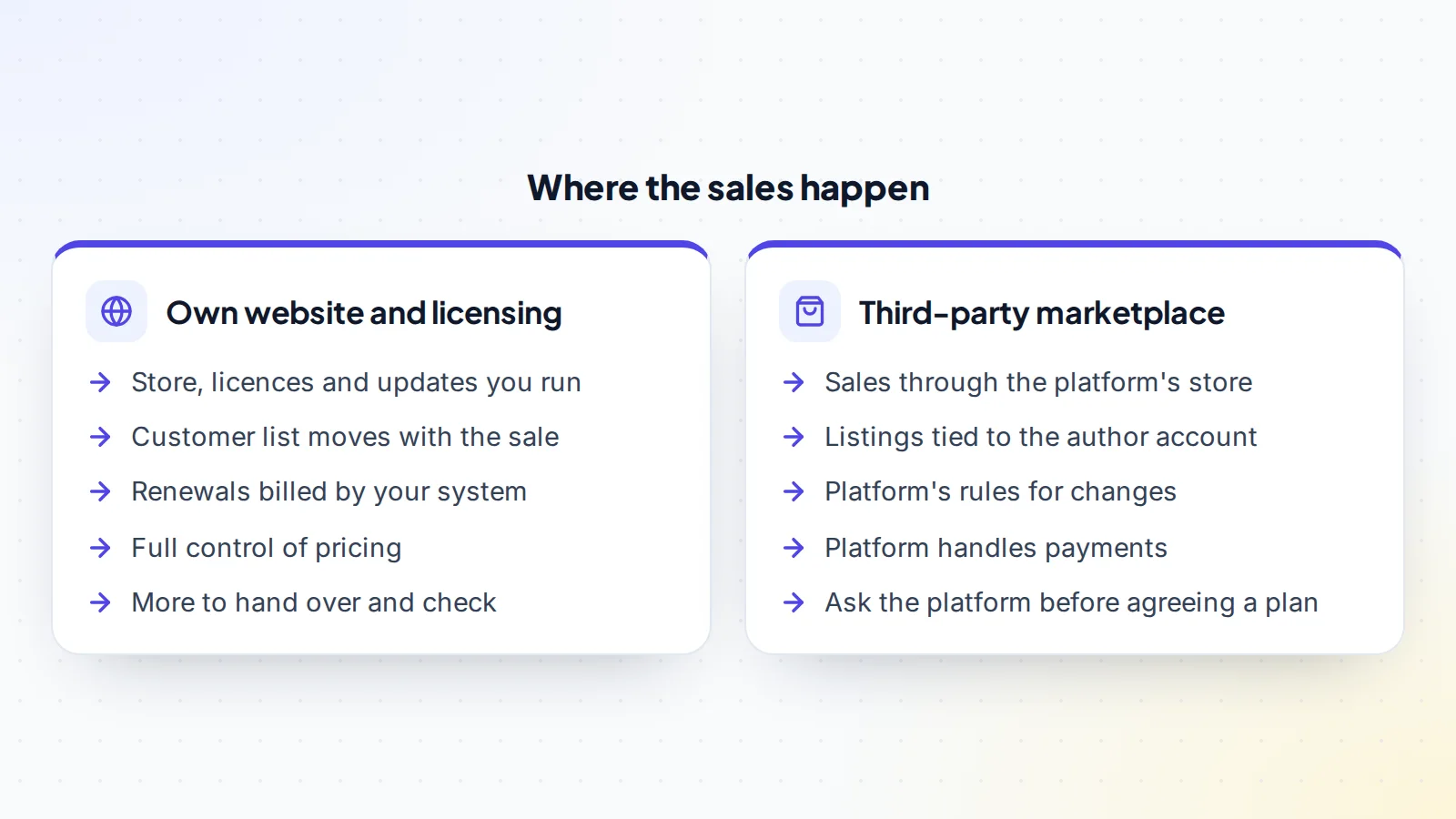
Your own website. Many theme and plugin businesses sell from their own site, with a store, a licensing system and an update server. Here, most of the business can move to a buyer: the domain, the store, the code, the licensing setup and, where the law and the privacy policy allow, customer records. This is usually the simplest structure to buy.
Third-party marketplaces. Some businesses sell through a marketplace that hosts the listings and handles payments. Listings and sales records usually belong to the author account, and each platform has its own rules on changes. Envato’s help centre, for example, says it can’t transfer data such as licences between Envato accounts. Before agreeing a plan, the seller should ask each platform what’s possible, and the deal should reflect the answer.
Free directory listings. On WordPress.org, the plugin handbook explains that a plugin can have many committers but only one official owner at a time. For smaller plugins, the owner can add the new owner as a committer and transfer the plugin from the plugin’s Advanced settings; larger plugins need a request by email to the plugin team from the current owner. Follow the handbook rather than sharing passwords.
A mix of channels. Many businesses use more than one: a free version in a directory, paid upgrades on their own site and perhaps a marketplace listing too. When you look at a theme business for sale with several channels, list each one separately, with its income, the account that holds it and how it would move. A channel that can’t transfer isn’t necessarily a problem, but its income should be valued with that in mind.
Review the code and the stack
You’re buying software, so look at it the way a developer would. Ask for read access to the repository before you commit, or have someone you trust review it under an NDA.
- Code quality: readable, consistent and documented, with a clear structure.
- Compatibility: tested with current versions of the platform it runs on, such as WordPress and PHP.
- Security: how inputs are handled, how updates are delivered and how past security reports were fixed.
- Dependencies: third-party libraries, their licences and how up to date they are.
- Release history: regular updates show a product that’s maintained.
For WordPress.org, the plugin guidelines require plugins to be compatible with the GNU General Public License, including bundled code and images. Check that every bundled library and asset fits the licence the product is sold under. Our guide to technical due diligence has a fuller code review checklist.
Check the licensing and update system
The licensing system is the engine of renewal income. Find out:
- Which tool issues licence keys and delivers updates, and who owns that account.
- Whether licences, subscriptions and customer records can move to your account, or whether customers will need to re-subscribe.
- How renewals are billed, and how many renew each year.
- How refunds and failed payments are handled.
If renewals are billed through a payment processor, read our guide to moving subscriptions to a new owner, because subscriptions often need to be recreated rather than simply moved.
Understand the support load
Support is the main running cost of most theme and plugin businesses, and the biggest call on the owner’s time. Ask for:
- Monthly ticket volume for the last 12 months.
- Average first-response and resolution times.
- The most common topics, which show where the product or docs need work.
- Who answers tickets now, and whether they’ll stay.
A product with clear documentation and few repeated questions is cheaper to run and easier to grow. If the seller handles everything personally, plan for the hours you or a hire will need.
Customers, reviews and reputation
Ratings, reviews and the tone of support forums show how customers feel. Read the newest reviews first: a recent run of complaints about bugs or slow support tells you more than an old average. Check how the seller responded to problems.
Customer lists are valuable but need care. Personal data can only move to a new owner in ways the law and the privacy policy allow. Our guide to legal due diligence explains what to check.
Valuing a theme or plugin business
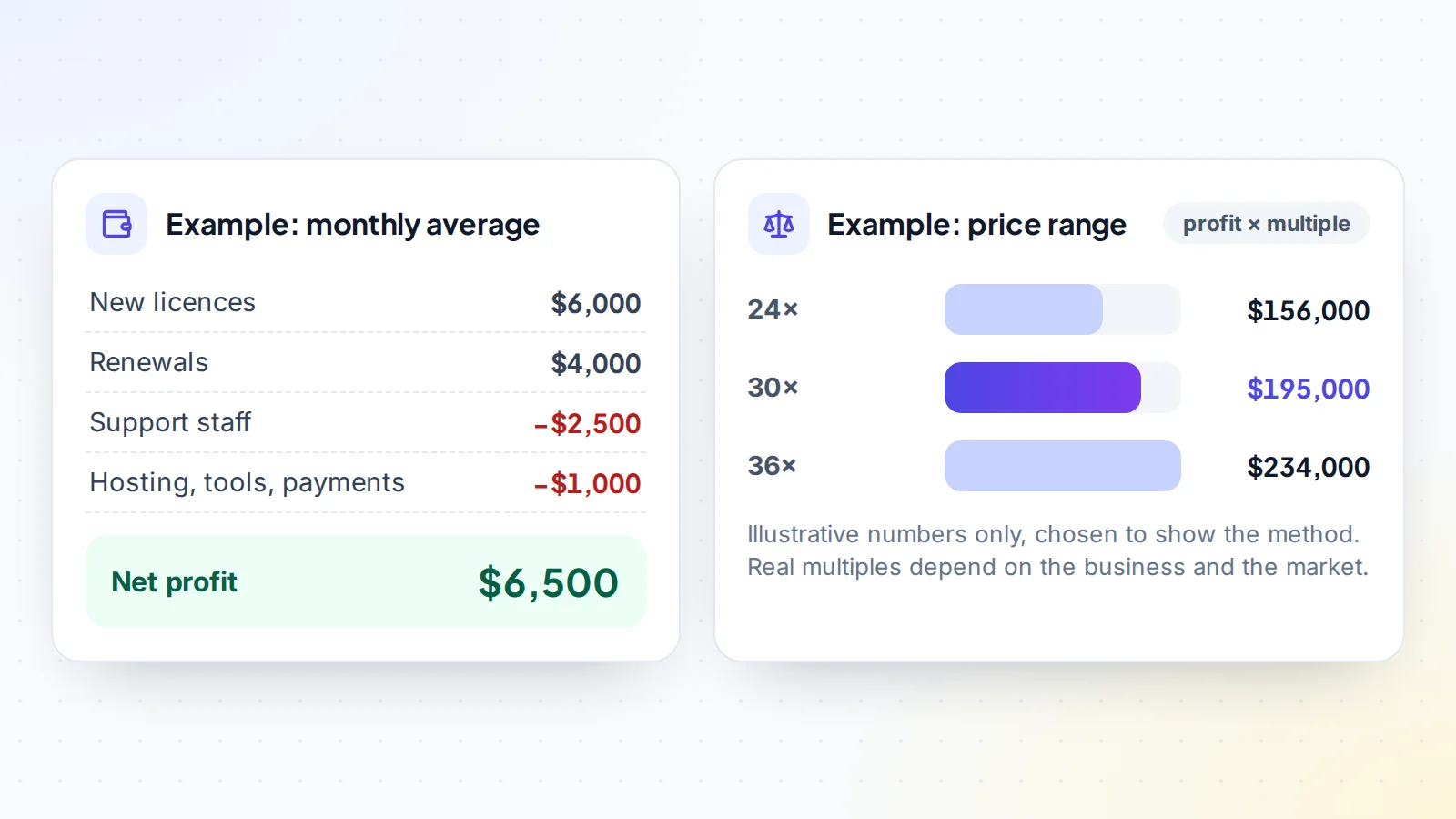
Like most online businesses, these are usually valued as a multiple of average monthly net profit. What moves the multiple:
- Renewal rate: a high share of repeat income raises it.
- Growth trend: rising sales and active users help.
- Channel: a business you can fully own and control is usually easier to transfer than one tied to a platform account.
- Support and maintenance costs: lower, predictable costs help.
- Dependence on the founder: the less the business relies on one person, the better.
- Platform risk: a big change in the platform it runs on can affect demand, so diversified products are worth more.
Planning the handover
A software handover has more moving parts than most, so write the plan into the agreement and work through it in order while the payment is held:
- Code and history: transfer the repository, with full history, to your account or organisation.
- Domain, site and email: move the domain, hosting and support inbox, copying DNS records first so nothing goes offline.
- Licensing and payments: move or recreate the licensing system, the update server and the payment accounts, and test a purchase, an update and a renewal end to end.
- Listings: follow each platform’s own process for marketplace or directory listings.
- Support: hand over the help desk, saved replies and documentation, and agree who answers tickets during the change.
- Customers: agree how and when customers are told, and send a short, friendly note when the time comes.
Our asset transfer checklist covers each step in more detail.
Where buyers find room to grow
Many theme and plugin businesses are run by small teams that haven’t had time for everything. That’s often where a new owner adds value:
- Documentation and onboarding that cut repeat support questions.
- Pricing and bundles, such as clearer tiers or an upgrade path for growing customers.
- Add-ons that answer the features customers ask for most.
- Email to existing customers about new releases and renewals, where they’ve agreed to hear from you.
- Content and tutorials that bring new users from search.
Price the business on what it earns today, and treat these ideas as your upside rather than something you pay the seller for. Sellers preparing to sell can read how to increase business value before a sale.
A worked example
The numbers below are made up to show the method.
Maya looks at a theme business for sale that sells a booking plugin from its own website. Over the last 12 months it averaged $6,000 a month from new licences and $4,000 from renewals. A part-time support person costs $2,500 a month, and hosting, tools and payment fees add $1,000. That leaves $6,500 a month in net profit.
The code review is positive, the plugin is tested with current versions, and ticket volume has been steady. The seller’s licensing system can be moved to Maya’s account, and customer records can transfer under the existing privacy policy. A free version on WordPress.org brings new users every month; the seller agrees to transfer ownership using the directory’s process. With a strong renewal share and a clean handover, they agree a price near the middle of the range.
Questions to ask the seller
- Where are sales made, and which accounts hold the listings, licences and payments?
- What can transfer on each channel, and what would customers need to do?
- How many licences renew each year?
- Who handles support, and how many hours does it take?
- Are there any bundled libraries, fonts or images with their own licences?
- What’s on the roadmap, and what feedback do customers ask for most?
- Will you help during a transition period after the sale?
Our list of questions to ask when buying a business covers the general ones.
Theme business for sale: the checklist
- Income split into new licences, renewals, add-ons and services.
- Sales channels listed, with what transfers on each.
- Platform rules checked with each marketplace or directory.
- Code reviewed: quality, compatibility, security, dependencies.
- Bundled code and assets checked for licences.
- Licensing and update system ownership confirmed.
- Support volume, costs and staffing understood.
- Customer data transfer checked against the law and privacy policy.
- Rights assignment in writing.
- Payment held by escrow or a middleman until the handover is complete.
Ready to find your next asset?
Browse listings with verified numbers, ask sellers your questions before you offer, and agree every step in a free Deal Room.
Frequently asked questions
What do you get when you buy a theme or plugin business?
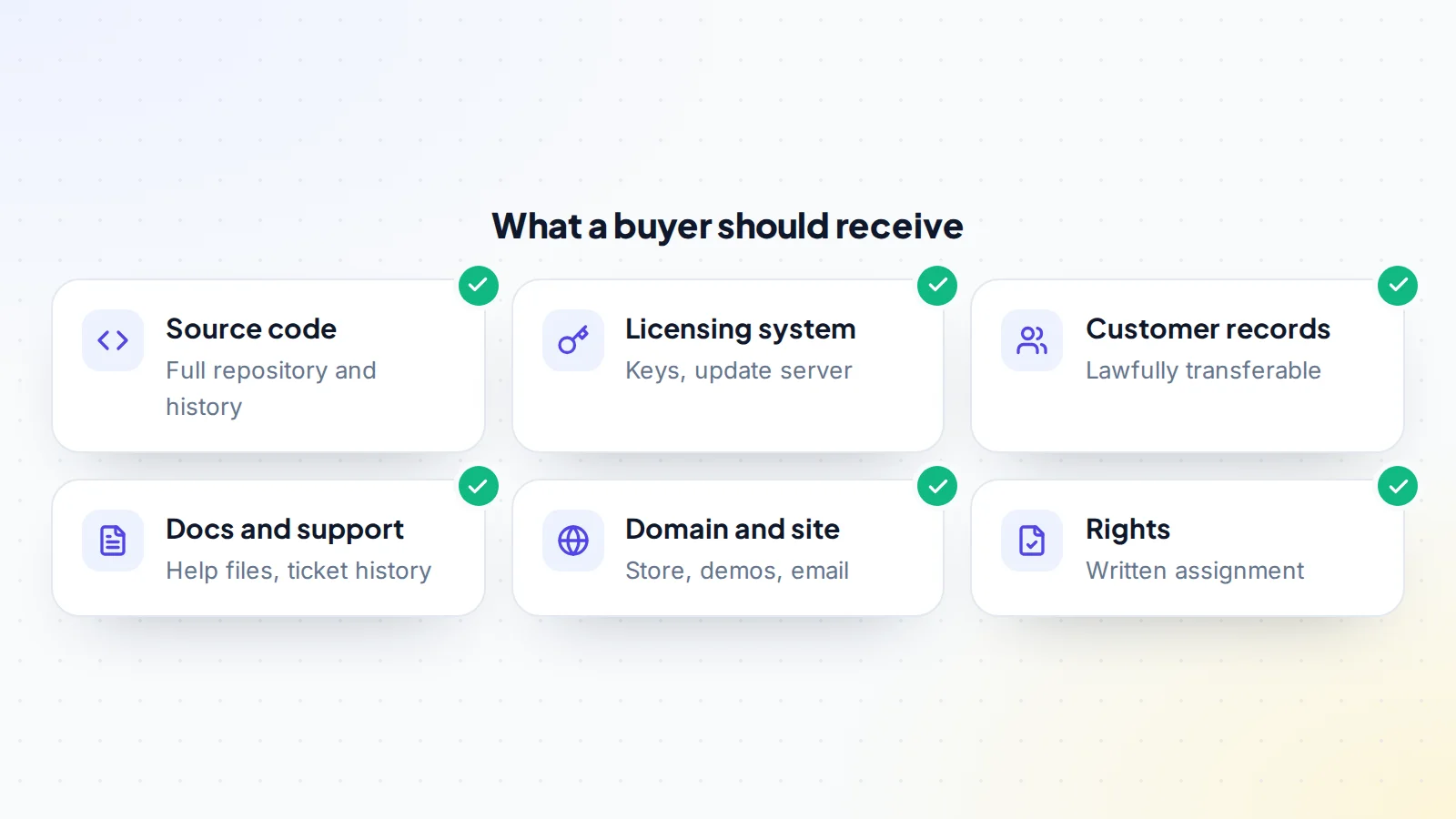
Usually the code, the brand and domain, the store and licensing system, documentation, support history and, where allowed, customer records, plus a written assignment of rights. On third-party platforms, what moves depends on the platform’s rules.
Can a WordPress.org plugin be transferred?
Yes. The plugin handbook describes how the current owner can transfer a plugin. Smaller plugins can be transferred from the plugin’s settings; larger plugins need a request to the plugin team.
Can marketplace listings move to my account?
It depends on the platform. Envato’s help centre, for example, says it can’t transfer data such as licences between accounts. Ask the platform before agreeing a plan.
How are theme and plugin businesses valued?
Usually as a multiple of average monthly net profit, adjusted for renewals, growth, support costs, the sales channel and how much the business depends on the founder.
Do I need to be a developer to buy one?
No, but you need access to one. A developer can review the code before you buy and help maintain it afterwards.
How do I pay safely?
Use escrow or a middleman so the payment is held until the handover is complete. On digiflippers.com, the ways to pay in a deal are: directly to the seller, through escrow, and the platform never holds the money itself.
What if the seller built everything alone?
That’s common. Agree a transition period in which the seller answers questions, explains the code and helps with the first releases, and write the hours and length into the agreement.
Are renewals guaranteed after the sale?
No. Customers renew because the product keeps working and improving. Keeping updates and support steady through the change gives customers the best reason to keep renewing.