Traffic Concentration Risk and Its Effect on Price
Why buyers pay less when traffic or revenue depends on one source, how to measure concentration in Analytics and Search Console, and how sellers can reduce it.

Two websites earn the same profit. One gets visitors from search, email, social and returning readers, across hundreds of pages. The other gets almost everything from one search engine, through five pages. Most buyers will pay more for the first. That difference is traffic concentration risk: the chance that one change, outside the owner’s control, cuts a large share of visits or income at once.
This guide explains what concentration is, the kinds buyers look for, how to measure it with standard tools, how it affects price, and what sellers can do about it before a sale. It builds on our guide to online business valuation.
Key takeaways
- Concentration means one channel, page, keyword, customer, partner or supplier drives a large share of results.
- It doesn’t make a business bad, but buyers price the risk, usually through a lower multiple.
- Google Analytics’ Traffic acquisition report and Search Console’s Performance report show most of what you need.
- Owned channels, such as an email list and direct visitors, reduce the risk.
- Sellers can diversify months before a sale and show the trend.
What traffic concentration risk means
Every online business depends on something it doesn’t fully control: a search engine, a social platform, an app store, an affiliate programme, a marketplace or a supplier. Dependence is normal. Concentration is when one of those sources is so large that a change in it would change the whole business.
Search is the most common example. Google says its core updates aren’t aimed at specific sites; they’re about improving how its systems assess content overall, and pages that drop haven’t necessarily done anything wrong. That’s reassuring for quality sites, but it also shows why a site relying on one search engine can see its traffic move for reasons beyond the owner’s control. Buyers know this, so they ask how much of the business sits on one source.
The kinds of concentration buyers check
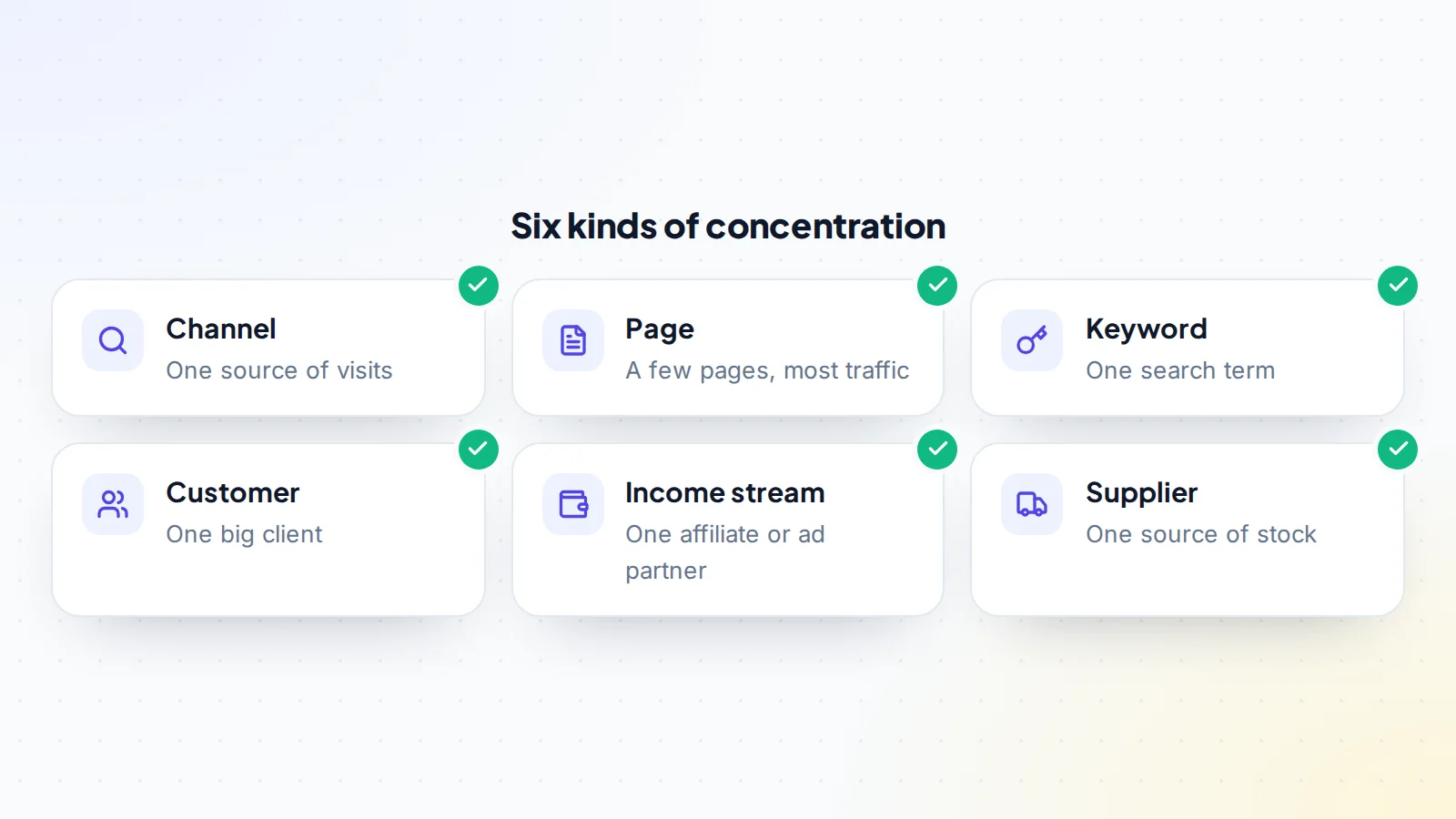
- Channel concentration: most visits come from one channel, such as organic search or one social platform.
- Page concentration: a handful of pages bring most of the traffic or income.
- Keyword concentration: one search term, or a small group of them, brings most search visits.
- Customer concentration: one client or a few accounts pay most of the revenue, common in SaaS and services.
- Income concentration: one affiliate programme, ad network or sponsor pays most of the income.
- Supplier concentration: one supplier provides most of the stock, common in e-commerce. Our guide to supplier due diligence covers this.
Measuring channel concentration
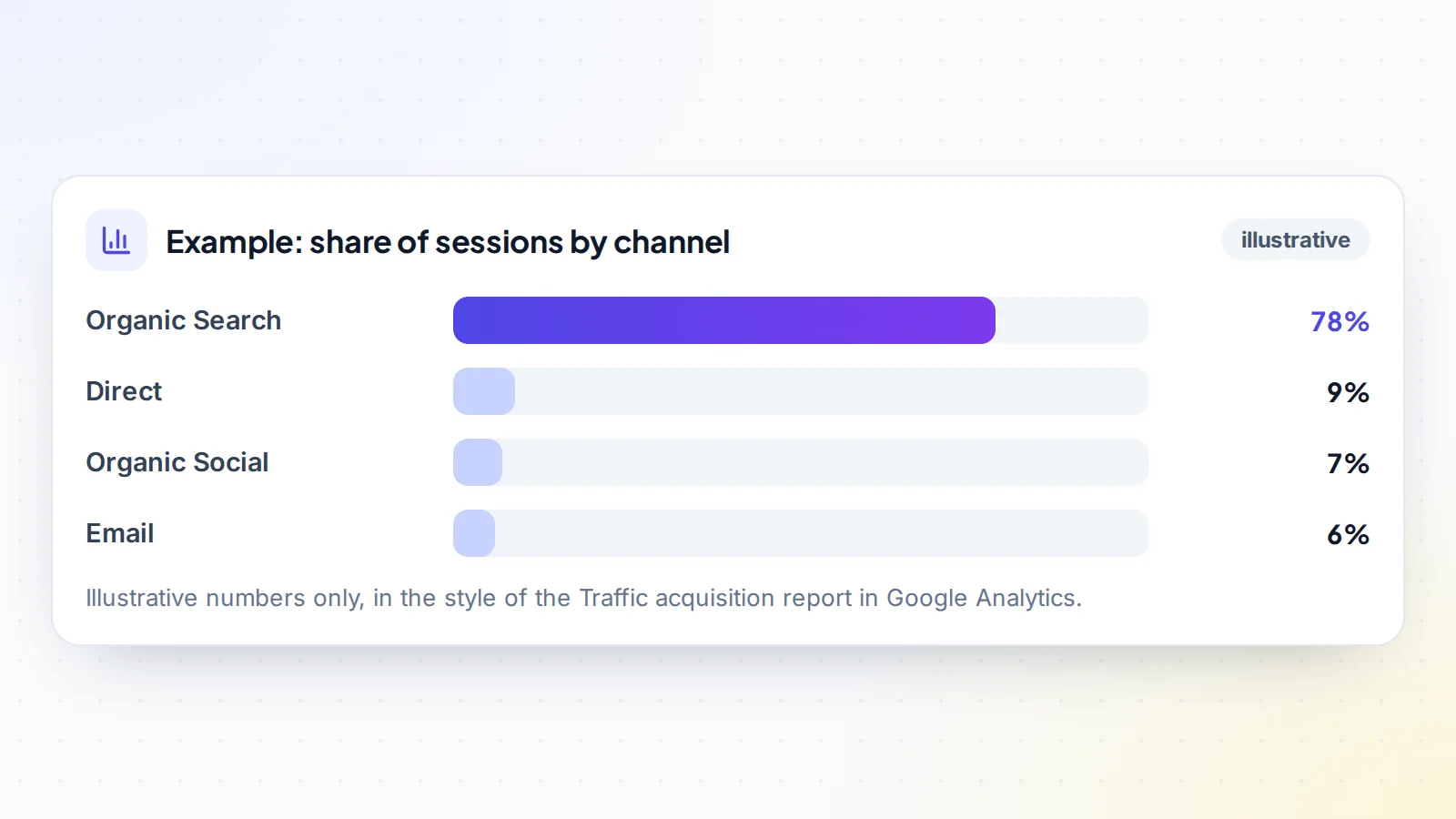
In Google Analytics, the Traffic acquisition report, under Reports, then Acquisition, shows where visitors came from when they started each session. Its default view groups sessions into channels such as Organic Search, Direct, Organic Social, Paid Social and Email. Look at:
- The share of sessions from the largest channel over the last 12 months.
- How that share has changed over time.
- Which channels bring visitors who buy, sign up or click affiliate links, not just visits.
- For income, the share of revenue linked to each channel, where the site tracks it.
Ask the seller to share the report live on a screen-share, or to add you as a viewer, rather than sending screenshots. Our guide to verifying website traffic explains how.
Measuring page and keyword concentration
Google Search Console’s Performance report shows clicks and impressions from Google Search, with tabs for queries and pages. Sort the Pages tab by clicks and add up the share from the top three, top ten and top fifty pages. Do the same in the Queries tab for search terms. A site where the top three pages bring most of the clicks is more exposed than one where traffic is spread across many pages.
Also check whether the top pages are all about one topic. Several pages on the same subject may be affected by the same change in search results, so they behave like one big page.
Reading traffic history
Concentration is easier to judge with a long view. Ask for at least two years of traffic data, ideally longer, and look for how the site behaved when things changed around it. Did search traffic dip and recover? Did a social platform change how posts are shown, and how did visits respond? A business that has held up through past changes gives a buyer more confidence, even with a concentrated source, than one with a short or very smooth history that hasn’t yet been tested.
Mark known events on the timeline, such as new content, redesigns, migrations and the dates of announced search updates, so changes in traffic can be explained rather than guessed at.
Measuring revenue and customer concentration
For income, list every source with its share of the last 12 months: each affiliate programme, ad network, sponsor, product or customer. For SaaS and services, the share paid by the largest customer and the top five customers is a standard check. For e-commerce, look at the share of sales from the best-selling product and the share of stock from the main supplier.
If one source pays most of the income, read its terms. Programmes can change commission rates or close, and some have rules about who can hold an account, which matters when the business changes hands.
How concentration affects price
Online businesses are usually valued as a multiple of average monthly net profit, and concentration is one of the main reasons the multiple moves. Buyers ask: if the largest source dropped by half next month, what would the business earn? The bigger that potential drop, the more a buyer will want a lower multiple, a longer checking period, or terms that share the risk, such as part of the price paid later if results hold.
Concentration rarely stops a sale on its own. A site with most traffic from search can still be a good buy if its content is strong, its traffic has been steady through past changes and its income comes from several partners. It’s the combination of concentrations that worries buyers most: one channel, a few pages and one partner, all at once.
Why owned channels matter
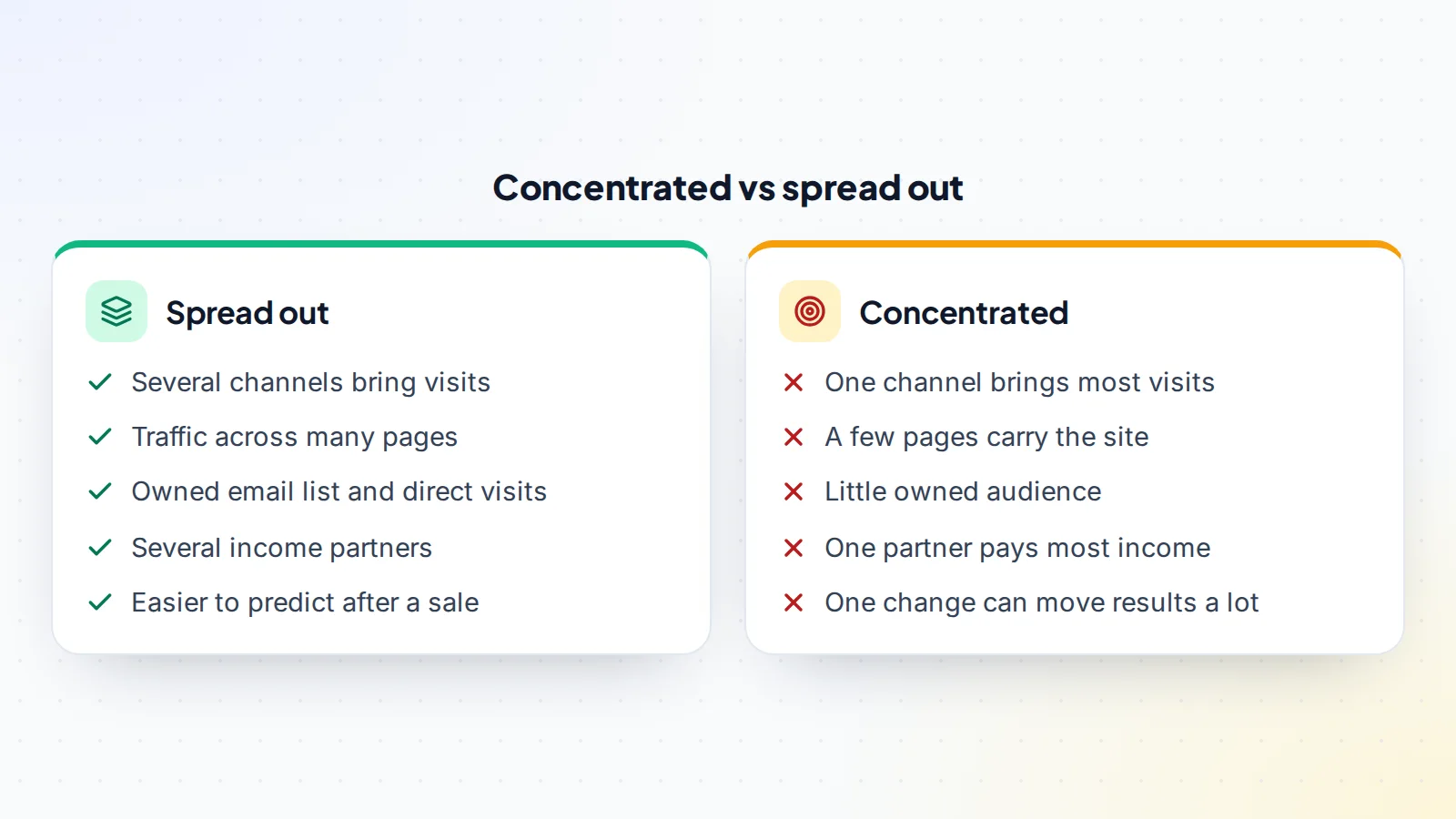
Some channels you rent; others you own. Search, social and marketplaces are rented: the platform decides how much traffic you get. An email list, returning direct visitors, an app with active users and customers who buy again are closer to owned: you can reach them whenever you like.
Buyers value owned channels because they make results more predictable after the sale. A content site with a modest email list that it uses well, or a store with a strong share of repeat customers, often earns a better multiple than a similar site with the same profit but no owned audience.
How sellers can reduce concentration
Diversification takes time, so start months before you plan to sell. Practical steps:
- Build an email list with a useful sign-up offer, and send to it regularly.
- Spread content across more topics and pages, so no few pages carry the site.
- Add income partners, such as a second affiliate programme or direct sponsors.
- Grow a second channel, such as video, social or a community, that links back to the site.
- Win more customers in SaaS and services, so the largest one pays a smaller share.
- Add a second supplier for key products in e-commerce.
Show the trend in your listing: a falling share for the largest source over the last six to twelve months tells buyers the risk is shrinking. Our guide to increasing business value before a sale has more ideas.
Concentration in other kinds of assets
The same idea applies well beyond websites:
- YouTube channels: a few videos bringing most views, or one sponsor paying most income.
- Social accounts and communities: one platform holding the whole audience, with no email list or website alongside.
- Mobile apps: most installs from one app store’s search or featured placement.
- SaaS: one integration, one marketplace listing or one large customer bringing most revenue.
- Digital products: one marketplace bringing most sales, or one best-seller carrying the catalogue.
In each case, the question is the same: what share depends on one thing, and how would the business cope if it changed?
Deal terms that share the risk
When buyer and seller see the risk differently, the deal structure can bridge the gap. Common options include:
- A longer checking period, so the buyer can watch traffic and income for a little longer before the payment is released.
- Part of the price paid later, if agreed results hold for a set period after the sale.
- Transition support from the seller, such as introductions to partners and help with the email list.
Write any such terms clearly, with how results will be measured and what happens if they aren’t met. Clear terms protect both sides.
A worked example
The numbers below are made up to show the method.
Two content sites each earn $4,000 a month in net profit. Site A gets 78% of sessions from organic search, its top three pages bring 45% of search clicks, and one affiliate programme pays 80% of income. Site B gets 55% from organic search and the rest from email, direct visits and social, its top three pages bring 15% of clicks, and income comes from three affiliate programmes and display ads.
A buyer asks the same question of both: what if the largest source halved? Site A could lose a large share of its income. Site B would feel it, but most of its income would continue. The buyer offers Site B a higher multiple, and offers Site A a lower multiple with part of the price paid after six months if traffic holds. Both are fair offers. They just reflect different levels of risk.
What buyers should ask
- What share of sessions, clicks and income comes from the largest channel, page, keyword and partner?
- How have those shares changed over the last 12 to 24 months?
- How did traffic behave through past search or platform changes?
- Which owned channels exist, and how engaged are they?
- Are the main income partners’ terms compatible with a change of owner?
Use the answers to set the multiple, the checking period and any terms that share the risk. The valuation tool on digiflippers.com lets you try different assumptions.
Traffic concentration risk: the checklist
- Sessions by channel reviewed for the last 12 months.
- Share of search clicks from the top 3, 10 and 50 pages calculated.
- Top queries reviewed for keyword concentration.
- Income split by partner, product and customer.
- Supplier share checked for e-commerce.
- Terms of the largest income partners read.
- Owned channels measured: email list, direct visits, repeat customers.
- Trend in concentration over time noted.
- Multiple and deal terms adjusted for the risk.
Ready to find your next asset?
Browse listings with verified numbers, ask sellers your questions before you offer, and agree every step in a free Deal Room.
Frequently asked questions
What is traffic concentration risk?
The risk that one source, such as a search engine, a few pages, a keyword, a customer or a partner, drives so much of a business’s results that a single change could cut visits or income sharply.
Is a site with mostly search traffic a bad buy?
Not necessarily. Many good sites get most visits from search. Buyers price the risk through the multiple and look at content quality, traffic history and how income is spread.
How do I measure channel concentration?
Use the Traffic acquisition report in Google Analytics to see sessions by channel, and Search Console’s Performance report to see clicks by page and query.
Does concentration lower the price?
Usually, through a lower multiple or terms that share the risk, such as part of the price paid later. The more sources that are concentrated at once, the bigger the effect.
How can I reduce concentration before selling?
Build an email list, spread content across more pages, add income partners, grow a second channel and, in e-commerce, add a second supplier. Start months ahead and show the trend.
What counts as an owned channel?
Channels you can reach directly whenever you choose, such as an email list, returning direct visitors, app users and repeat customers.
Is customer concentration different from traffic concentration?
It’s the same idea applied to revenue. If one customer pays a large share of income, losing them would hit the business hard, so buyers price it the same way.