Revenue vs Profit: Which One Sets the Price?
Two businesses with the same revenue can be worth very different amounts. When profit sets the price, when revenue does, and how to compare offers fairly.

A listing says “valued at 3× revenue”. Another says “valued at 36× monthly profit”. Which is the better deal? You can’t tell until you know both numbers. The revenue vs profit valuation question matters because the base you choose changes the price completely, and mixing them up is one of the most common ways buyers overpay and sellers set unrealistic prices.
This guide explains the difference between revenue and profit, why most small online businesses are valued on profit, when revenue-based valuations make sense, how to convert between the two, and how to compare listings fairly. For the full method, see online business valuation.
Key takeaways
- Revenue is everything the business takes in; profit is what’s left after all costs.
- Most small online businesses are valued on profit, because profit is what the owner can actually keep.
- Revenue multiples are used mainly for fast-growing subscription software and some strategic purchases.
- A revenue multiple and a profit multiple can’t be compared directly; convert using the profit margin.
- Always check which figure a listing uses, over which period, and after which costs.
Revenue and profit: the difference
Revenue is the total money a business takes in from sales, subscriptions, ads, commissions or services, usually after refunds. Profit is what remains after every cost of running the business: product costs, hosting, software, advertising, contractors, fees and any staff. Net profit is the figure most buyers care about, because it’s what pays the owner and repays the purchase price.
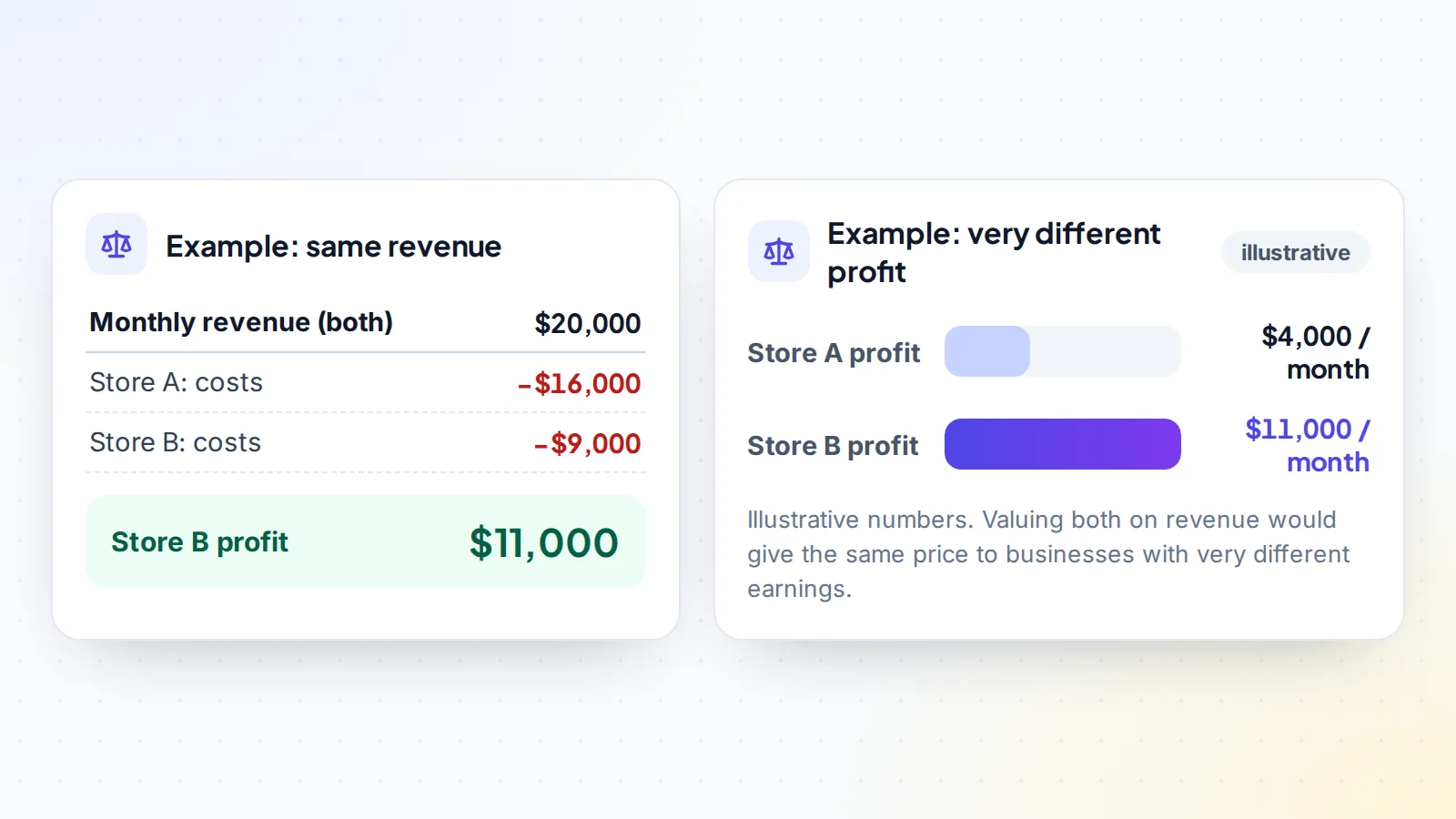
Two businesses can have identical revenue and very different profit, which is the whole point of this comparison. An e-commerce store with expensive products and heavy advertising may keep a small share of each sale; a digital product business with low costs may keep most of it. That’s why revenue alone can’t tell you what a business is worth.
Why most online businesses are valued on profit
- Profit is what the buyer receives. A buyer paying for income wants to know what they’ll actually earn.
- It accounts for costs. High revenue with high costs is worth less than moderate revenue with low costs.
- It’s comparable. Profit multiples can be compared across different types of business.
- It reflects the payback period. A profit multiple tells a buyer roughly how long it takes to earn back the price.
The U.S. Small Business Administration’s guide to buying a business describes several valuation approaches, many of which start from the business’s earnings. For small online businesses, average monthly net profit or seller discretionary earnings over the last 12 months is the usual base; see trailing twelve months profit and seller discretionary earnings.
When revenue-based valuations are used
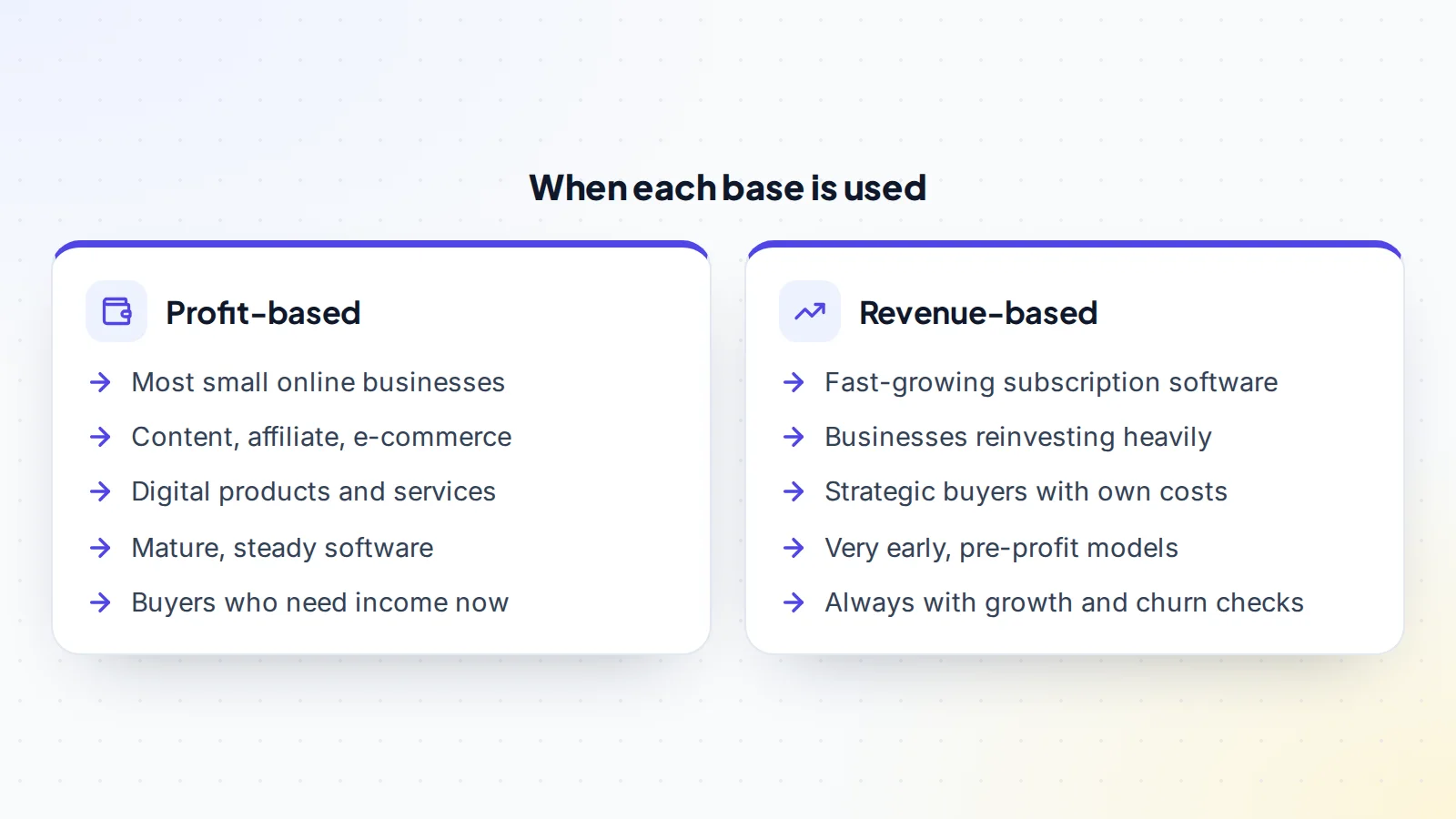
Revenue multiples appear mainly in situations where profit doesn’t reflect what the business is worth:
- Fast-growing subscription software that reinvests most of its income in growth. Stripe describes monthly recurring revenue as the predictable revenue a subscription business expects each month, which is why recurring revenue is often the focus for these businesses. See MRR vs ARR.
- Strategic buyers who will run the business with their own team and costs, so the seller’s costs matter less to them.
- Early businesses with growing revenue but little or no profit yet.
Even then, revenue multiples come with careful checks on growth, churn and the cost of acquiring customers. A revenue multiple on a business with high churn or falling revenue is very risky.
Converting between the two
The link between a revenue multiple and a profit multiple is the profit margin (profit divided by revenue):
Profit multiple = revenue multiple ÷ profit margin
For example, a business priced at 2× annual revenue with a 25% profit margin is priced at 8× annual profit (2 ÷ 0.25). The same 2× revenue on a business with a 50% margin is 4× annual profit. Converting like this is the quickest way to see whether a revenue-based price is reasonable.
A worked example
The numbers below are made up to show the method, not market data.
Two stores each have $20,000 of monthly revenue. Store A’s costs are $16,000 a month, leaving $4,000 profit. Store B’s costs are $9,000, leaving $11,000 profit. A seller of Store A asks “the same multiple of revenue as Store B”, arguing the businesses are the same size.
A buyer converts: at the same revenue-based price, Store A would cost nearly three times as much per dollar of profit. On a profit basis, Store B is clearly worth more. The buyer offers on Store A’s profit, explains the conversion, and the conversation moves to what could raise Store A’s margin, which is where any extra value would really come from.
Which profit? Net profit, SDE and EBITDA
“Profit” itself has several versions, and listings don’t always say which:
- Net profit: revenue minus every cost. The usual base for small online businesses.
- Seller discretionary earnings (SDE): net profit plus the owner’s pay and genuine personal or one-off costs. It shows what one owner-operator earns, and is usually valued at a lower multiple than net profit.
- EBITDA: earnings before interest, tax, depreciation and amortisation, common for larger companies.
A price quoted on SDE and a price quoted on net profit aren’t directly comparable either. Ask which figure is used, and recalculate if you need to compare.
A second example: subscription software
The numbers below are made up to show the method, not market data.
A software product has $30,000 of monthly recurring revenue, growing steadily, and reinvests most of it in development and marketing, leaving $3,000 of monthly profit. Valued on profit alone, the price would look low compared with the size and growth of the business. The seller proposes a price based on recurring revenue instead.
The buyer agrees to discuss a revenue-based price, but checks what justifies it: revenue churn, net revenue retention, growth over 12 months, and how much of the spending would continue under new ownership. Churn is low and existing customers are upgrading, so the buyer accepts a revenue-based approach, converting it to a profit view to check the payback is acceptable once growth spending is adjusted. Our guide to SaaS churn rate explains the checks.
Common pitfalls
- Comparing a revenue multiple with a profit multiple. Convert first.
- Revenue before refunds. Always use revenue after refunds and chargebacks.
- Profit that ignores some costs, such as the owner’s unpaid work or advertising. See add-backs.
- Different periods: monthly versus annual figures, or a few strong months versus a full year.
- Gross profit called profit: gross profit is revenue minus product costs only; it’s not net profit.
Margins by business type
Profit margins vary widely by model, which is why revenue alone says so little:
- Digital products and content sites often have high margins because each extra sale costs little.
- Software can have high margins once built, but development and support costs can be significant.
- E-commerce usually has lower margins because of product, shipping and advertising costs. See selling an e-commerce business.
- Services depend heavily on labour costs.
Check margins over time, too: a margin that’s shrinking because advertising costs are rising is a warning sign even if revenue grows.
Costs that hide behind revenue
When a listing leads with revenue, look carefully for costs that may not be obvious:
- Advertising needed to keep revenue at its current level.
- Payment, platform and marketplace fees taken before payouts.
- Refunds, returns and chargebacks.
- Contractors and the owner’s own time, which a buyer would have to pay for.
- Software and services that rise as the business grows.
- Deferred costs, such as content updates or software maintenance postponed before the sale.
Each one reduces profit, and therefore what the business is worth on a profit basis. Asking for a full cost breakdown is the quickest way to see whether a revenue-based asking price makes sense.
How the base differs by asset type
Content sites, affiliate sites, digital product stores and small services are almost always valued on profit. E-commerce stores are valued on profit, often with stock added separately. Subscription software may be valued on profit when mature and on recurring revenue when growing fast. Assets without profit, such as domains, social accounts and game accounts, are priced on comparable sales and demand rather than either multiple.
Quality of revenue
Not all revenue is equal. Recurring subscription revenue is more predictable than one-off sales; revenue from many customers is safer than revenue from a few; revenue from several traffic sources is safer than revenue from one. These qualities affect the multiple whichever base you use. Our guide to traffic concentration risk explains how to assess them.
How growth changes the picture
Profit-based valuations look backwards: they price what the business has earned. That works well for steady businesses, but can undervalue one that is growing quickly, or overvalue one that is shrinking. When revenue is rising strongly, buyers sometimes give more weight to recent months or use a revenue view alongside profit. When revenue is falling, they usually weight recent months more heavily the other way. Whichever approach is used, the reasoning should be explicit and backed by monthly data.
Using the right base in negotiation
Agreeing the base early prevents confusion later. Before discussing price, both sides should agree on the figure (net profit, SDE or revenue), the period (usually the last 12 months) and the adjustments. With that agreed, the conversation becomes a discussion about one number, the multiple, and the evidence behind it. That’s far more productive than two sides quoting figures calculated in different ways. For more on revenue vs profit valuation in practice, see the online business valuation multiple.
For buyers
- Ask for both revenue and profit, by month, for 12 months.
- Rebuild profit yourself from the cost records.
- Convert any revenue multiple into a profit multiple.
- Compare listings only on the same base and period.
- Use the free valuation tool for a starting range.
For sellers
- Present revenue and profit clearly, with every cost listed.
- State which base your asking price uses, and why.
- If you argue for a revenue-based price, back it with growth, retention and margin evidence.
- Improve margins before selling: they raise profit and the price together.
Improving the number that matters
For sellers, the practical lesson from revenue vs profit valuation is that profit usually sets the price, so improving margins is one of the most effective ways to raise a business’s value. Cutting advertising that doesn’t pay back, renegotiating supplier or software costs, reducing refunds by improving products, and documenting processes so a buyer doesn’t have to pay for expensive help all lift profit directly. A year of steadily better margins also supports a better multiple, because it shows the improvement is real.
Revenue vs profit valuation: the checklist
- Revenue after refunds, by month.
- Every cost listed; net profit calculated.
- Profit margin calculated and checked over time.
- Valuation base stated: revenue, net profit or seller discretionary earnings.
- Period stated: monthly or annual, over how many months.
- Any revenue multiple converted to a profit multiple.
- Quality of revenue assessed.
Ready to find your next asset?
Browse listings with verified numbers, ask sellers your questions before you offer, and agree every step in a free Deal Room.
Frequently asked questions
Is it better to value a business on revenue or profit?
For most small online businesses, profit, because it shows what the owner keeps. Revenue is used mainly for fast-growing subscription software and some strategic purchases.
How do I convert a revenue multiple to a profit multiple?
Divide the revenue multiple by the profit margin. At a 25% margin, 2× revenue equals 8× profit.
Why do some listings quote revenue?
Sometimes because the business reinvests heavily or is growing fast; sometimes simply because revenue sounds bigger. Either way, ask for profit too, month by month, before you compare.
What is gross profit?
Revenue minus the direct cost of the products sold. It’s not the same as net profit, which subtracts every cost, including advertising, fees, software, contractors and staff.
Does a high-revenue business always sell for more?
No. A smaller business with higher profit and steadier income can easily be worth more than a larger one with thin or shrinking margins.
Should a seller quote both revenue and profit?
Yes. Showing both, by month, with every cost listed, lets buyers understand the business quickly and builds trust from the first conversation.