Flippa Alternatives: Where Else to Buy and Sell Online Businesses
A fair look at Flippa alternatives: the main kinds of platforms for buying and selling online businesses, how fees and vetting differ, and how to pick the right one.

Flippa is one of the best-known places to buy and sell online businesses, but it’s far from the only one. Depending on what you’re selling, how big it is and how much help you want, another platform may suit you better, or you may use more than one. This guide looks at Flippa alternatives fairly: the main kinds of platforms, how their fees and processes differ, and how to choose the right one for your deal.
Fees and features change, so treat any figures here as a snapshot and check each platform’s current pricing page before you decide. For a deeper look at costs, see our guide to online business marketplace fees.
Key takeaways
- Platforms fall into a few kinds: open marketplaces, curated marketplaces, startup platforms, brokers and niche marketplaces.
- Fee models differ: success fees, listing fees, or a mix of both.
- Curated platforms vet listings; open ones give sellers more control and reach more small deals.
- How payments are handled matters as much as fees: look for escrow or trusted partners.
- Compare the total cost at your expected sale price, not just the headline rate.
How Flippa works, briefly
Flippa describes itself as a marketplace for websites, SaaS, e-commerce stores, YouTube channels, apps and other online businesses. According to its own help pages, sellers create a listing and choose either a timed auction or a classified listing with an asking price, then talk to buyers, agree terms, go through due diligence and get paid. At the time of writing, Flippa’s pricing page lists packages with a one-off listing fee plus a success fee on sale, with success fees ranging from 5% to 10% depending on the price and package. It also offers broker-led services for larger businesses.
That combination of reach, listing options and services is why many people start there. It’s also why people look for Flippa alternatives: some want lower costs, some want more vetting, some want a platform built around one type of asset, and some simply want to reach a different group of buyers.
The main kinds of Flippa alternatives
Rather than a long list of names, it’s more useful to understand the kinds of platform, because each kind suits different deals.

Curated marketplaces
Curated marketplaces review businesses before they’re listed, checking revenue, traffic and ownership. Empire Flippers is a well-known example: it says its team vets every listing before it goes live, and its fees page describes a commission charged when the business sells, with no fee to list. Buyers get pre-checked listings; sellers get help and an audience of serious buyers, in exchange for a success fee and a selective process that not every business passes.
Startup and SaaS platforms
Some platforms focus on startups, SaaS and apps. Acquire.com is one: it describes a guided process covering NDAs, data rooms, letters of intent, due diligence and purchase agreements, with closing handled through escrow partners. Its pricing combines a listing fee with a closing fee that applies when the deal completes. These platforms suit software businesses whose buyers expect structured information and contracts.
Brokers
Brokers manage the sale for you: valuation, marketing to their buyer network, negotiation and closing. They’re usually the most hands-off option and most often used for larger businesses, and they typically charge a success fee. Our guide to marketplace vs broker explains when each makes sense.
Niche and direct options
Some marketplaces specialise in one asset type, such as domains, game accounts or social media accounts. Others sell through their own networks: industry communities, newsletters and contacts. These can work well for assets with a clear, specific buyer base.
How fee models compare
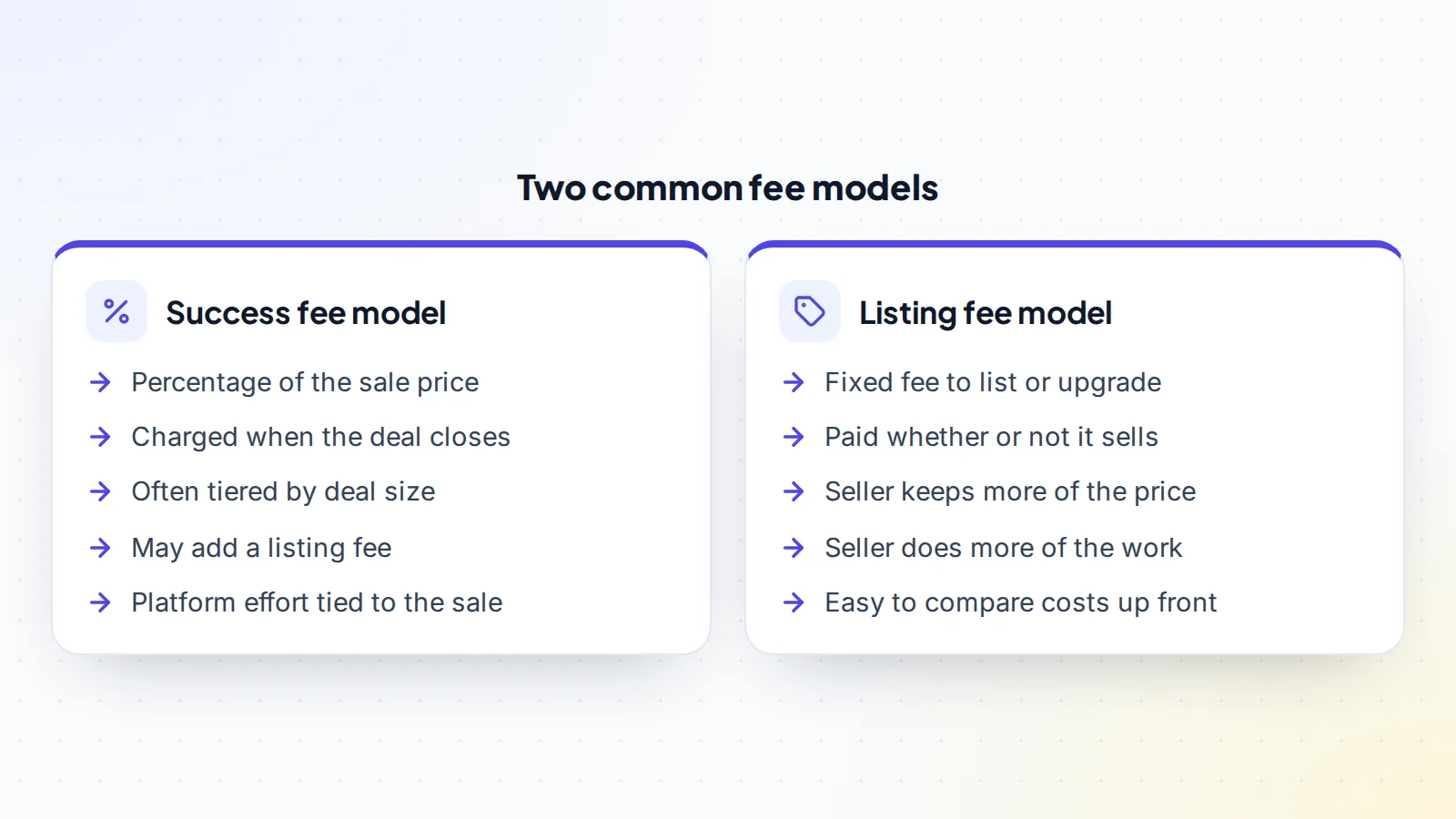
Most platforms use some mix of two models. A success fee is a percentage of the sale price, charged when the deal closes, often tiered so larger deals pay a lower percentage on part of the price. A listing fee is a fixed amount to list or to upgrade a listing, paid whether or not the business sells.
The right comparison is the total cost at the price you expect. A success fee of 10% on a $50,000 sale is $5,000; on a $500,000 sale, it’s $50,000, though tiers often reduce it. A listing fee is the same at any price, but you may do more of the selling work yourself. Our guide to success fees walks through the maths.
Auctions, asking prices and offers
Platforms also differ in how a price is set. Some, like Flippa, offer timed auctions as well as fixed-price listings. Others use an asking price with offers, or a price set with the platform’s help after vetting. Auctions create a deadline and can work well for assets with lots of interested buyers, but the final price depends on who’s bidding that week. An asking price gives you more control and time, and suits businesses whose buyers need longer to check the numbers.
Whichever method you use, set a minimum you’d genuinely accept, based on the business’s profit and comparable sales rather than hope.
Listing on more than one platform
Many sellers list in more than one place to reach more buyers. Before you do, check each platform’s terms for exclusivity periods, keep the price and figures identical everywhere, and track every conversation, so no buyer is told something different. If one platform vets your business, its checks can strengthen your listings elsewhere.
How payments are handled
The safety of the money is as important as the fee. Before choosing a platform, find out:
- Whether it uses a licensed escrow service, its own payment system or a partner.
- Who holds the buyer’s money, and when it’s released.
- What happens if there’s a dispute.
- Whether middleman or managed transfer services are available.
Avoid any deal where you’re asked to pay or transfer outside the platform’s agreed method. Our guide to middleman services explains how a neutral party protects both sides.
Where digiflippers.com fits
digiflippers.com is a marketplace for buying and selling websites, SaaS, domains, social media accounts, game accounts, digital products and communities. Selling comes with 0% success fee up to $10,000, then 5% (max $5,000), so sellers keep 100% of the price on sales up to $10,000. The ways to pay in a deal are: directly to the seller, through escrow, and the platform never holds the money itself. Sellers can verify their numbers and identity, buyers can see which figures are verified, and anyone can use the free valuation tool to get a quick price range.
Like any open marketplace, it puts more of the selling work in the seller’s hands than a broker would. If you want a fully managed sale, a broker may suit you better; if you want reach, control and low costs, it’s worth listing.
How to choose
- What are you selling? The asset type and size narrow the field. A small content site, a SaaS doing several hundred thousand a year and a premium domain usually belong on different platforms.
- Where do the right buyers look? Browse each platform’s sold or active listings to see what sells there.
- What’s the total cost? Work out listing fees, success fees and extras at your expected price.
- How is money handled? Prefer platforms with escrow or trusted partners and a clear dispute process.
- How much time can you give? Open marketplaces need more of your effort; brokers and curated platforms need less, at a higher cost.

For buyers: comparing platforms
Buyers face the same choice from the other side. Curated platforms save time on first checks, but you’ll still need your own due diligence. Open marketplaces offer more variety and smaller deals, with more checking to do. Startup platforms suit buyers who want structured data rooms and contracts. On every platform, verify the numbers yourself, keep messages on the platform and use protected payment. Our guide to where to buy a website covers the buyer’s view.
Signs of a trustworthy platform
Whichever kind you choose, look for the basics that protect both sides:
- Clear, published fees, with no surprises at closing.
- A defined payment process using licensed escrow, a trusted middleman or partners, with funds released only after the buyer confirms.
- Identity and data checks, such as verified sellers, verified revenue or connected analytics.
- A dispute process that’s written down before you need it.
- Messages kept on the platform, so there’s a record of what was agreed.
- Responsive support you can reach before, during and after a deal.
Questions to ask any platform
- What exactly will I pay, and when, at my expected sale price?
- Do you ask for exclusivity, and for how long?
- How are payments held and released, and by whom?
- What do you check before a listing goes live?
- How are disputes handled?
- What help do you offer with transfers and handovers?
- How many assets like mine have been listed recently?
Good platforms answer these clearly in their help pages or before you sign up. If a platform is vague about fees, payments or disputes, treat that as a reason to look elsewhere, however large its audience.
Prepare once, list anywhere
The preparation that sells a business is the same on every platform. Before you list, gather 12 to 24 months of profit and loss figures, traffic and revenue data you can verify, a list of every asset and account that will transfer, and clear answers to the questions buyers always ask: why you’re selling, how many hours the business takes and what could grow it. Sellers who arrive with this ready spend less time answering questions and give buyers fewer reasons to hesitate, on any platform. Our guide to trailing twelve months profit explains the figure most buyers start from.
A worked example
The details below are made up to show the method.
Omar has a content site earning about $3,000 a month in profit, with a likely sale price around $90,000. Omar compares three options. A curated marketplace would vet the site and bring serious buyers, with a success fee on the sale. An open marketplace with a listing fee and a success fee would give Omar more control. A marketplace without a success fee would mean keeping the full price, with more of the selling work on Omar’s side.
Omar works out the total cost of each at $90,000, checks how each handles payments, and looks at recently listed sites of the same kind. The decision is to list where the cost is lowest and that kind of site is common, prepares verified traffic and revenue data to reduce buyers’ checking time, and uses escrow for the payment.
Flippa alternatives: the checklist
- Asset type and expected price written down.
- Platforms short-listed by kind: open, curated, startup, broker, niche.
- Current pricing pages read for each one.
- Total cost worked out at your expected price.
- Payment and escrow process checked.
- Recent listings reviewed for assets like yours.
- Time and effort you can give compared with each process.
- Verified data prepared, whichever platform you choose.
Ready to find your next asset?
Browse listings with verified numbers, ask sellers your questions before you offer, and agree every step in a free Deal Room.
Frequently asked questions
What are the main Flippa alternatives?
Curated marketplaces such as Empire Flippers, startup platforms such as Acquire.com, business brokers, niche marketplaces for one asset type, and open marketplaces such as digiflippers.com.
Which platform has the lowest fees?
It depends on your sale price and the fee model. Compare the total cost at your expected price, including listing fees, success fees and any extras, using each platform’s current pricing page.
Is a curated marketplace better than an open one?
Not better, different. Curated platforms vet listings and bring serious buyers, usually for a success fee. Open marketplaces give sellers more control and suit a wider range of deal sizes.
When should I use a broker?
Usually for larger or more complex businesses, when you want someone to manage valuation, marketing, negotiation and closing for you.
Can I list on more than one platform?
Often yes, but check each platform’s terms, as some ask for exclusivity for a period. Keep prices and information consistent everywhere.
How do I keep the payment safe on any platform?
Use escrow or a middleman, keep messages on the platform, and never transfer anything before the money is confirmed by the neutral party.
Do I need to pay to see listings on these platforms?
Browsing is usually free, though some platforms ask buyers to register, sign an NDA or show proof of funds before revealing full details of a listing.