Bank Wire Safety: How to Pay Large Amounts Safely
How to pay large amounts by bank wire safely: verifying instructions, spotting payment-change scams, using escrow, and what to do quickly if something goes wrong.
Bank wires are one of the most common ways to pay for a business, especially for larger amounts. They’re fast and widely accepted. But they have one property every buyer should understand: once the money is sent, it’s very hard to get back. That’s what makes wire transfer safety so important when you’re paying for a website, SaaS or other online business. This guide explains the risks, how payment-change scams work, and the simple habits that keep large payments safe.
It’s written for buyers paying for a business and for sellers receiving payment, because both sides are targets for the same tricks. For the general case for protected payments, see our guide to escrow for online businesses.
Key takeaways
- The FTC warns that wiring money is like sending cash: once it’s sent, it’s very hard to reverse.
- For a business purchase, wire to a neutral party such as escrow, not directly to a seller you don’t know.
- The FBI warns of business email compromise, where fraudsters send fake payment instructions.
- Always confirm wire instructions by phone, on a number you already know.
- If something goes wrong, call your bank immediately and report it to the FBI’s IC3.
Why wires need extra care
The US Federal Trade Commission compares wiring money to sending cash: once it’s gone, you usually can’t get it back, and there’s no dispute process like the one cards offer. That’s useful for sellers, who know a completed wire won’t be clawed back weeks later. For buyers, it means every safeguard has to happen before the money leaves the account, not after.
The FTC also notes that scammers often ask for wire transfers precisely because they’re hard to trace and reverse. That doesn’t make wires bad; it makes the recipient and the instructions the two things to get absolutely right.
Who you wire to matters most
For a business purchase, the safest recipient is a neutral party: a licensed escrow service or a trusted middleman that holds the money until the business is transferred and you’ve confirmed it. California’s financial regulator, the DFPI, advises checking that an online escrow company is licensed and never relying on a link sent by the other side. Open the escrow service’s website yourself, create your own account, and use the payment instructions shown there.
Wiring directly to a seller you’ve never met means trusting them to deliver the business after they have your money. Even honest sellers can’t offer you the protection a neutral party gives. On digiflippers.com, the ways to pay in a deal are: directly to the seller, through escrow, and the platform never holds the money itself.
How payment-change scams work
The FBI describes business email compromise as a scam in which fraudsters compromise or imitate email accounts to redirect payments. In a business sale, it can look like this: you’ve agreed a deal and are expecting wire instructions; an email arrives that appears to come from the seller or the escrow company, with new bank details and a reason for the change. The email address may be one letter different from the real one, or the real account may have been hacked. The money goes to the fraudster, and the real seller never receives it.
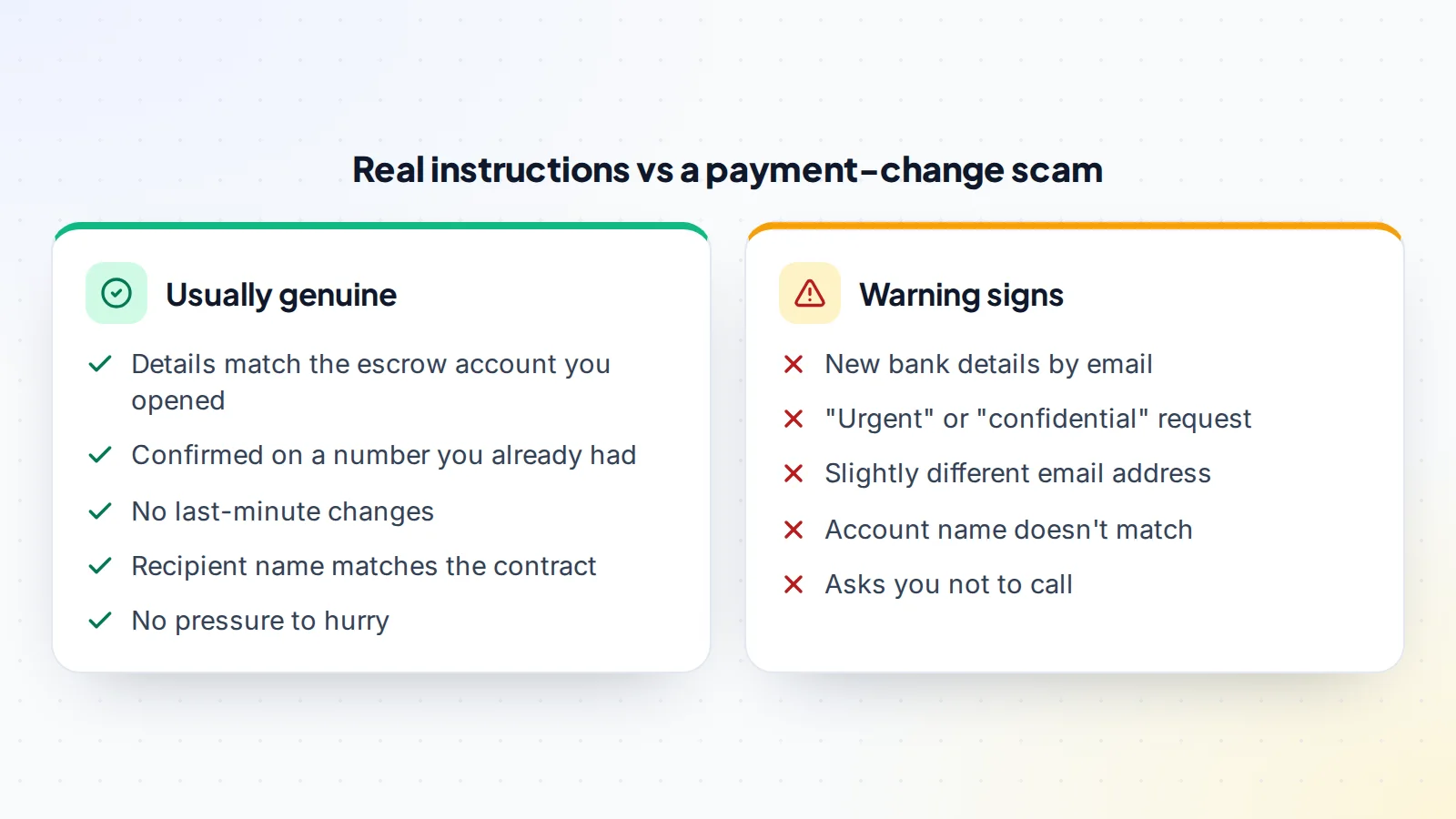
The FBI’s advice is simple and effective: verify payment requests and any change of account details by calling the person, using a number you know is genuine, not one given in the email.
Before you send: a safe routine
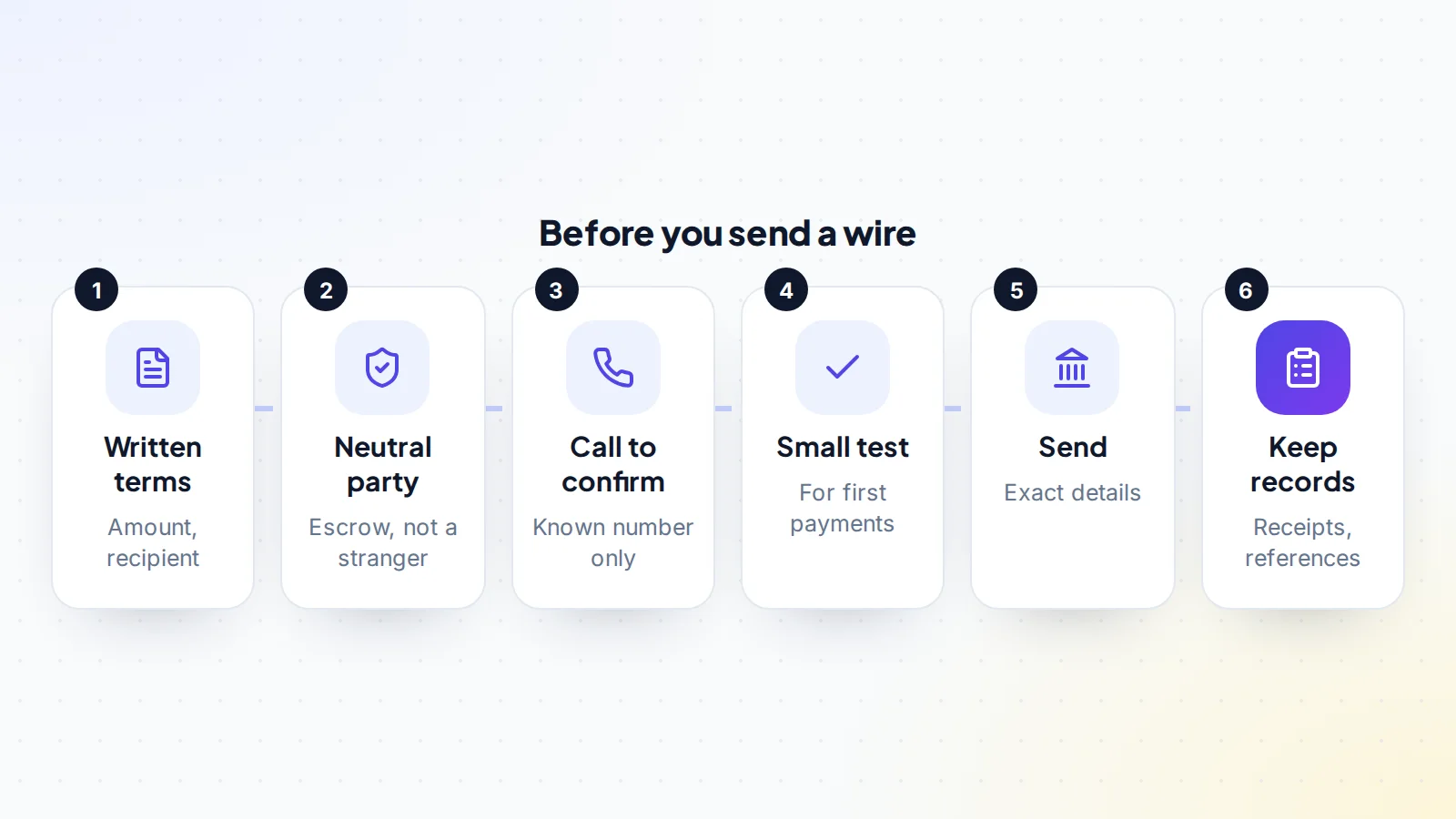
- Agree the terms in writing: the amount, the recipient and what triggers release.
- Send to a neutral party wherever possible, using instructions from inside your own escrow account.
- Call to confirm the instructions on a number you already had, such as the escrow company’s number from its official website.
- Treat any change as suspicious until confirmed by phone, however convincing the email.
- Send a small test amount for a first payment to a new recipient, and confirm it arrived.
- Check the account name matches the recipient in your agreement.
- Keep every record: the instructions, the bank’s confirmation and the transaction reference.
Protect your own email
Payment-change scams often start with a compromised inbox, yours or the other side’s. Turn on two-step sign-in for your email, use a unique password, and watch for forwarding rules you didn’t create. During a deal, keep conversations on the marketplace where possible, so there’s a record that can’t be quietly edited, and be wary of anyone who moves the discussion to a new email address mid-deal. Our guide to marketplace impersonation scams describes a related trick.
International wires
Cross-border deals add a few extra details. International wires pass through intermediary banks, can take several days and may lose part of the amount to fees along the way. Agree in writing who pays which fees, and ask the recipient for the exact details their bank needs, such as the SWIFT/BIC code and IBAN where used. Currency conversion is another cost: compare your bank’s rate with the market rate before you send. Allow extra time before any deadline, and tell the escrow service or seller when the wire was sent, with the reference, so they can trace it on arrival.
Paying large amounts in stages
For very large purchases, some buyers split the payment: a first tranche when key assets move, the rest when everything is confirmed. With escrow, the whole amount is usually held at once and released in agreed stages, which keeps the process simple. Without escrow, staging limits how much is at risk at any moment, but every stage needs the same verification routine. Never let the urgency of a later stage persuade you to skip the phone call.
Questions to ask your bank
- What are the daily or per-transfer limits on my account, and how do I raise them in advance?
- How long will the transfer take, and when is the cut-off time?
- What fees apply, including for international wires?
- Can you confirm the recipient’s account name matches before the money is sent?
- What’s the process and phone number for an urgent recall?
Asking these well before deal day avoids last-minute surprises, which are exactly when costly mistakes happen.
For sellers
Sellers are targets too. Fraudsters may impersonate the escrow company to tell you funds have arrived, hoping you’ll transfer the business early. Always confirm funds by signing in to the escrow account yourself, never from an email or screenshot. If you’re receiving a wire directly, wait until your own bank confirms the funds have cleared before transferring anything.
Habits for the whole deal
Wire safety starts long before payment day. From the first message, keep conversations on the marketplace, so you have a full record and can spot a sudden change of tone or contact details. Save the escrow company’s official phone number and website address at the start, from a search you did yourself, so you’re not relying on links later. Agree with the other side, in writing, that payment details will never change by email, and that any change must be confirmed by phone. Fraudsters rely on surprise; a shared rule removes it.
Pressure is a warning sign
Many payment scams rely on urgency: a deadline that’s about to pass, another buyer about to step in, an account that will be “frozen” if you don’t act today. Genuine sellers and escrow companies understand that large payments take a little time to check. If someone pushes you to skip a step, treat that as a reason to slow down, call a known number and confirm. A deal that’s real will still be there in an hour; money sent to the wrong account may not come back.
Records that help later
Keep the written agreement, the instructions you used, your bank’s wire confirmation with its reference number, and screenshots from your escrow account showing the transaction. If a dispute or fraud report is ever needed, these records make it far easier for your bank, the escrow company or investigators to help.
If you think a wire went wrong
Act fast. The FBI’s advice for business email compromise is to contact your bank immediately and ask it to recall the transfer, and to report the incident to the FBI’s Internet Crime Complaint Center (IC3). The FTC also takes reports at ReportFraud.ftc.gov. Then secure your email, tell the marketplace and the other party, and keep every record.
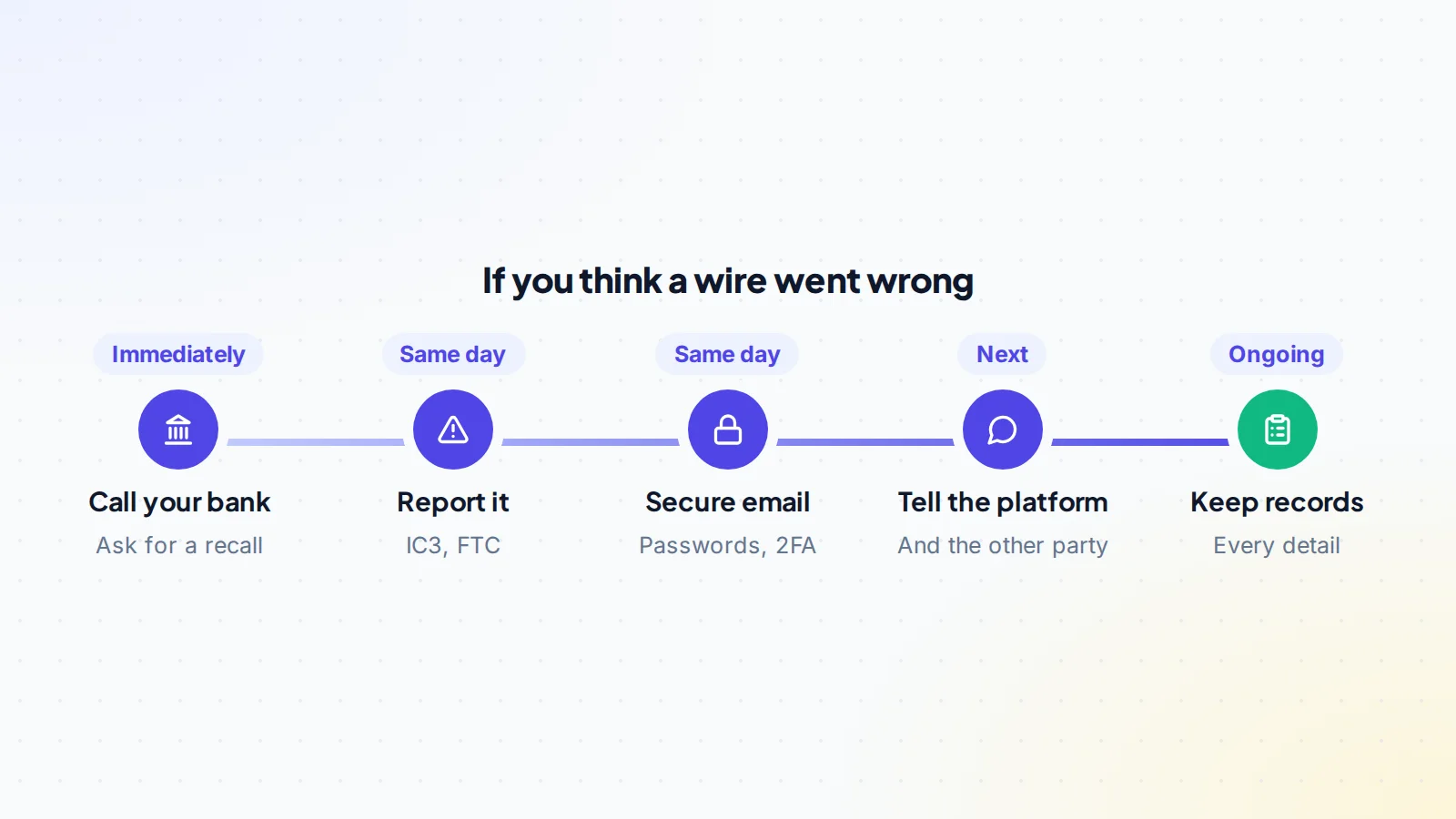
Speed matters: a bank has a much better chance of stopping a transfer before the money has moved on. Don’t wait to be certain, and don’t let embarrassment slow you down; fraudsters are skilled, and reporting quickly is the most useful thing you can do. Be wary, too, of anyone who contacts you afterwards offering to recover the money for a fee, which the FTC warns is a common follow-up scam.
Common mistakes
- Using bank details from an email instead of from inside your escrow account.
- Calling the phone number given in a suspicious email to “verify” it.
- Rushing a wire because a deadline is close or someone says another buyer is waiting.
- Sending the full amount before a first test payment to a new recipient.
- Leaving your own email without two-step sign-in during a deal.
Good wire transfer safety is mostly about routine: the same checks, in the same order, every time, however familiar the deal feels.
A worked example
The details below are made up to show the method.
Nadia agrees to buy a content site for $60,000 using escrow, opens the escrow company’s website directly, creates an account and sees the wire instructions there. That evening, an email that looks like it’s from the escrow company says the bank account has changed “due to an audit” and asks for the new details to be used urgently.
Nadia doesn’t reply, and instead calls the escrow company on the number from its official website, and they confirm the details haven’t changed and the email is fake. Nadia wires to the original account, confirms receipt in the escrow dashboard, and reports the fake email to the marketplace. The deal completes as planned.
Other payment methods
Wires are only one option. Cards and some payment apps offer disputes but can be reversed after a seller hands over a business, which sellers rightly worry about; our guide to chargeback risk explains it. Crypto is also hard to reverse, with similar risks; see our guide to paying with crypto. For most larger deals, a wire to a licensed escrow service gives both sides what they need.
Wire transfer safety: the checklist
- Terms agreed in writing: amount, recipient, release conditions.
- Escrow service opened and checked by you, not via a link.
- Wire instructions taken from inside your own escrow account.
- Instructions confirmed by phone on a known number.
- Any change to details treated as suspicious and verified.
- Small test sent for first payments to a new recipient.
- Account name checked against the agreement.
- Email secured with two-step sign-in.
- Receipts and references kept.
Ready to find your next asset?
Browse listings with verified numbers, ask sellers your questions before you offer, and agree every step in a free Deal Room.
Frequently asked questions
Can a wire transfer be reversed?
Rarely. The FTC compares wiring money to sending cash. If something goes wrong, call your bank immediately and ask for a recall; speed improves the chances.
Should I wire money directly to a seller?
For a business purchase, it’s safer to wire to a neutral party such as a licensed escrow service, which releases funds only after the transfer.
How do I spot fake wire instructions?
Be suspicious of any change to bank details by email, urgent requests, slightly different email addresses and account names that don’t match. Confirm by phone on a number you already know.
What is business email compromise?
A scam the FBI describes in which fraudsters compromise or imitate email accounts to redirect payments to their own accounts.
Where do I report wire fraud?
Call your bank first, then report to the FBI’s IC3 at ic3.gov and to the FTC at ReportFraud.ftc.gov.
Is a small test payment worth it?
For a first payment to a new recipient, yes. It confirms the details work before you send the full amount.
What’s the most important wire transfer safety step?
Confirming the payment instructions by phone, on a number you already know is genuine, before you send. It stops most payment-change scams.