Google Updates and Website Value: How Buyers Assess the Risk
How Google updates affect the value of websites: what core and spam updates are, how to check a site's history against update dates, warning signs, how to reflect the risk in price and how owners can reduce it.

Many websites earn most of their income from Google search traffic. That traffic is valuable, but it isn’t guaranteed: Google updates its ranking systems regularly, and some updates move sites up or down sharply. For anyone buying or selling a website, Google algorithm update risk is one of the most important factors in the price. This guide explains what core and spam updates are, how to check a site’s history against update dates, how to reflect the risk in a deal, and what owners can do to reduce it.
For the wider review of search traffic, see our guide to SEO due diligence. For the full buying process, read how to buy a website.
Key takeaways
- Google makes broad core updates several times a year, plus spam updates and others.
- Google says core updates aren’t aimed at specific sites, and drops don’t necessarily mean a violation.
- Compare a site’s monthly clicks with the dates on Google’s Search Status Dashboard.
- Price the risk through the multiple and deal terms, not by guessing the next update.
- Helpful content, earned links and an owned audience make sites more resilient.
What is Google algorithm update risk?
Google algorithm update risk is the chance that a change to how Google ranks pages will reduce a website’s search traffic, and so its income. Google uses many automated ranking systems and updates them often. Most changes are small and unnoticed, but some are larger and affect many sites at once. For a site that relies on search, a big drop after an update can cut its value quickly.
The risk works both ways: updates can also lift sites. But because buyers pay for future profit, the downside matters most when setting a price.
Why it matters more for some sites
Not every website carries the same update risk. A site whose visitors mostly come from search, and whose income comes mostly from those visitors, is the most exposed. A business that sells its own products, has a loyal email list, or gets visitors from social media, partners and direct visits feels a search change less. Within search, sites that rank for a few highly competitive queries are often more exposed than those that rank for thousands of specific, long-tail queries spread across many pages.
Topic matters too. Google’s guidance puts extra weight on reliability for subjects that can affect people’s health, finances or safety. Sites in those areas need especially strong evidence of expertise and accuracy, and buyers should look at them with particular care.
Core updates
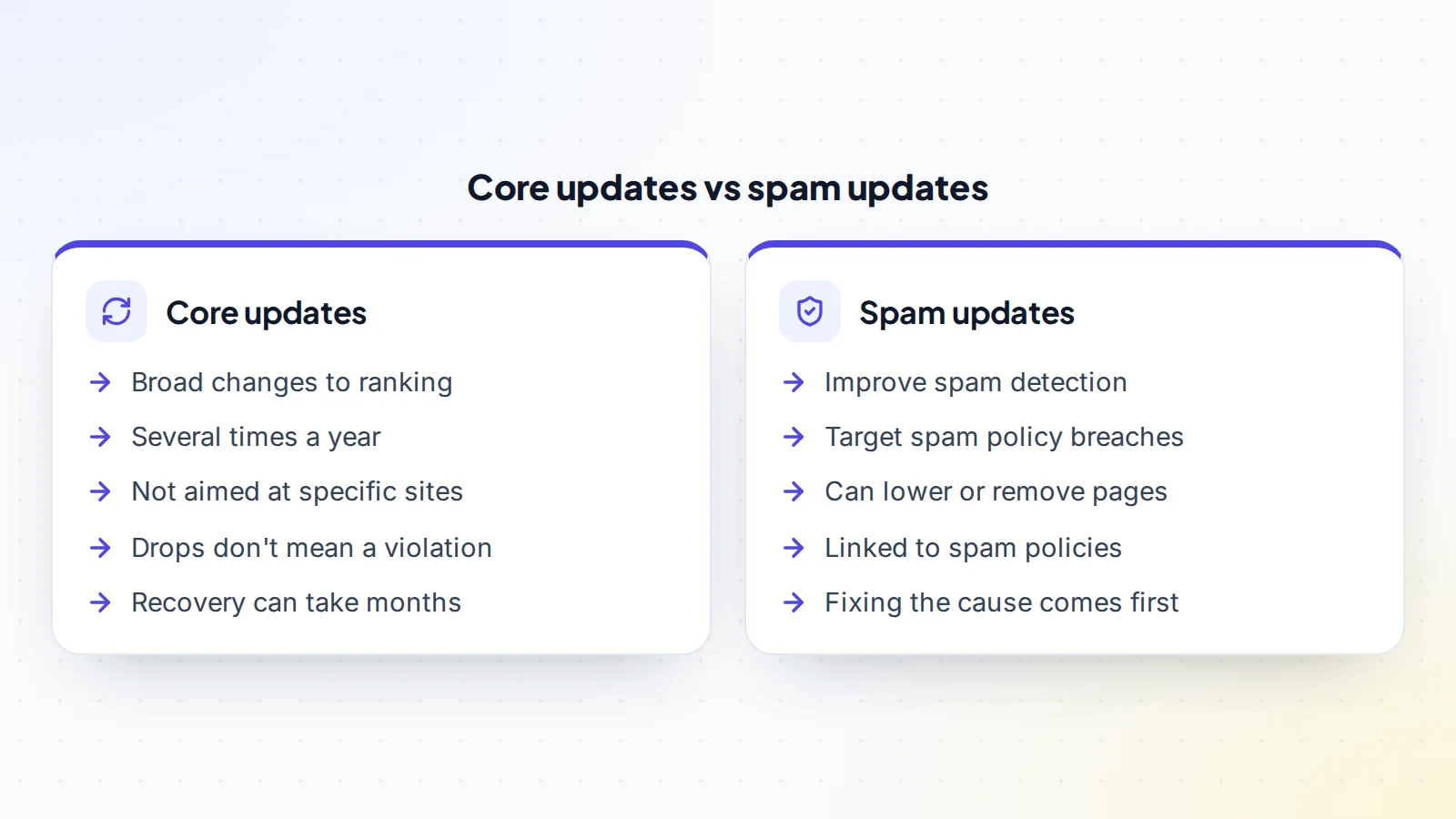
Google describes core updates as significant, broad changes to its search algorithms and systems, made several times a year. It says they’re designed to make sure Search shows helpful, reliable results, and that they aren’t aimed at specific pages or sites. A page that drops after a core update hasn’t necessarily done anything wrong; other pages may simply be judged more helpful.
Google also says that improvements may not be seen right away, and that some changes may only be reflected after a later core update. In practice, recovery from a core update drop can take months, if it happens at all.
Spam updates
Spam updates are improvements to Google’s automated spam detection. Sites that break Google’s spam policies, such as through link spam, scaled content abuse, expired domain abuse or site reputation abuse, may rank lower or not appear at all. Google says that sites seeing a change after a spam update should review its spam policies, and that improvements may take months to be recognised after problems are fixed.
For buyers, a drop that coincides with a spam update deserves especially careful questions, because it may point to practices the new owner would inherit.
Other updates and systems
Google also updates other systems, such as those for reviews, page experience or particular types of search result, and adds new spam policies from time to time. Not every change is announced. The Google Search Status Dashboard lists ranking updates and incidents with their dates, and keeps that history for five years, which makes it the best single place to check what happened when.
How to check a site’s history
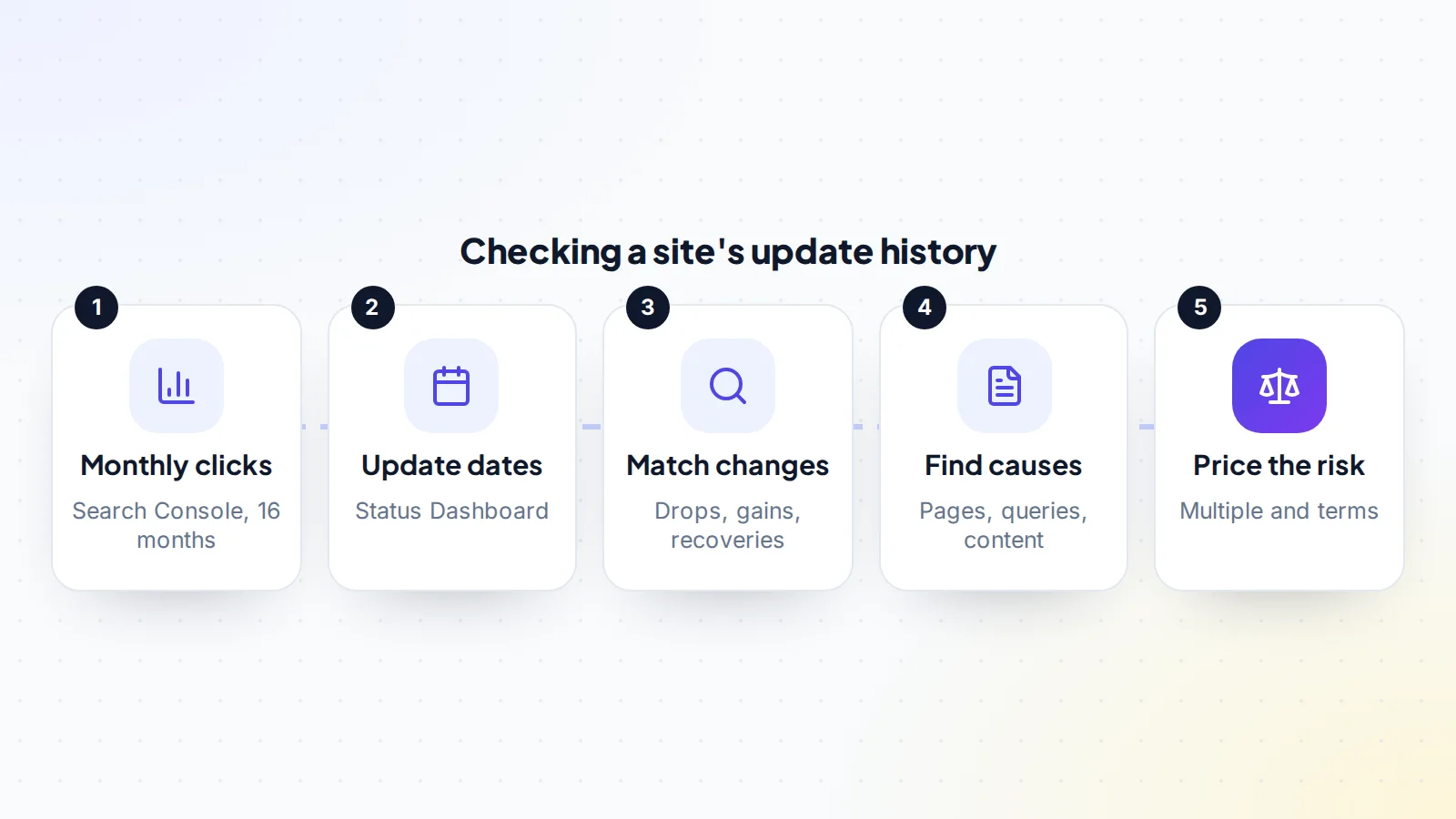
- Get the data: ask for restricted access to Search Console, which shows up to 16 months of clicks and impressions, and Viewer access to Google Analytics for a longer view of organic traffic.
- List the dates: note core and spam updates from the Search Status Dashboard for the same period.
- Match changes: mark any big drops, gains or recoveries and see whether they line up with updates.
- Find causes: look at which pages and queries changed. Was it the whole site or a few pages? Particular topics or content types?
- Ask the seller: what changed, what they did in response, and what happened next.
A site that has held steady or grown through several updates has shown real resilience. A site that has dropped and recovered shows it can bounce back. A site that dropped and stayed down needs a clear explanation before you price it.
Warning signs
- A sharp drop after a recent update that the listing doesn’t mention.
- A drop after a spam update, especially with a history of bought links.
- Large numbers of thin or very similar pages created quickly.
- Income concentrated on a few pages that rank for competitive queries.
- Recent rapid growth from a single update, which could reverse.
- A listing timed just after a strong month following an update.
Our guide to the backlink audit before buying explains how to check links, and our guide to fake revenue screenshots covers how to confirm the income side.
How the risk affects price
Buyers can’t predict the next update, so they price the risk through the multiple and the deal terms. Sites with a stable history, diverse traffic and strong content usually earn a higher multiple. Sites that depend heavily on search, have a volatile history or show signs of risky practices earn a lower one. Some buyers use averages over a longer period, so a recent spike doesn’t inflate the price, or exclude months that were clearly boosted by an update.
Deal terms can share the risk too. An earn-out ties part of the price to future performance; an inspection period gives time to confirm traffic after the handover. These tools are especially useful when a site’s search history is uneven. Our guide to small business vs startup valuation explains how different buyers weigh proven profit against potential.
Timing a sale around updates
Sellers sometimes wonder whether to list right after a good update. A strong recent month can raise interest, but careful buyers average over a longer period and look closely at recent jumps. It’s usually better to list when traffic has been steady for several months, with a clear record of how the site handled past updates. If an update is rolling out while you’re in a deal, both sides should agree how to handle any change in traffic before closing.
How owners reduce the risk
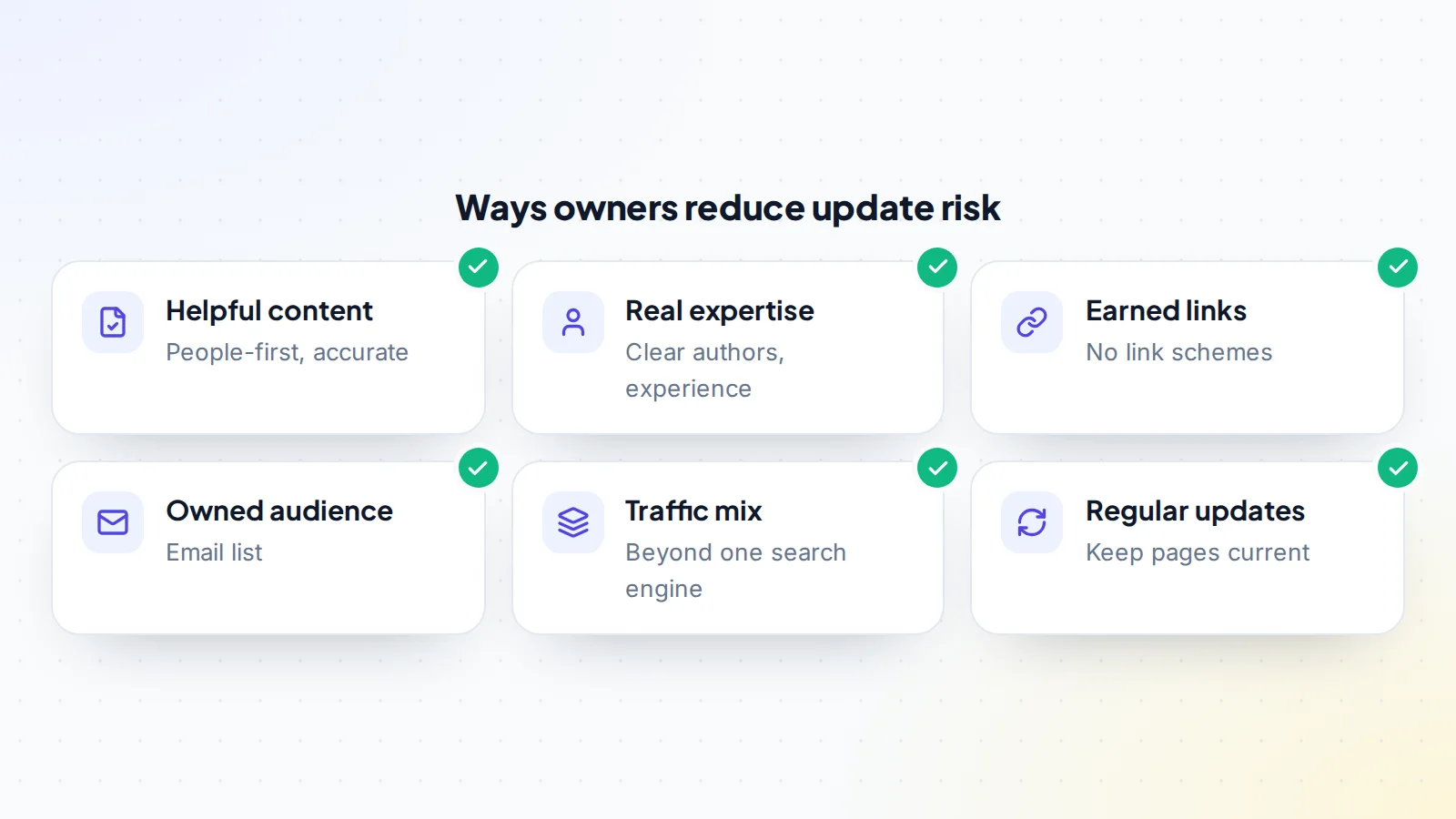
No site is immune to updates, but some are much sturdier than others. Google’s own guidance on creating helpful, reliable, people-first content is the best starting point. In practice, owners reduce risk by:
- Publishing content that’s genuinely useful and accurate, written for readers rather than for rankings.
- Showing real expertise and experience, with clear information about who creates the content.
- Earning links naturally rather than buying them or using link schemes.
- Building an email list and other channels that bring visitors back directly.
- Spreading traffic and income across many pages and sources.
- Keeping important pages up to date and removing or improving weak ones.
Our guide to revenue diversification explains why spreading income and traffic lifts a site’s value.
What sellers should prepare
Sellers can turn update history from a worry into a strength by explaining it up front. Prepare a simple timeline of monthly clicks with update dates marked, and a short note on each notable change: what happened, which pages moved, what you did and how traffic responded. If the site held steady through several updates, say so and show it. If it dropped, explain what you learned and changed. Buyers trust sellers who address the question before it’s asked, and a clear record often supports a better multiple than silence would.
Offer read-only access to Search Console and Analytics early, so buyers can check the timeline themselves.
After you buy
New owners should avoid big changes in the first few months, such as redesigns, URL changes or mass content edits, so they can see how the site performs on its own. Keep publishing in the same style and quality, watch Search Console weekly, and note the dates of any updates on the Search Status Dashboard. If traffic moves, you’ll be able to tell whether it’s an update or something you changed. A simple change log, noting what you edited and when, makes this much easier and is useful if you sell the site again later.
Ad-supported sites
Sites that earn mainly from display ads are especially sensitive to search traffic, because income tracks page views closely, and ad rates also change with the season and the advertising market. A drop in traffic shows up in income almost immediately. If you’re looking at an ad-supported site, our guide to AdSense websites for sale covers the extra checks for ad income.
Common mistakes
- Judging a site on its last three months instead of its full history.
- Assuming a drop means the site broke Google’s rules.
- Assuming a recent jump will last.
- Ignoring which pages and queries actually moved.
- Making big changes straight after buying, then not knowing what caused a drop.
A worked example
The details below are made up to show the method.
Ivy is comparing two cooking sites, each earning $3,000 a month. With Search Console access, Ivy lays monthly clicks alongside the update dates from the Search Status Dashboard. Site A grew steadily through two core updates and one spam update, with a small dip after one update that recovered within a few months. Site B jumped sharply after a core update six months ago and has been flat since; before that, it had lost about a third of its clicks after an earlier update.
Ivy reads the top pages of both. Site A’s recipes are detailed, tested and clearly authored; Site B has many short, similar pages. Ivy offers a fair multiple for Site A, and for Site B proposes a lower multiple using a longer average, plus a small earn-out. The seller of Site A accepts. Ivy passes on Site B.
Google algorithm update risk: the checklist
- Search Console and Analytics access obtained.
- Monthly clicks reviewed for the full available period.
- Update dates listed from the Search Status Dashboard.
- Drops, gains and recoveries matched to updates.
- Affected pages and queries identified.
- Seller’s explanation recorded in writing.
- Content and links checked against Google’s policies.
- Risk reflected in the multiple or deal terms.
- No big site changes planned for the first months.
Browse websites for sale, or list your website with 0% success fee up to $10,000, then 5% (max $5,000). Read more about trust and safety on digiflippers.com.
Ready to find your next asset?
Browse listings with verified numbers, ask sellers your questions before you offer, and agree every step in a free Deal Room.
Frequently asked questions
What is a Google core update?
A significant, broad change to Google’s ranking systems, made several times a year. Google says they aren’t aimed at specific sites.
Does a drop after a core update mean the site broke the rules?
Not necessarily. Google says drops after core updates don’t mean a page has violated its policies; other pages may be judged more helpful.
Where can I see when updates happened?
On the Google Search Status Dashboard, which lists ranking updates and keeps five years of history.
How long does recovery take?
It can take months, and sometimes changes only show after a later core update. Recovery isn’t guaranteed.
How should buyers price update risk?
Through the multiple and deal terms, such as longer averages, an earn-out or an inspection period, rather than by predicting the next update.
What makes a site more resilient?
Helpful, accurate content, real expertise, earned links, an owned audience and traffic spread across many pages and sources.
Should I sell right after a good update?
Careful buyers average over longer periods, so steady traffic over several months is usually a stronger position.