Income Diversification: How Multiple Revenue Streams Change the Value
An explainer on revenue diversification: income sources, traffic sources, customers and platforms, how concentration lowers a business's value, how to measure it, and sensible ways to diversify before a sale.

Two online businesses can earn exactly the same profit and still sell for very different prices. Often the difference is how that profit is made. One earns almost everything from a single affiliate programme, fed by a single traffic source. The other earns from several products, partners and channels. Buyers see the first as fragile and the second as resilient. Revenue diversification is the practice of spreading income so that no single change can sink the business. This guide explains why it matters for value, how to measure it and how to diversify sensibly.
For the basics of how businesses are priced, see our guide to online business valuation. If you’re preparing to sell, read how to price a business listing.
Key takeaways
- Diversification spreads income across sources, traffic channels, customers, partners and markets.
- Concentrated income usually lowers the multiple buyers will pay.
- Measure the share of profit from your largest source, channel and customer.
- Diversify into things that fit your audience; don’t add streams for their own sake.
- Start well before a sale, so new income has a track record.
What is revenue diversification?
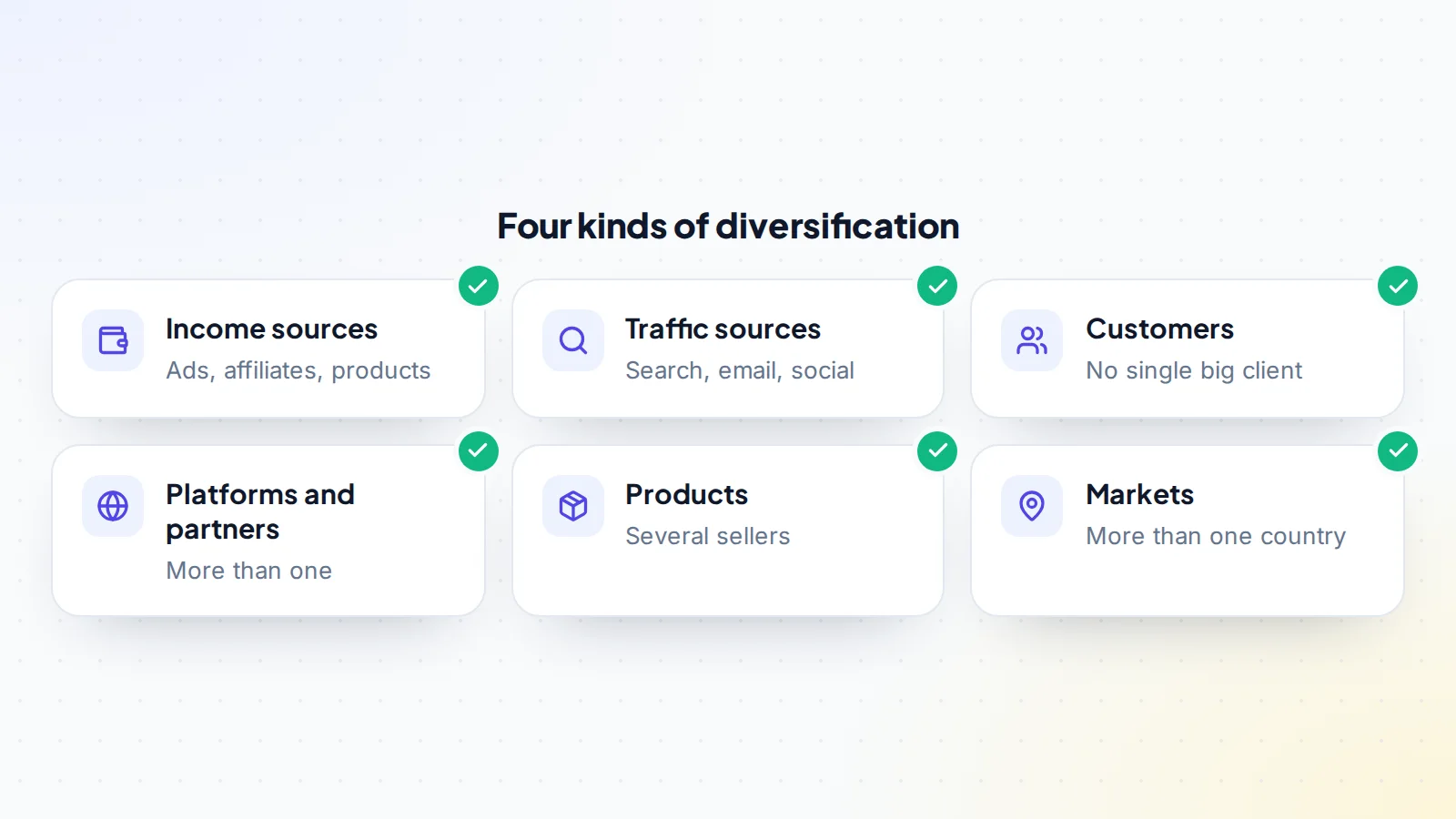
Revenue diversification means earning from more than one source, so the business doesn’t depend on any single one. For an online business, it can mean several income streams, such as advertising, affiliate commissions, digital products and sponsorships. It can also mean several traffic channels, several customers, several partners or several markets. Each kind reduces a different risk.
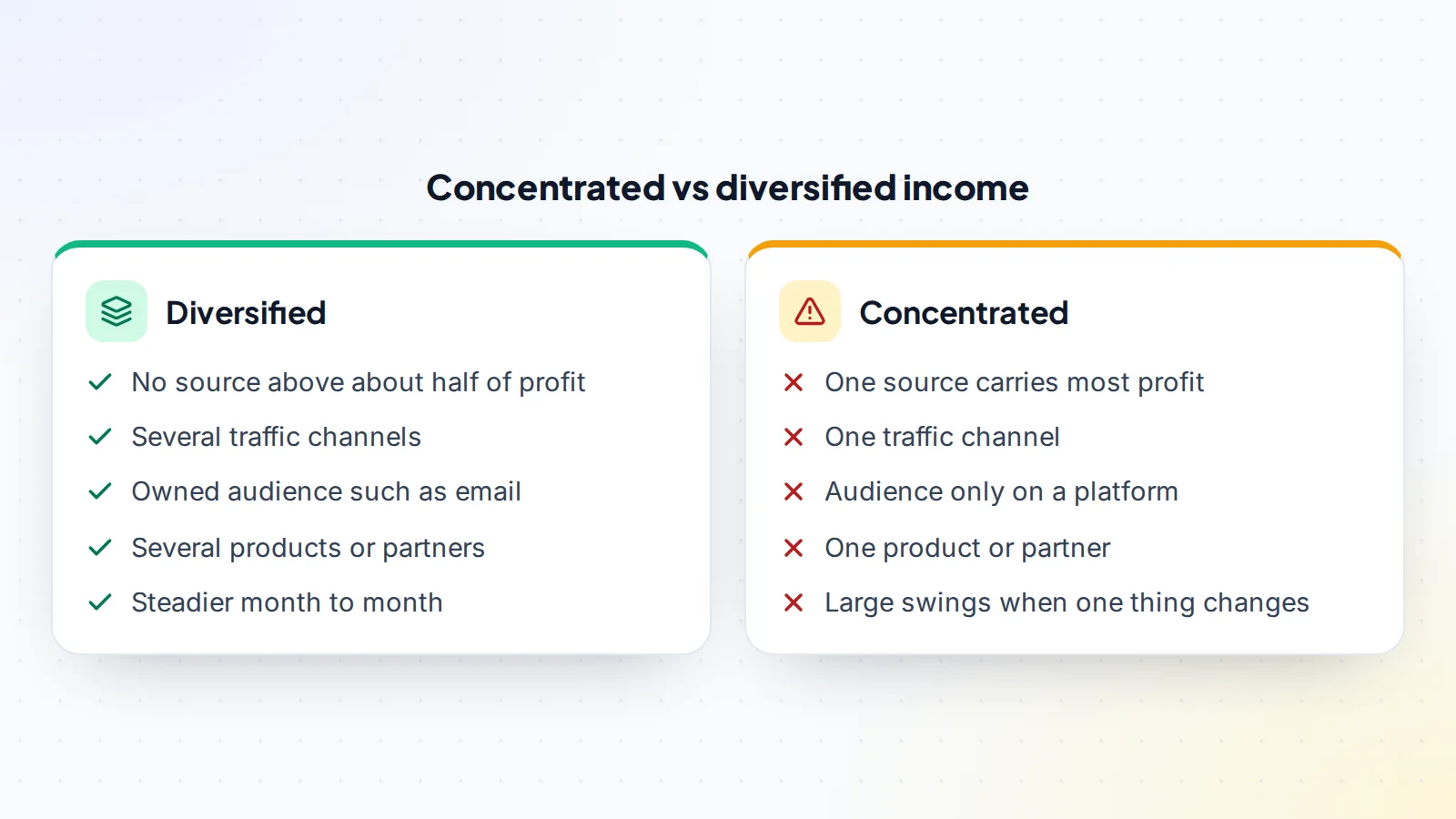
Diversification isn’t about having as many streams as possible. A business with ten tiny income sources that all depend on the same traffic channel isn’t really diversified. What matters is whether the business could survive losing its biggest source, channel or partner.
Why buyers pay more for diversified income
Buyers pay a multiple of profit because they expect the profit to continue. Anything that makes it less likely to continue lowers the multiple. Concentration is one of the clearest risks: if most income comes from one place, a single change can cut it sharply.
Those changes happen. Affiliate programmes can change commission rates or terms; Amazon’s Associates operating agreement, for example, says Amazon may modify the agreement and its fee schedules. Search engines update how they rank pages, and Google notes that core updates can change how sites perform. Platforms change policies, and big customers move on. A buyer looking at concentrated income has to price in the chance of one of these happening soon after the sale. Diversified income spreads that risk, so buyers can afford to pay more.
Diversifying income sources
Many online businesses start with one way to earn, such as display ads or one affiliate programme. Common ways to add income include:
- More affiliate partners: recommending products from several programmes rather than one.
- Your own products: digital products, courses or tools that your audience already wants.
- Sponsorships: brands paying to reach your audience, clearly disclosed.
- Memberships or subscriptions: recurring income from your most engaged readers or users.
- Services: consulting or done-for-you work, though these often depend on the owner’s time.
Choose streams that fit the audience and the business. A recipe site might add a cookbook or meal-plan subscription; a software review site might add a comparison tool or sponsorships. Income that depends on the owner’s personal time is worth less to a buyer, so favour streams that can run without you.
Diversifying traffic
Traffic concentration is often a bigger risk than income concentration. A site that gets almost all its visitors from one search engine, or a business that relies on one social platform, can lose most of its audience overnight. Ways to spread traffic include building an email list, growing a presence on more than one social platform, earning referral traffic from partners, and investing in direct traffic through a recognisable brand.
Email deserves special mention, because it’s an audience the business owns. A list of engaged subscribers can bring visitors back whatever happens to search rankings or social reach. Our guide to traffic concentration risk explains how buyers measure this.
Diversifying customers and partners
For service businesses, SaaS tools with business clients and agencies, one large customer can make up a big share of revenue. If that customer leaves, the business shrinks overnight. The same applies to partners: an e-commerce store with one supplier, or an app that relies on one platform’s API, carries a single point of failure. Spreading customers and partners, or at least having alternatives ready, reduces that risk.
How to measure concentration
Measuring concentration is simple. For the last 12 months, calculate:
- The share of profit from your largest income source.
- The share of visitors from your largest traffic channel.
- The share of revenue from your largest customer, partner or product.
- The share of income from your largest country or market.
There’s no official threshold, but the higher each share, the more a buyer will worry. If one source brings in most of your profit, expect buyers to ask what happens if it changes, and to reflect the answer in their offer. Our guide to owner hours and valuation covers another kind of dependence buyers look at: dependence on the owner’s own time.
How to diversify sensibly
Diversification works best when it grows from what the business already does well. A few principles help:
- Start with your audience: ask what they need that you could provide, and test small.
- Add one stream at a time: give each enough attention to work before starting another.
- Keep quality high: a poor product or irrelevant sponsorship can damage trust and the main income stream.
- Track each stream separately: so you can show buyers exactly what each earns and costs.
- Build owned channels: email lists and direct relationships reduce dependence on platforms.
Avoid adding streams just to look diversified. Buyers will look at how much each stream earns and whether it’s steady. A new stream with two months of history and falling sales adds little.
Timing before a sale
If you plan to sell, start diversifying early, ideally a year or more before listing. Buyers value income with a track record, and most new streams take months to settle. A stream that has earned steadily for 12 months counts for far more than one started just before the sale. Our guide to increasing business value before a sale covers other improvements worth making in the same period.
Focus versus diversification
Diversification has a cost. Every new stream takes time, attention and sometimes money, and a business that spreads itself too thin can weaken the thing it does best. Many successful online businesses grew by focusing on one channel or product until it worked well, then diversifying from a position of strength. The balance depends on the stage: early on, focus usually wins; as income grows and a sale comes into view, reducing concentration becomes more valuable.
A useful test is to ask whether a new stream makes the business stronger for its audience, not just safer on paper. If it does both, it’s usually worth doing.
Questions buyers ask about concentration
- What share of profit comes from the largest source, and has that share changed over time?
- Has the largest source ever changed its terms or rates, and what happened?
- How much traffic would remain if the largest channel dropped by half?
- Which income streams need the owner’s personal time to keep running?
- What would you add next if you kept the business?
Sellers who prepare clear answers, with figures to back them up, make concentration a discussion about a plan rather than a reason to lower the price.
What buyers should look for
Buyers should calculate concentration themselves rather than relying on the seller’s summary. Break income down by source and month, traffic by channel, and revenue by customer or product. Ask what would happen if the largest source changed, and whether the seller has seen changes before. Look for owned assets, such as email lists, that would help the business recover from a shock. Check too whether the seller has already tested other income ideas and what happened, because a failed test is useful information and a successful one may be an easy win for the new owner. A concentrated business can still be a good buy at the right price, especially if you have a clear plan to diversify it.
Direct access to analytics helps. Sellers can give Google Analytics access so buyers can see traffic sources for themselves.
Diversification by business type
- Content sites: mix ads, several affiliate programmes, sponsorships and an email list; spread traffic beyond one search engine.
- E-commerce: sell through more than one channel, use more than one supplier and avoid relying on one product.
- SaaS and apps: spread revenue across many customers and plans; avoid one dominant client.
- Software add-ons: extensions and plugins can add paid tiers, team plans or related tools; see our guide to browser extensions for sale.
- Social and creator businesses: build an email list and a presence on more than one platform alongside brand deals.
Early-stage businesses
For businesses with little revenue yet, diversification looks different. The focus is on traffic and audience: are visitors coming from several places, and is an email list growing? Early income from more than one test, such as a few affiliate links and a small product, also shows buyers which options might work. Our guide to pre-revenue valuation explains how early businesses are valued.
Common mistakes
- Adding many small streams that all depend on the same traffic.
- Launching products that don’t fit the audience and hurt trust.
- Starting new streams just before a sale, with no track record.
- Not tracking income by source, so its value can’t be shown.
- Relying on streams that need the owner’s personal time.
A worked example
The details below are made up to show the method.
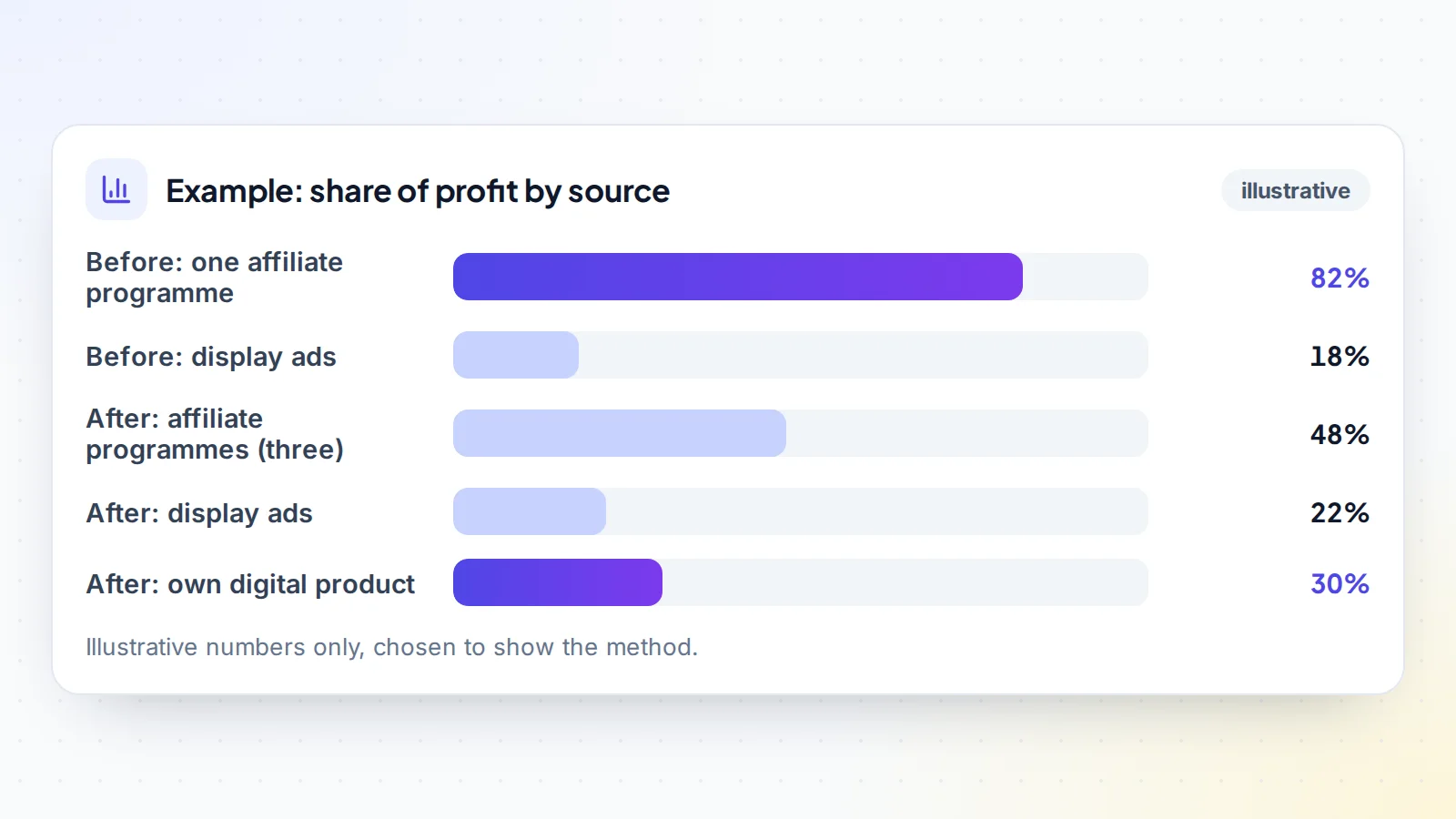
Hana runs a camping gear review site earning $3,500 a month in profit. Over the last year, 82% came from one affiliate programme and 18% from display ads, with almost all traffic from search. Planning to sell in about 18 months, Hana makes three changes: adds two more affiliate programmes for gear the main one doesn’t stock, builds an email list with a weekly gear deals newsletter, and launches a printable trip-planning kit.
A year later, profit is similar, but the mix has changed: 48% from three affiliate programmes, 22% from display ads and 30% from the planning kit, with a growing share of visits from email. When Hana lists the site, buyers see income that no longer depends on one partner, with a year of history for each stream. Several buyers comment on the reduced risk, and offers come in at a higher multiple than Hana was quoted the year before.
Revenue diversification: the checklist
- Profit broken down by income source for 12 months.
- Traffic broken down by channel.
- Revenue broken down by customer, product and market.
- Largest share in each area calculated.
- Owned audience, such as an email list, building steadily.
- New streams chosen to fit the audience.
- Each stream tracked separately with its costs.
- Diversification started a year or more before a sale.
Thinking about selling? Try the free valuation tool, or list your business on digiflippers.com with 0% success fee up to $10,000, then 5% (max $5,000).
Ready to find your next asset?
Browse listings with verified numbers, ask sellers your questions before you offer, and agree every step in a free Deal Room.
Frequently asked questions
What is revenue diversification?
Earning from more than one source, so the business doesn’t depend on any single income stream, traffic channel, customer, partner or market.
Why does it affect valuation?
Buyers pay for profit they expect to continue. Concentrated income can fall sharply after one change, so buyers usually pay a lower multiple for it.
How much concentration is too much?
There’s no official threshold. The higher the share from one source, the more buyers will ask what happens if it changes.
What’s the easiest way to start diversifying?
Often an email list and a second or third affiliate partner, because they build on what the business already does.
Should I add income streams just before selling?
New streams without a track record add little value. Start a year or more ahead if you can.
Is a concentrated business a bad buy?
Not necessarily. At the right price, and with a clear plan to diversify, it can be a good opportunity.
Does traffic diversification matter as much as income?
Often more. Income from several sources can still collapse if all of it depends on one traffic channel.