Asset Purchase Agreements for SaaS Deals: Key Clauses in Plain English
A plain-English guide to the asset purchase agreement in a SaaS deal: what an asset sale is, the purchased and excluded assets, price and payment terms, warranties, indemnities and caps, customer contracts and data, IP, transition services, non-competes, closing conditions and common traps.
When a software business changes hands, the deal is usually written down in an asset purchase agreement, often shortened to APA. It’s the document that says exactly what the buyer is getting, what they’re paying and when, what the seller promises about the business, and what happens if those promises turn out to be wrong. A SaaS asset purchase agreement has some clauses you won’t find in other small business sales, around code, customer data and subscriptions. This guide explains the key clauses in plain English, so you know what to look for and what to ask your lawyer about.
This is general information, not legal advice. Laws differ by country and every deal is different, so have a lawyer draft or review your agreement. For the wider sale process, read how to sell a SaaS business.
Key takeaways
- In an asset sale, the buyer buys the product and its assets, not the seller’s company.
- The agreement must list exactly which assets and liabilities move and which don’t.
- Warranties are the seller’s promises; indemnities say who pays if they’re wrong.
- SaaS deals need clauses on code, IP, customer contracts, data and subscriptions.
- Price terms, holdbacks, transition help and non-competes all affect the real value.
What an asset purchase agreement is
There are two main ways to buy a business: buy the company that owns it (a share or stock purchase), or buy the assets the business uses (an asset purchase). Most small SaaS deals are asset purchases. The buyer gets the code, domain, brand, customer contracts, accounts and data, while the seller keeps their company, along with its history and most of its liabilities. The APA is the contract that makes this happen.
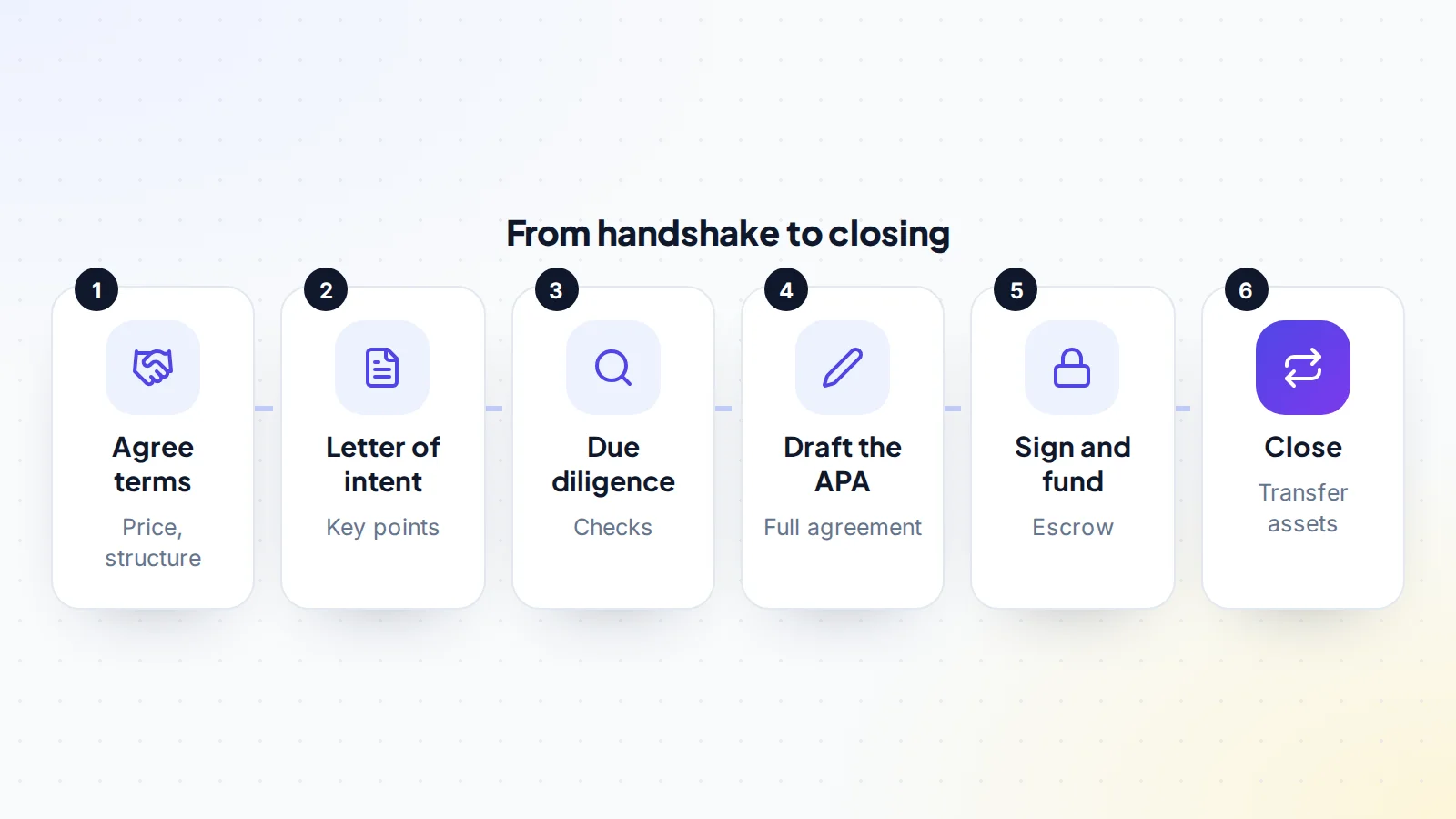
The main points are often agreed first in a shorter, mostly non-binding letter of intent. The full agreement comes after due diligence, when both sides know what they’re dealing with. Read letters of intent.
The main parts
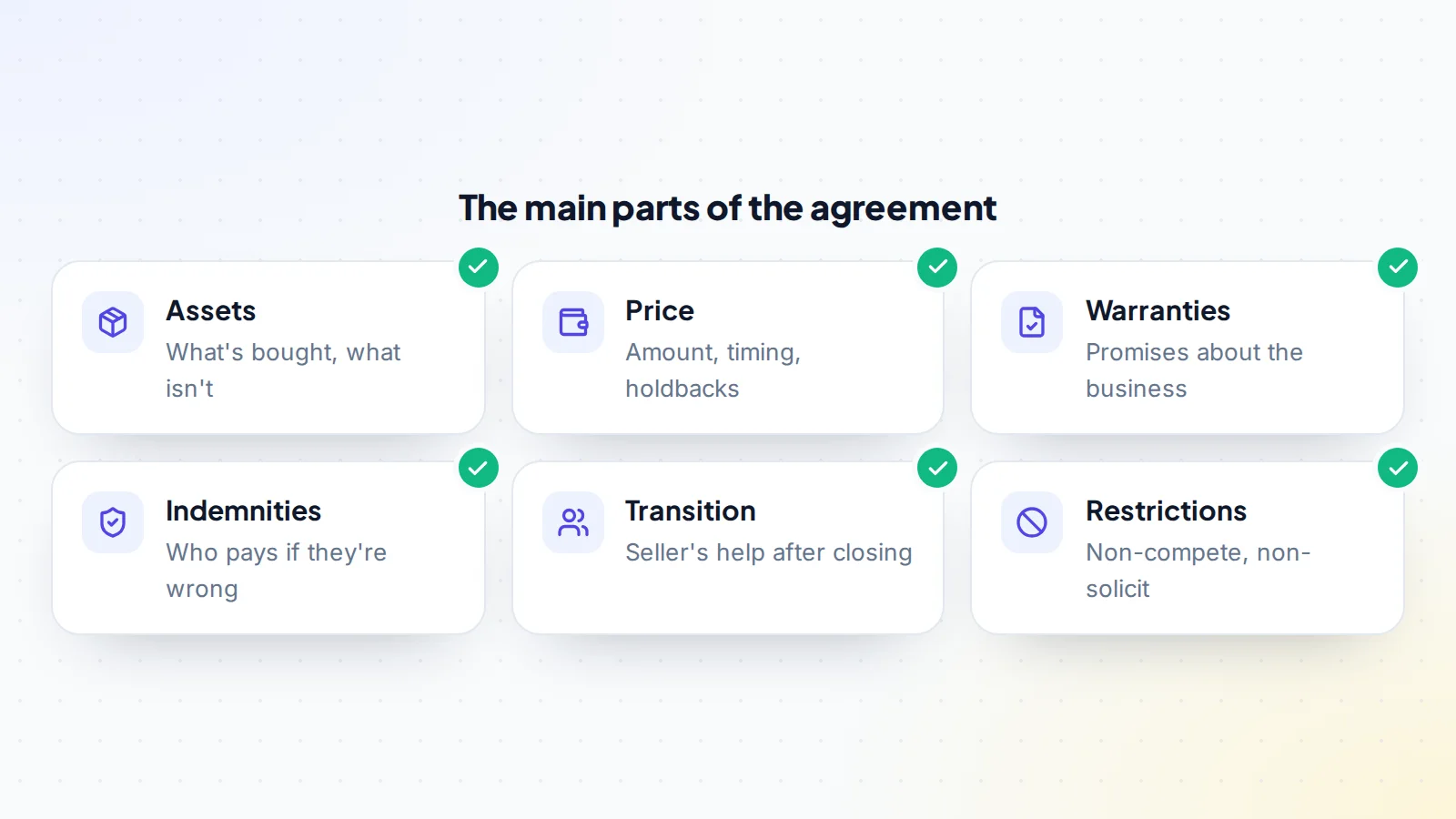
Purchased assets
This section lists everything the buyer gets. For SaaS, that typically includes the source code and repositories, the domain and brand, trademarks if registered, customer contracts and subscriptions, the customer list and data, documentation, design files, social accounts, email lists, and third-party accounts that can be transferred. Be specific. “All assets used in the business” invites argument; a schedule listing each item doesn’t.
Excluded assets
Just as important is what doesn’t move: the seller’s bank accounts, cash, other products, personal accounts, and anything the seller uses for other businesses. If the seller keeps a shared tool or library, the agreement should say whether the buyer gets a licence to use it.
Liabilities
An asset purchase usually lets the buyer take only the liabilities they agree to, such as obligations under customer contracts going forward. Everything else, such as past taxes, old disputes or debts, stays with the seller. The agreement should list “assumed liabilities” clearly and say that all others are excluded.
Price and payment
This section sets the total price and how it’s paid: how much at closing, whether part is held back for a period to cover claims, whether part is paid in instalments, and whether any part depends on future results. Each changes the real value of the deal for both sides. Read earn-outs for performance-based payments, and escrow for how funds are held at closing.
Price allocation
The price is usually split across categories of assets, and that split can affect tax for both sides. In the US, buyers and sellers of a business’s assets generally report the allocation on Form 8594; the IRS explains this in its instructions for Form 8594. Agreeing the allocation in the APA keeps both sides’ tax filings consistent. Get tax advice before agreeing it.
Adjustments at closing
SaaS revenue is often paid upfront, for example annual plans. If customers have prepaid for months after closing, the buyer will deliver that service without receiving the cash. Many agreements adjust the price for prepaid subscriptions, deferred revenue or other timing differences. Make sure the method is clear and the numbers are checked at closing.
Warranties
Warranties (sometimes called representations) are the seller’s statements of fact about the business: that they own what they’re selling, that the financial figures are accurate, that the code doesn’t infringe anyone’s rights, that there are no undisclosed disputes, that the business complies with data protection law, and so on. If a warranty turns out to be untrue, the buyer may have a claim. Sellers usually limit warranties to what they know and disclose known issues in a separate document, so they aren’t caught by things they’ve already told the buyer.
Indemnities, caps and time limits
An indemnity is a promise to pay for specific losses, such as claims arising from the seller’s time owning the business. Agreements usually cap the total amount the seller can owe, set a minimum before claims count, and set a time limit for making claims. These numbers are often negotiated hard. Buyers want them high and long; sellers want them low and short.
Intellectual property
The agreement should assign all rights in the code, content, designs and brand to the buyer. The seller should confirm that everyone who contributed, including contractors, assigned their rights to the seller, so the seller can pass them on. Open-source components should be listed, with their licences, so the buyer knows any obligations. Read SaaS technical due diligence.
Customer contracts and subscriptions
Some customer contracts, especially with larger customers, need the customer’s consent before they can be assigned to a new owner. The agreement should list which contracts need consent and what happens if a customer refuses. For self-serve subscriptions, the practical issue is moving billing; read transferring Stripe subscriptions.
Customer data and privacy
Moving customer data to a new owner raises data protection questions. In the UK, the ICO’s guidance on due diligence in mergers and acquisitions says to establish the purposes for which data was collected and the lawful basis for sharing it. The APA often includes warranties about the seller’s compliance and sets out how data will be transferred securely. Read GDPR in a SaaS sale.
Transition services
The seller’s help after closing should be defined: how long, how many hours, which tasks, response times, and a rate for extra help. Vague promises lead to frustration. Read the SaaS transition period for what to include.
Non-compete and non-solicit
Buyers usually want the seller not to launch a competing product or approach customers and staff for a period after the sale. Enforceability depends on the country and how reasonable the scope is. Read non-competes in online business sales.
Conditions and closing
Some deals sign and close on the same day. Others sign first and close later, once conditions are met, such as key customer consents or a successful technical handover. The agreement lists the conditions, what each side must deliver at closing, and what happens if a condition isn’t met by a deadline.
Employees and contractors
If staff or contractors will work for the buyer, the agreement should say how that happens. In some countries, employees can transfer automatically with a business, with legal protections. Get local advice if there’s a team.
Disputes and governing law
The agreement should say which country’s law applies and how disputes are resolved, for example by negotiation first, then mediation or arbitration, or the courts of a named place. When buyer and seller are in different countries, this choice matters, because it decides where and how any claim would be heard and how much it might cost.
What each side wants
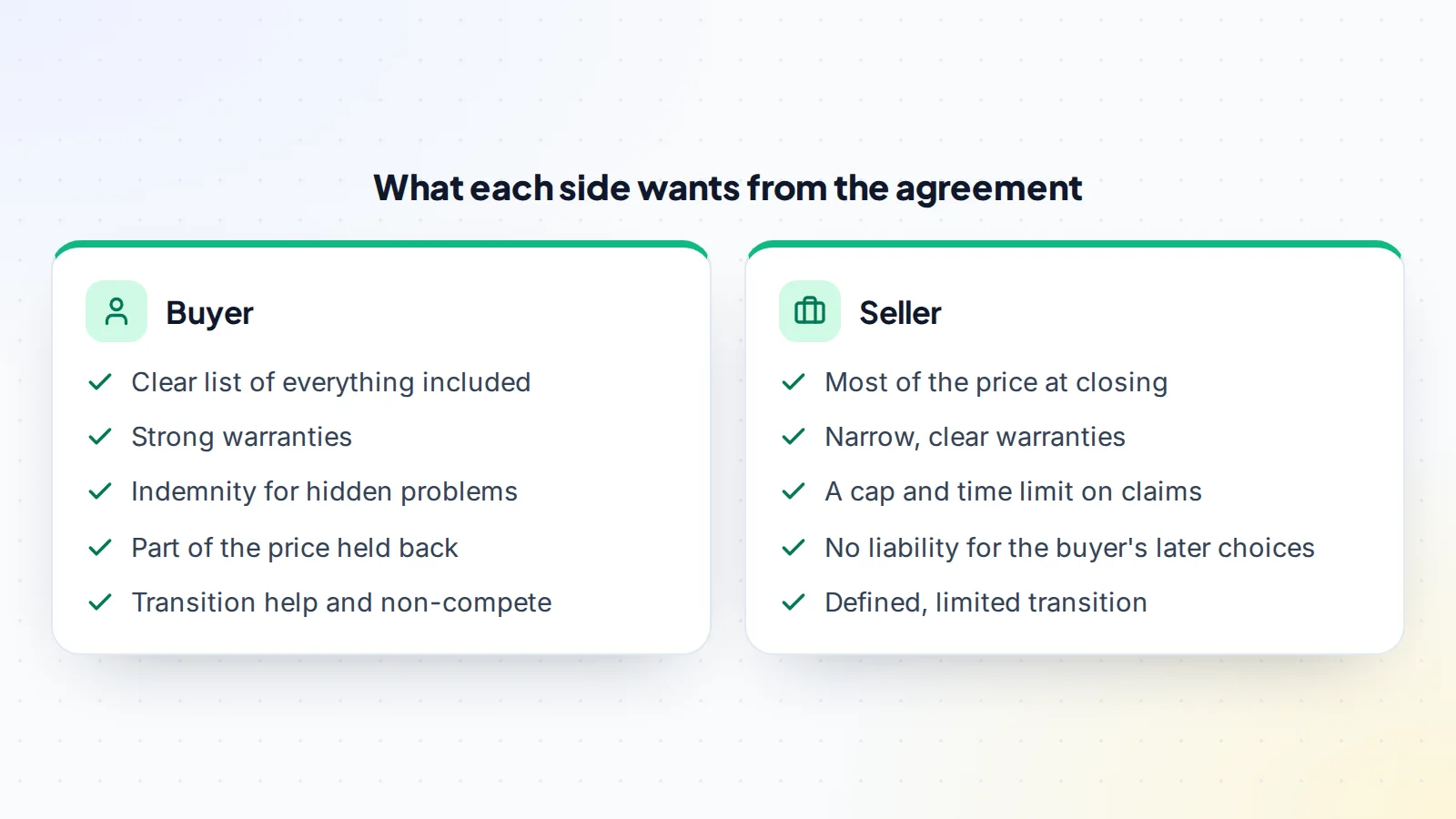
Good agreements are balanced. A buyer who demands unlimited warranties may scare off a good seller; a seller who refuses any holdback may lose a good buyer. Understanding the other side’s concerns makes negotiation faster. Often a compromise on one clause, such as a longer transition in return for a lower cap, settles several points at once.
Third-party services and accounts
SaaS products run on other companies’ services: hosting, payment processing, email delivery, analytics and APIs. Some accounts can move to the buyer; others must be opened fresh. A good SaaS asset purchase agreement lists each key service, says how it will be handed over, and sets out what happens if a provider won’t allow a transfer. It may also require the seller to keep an account running for a short time while the buyer sets up their own. Read transferring third-party accounts.
Confidentiality
Before and after the deal, both sides share sensitive information: customer lists, revenue, code and plans. The agreement usually includes confidentiality terms, often carrying on from an earlier non-disclosure agreement. After closing, the seller must keep the business’s information private, since it now belongs to the buyer. Read NDAs when buying a business.
Reading the draft
When you receive a draft SaaS asset purchase agreement, read it against your letter of intent and due diligence notes. Check that the price and payment terms match what you agreed, that every asset you expect is in the schedule, and that the warranties reflect what you learned. Mark anything you don’t understand and ask your lawyer. Small wording differences, such as “to the seller’s knowledge”, can change who carries a risk.
Smaller deals
For very small SaaS products, a full APA may feel heavy. Simpler agreements exist, and marketplaces often provide templates. Even then, make sure the basics are covered: exactly what’s included, the price and payment terms, ownership and IP, data handling, transition help, and what happens if something’s wrong. The cost of a lawyer’s review is usually small compared with the risk, and it often speeds up closing because both sides trust the paperwork.
Common mistakes
- Vague asset lists instead of detailed schedules.
- Forgetting excluded assets and liabilities.
- No adjustment for prepaid annual subscriptions.
- Contractor work not assigned to the seller.
- Undefined transition help.
- No cap or time limit on claims.
A worked example
The details below are made up to show the method.
Ash buys a project management SaaS from Blair. The letter of intent sets a price of $300,000, with 85% at closing and 15% held in escrow for twelve months to cover warranty claims. Due diligence finds that one contractor never signed an IP assignment; Blair gets it signed before closing.
The APA lists the purchased assets in a schedule: code repositories, domain, trademark application, customer subscriptions, help docs and the email list. Blair’s other product and bank accounts are excluded. Warranties cover ownership, accurate financials and data protection compliance, with Blair’s known issues disclosed. The cap on claims is the held-back amount. Prepaid annual subscriptions reduce the price at closing by the value of service still owed. Blair agrees to six weeks of transition help and a two-year non-compete in the same niche. Both sides’ lawyers review the draft, and the deal closes through escrow.
SaaS asset purchase agreement: the checklist
- Detailed schedule of purchased assets.
- Excluded assets and liabilities listed.
- Price, payment timing and holdbacks clear.
- Price allocation agreed with tax advice.
- Adjustment for prepaid subscriptions defined.
- Warranties, disclosures, caps and time limits agreed.
- IP assignments from all contributors in place.
- Data transfer, transition help and non-compete covered.
Browse SaaS and apps for sale, or list your SaaS with 0% success fee up to $10,000, then 5% (max $5,000). Try the valuation tool on digiflippers.com.
Ready to find your next asset?
Browse listings with verified numbers, ask sellers your questions before you offer, and agree every step in a free Deal Room.
Frequently asked questions
What is an asset purchase agreement?
The contract for buying a business’s assets rather than the company that owns them.
Why are most small SaaS deals asset purchases?
The buyer gets the product without the seller’s company history and most of its liabilities.
What’s the difference between a warranty and an indemnity?
A warranty is a promise about facts. An indemnity is a promise to pay for specific losses.
What is a holdback?
Part of the price kept back, often in escrow, for a period to cover possible claims.
Do customer contracts transfer automatically?
Not always. Some need the customer’s consent; check each one.
Is a non-compete always enforceable?
It depends on the country and how reasonable it is. Get local advice.
Do I need a lawyer?
It’s strongly advised. The cost is usually small compared with the risk.
Can I use a template?
Templates help for small deals, but have a lawyer check it fits your situation.