Exit Options for a Bootstrapped SaaS Founder
A guide to bootstrapped SaaS exits: the main options (full sale to an individual, a company or a competitor; partial sale; hiring an operator; a planned wind-down), what each means for price, time and risk, how to prepare, deal structures and life after the exit.

Most bootstrapped software founders never plan an exit when they start. They build a product, find customers, and years later realise the business could fund a new chapter, if they could step away from it. A bootstrapped SaaS exit doesn’t have to mean a dramatic acquisition. It can be a clean sale to an individual buyer, a sale to a company that wants your customers, a partial sale to a partner, hiring someone to run it, or a careful wind-down. This guide explains each option, what it means for price, time and risk, and how to prepare.
For the step-by-step sale process, read how to sell a SaaS business. For what drives the price, see SaaS valuation multiples.
Key takeaways
- Start with your goal: cash, time, continued income or a clean break.
- Full sales go to individuals, companies or competitors, each valuing the product differently.
- Partial sales and hiring an operator let you step back without selling everything.
- Preparation (clean metrics, low churn, handed-off tasks) takes six to twelve months to show.
- The deal structure matters as much as the headline price.
Start with your goals
Before choosing an exit, decide what you want from it. A lump sum to buy a house or fund a new venture? Freedom from support tickets and on-call duty? Ongoing income with less work? A clean break with no ties? Each goal points to a different option. A founder who wants maximum cash and no further involvement needs a different exit from one who wants passive income and a say in the product’s future. Write your goals down; you’ll use them to judge every offer.
Be honest about your energy too. Founders who are burnt out often accept weaker terms just to be done. If that’s you, consider stepping back first (hiring help, cutting scope), then selling from a calmer position.
The main exit options
Sell to an individual buyer
Many small SaaS products are bought by individuals: people who want to own a software business, often with technical or marketing skills, and sometimes funded by savings or a loan. They usually value the business on profit and care a lot about how much time it takes to run. Marketplaces connect you with these buyers directly. The process is usually faster and simpler than selling to a company, but buyers will want a solid transition period. Read the SaaS transition period.
Sell to a company
Holding companies that collect small software businesses, and companies adding a product to their range, are common buyers. They tend to be experienced, move methodically, and focus on churn, margins and technical quality. They may pay more for products that fit their existing customers or tools, and less for ones that need heavy integration work. Expect a more thorough due diligence process. Read SaaS due diligence.
Sell to a competitor or partner
A competitor may value your customers, your features or your team more than anyone else, because they can fold them into an existing product and cut costs. That can mean a higher price. It can also mean sharing sensitive information with a rival, so use a confidentiality agreement and share details in stages. Partners you already integrate with can also be natural buyers.
Partial sale or partner
If you don’t want to let go entirely, you can sell part of the business to a partner who takes on day-to-day work, or bring in someone who earns equity over time. You keep a share of the profits and the upside, while reducing your workload. This needs a clear legal agreement on decision-making, profit sharing and what happens if either side wants out later.
Hire an operator and keep it
Some founders “exit” from daily work without selling: they hire a general manager or a small team, document processes, and step into an owner role with a few hours of oversight a week. You keep the income, minus the cost of the team. This works best for stable products with predictable revenue. It also tends to raise the value if you sell later, because a business that runs without its founder is worth more. Read how owner hours affect valuation.
A planned wind-down
If the product is declining, costs more than it earns, or depends on a platform that’s closing, a planned wind-down can be the right exit. Give customers generous notice, help them export their data, suggest alternatives, and close billing cleanly. Before winding down, check whether someone would buy it: even a declining product can have value to a buyer with a different plan, and a sale is better for customers than a shutdown.
Comparing the options
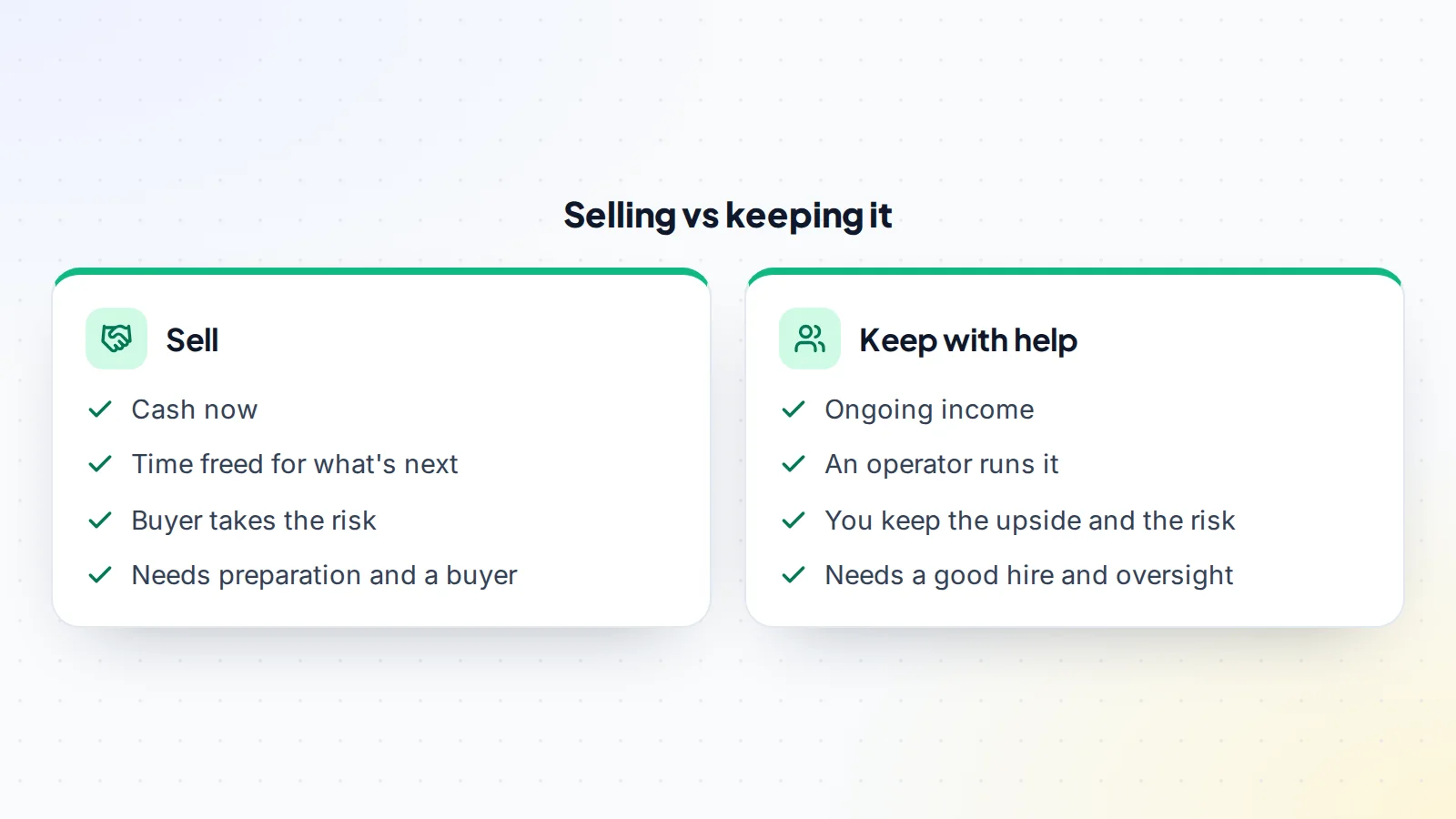
- Full sale: most cash now, cleanest break, needs preparation and a buyer.
- Partial sale: some cash, less work, shared control.
- Operator: ongoing income, little cash now, you keep the risk.
- Wind-down: no sale proceeds, but a clean end and goodwill with customers.
Preparing for a sale
Buyers judge trends over months, so start early.
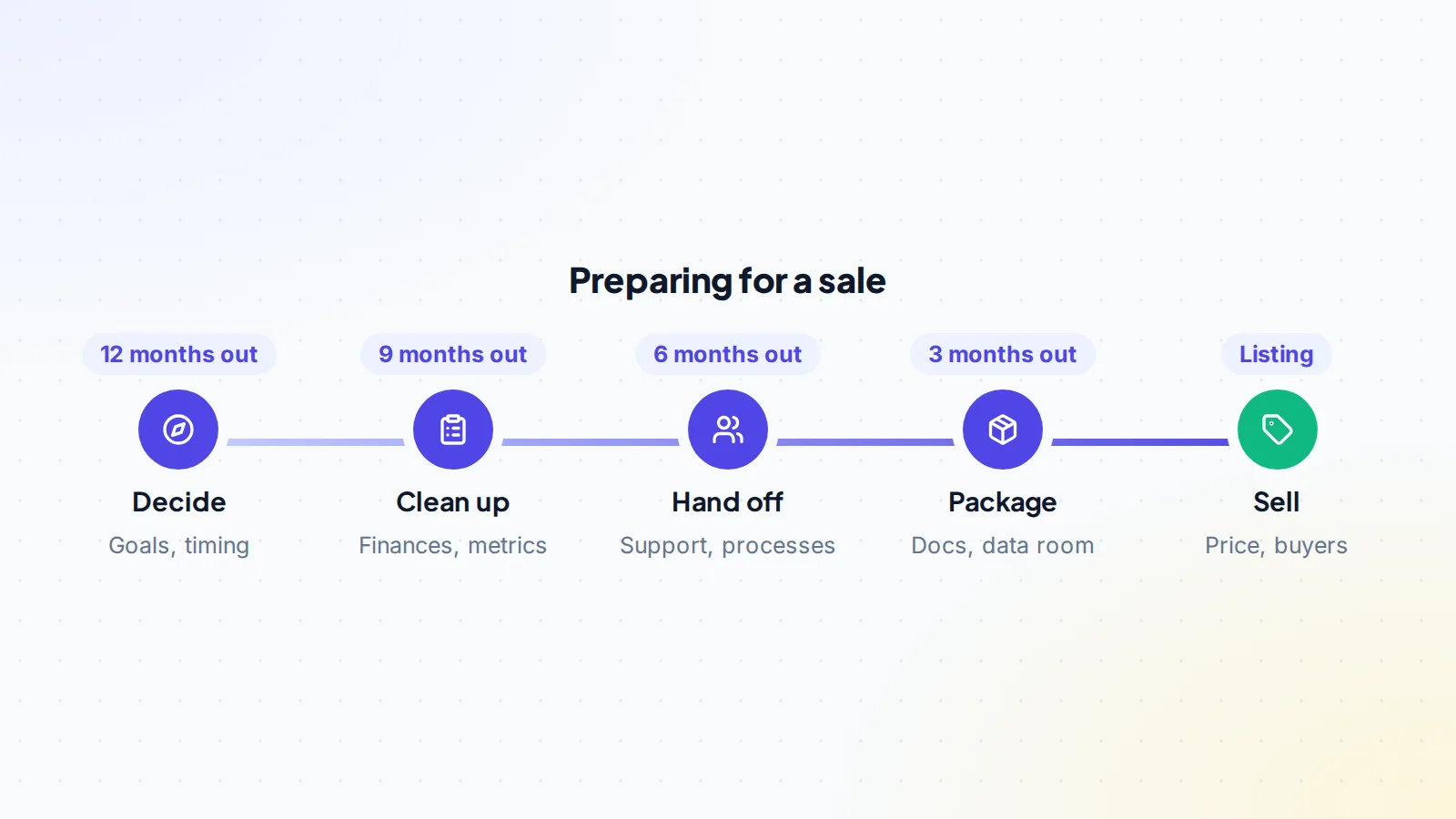
Clean up your finances so monthly revenue, costs and profit are easy to read. Track churn, retention and recurring revenue properly. Reduce churn where you can; read how to reduce SaaS churn. Hand off support and routine tasks, and write runbooks. Update dependencies and add tests. Then package it: a short overview, financials, metrics, technical documentation and a list of every account and service.
The metrics buyers will ask for
Expect requests for monthly recurring revenue over time, customer and revenue churn, net revenue retention, customer acquisition sources, gross margin, the largest customers’ share of revenue, and hours you spend each week. Stripe’s guides on monthly recurring revenue and churn rates explain the standard definitions. Read SaaS metrics.
Reduce risks buyers worry about
Buyers discount for risks they can see: one customer bringing a large share of revenue, all sign-ups from one channel, a product that depends on one platform’s rules, or a founder who holds all the knowledge. You can’t remove every risk, but you can reduce some before selling and explain the rest honestly. Read traffic concentration risk.
Deal structures
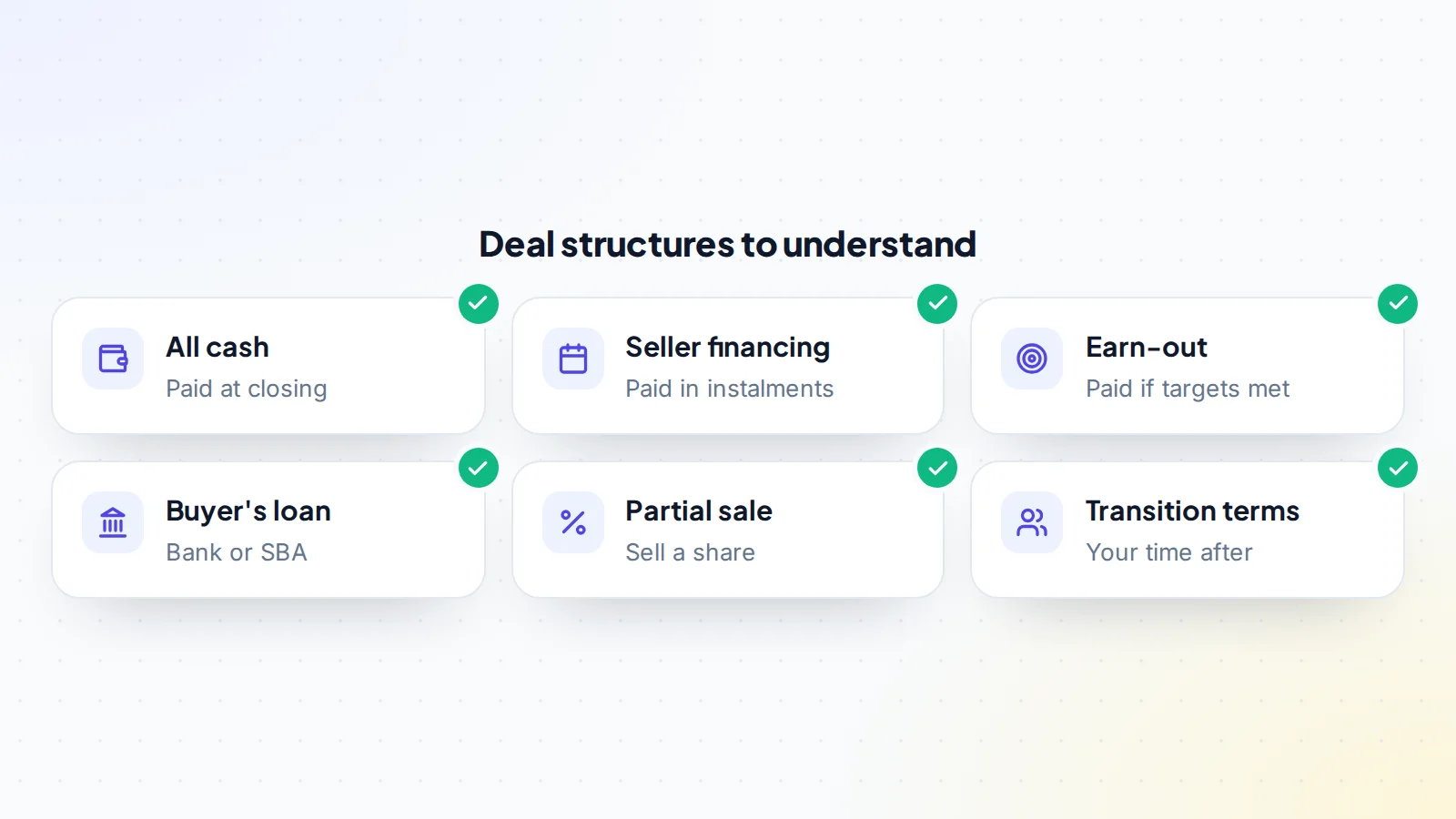
All-cash deals are simplest. Seller financing, where you receive part of the price in instalments, can widen the pool of buyers and support a higher price, but leaves you exposed if the buyer struggles; the IRS describes how installment sales are treated for tax in the US. Earn-outs tie part of the price to future results you no longer control; read earn-outs. Some buyers use bank or SBA loans; read SaaS acquisition financing.
The purchase agreement
Most small SaaS sales are asset sales: the buyer buys the code, domain, customers and accounts rather than your company. The agreement sets out what’s included, the price and payment terms, warranties about the business, transition help, and any non-compete. Read the SaaS asset purchase agreement and non-competes, and have a lawyer review it.
Choosing the moment
The best time for a bootstrapped SaaS exit is usually when the product is steady or growing, churn is under control, and you still have the energy to run a good sale and transition. Selling at a peak after a strong year gives buyers confidence; selling after a decline means explaining it and accepting a lower price. Watch for outside changes too: a platform you depend on changing its rules, a new competitor, or a shift in your market can all affect value. If one is coming, selling before it lands, with honest disclosure, can be wiser than waiting.
Keeping the sale confidential
Word that a product is for sale can worry customers and staff. Many founders list without naming the product publicly, share details only with buyers who’ve signed a confidentiality agreement, and reveal sensitive data in stages as buyers show they’re serious. Plan what you’ll say if someone asks before the deal is done. A calm, prepared bootstrapped SaaS exit keeps the business steady while buyers look closely at it.
Looking after customers
Your customers trusted you; a good exit respects that. Choose a buyer who’ll keep the product running and supported. Plan how and when customers hear about the change. Make sure billing moves smoothly, so nobody is charged twice or loses access. Read transferring Stripe subscriptions and telling customers a business was sold.
If you have a team or contractors
Contractors and employees are often part of what makes the product work. Decide whether they’ll stay with the buyer, and talk to them at the right time. Buyers often value continuity, and a team that stays can support a better price. Make sure any contractors have assigned their work to the business, so it can be transferred. Agree with the buyer who tells the team, and when, so nobody hears it second-hand.
Tax and personal finances
The way a sale is structured affects your tax. How the price is allocated across assets, whether it’s paid at once or in instalments, and where you live all matter. Speak to an accountant before agreeing terms, not after. Plan what you’ll do with the proceeds, too: many founders are surprised how quickly a lump sum feels smaller after tax and the next project.
Life after the exit
Expect mixed feelings: relief, freedom, and sometimes a sense of loss. Honour your transition commitments generously; it protects any deferred payments and your reputation. Respect your non-compete. Keep a copy of your records from the sale for tax and reference. Then take time before the next thing. Many founders say the second product goes better because they understand from the start what makes a business sellable.
Common mistakes
- Deciding to sell while burnt out and accepting weak terms.
- Starting preparation a month before listing.
- Comparing offers only on the headline price.
- Agreeing an earn-out based on results you won’t control.
- Sharing sensitive data with competitors too early.
- Forgetting customers in the excitement of the deal.
A worked example
The details below are made up to show the method.
Dana has run a scheduling tool for therapists for six years, with steady revenue, low churn and about twenty hours a week of work, mostly support. Dana wants to move on to a new project within a year, with as much cash at closing as possible.
Dana starts preparing twelve months out: moves customers to annual plans with a discount, hires a part-time support contractor, writes runbooks and updates the codebase. Churn drops and Dana’s weekly hours fall to five. At listing, two individual buyers and a small holding company make offers. The holding company offers more but with a third paid over two years on revenue targets; an individual buyer offers slightly less, with 85% at closing and a loan for the rest. Dana chooses the individual buyer, agrees an eight-week transition, and the contractor stays on with the new owner.
Bootstrapped SaaS exit: the checklist
- Personal goals for the exit written down.
- Exit option chosen: full sale, partial sale, operator or wind-down.
- Preparation started six to twelve months ahead.
- Finances and SaaS metrics clean and easy to read.
- Support and routine work handed off and documented.
- Deal structures understood and preferences decided.
- Customers’ transition planned.
- Accountant and lawyer consulted before agreeing terms.
Ready to explore a sale? List your SaaS on digiflippers.com with 0% success fee up to $10,000, then 5% (max $5,000), and get your metrics verified.
Ready to sell?
List it on digiflippers.com with verified numbers, answer buyers in one place and agree every step in a free Deal Room. 0% success fee up to $10,000, then 5% (max $5,000).
Frequently asked questions
What exit options does a bootstrapped founder have?
A full sale to an individual, company or competitor; a partial sale; hiring an operator; or a planned wind-down.
How long does it take to prepare?
Ideally six to twelve months, because buyers look at trends.
Who usually buys small SaaS products?
Individual buyers, holding companies, and companies or competitors adding products.
Is an earn-out a good idea?
Only if the targets are clear and depend on things that will stay in the business’s control after the sale.
Can I step back without selling?
Yes, by hiring an operator or selling a partial stake, though you keep some risk and oversight.
Should I tell customers I’m selling?
Usually after the deal is agreed, with a clear plan for continuity.
What do buyers look at first?
Recurring revenue, churn, retention, margins and how much the founder does.
Do I need a lawyer?
For the purchase agreement, it’s wise. An accountant should review the tax side.