How to Reduce Churn in a SaaS You Just Bought
A practical plan to lower churn after buying a SaaS: measuring customer and revenue churn, finding why customers leave, recovering failed payments, onboarding, support, pricing and plans, product fixes, annual billing, win-backs and tracking cohorts.
Churn is the quiet drain on every subscription business: customers who cancel or stop paying each month. When you buy a SaaS, lowering churn is often the fastest way to grow revenue, because every customer kept is one you don’t need to replace. This guide explains how to reduce SaaS churn step by step: measuring it properly, recovering failed payments, learning why customers leave, improving onboarding and support, adjusting plans and pricing, and tracking results by cohort.
For buying a SaaS in the first place, read how to buy a SaaS business. For the metrics behind it, see SaaS metrics and SaaS churn rate.
Key takeaways
- Measure customer and revenue churn separately, and track them by cohort.
- Split voluntary churn (cancellations) from involuntary churn (failed payments).
- Failed-payment recovery is often the quickest win.
- Ask leaving customers why, and fix the most common reasons first.
- Better onboarding, support and plan fit reduce cancellations over time.
Why churn matters so much
A subscription business grows when new revenue outpaces lost revenue. High churn means you need more and more new customers just to stand still. Lower churn compounds: customers stay longer, lifetime value rises, and growth from new customers adds up instead of refilling a leaking bucket. Buyers and future buyers also value low churn highly; read SaaS valuation multiples.
Measure it properly
Start with a clear baseline. Customer churn is the share of customers who leave in a period; revenue churn is the share of recurring revenue lost, including downgrades. Stripe’s guides to calculating churn rates and revenue churn explain the standard methods. Track both monthly, and look at cohorts: of the customers who joined in a given month, how many are still paying after one, three, six and twelve months?
Also track net revenue retention, which includes upgrades from existing customers. Stripe explains it in its guide to net dollar retention. A business can have some churn and still grow revenue from existing customers if upgrades outweigh losses.
Two kinds of churn
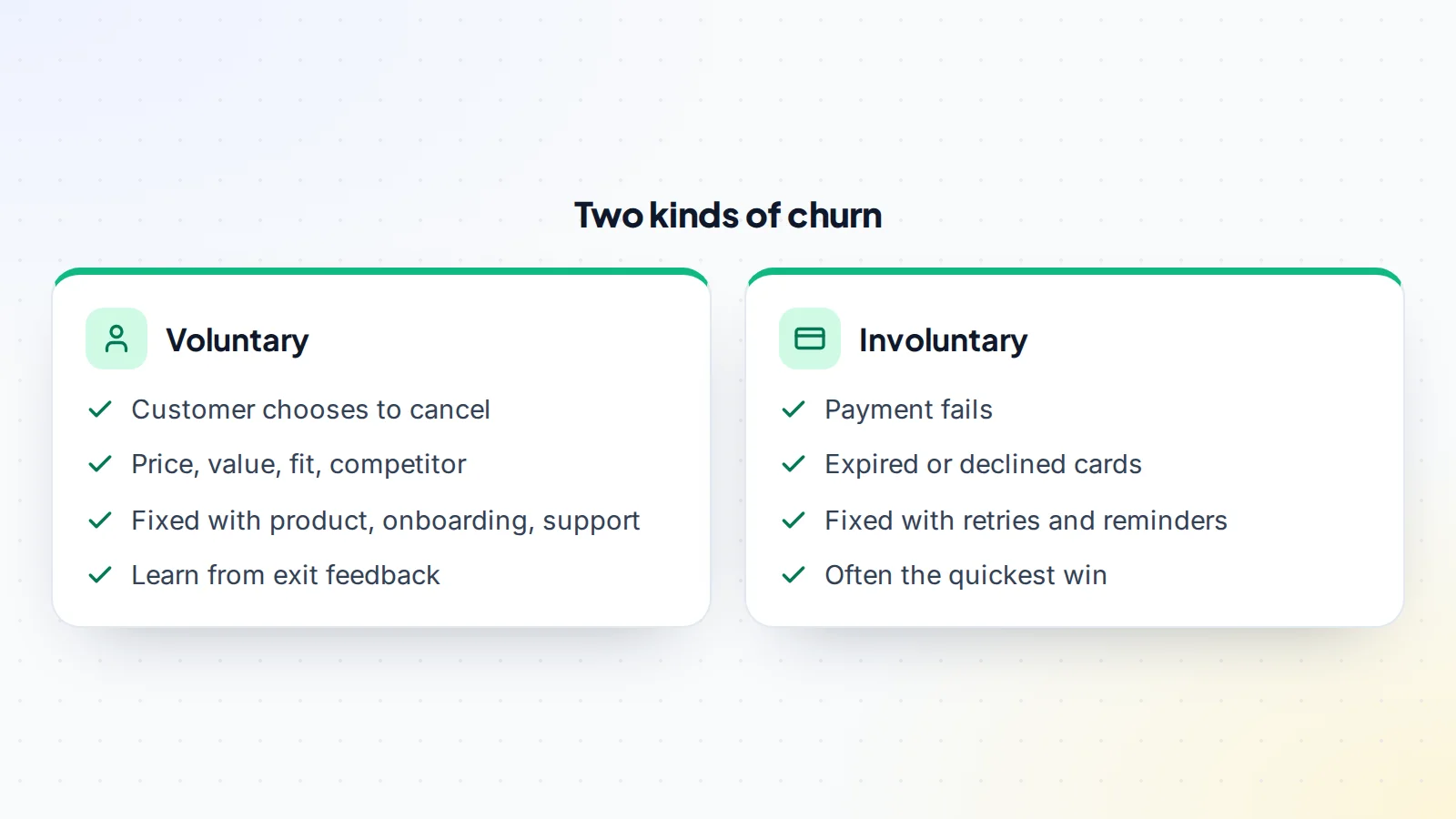
Split churn into voluntary (customers who cancel) and involuntary (customers lost because a payment failed). They have different causes and different fixes. Many owners are surprised how much churn comes from failed payments.
Fix failed payments first
Cards expire, get replaced or hit limits, and payments fail. Without a recovery process, those customers simply disappear. Most billing systems can retry failed payments automatically on a sensible schedule, send reminder emails asking customers to update their card, and update card details automatically where card networks support it. Check that these features are switched on, write clear, friendly reminder emails, and give customers an easy link to update payment details. This is often the fastest way to reduce SaaS churn, because it recovers customers who never meant to leave.
Find out why customers leave
Add a short, optional question when customers cancel: why are you leaving? Offer a few common reasons plus a free-text box. Read every answer. Common reasons include price, not using the product enough, missing features, switching to a competitor, or the business closing. Group the answers and fix the biggest categories first. Revisit the groups every month; the top reasons often change as you fix earlier ones.
Talk to customers too, both those who left and those who stayed. A handful of short calls can reveal problems no dashboard shows.
Improve onboarding
Many cancellations happen early, because customers never reached the moment where the product proved its value. Map the steps a new customer takes, find where they get stuck, and shorten the path. Clear first steps, a short welcome email series, templates or sample data, and a nudge when someone hasn’t completed key setup can all help. Measure how many new customers complete the important first actions, and watch early churn as that number improves.
Watch for warning signs
Customers often stop using a product before they cancel. Track simple usage signals, such as logins, key actions and team members active, and flag accounts whose usage drops. Reach out with help, tips or a check-in before they decide to leave. Even a short, personal email can bring a customer back to the product. Track how many contacted accounts become active again, so you know the outreach is worth the time.
Support that keeps customers
Slow or unhelpful support pushes customers away. Answer quickly, solve problems fully, and follow up. Turn common questions into help articles. Track which issues come up most, and fix the product so they stop happening. Good support is one of the most reliable ways to keep customers, and fast, friendly answers are often remembered longer than any feature.
Plans and pricing
Customers sometimes cancel because they’re on the wrong plan: paying for more than they use, or missing a feature from a higher tier. Offering a lower plan or a pause option can keep customers who would otherwise leave. Annual plans reduce monthly churn, because customers commit for longer; offer a fair discount for paying yearly. Be careful with price rises: give clear notice and explain the value. Read SaaS pricing strategy.
Fix the product
If many customers leave for the same missing feature or recurring bug, that’s your product roadmap. Prioritise fixes that affect the most customers or the most valuable ones. Tell customers when you’ve fixed something they asked for; it shows you’re listening and can win back those who left.
A fair cancellation flow
Make cancelling clear and easy, but use the moment well. Offer relevant alternatives, such as a lower plan, a pause, or help with a specific problem, then let the customer leave if they still want to. Hiding the cancel button or making it hard to leave damages trust and can create legal problems. A respectful exit leaves the door open for customers to return.
Win back former customers
Customers who left for reasons you’ve since fixed are good candidates to win back. Send a short, personal email explaining what’s changed. Some may return, especially if they liked the product but hit a specific problem. Keep win-back emails occasional and relevant, and stop sending them to anyone who asks.
Track progress by cohort
Overall churn moves slowly and mixes old and new customers. Cohort tracking shows whether recent improvements are working: if customers who joined after an onboarding change stay longer than those who joined before, the change is working. Review cohorts monthly and record what you changed and when, so you can link each improvement to its effect.
Look after your largest customers
If a few customers bring a large share of revenue, losing one hurts. Give them extra attention: a named contact, regular check-ins, early notice of changes, and a quick route to support. Ask what they’d need to stay for years. Keeping one large account can matter more than winning several small ones, and it also lowers revenue churn even when customer churn stays the same.
Help customers use more of the product
Customers who use several features tend to stay longer than those who use one. Send short, practical emails that introduce useful features at the right moment, such as after a customer completes a first task. Add in-app hints for features that solve common problems. The goal is simple: help each customer get more value, so the subscription feels worth it every month.
Communicate changes well
Changes to pricing, features or the interface can trigger cancellations if they surprise customers. Announce changes in advance, explain why, and show what customers gain. For price changes, consider keeping existing customers on their current price for a period. Customers who feel respected are more likely to stay through change.
Seasonal and natural churn
Some products are used seasonally, such as tax tools or event software, and some customers leave for reasons you can’t control, such as closing their business. Separate these from churn you can influence, so you focus effort where it helps. Pause options can work well for seasonal customers who would otherwise cancel and re-subscribe.
Who works on churn
In a small SaaS, the owner often handles churn work alongside everything else. Set aside regular time each week to review cancellations, failed payments and usage warnings. If you have support staff, give them the information and authority to help at-risk customers, such as offering a plan change. To reduce SaaS churn steadily, treat retention as an ongoing routine rather than a one-off project.
Churn during the handover
A change of owner can unsettle customers, especially if billing details or contacts change. Keep the product stable, support responsive, and communications clear during the transition. Make sure subscriptions move cleanly; read transferring Stripe subscriptions and the SaaS asset purchase agreement for how billing is handled in the deal.
Lower churn raises value
Every point of churn you remove makes the business more valuable, both in income and in what a future buyer will pay. Keep clean records of churn, cohorts and the changes you made. Read how to increase a business’s value before a sale.
A simple monthly churn report
- Customers at the start and end of the month, and how many left.
- Customer churn and revenue churn, with the trend over six months.
- Failed payments, how many were recovered, and how many were lost.
- Top three cancellation reasons and their counts.
- Retention for the last few monthly cohorts.
- What you changed this month, and what you’ll try next.
A one-page report like this takes less than an hour to prepare once the data is set up, and it keeps churn work focused on what’s actually moving the numbers.
Set realistic expectations
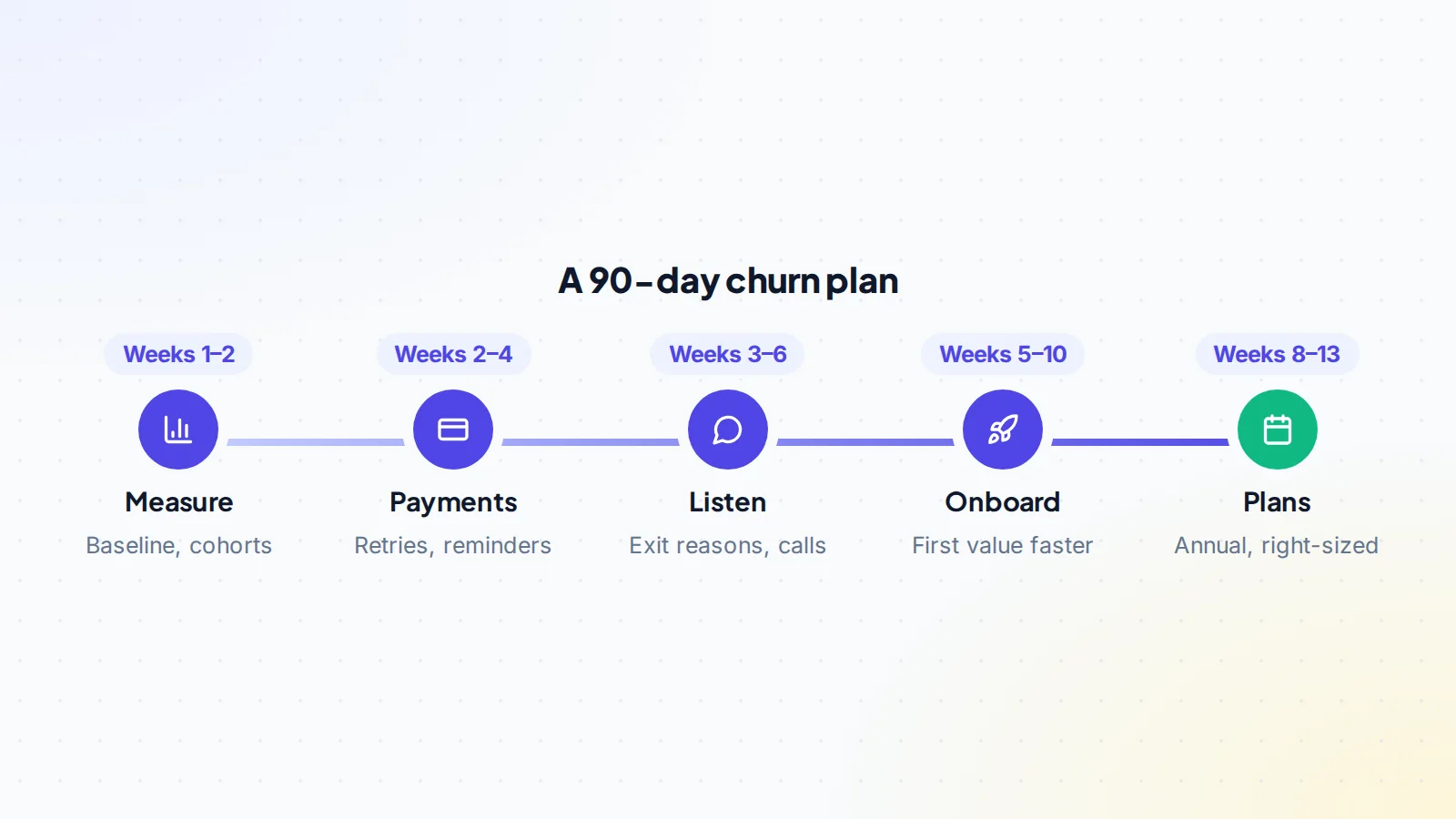
Churn rarely falls overnight. Payment fixes can show results within weeks; onboarding and product improvements often take a few months to show in cohort data. Make one meaningful change at a time where you can, give it time to work, and judge it on the cohorts it affects.
Common mistakes
- Measuring only customer churn, not revenue churn.
- Ignoring failed payments.
- Not asking leaving customers why.
- Making cancellation hard instead of fixing reasons to leave.
- Raising prices without notice or explanation.
- Judging changes on overall churn instead of cohorts.
A worked example
The details below are made up to show the method.
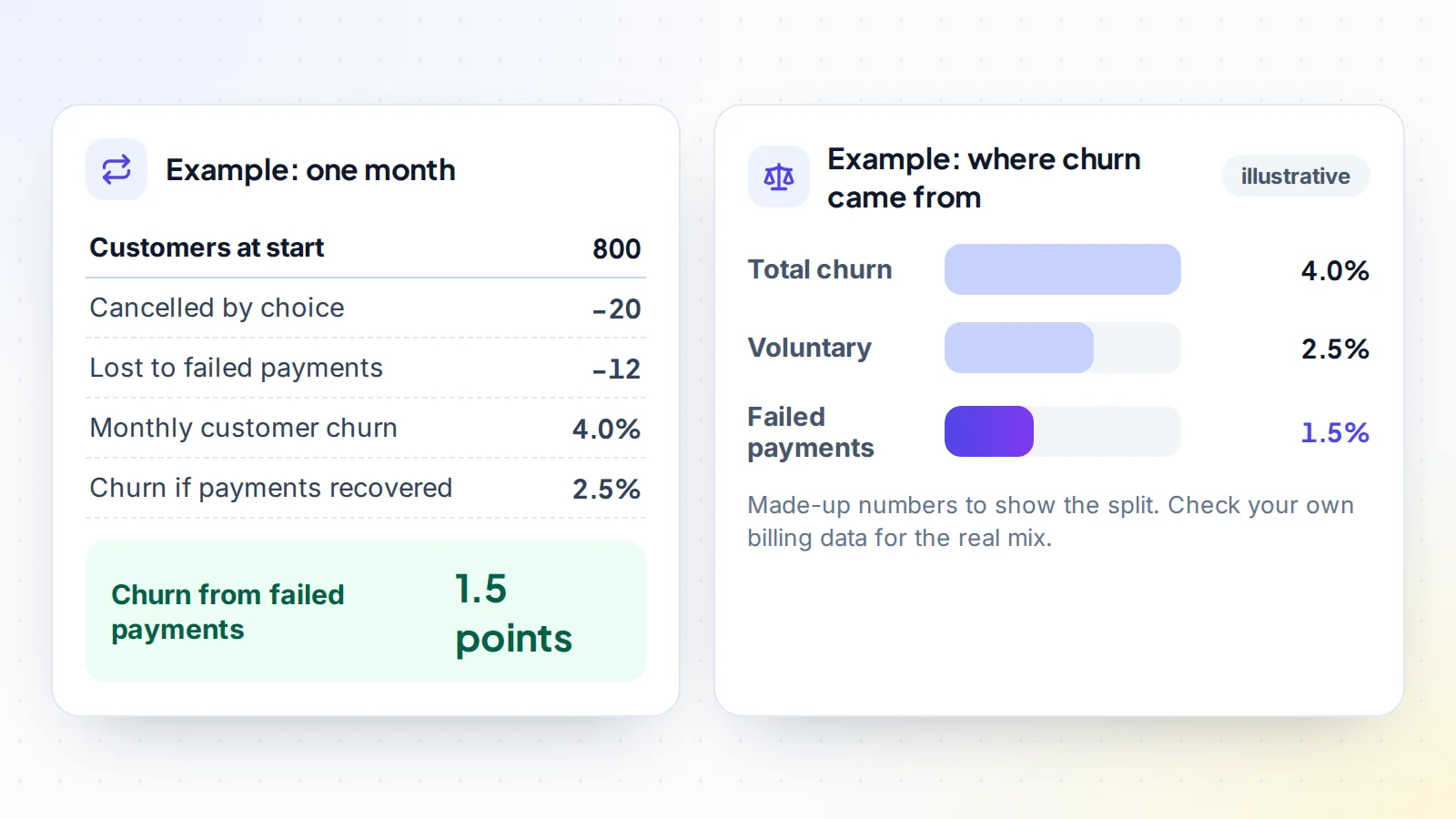
Jamie buys a project management SaaS with 800 customers and monthly churn of 4%. Billing data shows that a third of lost customers left because payments failed. Jamie switches on automatic retries and card updates, and writes friendly reminder emails. Within two months, failed-payment churn falls by more than half.
Exit answers show many customers leave in their first month because they never set up their first project. Jamie adds templates and a three-email onboarding series, and checks in with accounts that haven’t created a project after a week. Customers who join after the change stay noticeably longer than earlier cohorts. Jamie also introduces an annual plan with a modest discount. After six months, overall churn is close to 2.5%, and revenue is growing faster than before the purchase.
Reduce SaaS churn: the checklist
- Customer and revenue churn measured monthly.
- Cohort retention tracked.
- Failed-payment retries and reminders switched on.
- Exit question added to the cancellation flow.
- Onboarding mapped and shortened.
- Usage warning signs tracked with outreach.
- Plans reviewed, including annual and lower tiers.
- Changes logged and compared by cohort.
Browse SaaS and apps for sale, and read how it works on digiflippers.com.
Ready to find your next asset?
Browse listings with verified numbers, ask sellers your questions before you offer, and agree every step in a free Deal Room.
Frequently asked questions
What’s the quickest way to reduce churn?
Often fixing failed payments with retries, card updates and reminder emails.
What’s the difference between customer and revenue churn?
Customer churn counts customers lost; revenue churn measures recurring revenue lost, including downgrades.
Why track cohorts?
They show whether recent changes are working, without older customers blurring the picture.
Do annual plans reduce churn?
They usually lower monthly churn because customers commit for longer.
Should I make cancelling harder?
No. Make it clear and fair, offer alternatives, and fix the reasons people leave.
How do I find out why customers leave?
Ask a short, optional question when they cancel, and talk to customers directly.
What is good churn?
It depends on the market and price point. Track your own trend and cohorts.
Does churn affect valuation?
Strongly. Lower churn makes future revenue more certain, which buyers pay more for.