SaaS Valuation Multiples: What Drives Them Up or Down
A guide to SaaS valuation multiples: profit vs revenue multiples, the factors buyers weigh (growth, churn, net revenue retention, margins, customer concentration, owner dependence, code quality), how to compare offers and how to raise your multiple.

Two software products with the same profit can sell for very different prices. The reason is the multiple: the number buyers apply to profit or revenue to reach a price. SaaS valuation multiples rise when buyers believe profit will last and grow, and fall when they see risk. This guide explains how the multiple works, the factors that move it, how to compare offers, and what sellers can do to raise it before a sale.
For the full sale process, read how to sell a SaaS business. For how valuation works across all online businesses, see revenue vs profit valuation.
Key takeaways
- Small SaaS is usually valued on profit; larger, fast-growing SaaS often on revenue.
- Growth, churn and retention are the biggest drivers of the multiple.
- Margins, customer spread, owner time and code quality also matter.
- Deal terms change what a headline multiple is really worth.
- Most improvements take months to show, so start well before selling.
What a multiple is
A multiple turns a year of earnings into a price. If a product earns $100,000 of profit a year and a buyer offers three times that, the price is $300,000. The multiple is the buyer’s shorthand for everything they believe about the future: how long the profit will last, whether it will grow, and how much work and risk it takes to keep it.
That’s why it isn’t a fixed number you can look up. It’s the result of a negotiation between what a seller can show and what a buyer believes. Published ranges from brokers and marketplaces can be useful context, but every deal is priced on its own facts.
Profit multiples vs revenue multiples
Small software businesses, especially those run by a founder or a small team, are usually valued on profit. Buyers often use seller’s discretionary earnings (profit plus the owner’s pay and personal costs) or net profit over the last twelve months. Read seller’s discretionary earnings for how that’s worked out.
Larger and fast-growing SaaS businesses are often valued on revenue instead, usually annual recurring revenue. That’s because a growing company may be spending heavily on growth, so today’s profit understates what it could earn. A revenue multiple is lower in number than a profit multiple for the same business, but applies to a larger base. Read MRR vs ARR for how recurring revenue is measured.
The factors that move SaaS valuation multiples
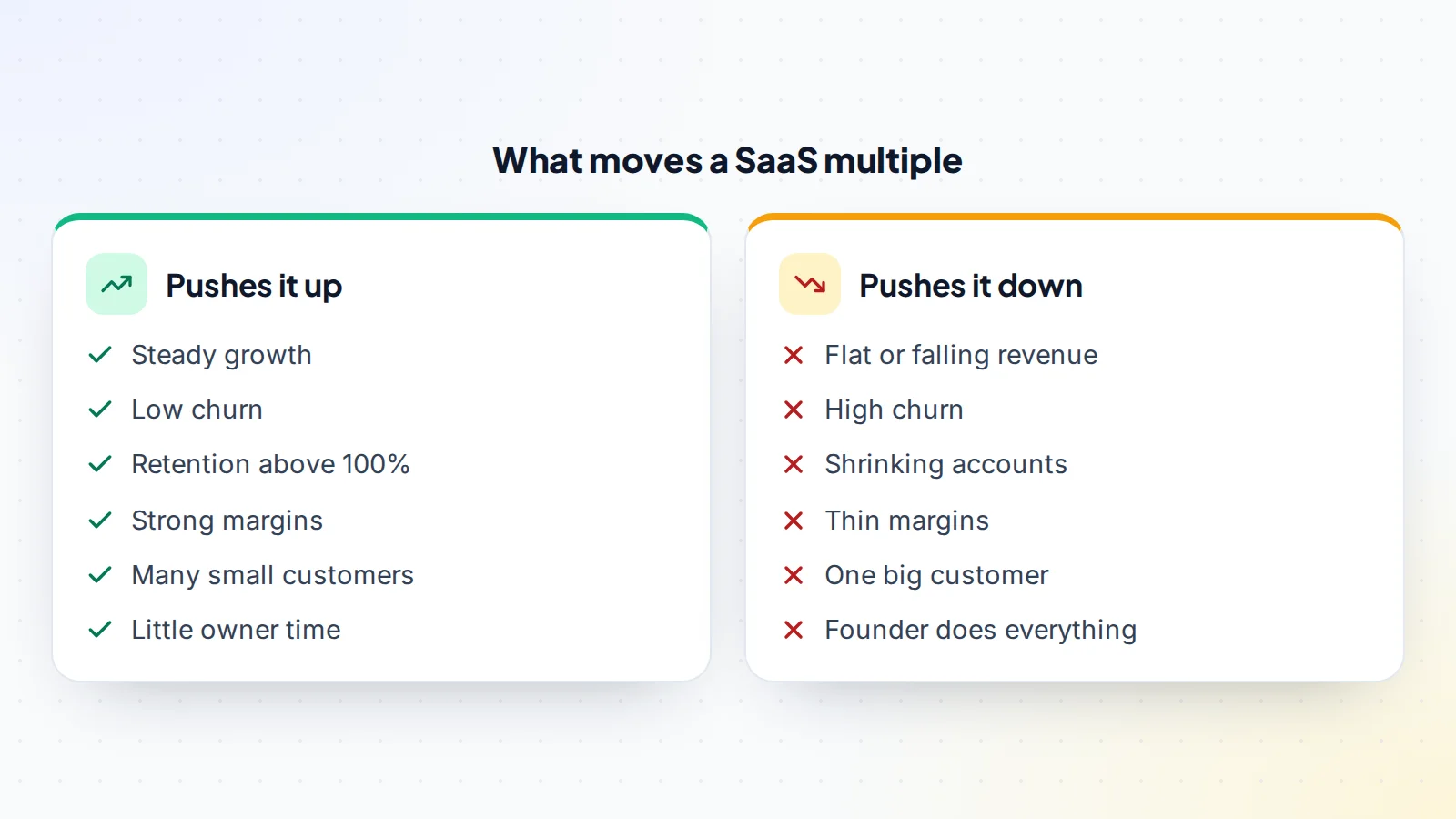
Buyers weigh many things, but a handful matter most. Each one answers the same question: how confident can I be about future profit?
Growth
Steady growth is the strongest single driver. A product growing year on year gives the buyer more profit next year than this year, which justifies paying more for it. Buyers look at the trend over at least a year, ideally longer. One spike followed by a flat line is worth less than slower, steady growth, because it’s harder to trust.
Growth from organic channels, such as search, word of mouth and integrations, is usually valued more than growth that depends on paid ads, because it’s cheaper to keep going.
Churn
Churn is the share of customers or revenue lost each month. High churn means the business has to keep replacing customers just to stand still, which costs money and makes the future uncertain. Stripe’s guide to calculating churn rates explains the difference between customer churn and revenue churn; buyers look at both. Read SaaS churn rate for what good looks like and how to reduce it.
Net revenue retention
Net revenue retention (NRR) shows whether existing customers spend more or less over time, after upgrades, downgrades and cancellations. Above 100% means the customers you already have are growing revenue on their own, even before new sign-ups. Stripe explains it in its guide to net dollar retention. Buyers prize strong retention because it means growth doesn’t depend entirely on finding new customers.
The same profit, two prices
The effect of growth and churn is easiest to see side by side.
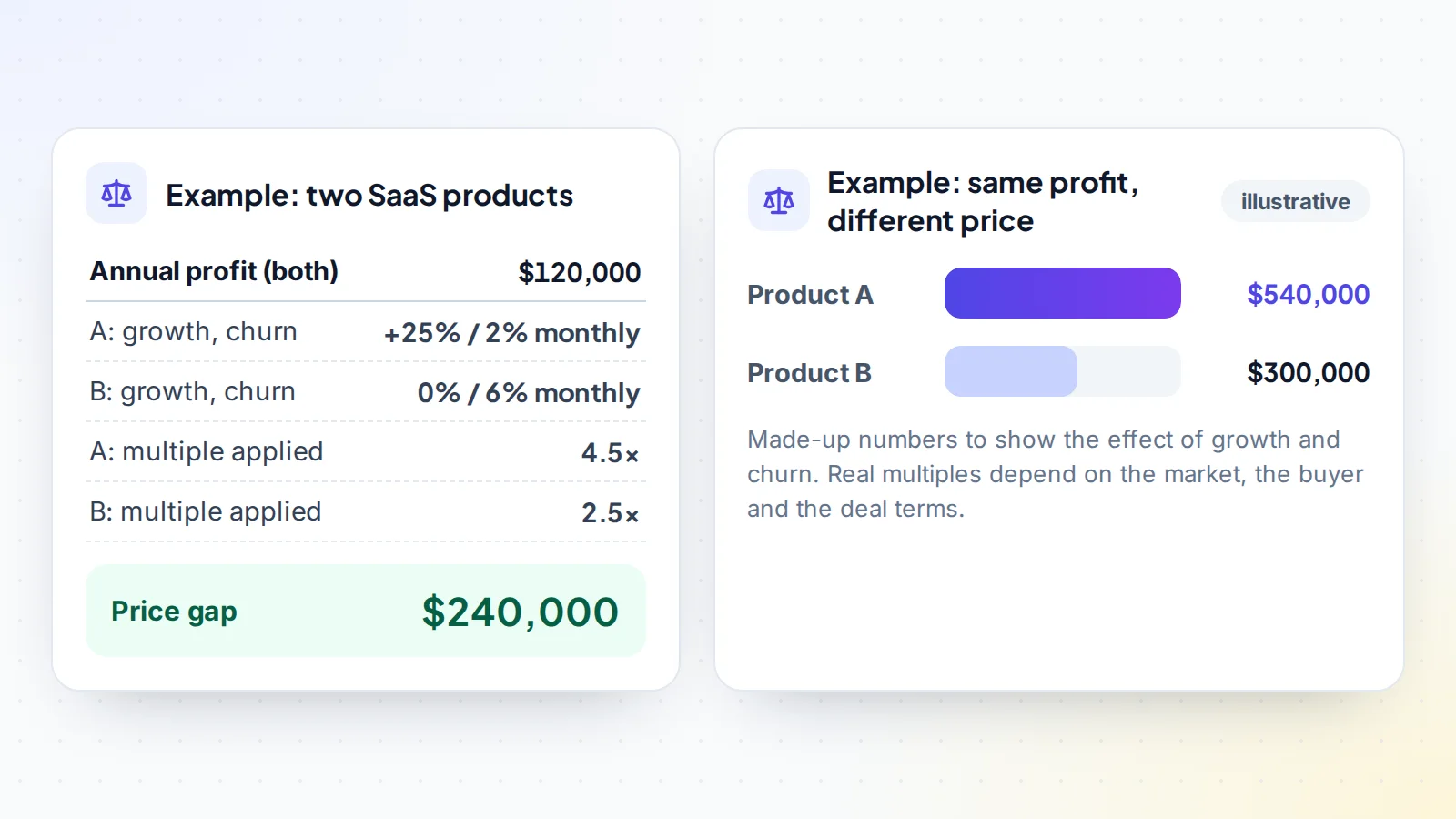
Both products earn the same today. A buyer of product A expects more profit next year; a buyer of product B expects to work hard just to keep it. The multiples reflect that.
Margins
Gross margin is revenue minus the direct costs of serving customers: hosting, third-party services, payment fees and support. Software usually has high gross margins, which is part of why it attracts higher multiples than many other businesses. Stripe’s guide to SaaS gross margin explains what goes into it. Products with heavy per-customer costs, such as those that rely on paid AI model calls or expensive data, have thinner margins and usually lower multiples. Read buying an AI SaaS for that case.
Customer concentration
If one customer brings a large share of revenue, losing them would hurt badly. Buyers discount for that risk, sometimes heavily. A product with hundreds of small customers is usually safer than one with three large ones, even at the same revenue. Contracts with notice periods or multi-year terms reduce the risk a little; a large customer on a month-to-month plan raises it.
Owner dependence
If the founder writes all the code, answers all the support and closes all the sales, the buyer has to replace all that work. Buyers either pay less or ask for long transition support. Products with documented processes, a support team or contractors, and automated operations attract higher multiples. Read how owner hours affect valuation.
Code quality and tech debt
Buyers check the code before closing. Outdated frameworks, no tests, security gaps and fragile deployments all mean work and risk after purchase, and buyers price that in. A clean, documented, tested codebase on supported versions makes due diligence faster and the buyer more confident. Read SaaS technical due diligence.
Other factors
- Age and track record. Longer history gives buyers more data to trust.
- Market. A growing niche supports higher multiples than a shrinking one.
- Competition. Products that are easy to copy or face strong rivals get lower multiples.
- Billing mix. Annual plans paid upfront give more certainty than monthly ones.
- Platform risk. Products built entirely on another company’s platform carry that platform’s risk.
- Legal and data. Clean contracts, terms and privacy practices remove a source of doubt.
Deal terms change the real multiple
A headline multiple doesn’t tell you what a seller actually receives. An offer at a high multiple with half the price paid later on targets may be worth less than a lower multiple paid in full at closing. Compare offers on the cash at closing, the amount deferred and its conditions, the length of transition support, any non-compete, and who pays fees. Read earn-outs and SaaS asset purchase agreements. Put every offer into a simple table with the same columns, and the real differences between them become clear quickly.
Different buyers, different multiples
An individual buying their first business, a small holding company and a competitor will value the same product differently. A competitor might pay more because it can merge the customers into its own product and cut costs. An individual may pay less but close faster. Knowing who’s likely to buy helps you understand the offers you get and which ones to take seriously.
Why headline multiples mislead
News stories about software acquisitions often quote large revenue multiples for venture-backed companies. Those deals involve large teams, fast growth, strategic buyers and very different risk. A small product run by one founder is a different asset, and SaaS valuation multiples for it are usually set on profit, by individual buyers or small firms, with more weight on how much work the owner does. Use headline numbers as context about the wider market, not as a price for your product.
Balancing growth and profit
Some buyers of larger SaaS use a rule of thumb called the Rule of 40: the yearly growth rate plus the profit margin should add up to at least 40%. A product growing 30% with a 10% margin passes; so does one growing 5% with a 35% margin. It’s a shorthand for whether a company is balancing growth and profit sensibly, not a pricing formula, and it’s used far less for small founder-run products. Still, it’s a helpful reminder that buyers weigh growth and profit together.
How buyers check the numbers
Whatever multiple is agreed, it only holds if the numbers behind it survive due diligence. Buyers compare the profit and loss statement with payment processor records, bank statements and invoices. They rebuild monthly recurring revenue from subscription data, check churn by cohort, and look for one-off income that inflates the year. If the checked figure is lower than the one in the listing, the price drops with it, often by the full multiple. Accurate numbers from the start protect a seller’s price and save weeks of back-and-forth.
How to raise your multiple before selling
Most improvements need time to show in the numbers, so start six to twelve months before you plan to sell.
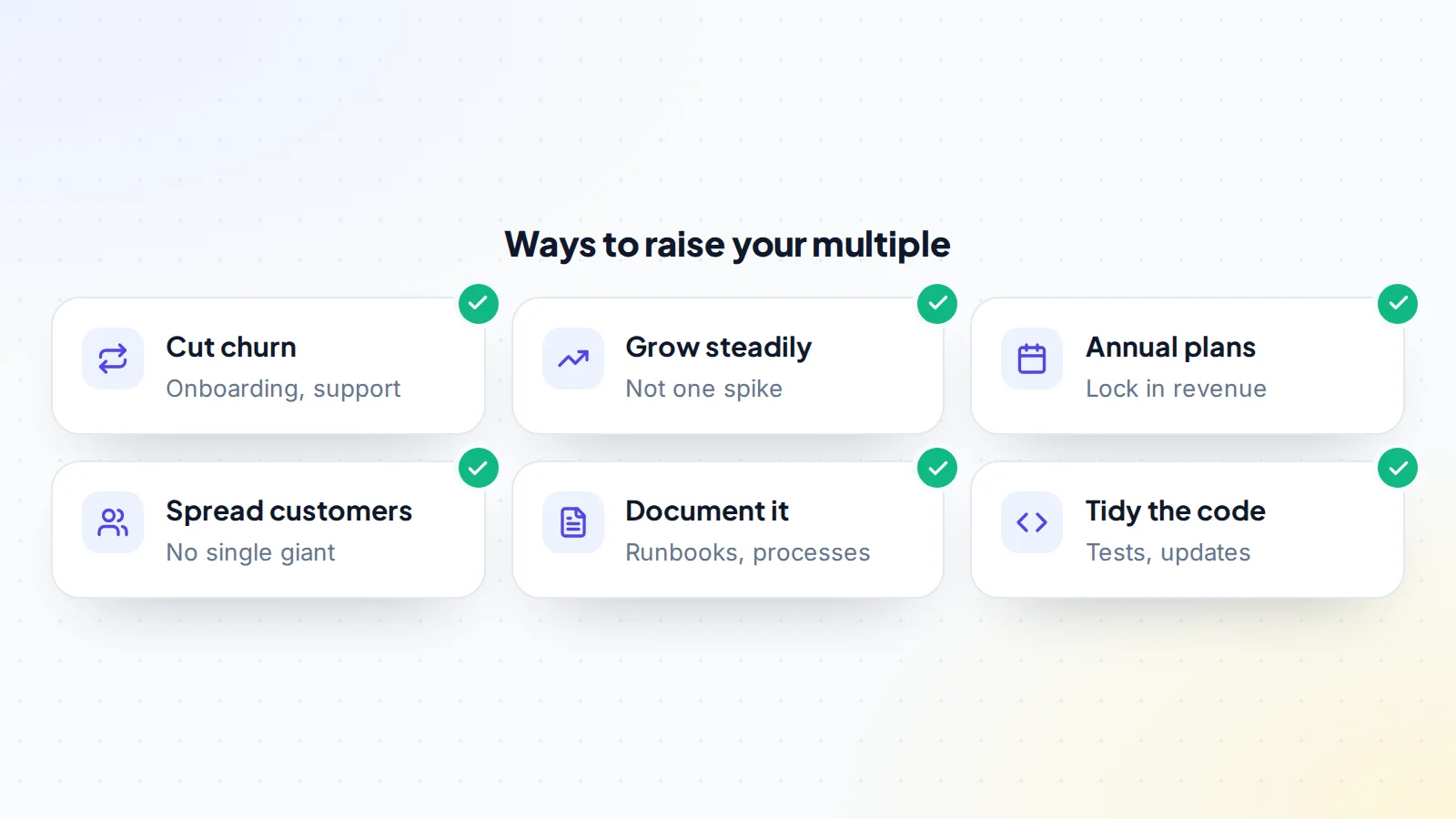
Reduce churn with better onboarding and support. Offer annual plans. Grow steadily rather than chasing a short spike. Reduce dependence on any one customer or channel. Document how the business runs and hand off tasks you do yourself. Update dependencies and add tests. And keep clean monthly financials, so due diligence goes quickly. Read how to increase a business’s value before a sale.
For buyers: reading a multiple
If you’re buying, don’t anchor on a multiple you’ve seen elsewhere. Ask what you’re getting for it. Check growth over at least a year, churn and retention by cohort, margins after every real cost, customer concentration and how much work the owner does. A lower multiple on a risky product can still be expensive; a higher one on a strong product can be good value. Read SaaS due diligence.
Common mistakes
- Applying a multiple from a news story to a small founder-run product.
- Comparing a revenue multiple with a profit multiple.
- Ignoring churn because revenue is growing.
- Judging offers on the headline multiple instead of the cash and terms.
- Making improvements a month before selling and expecting buyers to pay for them.
A worked example
The details below are made up to show the method.
Morgan runs a booking tool for small gyms with $120,000 of annual profit. A first buyer offers 2.5 times profit, pointing to 6% monthly churn and the fact that Morgan does all the development and support. Morgan decides to wait a year.
Over the next twelve months, Morgan improves onboarding, offers a discount for annual plans, hires a part-time support contractor and writes runbooks for deployments. Churn falls to 2% a month, a third of customers move to annual plans, and revenue grows 25%. Profit holds steady because of the new support cost. When Morgan lists again, buyers see a growing product with low churn and a business that runs without the founder on every task. The best offer is 4.5 times profit, with 80% paid at closing.
SaaS valuation multiples: the checklist
- Twelve months or more of clean monthly financials.
- Growth trend shown over at least a year.
- Customer and revenue churn measured.
- Net revenue retention calculated by cohort.
- Gross margin worked out after every direct cost.
- Revenue share of the largest customers known.
- Owner tasks documented or handed off.
- Code updated, tested and documented.
Browse SaaS and apps for sale, or list your SaaS with 0% success fee up to $10,000, then 5% (max $5,000). Read how escrow protects both sides on digiflippers.com.
Ready to find your next asset?
Browse listings with verified numbers, ask sellers your questions before you offer, and agree every step in a free Deal Room.
Frequently asked questions
What is a typical SaaS multiple?
There isn’t one. It depends on size, growth, churn, margins and risk, and on the buyer and the deal terms.
Is SaaS valued on profit or revenue?
Small founder-run SaaS is usually valued on profit. Larger, fast-growing SaaS is often valued on recurring revenue.
What raises a multiple the most?
Steady growth with low churn and strong retention, because it makes future profit more certain.
Does customer concentration matter?
Yes. A large share of revenue from one customer is a risk buyers discount for.
How much does code quality matter?
A lot for software. Poor code means work and risk after the sale, which lowers offers.
Should I take the highest multiple?
Not automatically. Compare cash at closing, deferred amounts and their conditions, and other terms.
How long does it take to improve a multiple?
Usually six to twelve months, because buyers look at trends.
Do annual plans help?
They give more certainty about future revenue, which buyers value.