How Much Is a YouTube Channel Worth?
A clear method for YouTube channel value: profit-based pricing for earning channels, audience-based pricing for growing ones, and the factors buyers weigh.

A YouTube channel can be a serious business: a library of videos that keeps earning, an audience that returns every week, and income from ads, sponsors and products. Working out YouTube channel value is about separating what the channel earns today from how likely it is to keep earning for a new owner, and that’s where most of the price is decided.
This guide explains how channels are valued, from profit-based pricing for earning channels to audience-based pricing for channels that are still growing. It covers the numbers that matter, what RPM tells you, the factors that raise or lower the price, and a worked example.
For the practical side, see our guides on how to buy a YouTube channel and how to sell a YouTube channel.
Key takeaways
- Earning channels are usually valued as a multiple of average monthly net profit over the last 6 to 12 months.
- Channels that don’t earn yet are valued on views, watch time, engagement, niche and the library.
- RPM (revenue per 1,000 views) shows how well views turn into income; it varies a lot by niche and audience region.
- Evergreen videos, several income sources and a format that doesn’t depend on one person raise the multiple.
- Subscriber count on its own is a weak guide to value.
Two ways channels are valued
Channels fall into two broad groups, and each is valued differently:
- Earning channels have a track record of income: ad revenue through the YouTube Partner Program, sponsorships, memberships, affiliate links or products. They’re valued mainly on profit.
- Growing channels don’t earn much yet, or have only just qualified for monetisation. They’re valued on audience and potential: views, watch time, engagement, the niche and the quality of the library.
YouTube’s help centre sets out the eligibility thresholds for the Partner Program, including subscriber and watch-time or Shorts-view requirements. A channel that already meets them, with monetisation on and a good standing, is usually worth more than one that doesn’t, because the buyer can start earning straight away.
Valuing an earning channel
For an earning channel, the starting point is average monthly net profit over the last 6 to 12 months:
- Add up all income: ad revenue, sponsorships, memberships, affiliate commissions and product sales.
- Subtract all costs: editors, voice-over, scriptwriters, thumbnail designers, music licences, equipment and software.
- Count the owner’s work: if the seller does everything, a buyer will count the cost of replacing that work.
- Average it over at least six months, so one viral month doesn’t distort the figure.
Then a multiple is applied. The multiple reflects how confident a buyer can be that the profit will continue, and how much work it takes. Read our guide to the online business valuation multiple for how buyers think about it.
What RPM tells you
YouTube’s help centre explains two figures that are often confused. CPM is what advertisers pay per 1,000 ad impressions, before YouTube’s revenue share. RPM (revenue per mille) is what the creator earns per 1,000 video views, after YouTube’s share, and it includes several revenue sources, such as ads, memberships and YouTube Premium revenue, and counts all views, including ones that showed no ads.
RPM is the more useful figure for valuation, because it shows how efficiently views turn into income for the owner. It varies widely:
- By niche: topics advertisers value highly, such as finance, software and business, tend to earn more per view.
- By audience region: viewers in some countries attract higher ad prices.
- By format: Shorts and long-form videos are monetised differently, so a channel’s mix affects its RPM.
- By season: ad prices often rise and fall during the year.
A buyer looks at RPM over 12 months, not a single good month, and asks why it is what it is.
Valuing a channel that doesn’t earn yet
Without profit to multiply, value comes from the audience and what a buyer can build on it:
- Views and watch time over the last 12 months, and the trend.
- Engagement: comments, likes, returning viewers and how long people watch.
- Traffic sources: browse and suggested videos and search show the channel is recommended; heavy reliance on one outside source is weaker.
- Niche: a niche with strong advertiser and sponsor demand gives more room to grow income.
- Library: how many videos keep getting views, and how close the channel is to monetisation thresholds.
Prices for these channels are usually set by comparing similar channels that have sold, adjusted for these factors.
What raises and lowers the value
Factors that raise YouTube channel value:
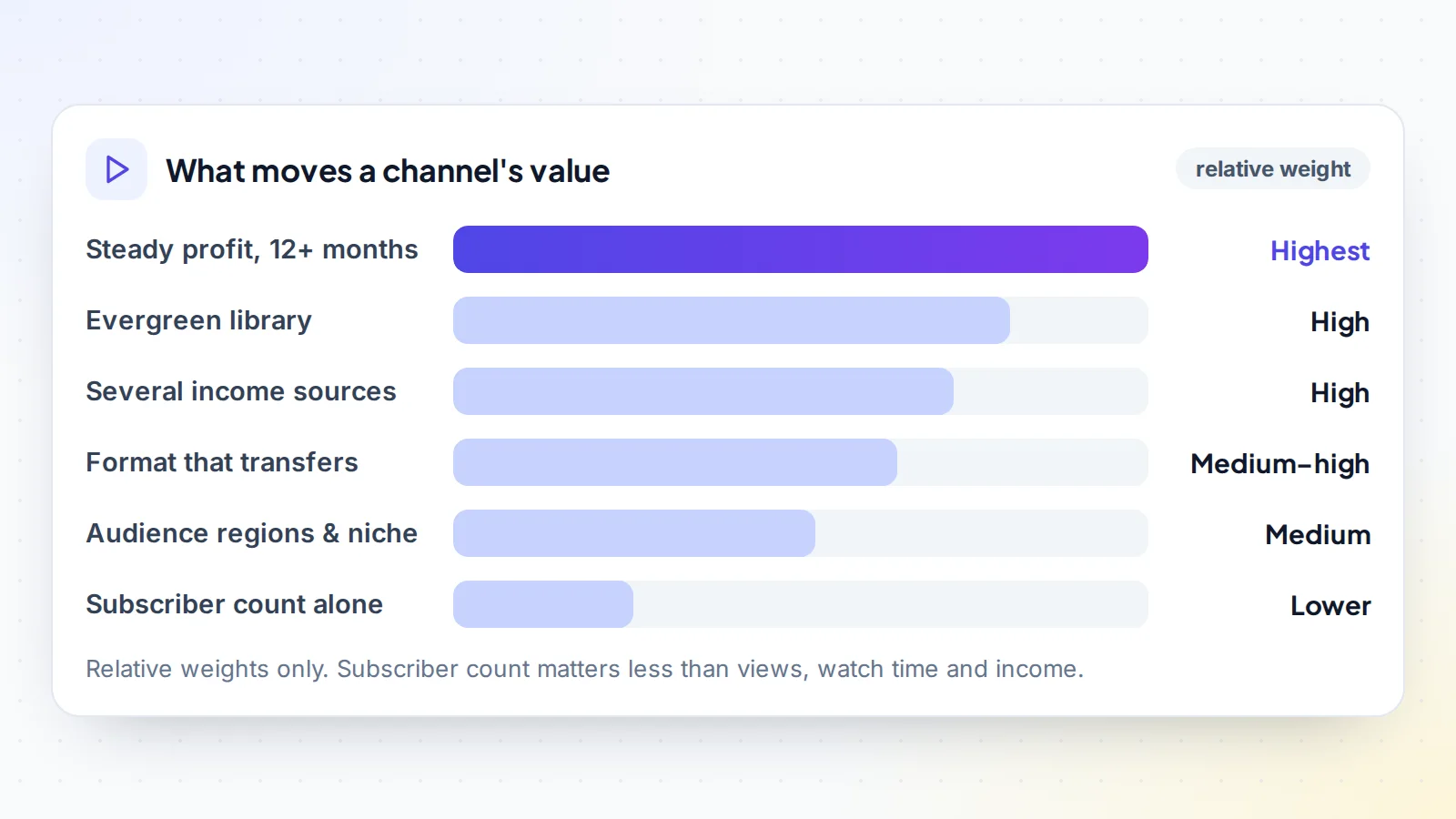
- A long, steady record of views and income.
- Evergreen videos that keep earning years after upload.
- Several income sources, so the channel doesn’t depend on ads alone.
- A format that transfers, such as faceless, voice-over, animation or screen recordings, so viewers come for the topic.
- A documented process and a team that can continue.
- Viewers in high-RPM regions and a niche advertisers value.
- Monetisation on and a clean standing.
Factors that lower it:
- A recent drop in views or income.
- One viral video producing most of the income.
- A personality-led format without a transition plan.
- Heavy reliance on Shorts where revenue per view is lower.
- Income from a single sponsor on short-term deals.
Concentration is worth measuring carefully; our guide to traffic concentration risk explains how.
How value differs by kind of channel
- Education and how-to channels often have the most evergreen libraries, because the same questions get searched year after year. Buyers value that steadiness.
- Review and tech channels can earn well from affiliate links and sponsors, but videos date quickly as products change, so the library needs regular refreshing.
- Entertainment and commentary channels can grow fast, but views tend to come from new uploads rather than the library, and the format often depends on a personality.
- Compilation and relaxation channels can be easy to run, but buyers check carefully that every clip, image and sound is original or properly licensed.
Knowing which group a channel belongs to helps set realistic expectations before looking at the numbers.
Why subscriber count isn’t the answer
It’s tempting to price a channel by subscribers, but subscribers don’t pay the bills. A channel with 200,000 subscribers who no longer watch can be worth less than one with 40,000 subscribers who watch every video. Views, watch time and income tell you what the audience actually does. Subscribers are a signal of past interest; buyers look at them, but don’t price on them alone.
A worked example
The numbers below are made up to show the method, not market data.
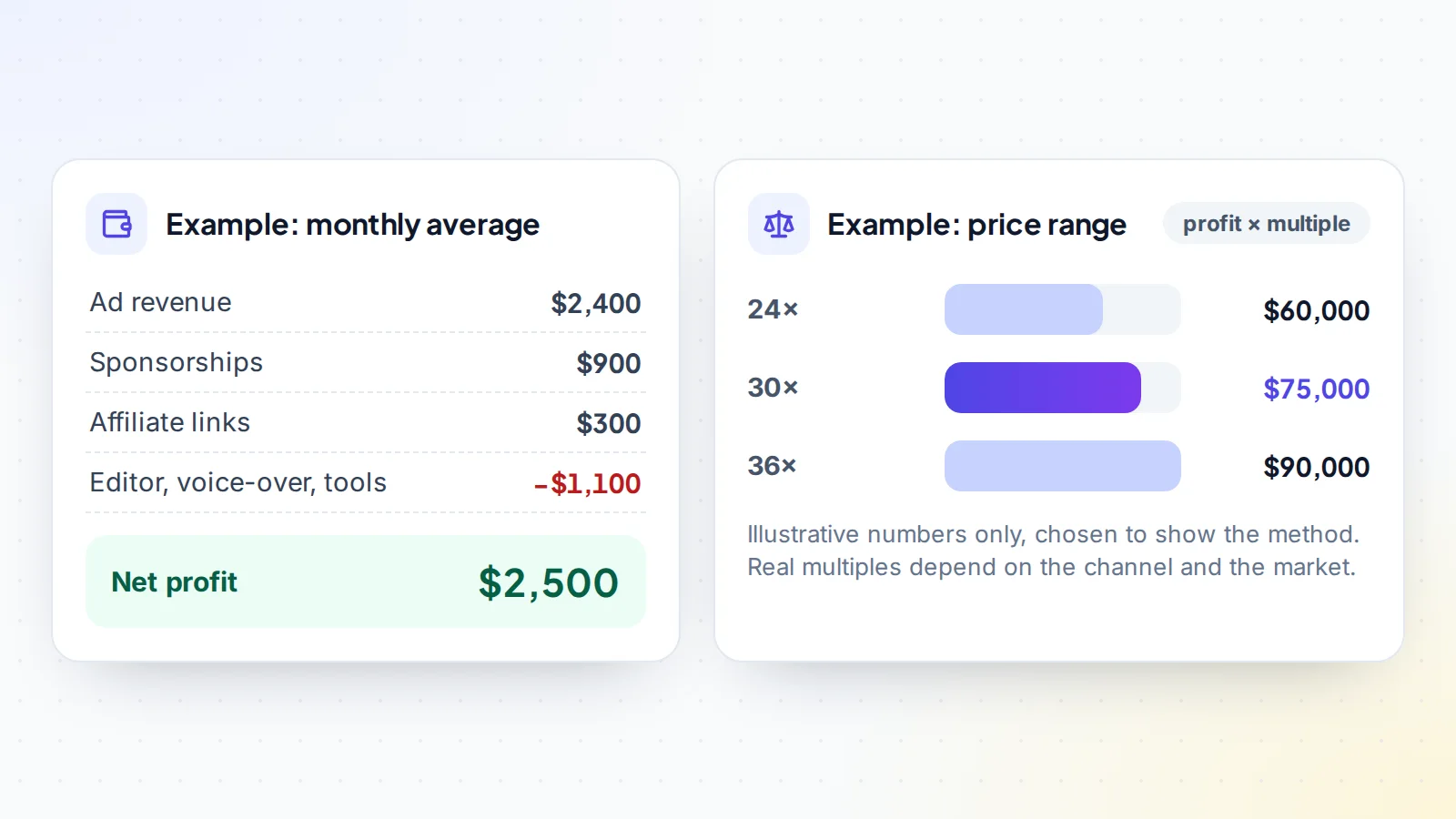
A faceless channel explains personal finance basics with animation. Over the last 12 months it averaged $2,400 a month from ads, $900 from sponsorships and $300 from affiliate links: $3,600 in revenue. An editor, a voice-over artist and software cost $1,100 a month, so net profit averages $2,500.
The buyer weighs the evidence. Strengths: a niche advertisers value, 70% of views on videos more than a year old, three income sources and a team that will stay. Weaknesses: the sponsor deals are month to month, and one video brings a fifth of the views. On balance, the buyer settles on a multiple in the upper middle of the example range, around 30 times monthly profit, or $75,000, and plans to secure longer sponsor agreements after the purchase.
How sponsorship income is valued
Sponsorships can be a large share of a channel’s income, and buyers treat them carefully. A sponsor pays because of the audience, but often also because of a relationship with the creator. Buyers ask:
- How many sponsors contributed over the last 12 months, and how much each paid.
- How deals were agreed: one-off, monthly or longer contracts.
- Whether sponsors will continue with a new owner, and whether the seller will introduce them.
- How sponsors were found: inbound enquiries suggest demand for the audience; outreach by the seller suggests the income depends on the seller’s effort.
Recurring sponsors with written agreements and inbound demand support the full value of that income. One-off deals that depended on the seller’s personal network are usually discounted.
Valuing the extras
A channel sale often includes more than the channel itself, and each extra can add value:
- An email list of viewers, which gives the owner a direct line to the audience that doesn’t depend on recommendations.
- A website or blog with its own traffic and income.
- Social accounts on other platforms that promote the videos.
- Project files: raw footage, scripts, thumbnails and templates, which make it easier to keep the style consistent.
- Products or courses sold to the audience.
Buyers usually value extras on the income they produce, plus a premium where they clearly make the channel easier to run or grow.
Seasonality and trends
YouTube channel value can move with the calendar and with the topic. Ad prices often change through the year, so a few strong months may reflect seasonal advertising rather than lasting growth; that’s another reason buyers average over 12 months. Topics also rise and fall: a channel built on a trend that’s fading may show strong history but weak prospects. Buyers ask whether the topic will still matter in two or three years, and whether the library will keep finding viewers.
How buyers check the numbers
All of this depends on the data being real. Buyers look at YouTube Studio live, in a screen share where they choose the date ranges, or through a read-only connection, rather than relying on screenshots. They check revenue in Studio against payout records, look at traffic sources and audience, and confirm the channel’s standing. See verified metrics for why connected data matters, and digital asset scams for the warning signs.
Value after the handover
A channel’s value to a buyer also depends on how smoothly it moves. YouTube’s Brand Account tools let ownership change without sharing passwords, with a 7-day wait before a new owner can become primary owner. Income continues once the buyer links their own payment setup. Our guides to transferring YouTube channel ownership and monetisation after a purchase explain the steps.
For owners: raising your channel’s value
- Keep uploading on a steady schedule.
- Refresh titles and thumbnails on older videos that still get views.
- Add an income source beyond ads, such as affiliate links or a product.
- Secure longer sponsor agreements.
- Document how videos are made, and build a small team.
Try the free valuation tool for a quick range, and see how each factor moves it.
YouTube channel value: the checklist
- Income by source for 12 months, from YouTube Studio and payout records.
- All costs listed, including the owner’s work.
- Average monthly net profit calculated.
- RPM reviewed over 12 months, with reasons for changes.
- Views, watch time, traffic sources and audience regions reviewed.
- Share of views from evergreen videos measured.
- Concentration in one video, sponsor or format checked.
- Monetisation status and standing confirmed.
- Multiple chosen with strengths and weaknesses listed.
Ready to find your next asset?
Browse listings with verified numbers, ask sellers your questions before you offer, and agree every step in a free Deal Room.
Frequently asked questions
How much is a YouTube channel worth?
Earning channels are usually valued as a multiple of average monthly net profit. Growing channels are valued on views, watch time, engagement, niche and library, compared with similar channels that have sold.
Is a channel with more subscribers always worth more?
No. Views, watch time and income matter more. An engaged smaller audience can be worth more than a large inactive one.
What is a good RPM?
It depends heavily on niche, audience region and format. Compare a channel’s RPM with similar channels, and look at how stable it is over a year.
Do Shorts views count toward value?
Yes, but buyers look at the income they produce and whether Shorts viewers also watch longer videos, because revenue per view usually differs.
Does a monetised channel sell for more?
Usually, because the buyer can earn from day one. Monetisation status, standing and a record of payments all support the price.
Are sponsorships counted in the valuation?
Yes, but recurring sponsors with written agreements are valued more highly than one-off deals that depended on the seller’s personal relationships.
How long does it take to work out a channel’s value?
A first estimate takes minutes with a valuation tool. A price a buyer will actually pay comes after checking 12 months of YouTube Studio data, income records and costs, which usually takes a few days of back and forth.