Buying vs Starting an Online Business: Cost, Time and Risk
Should you build an online business from scratch or buy one that already earns? An honest comparison of money, time, risk and skills, and how to decide.

If you want to own an online business, there are two ways in: build one from nothing, or buy one that already exists. Both can work, and both can fail. The buy vs start online business question comes down to what you have more of (money or time), how soon you need income, which skills you bring, and which kind of risk you’d rather take.
This guide compares the two paths honestly: what each really costs, how long each takes to earn, the risks on each side, the skills each demands, and a worked example. At the end, five questions help you decide.
If the basics are new, start with what a digital asset is and how online businesses make money.
Key takeaways
- Buying costs more up front but can bring income from the first month, with a track record you can check.
- Starting costs less money but more time, and many new businesses take months to earn meaningfully, if they ever do.
- Buying’s main risks are overpaying and inheriting hidden problems; starting’s main risk is never getting traction.
- Your skills matter: builders often enjoy starting; operators and marketers often do better buying.
- Many owners do both over time: buy something that earns, then build on it.
The two paths
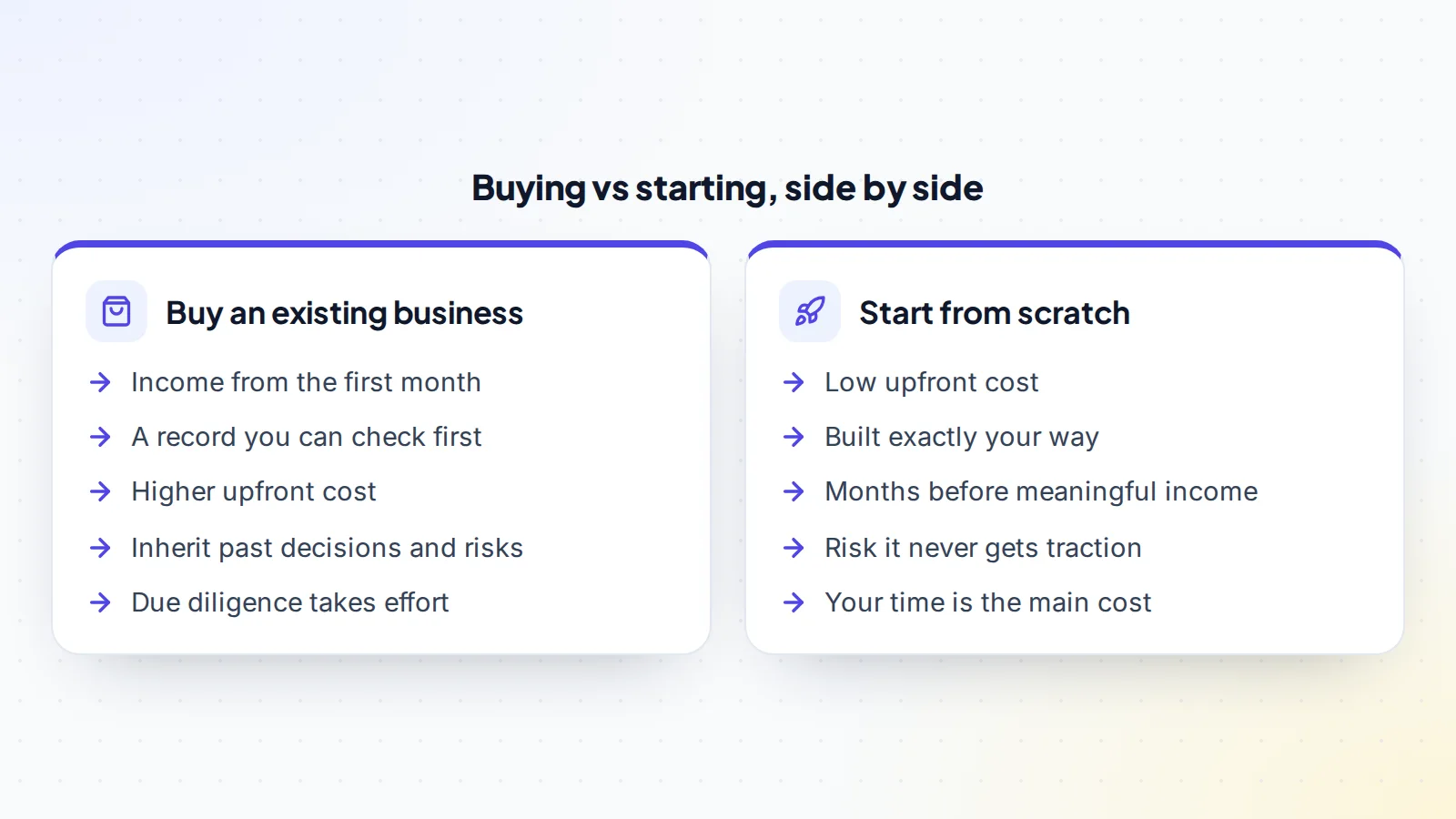
Starting means choosing a niche, building a website, app, channel or product, attracting an audience and finding a way to earn from it. You control every decision, and the main investment is your time.
Buying means finding a business that already has content, traffic, customers and income, checking it carefully, paying for it, and taking over. You skip the early stage, and the main investment is money, plus the time to check what you’re buying.
The U.S. Small Business Administration’s guide to buying an existing business describes the same trade-off for businesses of every kind: an existing business comes with customers and a track record, but costs more and needs careful due diligence.
Cost
Starting usually needs little cash: a domain, hosting or a platform subscription, tools and perhaps some design or writing help. The SBA suggests listing every startup cost in advance, from one-time expenses to the money needed to keep going until income arrives. The hidden cost of starting is your time, often hundreds of hours before meaningful income.
Buying needs more cash up front. Established online businesses are usually priced as a multiple of their monthly profit, so a business earning a steady profit costs many months of that profit to buy. Add the costs of due diligence, escrow, transfer and any professional help. Our guide to setting a budget to buy an online business breaks these down.
Time to income
This is where the paths differ most. A business you buy can pay you from the first month, because the income already exists. A business you start may take many months to earn anything meaningful: new websites need time to be found in search, new channels need time to build an audience, new products need time to find customers. Some never reach that point.
Search traffic in particular can be slow to build and can change: Google explains that it updates its ranking systems several times a year, and that recovering from a drop can take months. A bought site arrives with a search history you can study; a new site has to earn one.
If you need income soon, buying is usually the faster route. If you can wait and enjoy the building process, starting can work.
Risk
Both paths carry risk, but of different kinds.
Risks when buying
- Overpaying because the numbers were exaggerated or the price ignored weaknesses.
- Hidden problems: traffic about to fall, income from one source, content you don’t have rights to.
- Transition loss: income that depended on the previous owner.
- Scams by people selling assets that don’t exist or aren’t theirs.
These are reduced by careful due diligence, verified numbers and protected payment.
Risks when starting
- No traction: the idea doesn’t attract an audience or customers.
- Time lost: months of work with little to show.
- Running out of patience or money before it works.
These are reduced by choosing a niche you understand, testing ideas cheaply and setting a time limit to review progress.
The key difference: when buying, you can check much of the risk before committing. When starting, you only find out by trying.
Skills
The two paths reward different strengths:
- Starting suits builders: people who enjoy creating content, products or software from nothing, experimenting and learning as they go.
- Buying suits operators and marketers: people who are good at improving something that already works, analysing numbers, managing contractors and finding growth.
Buying also needs a skill starters can skip: judging a business from the outside. Reading financial records, traffic data and contracts takes practice, which is why first-time buyers often start small.
Control and learning
Starting gives you full control: the niche, the brand, the design, the tone. You also learn every part of the business by building it, which is valuable if you plan to start more. Buying means inheriting someone else’s choices: the brand, the content style, the tools. You can change them over time, but carefully, because the existing audience chose the business as it is.
A worked example
The numbers below are made up to show the method, not market data.
Alex has $30,000 to invest and about ten hours a week, and wants an online income within a year.
Option 1: start. Alex spends $3,000 on a domain, hosting, tools and some freelance articles, and writes the rest. After nine months, the site has growing traffic and earns a few hundred dollars a month. It might grow well from there, or stall. Alex has learned a lot and still has $27,000 in the bank.
Option 2: buy. Alex buys a small content site with 18 months of verified, steady profit of about $1,000 a month, paying close to $30,000 after due diligence and escrow. From the first month it earns about $1,000. Alex spends the ten hours a week improving it: refreshing old articles, adding an email list, adding a second income source. Within a year, profit is higher, but Alex’s savings are now invested in the site, and its value depends on keeping traffic steady.
Neither option is wrong. Option 1 risks time; option 2 risks money. Alex chooses based on what matters more: keeping the cash, or getting income now.
What the first year looks like
If you start
The first months are mostly building: choosing a niche, setting up the site or channel, publishing regularly and learning what works. Income is usually small or absent at first. By the end of the year, a successful new business has a growing audience, a first income source and a clear direction; an unsuccessful one has taught you a lot, at the cost of time.
If you buy
The first weeks are the handover: moving domains, accounts and tools, and getting to know the audience. The first months are about protecting what you bought: keeping the publishing or update schedule, fixing anything broken and watching the numbers closely. Then comes growth: improving content, adding income sources and building an email list. By the end of the year, a well-chosen purchase has paid back part of its price and is worth more than you paid, if you’ve improved it.
Seen side by side, the buy vs start online business decision is really a choice of which first year you’d rather have.
Putting a value on your time
A fair comparison counts your time as well as your money. If you’d spend 500 hours building a site that reaches a certain profit, ask what those hours are worth to you, and whether buying a site already at that profit would cost less than your time. For some people, time is cheap and money is scarce, so starting makes sense. For others, especially those with demanding jobs, buying saves the scarcer resource.
Doing both
Many owners combine the paths. Some buy a small business first to learn how an earning business works, then start their own. Others start a project and later buy a competitor or a complementary site to grow faster. Some buy a business with an audience and start a new product for it. Seen this way, buy vs start isn’t a lifetime choice; it’s a decision for your next step.
How to decide
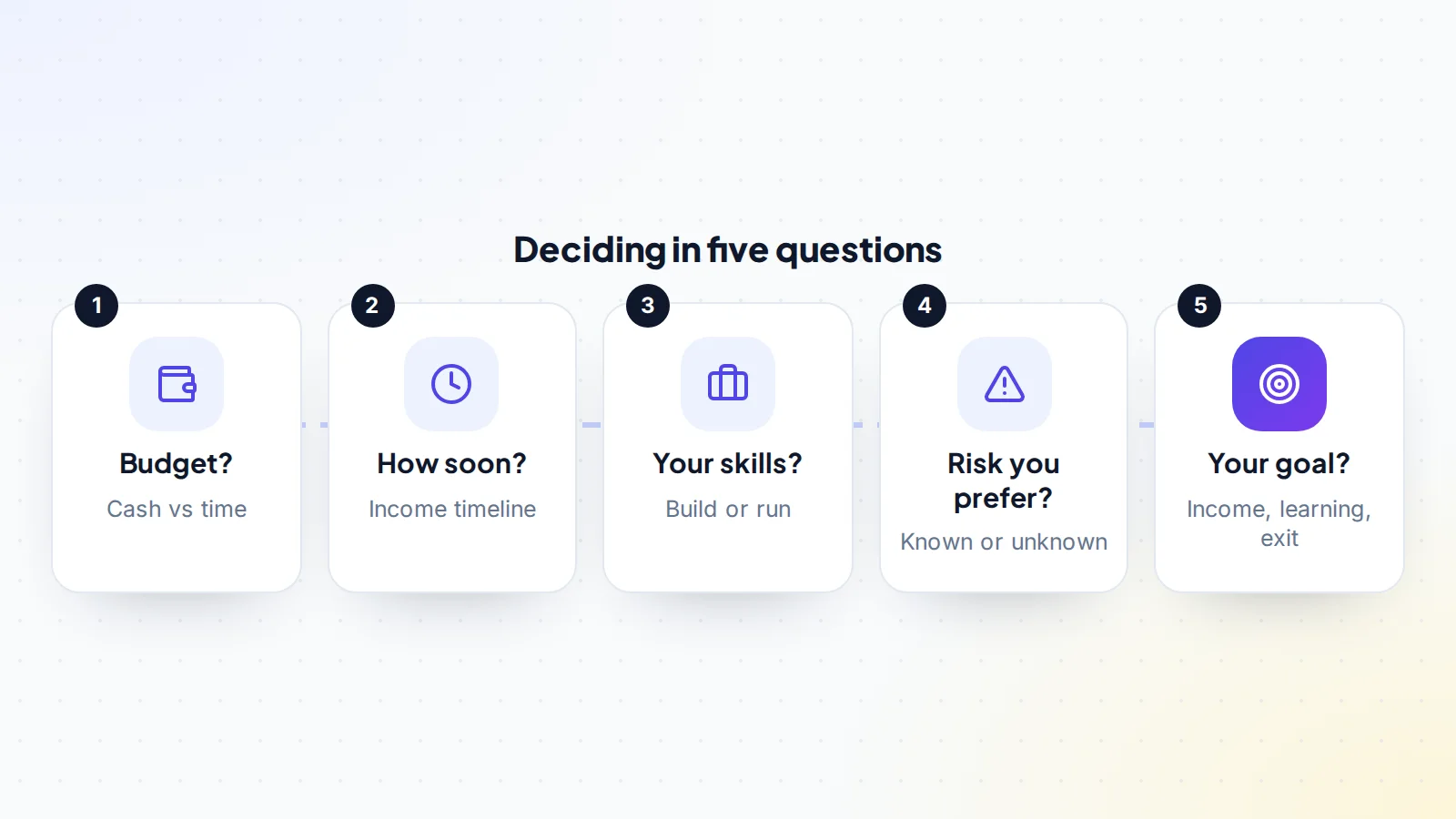
- What’s your budget? If you have more time than money, starting fits. If you have money and limited time, buying fits.
- How soon do you need income? Soon: buying. Can wait: either.
- What are your skills? Builder: starting. Operator or marketer: buying.
- Which risk do you prefer? Checkable risk (buying) or unknown-until-you-try risk (starting).
- What’s your goal? Income now, learning, or building something to sell later?
If you decide to buy
- Start small, so mistakes are affordable.
- Choose a model you understand.
- Verify every number at the source.
- Check the seller and pay through escrow or a middleman.
- Plan the first 90 days after the purchase.
Our guides on how to buy an established website and how to buy a website walk through each step. You can browse listings on digiflippers.com’s marketplace.
If you decide to start
- Pick a niche you know or can learn deeply.
- Test demand cheaply before investing a lot.
- Set milestones and a date to review progress honestly.
- Build an email list early; it’s the asset that holds value whatever happens.
- Keep records from day one; they’ll matter if you ever sell.
Thinking of it as digital real estate
Some people compare online businesses to property: you can build a house or buy one, and both have a place. A bought business is like buying a house with tenants; a new one is like building on empty land. The comparison is imperfect, because online businesses change faster than buildings, but it captures the trade-off. See digital real estate for more.
Who each path tends to suit
- Starting often suits students, creators with an idea they care about, developers who enjoy building, and anyone who wants to learn every part of an online business first-hand.
- Buying often suits people with savings and limited time, experienced marketers or operators, owners of an existing business looking to add a related one, and investors who want income from a known starting point.
These are tendencies, not rules. Plenty of first-time owners buy, and plenty of experienced investors still start new projects.
Common mistakes
- Buying without checking because it seems faster.
- Starting without a time limit, and drifting for years.
- Spending the whole budget on a purchase, leaving nothing to improve it.
- Underestimating the work in either path.
- Comparing a bought business’s price with a startup’s cash cost, while ignoring the startup’s time cost.
Buy vs start online business: the checklist
- Budget in cash and hours per week written down.
- Income timeline decided.
- Skills honestly assessed.
- Preferred risk chosen.
- Goal defined: income, learning or eventual sale.
- If buying: due diligence and protected payment planned.
- If starting: niche, milestones and review date set.
Ready to find your next asset?
Browse listings with verified numbers, ask sellers your questions before you offer, and agree every step in a free Deal Room.
Frequently asked questions
Is it better to buy or start an online business?
Neither is better in general. Buying suits people with capital who want income sooner; starting suits people with time who enjoy building.
Is buying an online business risky?
It carries risks such as overpaying and hidden problems, but many of them can be checked before you commit through due diligence and verified numbers.
How much does it cost to start an online business?
Often little cash, for a domain, hosting and tools, but a lot of time. List all costs, including what you’ll need until income arrives.
How long does a new online business take to earn?
It varies widely. Many take months to earn meaningfully, and some never do. That’s the main reason people buy instead.
Can I buy a small business to learn first?
Yes. Starting small is a common way to learn how earning businesses work, with mistakes that stay affordable.
In the buy vs start online business choice, which is cheaper?
Starting costs less cash; buying usually costs less time. Count both before deciding.