How Much Is an Email List Worth in a Sale?
How to value an email list in an online business sale: why engagement beats size, measuring revenue per subscriber, list health and deliverability, consent and privacy rules, transfer questions and a worked example.

An email list is one of the few audiences a business truly owns. Search rankings change and social reach rises and falls, but a list of people who chose to hear from you can be reached directly, any time. That’s why email list value matters so much in online business sales, from newsletters and course businesses to e-commerce stores and digital product shops. But size alone says little. This guide explains what really drives the value of an email list, how to measure it, the warning signs of an inflated list, the consent questions that affect a sale, and a simple way to estimate what a list is worth.
Email lists are central to many digital businesses; see our guide to digital product business valuation. If you’re selling, read how to sell a digital product business.
Key takeaways
- Engagement and revenue matter far more than the number of subscribers.
- Measure revenue and profit per subscriber from email over 12 months.
- Check list health: bounces, complaints, inactive subscribers and how people joined.
- Consent and privacy rules affect whether and how a list can move to a buyer.
- Deliverability is part of value: a list that doesn’t reach inboxes earns little.
Why email lists are valuable
When a business sends an email, it reaches people directly, without paying for each view and without depending on an algorithm. That makes email a reliable channel for launching products, sharing content, recovering abandoned carts and building relationships. For a buyer, a healthy list means a ready audience on the first day of ownership. For a seller, it’s often one of the clearest ways to show that the business has loyal customers.
Size vs engagement
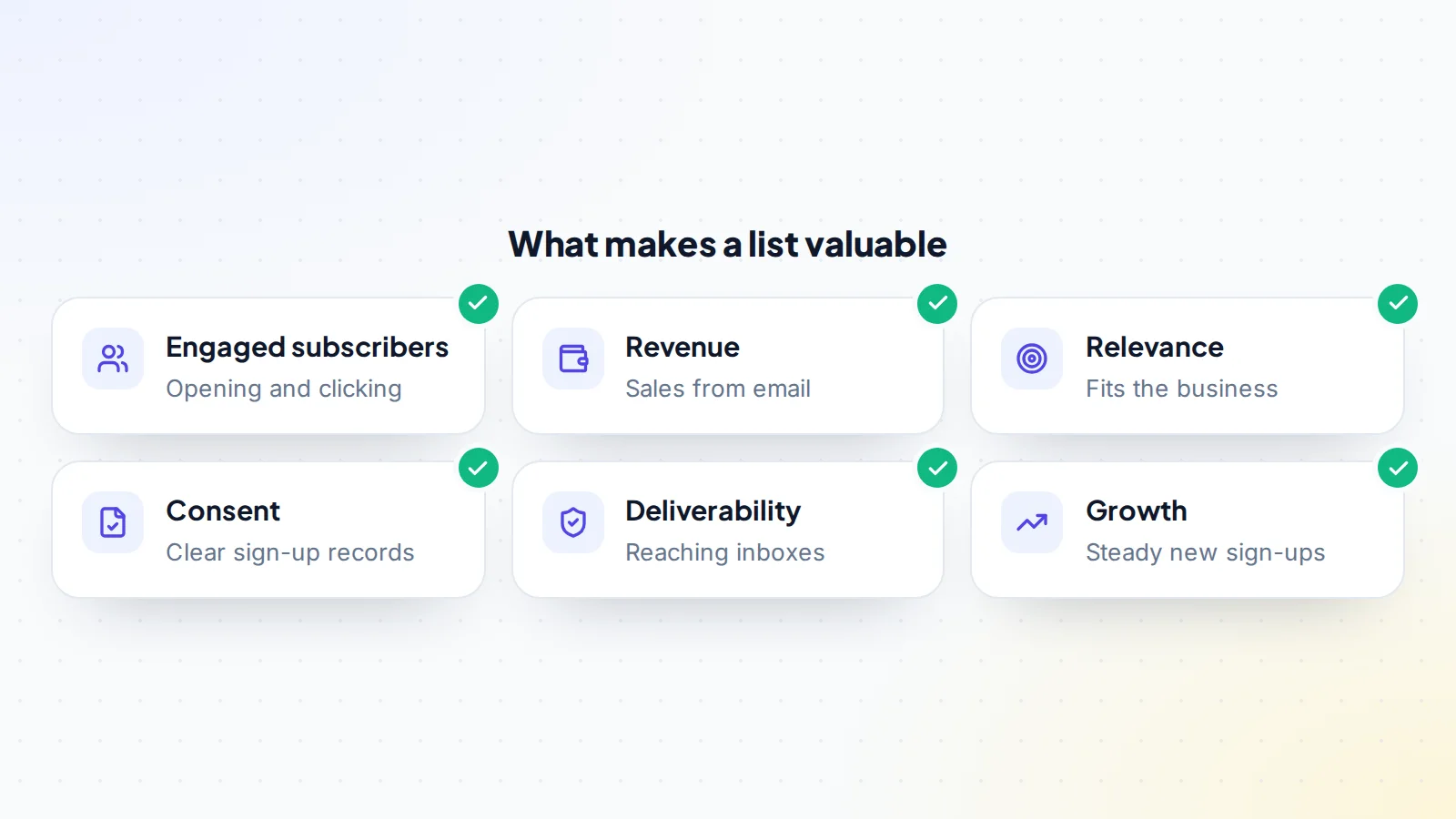
A list of 100,000 addresses where few people open or click can be worth less than a list of 10,000 engaged readers who buy regularly. What matters is how many people actually read, click and act. Look at engagement over recent months: clicks, replies, purchases and how many subscribers have engaged at least once in the last 90 days. Our guide to engagement rate explains how to compare audiences fairly.
Be careful with open rates. Apple’s Mail Privacy Protection loads remote content privately, which can make opens look higher than real reading. Clicks, replies and purchases are more reliable signals.
Revenue per subscriber
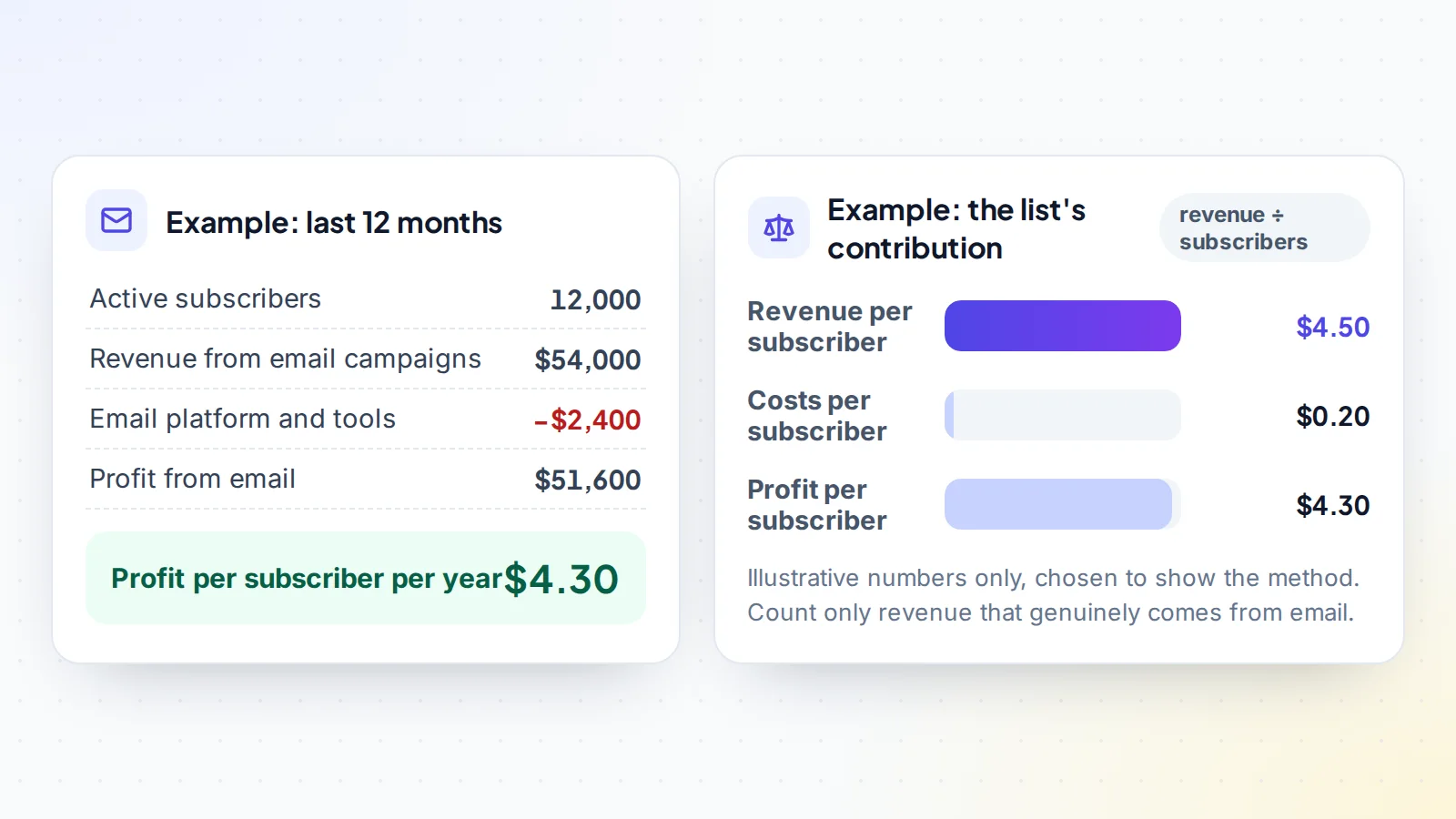
The most useful single measure of email list value is how much revenue, and profit, the list produces. Over the last 12 months, add up revenue that clearly came from email: sales from campaigns, automated sequences, sponsorships in a newsletter and affiliate commissions from email links. Subtract the cost of the email platform and tools. Divide by the number of active subscribers to get profit per subscriber per year.
Be strict about attribution. Count only revenue you can trace to email through links, codes or the platform’s reporting, not every sale that happened while emails were being sent. A realistic number is more useful than a flattering one.
List health
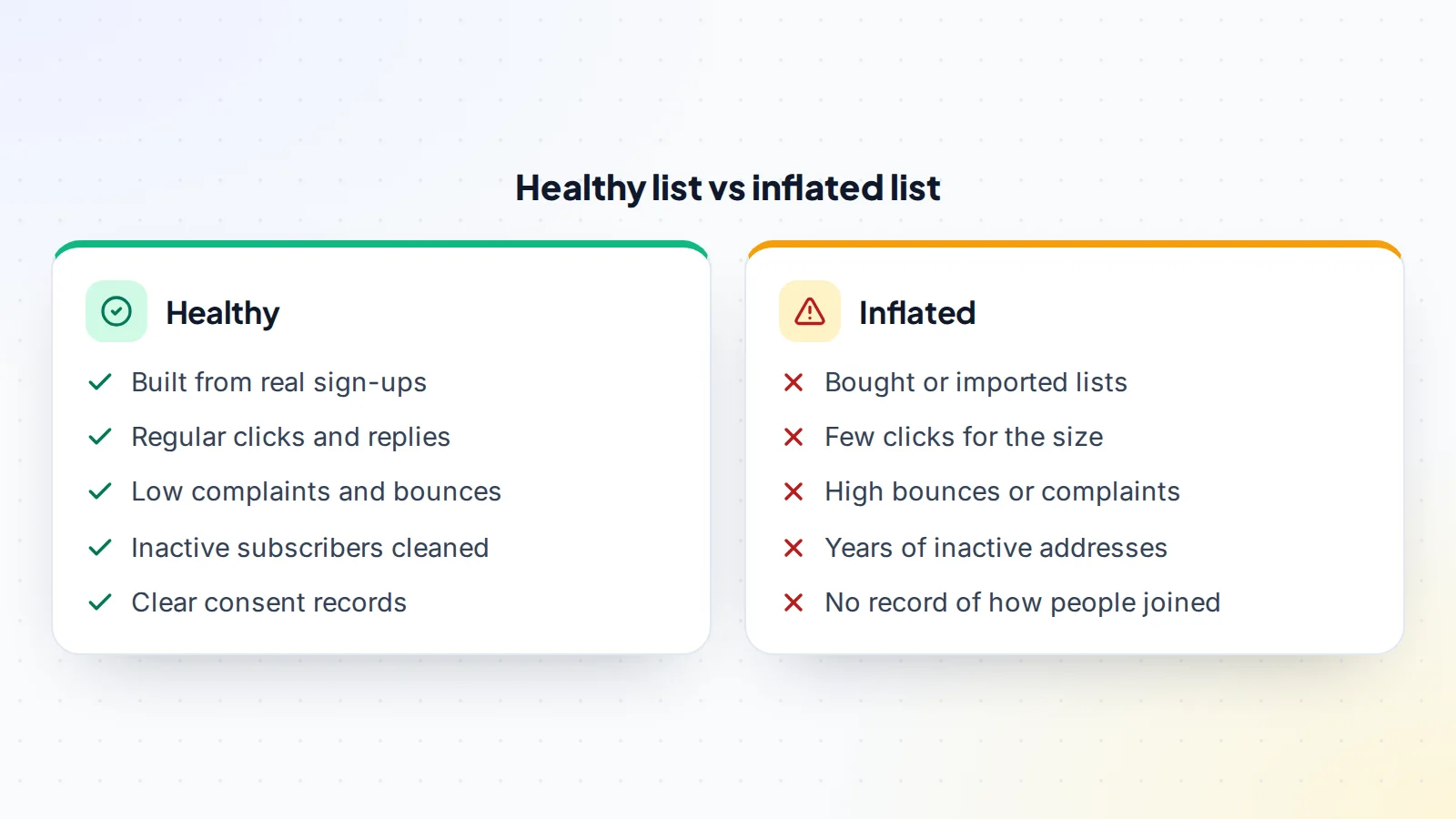
A healthy list is built from real sign-ups, cleaned regularly and engaged. Signs of a healthy list include low bounce rates, low complaint rates, a regular process for removing long-inactive subscribers and a clear record of where subscribers came from. Warning signs include bought or imported addresses, sudden jumps in size with no clear source, high bounces and a large share of people who haven’t engaged for years.
List health matters for value because it affects deliverability. Google’s guidelines for bulk email senders include requirements such as authenticating email, keeping spam rates low and offering easy unsubscribes. A list that triggers complaints or bounces can hurt the sender’s reputation, so emails land in spam for everyone.
Deliverability
An email that doesn’t reach the inbox earns nothing. Check how the list’s emails are authenticated, with SPF, DKIM and DMARC, whether the sending domain will move with the business, and recent delivery reports from the email platform. Ask about any past deliverability problems and how they were fixed. Our guide to the email deliverability check covers this in more detail, and a buyer should plan to keep the same sending domain and authentication where possible, so the list’s reputation carries over.
Consent and privacy
How subscribers joined affects whether and how the list can be used after a sale. Rules differ by country. In the US, the FTC’s CAN-SPAM guidance sets requirements for commercial email, including honest headers and subject lines, identifying the message as an ad where relevant, including a physical address and honouring opt-out requests promptly. In the UK and EU, rules for marketing email generally require consent, and data protection law covers how personal data is shared when a business changes hands.
Ask the seller for records of how people signed up, what they were told, and what they agreed to receive. A list with clear consent records is worth more and easier to transfer. Our guide to transferring email subscribers under GDPR explains the European rules.
Relevance to the business
A list is most valuable when subscribers want what the business offers. A list of people who joined for free recipes may be less interested in a paid software tool. Look at what subscribers signed up for and what they’ve bought. A buyer planning to change the business’s direction should value the list on how well it fits the new plans, not the old ones. Our guides to print-on-demand stores and digital asset libraries show how lists support different business models.
Segments and automations
Lists aren’t just one block of addresses. Many businesses segment subscribers by interest, purchase history or how they joined, and run automated sequences such as welcome series, product launches and cart reminders. These segments and automations are often where most email revenue comes from, and they’re part of what a buyer is paying for. Ask to see them: which sequences run, how much each earns, and how they’re triggered. A list with well-built automations keeps earning with little day-to-day work, which supports value. If you plan to move the list to another platform, check whether the automations can be rebuilt there, because they don’t always transfer automatically.
Newsletters and sponsorships
For newsletter businesses, the list is the product. Value often comes from sponsorships, paid subscriptions or both. Sponsors care about engagement and audience fit, so the same measures apply: clicks, replies and who the readers are. Our guides to newsletter valuation and buying a newsletter cover how these businesses are priced and handed over.
Where subscribers come from
The sources of new subscribers say a lot about a list’s future. Sign-ups from search traffic, useful free resources, a popular newsletter archive or checkout opt-ins tend to bring engaged readers who keep coming. Sign-ups from giveaways or contests often bring people who wanted the prize, not the content, and many leave or go quiet soon after. Ask the seller to show where subscribers joined over the last year and how engaged each group is. A list that grows steadily from sources that will continue after the sale is worth more than one that grew in short bursts.
How to estimate email list value
- Count active subscribers, defined as those who engaged in a recent period, such as 90 days.
- Add up revenue clearly attributable to email over 12 months.
- Subtract email platform and tool costs to get profit from email.
- Divide by active subscribers for profit per subscriber per year.
- Adjust for health, consent quality, relevance, growth and deliverability.
- Remember the list is usually valued as part of the whole business, not separately.
In most sales, the list isn’t priced on its own; it supports the profit that the whole business is valued on. Its value shows up in the multiple: a business with a healthy, engaged list usually earns a higher one, because its income is more resilient. Our guide to pricing a business listing explains how that comes together.
Moving a list in a sale
Lists usually move in one of two ways: the email platform account is transferred to the buyer, or the list is exported and imported into the buyer’s account. Some platforms support changing account ownership; others require a fresh account. Importing a list into a new account can trigger checks by the platform, so keep consent records ready. Keep the sending domain and authentication the same where possible, and send a short note introducing the new owner. Our guide to the due diligence timeline shows where the list review fits in the overall process.
For sellers: raising your list’s value
- Clean inactive subscribers and fix bounces regularly.
- Track revenue from email clearly, by campaign and sequence.
- Keep records of sign-up forms, wording and consent.
- Set up SPF, DKIM and DMARC on your sending domain.
- Segment subscribers by interest so buyers can see who wants what.
- Grow steadily from real sources, such as content and lead magnets.
When you’re ready, list your business on digiflippers.com with 0% success fee up to $10,000, then 5% (max $5,000). Sellers can verify key figures; see how verification works.
For buyers: what to ask
- How was the list built, and is there a record of consent?
- How many subscribers engaged in the last 90 days?
- What revenue came from email in the last 12 months, by source?
- What are the bounce and complaint rates?
- Has the list ever been bought, rented or imported from elsewhere?
- How will the list and sending setup move to me?
Browse digital product businesses for sale to see how sellers present their lists.
After the sale
The first emails after a change of owner matter. Send a short, friendly message introducing yourself, explaining what stays the same and what subscribers can expect, and making it easy to unsubscribe. Keep the same sending domain and a similar schedule at first. Then run a gentle re-engagement campaign for inactive subscribers, and remove those who don’t respond, which protects deliverability for everyone else.
Common mistakes
- Valuing a list on size alone.
- Trusting open rates without looking at clicks and purchases.
- Counting all revenue as email revenue.
- Ignoring how subscribers joined and what they agreed to.
- Changing the sending domain and losing its reputation after the sale.
- Emailing the whole list heavily straight after buying.
A worked example
The details below are made up to show the method.
Aria is buying a cooking course business with 30,000 email subscribers. The seller shows that 12,000 engaged in the last 90 days. Over 12 months, email campaigns and sequences produced $54,000 in course sales, traced through links in the platform’s reports, and the email platform costs $2,400 a year. That’s about $4.30 in profit per active subscriber per year.
Bounce and complaint rates are low, sign-up forms are documented with clear wording, and the sending domain uses SPF, DKIM and DMARC. Aria notes that 18,000 subscribers haven’t engaged recently and plans a re-engagement campaign before removing them. Because the list is healthy and drives a large share of revenue, Aria accepts a multiple toward the upper end of the range for similar businesses.
Email list value: the checklist
- Active subscribers counted over a recent period.
- Revenue from email traced and totalled for 12 months.
- Profit per subscriber calculated.
- Bounce, complaint and inactivity rates reviewed.
- Sign-up sources and consent records checked.
- SPF, DKIM and DMARC confirmed.
- Relevance to the business’s plans assessed.
- Transfer method and platform rules confirmed.
Ready to find your next asset?
Browse listings with verified numbers, ask sellers your questions before you offer, and agree every step in a free Deal Room.
Frequently asked questions
How do you value an email list?
Look at engaged subscribers, revenue and profit from email over 12 months, list health, consent quality and relevance. Profit per subscriber is a useful single measure.
Is a bigger list always worth more?
No. An engaged list that buys is often worth more than a larger, quiet one.
Are open rates reliable?
Less than they were. Privacy features such as Apple’s Mail Privacy Protection can inflate opens, so clicks, replies and purchases are better signals.
Can an email list be transferred in a sale?
Often, depending on consent, privacy rules and the email platform. Keep records of how subscribers joined.
Why does deliverability affect value?
Emails that land in spam earn nothing. Authentication and low complaint rates keep messages reaching inboxes.
Is an email list valued separately from the business?
Usually not. It supports the business’s profit and often lifts the multiple.
What’s the biggest warning sign?
A list that was bought, rented or imported without clear consent.