Making and Answering Offers: A Seller’s Guide to Negotiation
A seller's guide to making and answering offers: preparation, your three numbers, reading an offer, countering with reasons, trading price for terms, handling low offers and multiple buyers, staying calm through due diligence and closing.

Selling an online business is usually a negotiation, even with a clear asking price. Offers arrive below it, buyers ask for terms you hadn’t thought about, and due diligence raises questions that test your price. Knowing how to negotiate as a seller means preparing your numbers, answering offers with reasons rather than emotion, trading on terms as well as price, and keeping a good buyer engaged all the way to closing. This guide walks through each stage, with examples.
For setting the price in the first place, read how to price a business listing. For the buyer’s side of the table, see how to negotiate a business purchase.
Key takeaways
- Know your fair value, asking price and walk-away price before the first offer.
- Reply promptly, ask what’s behind an offer, and counter with reasons.
- Trade on terms (cash at closing, transition, timing) as well as price.
- Compare offers on cash, timing and risk, not just the headline number.
- Accurate numbers protect your price through due diligence.
Prepare before you list
Negotiation starts before the first message. Have twelve months of clean financials ready, verified traffic and revenue, a list of what’s included, and honest notes on the business’s weaknesses. Buyers who find information quickly trust the seller more and argue less. Read how to increase a business’s value before a sale for what to improve first.
Know your three numbers
Write down your fair value (what the business is worth on verified profit), your asking price (fair value plus modest room), and your walk-away price (the lowest you’d accept). Keep the last one to yourself. With these decided calmly in advance, you won’t accept a weak offer out of fear or reject a fair one out of pride.
Know what matters to you
Price isn’t the only goal. Some sellers want a fast sale, some want all cash at closing, some want to keep helping the business, some want a short handover. Decide what you care about most, and what you’d give up for it. That’s what lets you trade intelligently instead of arguing over one number.
When the first offer arrives
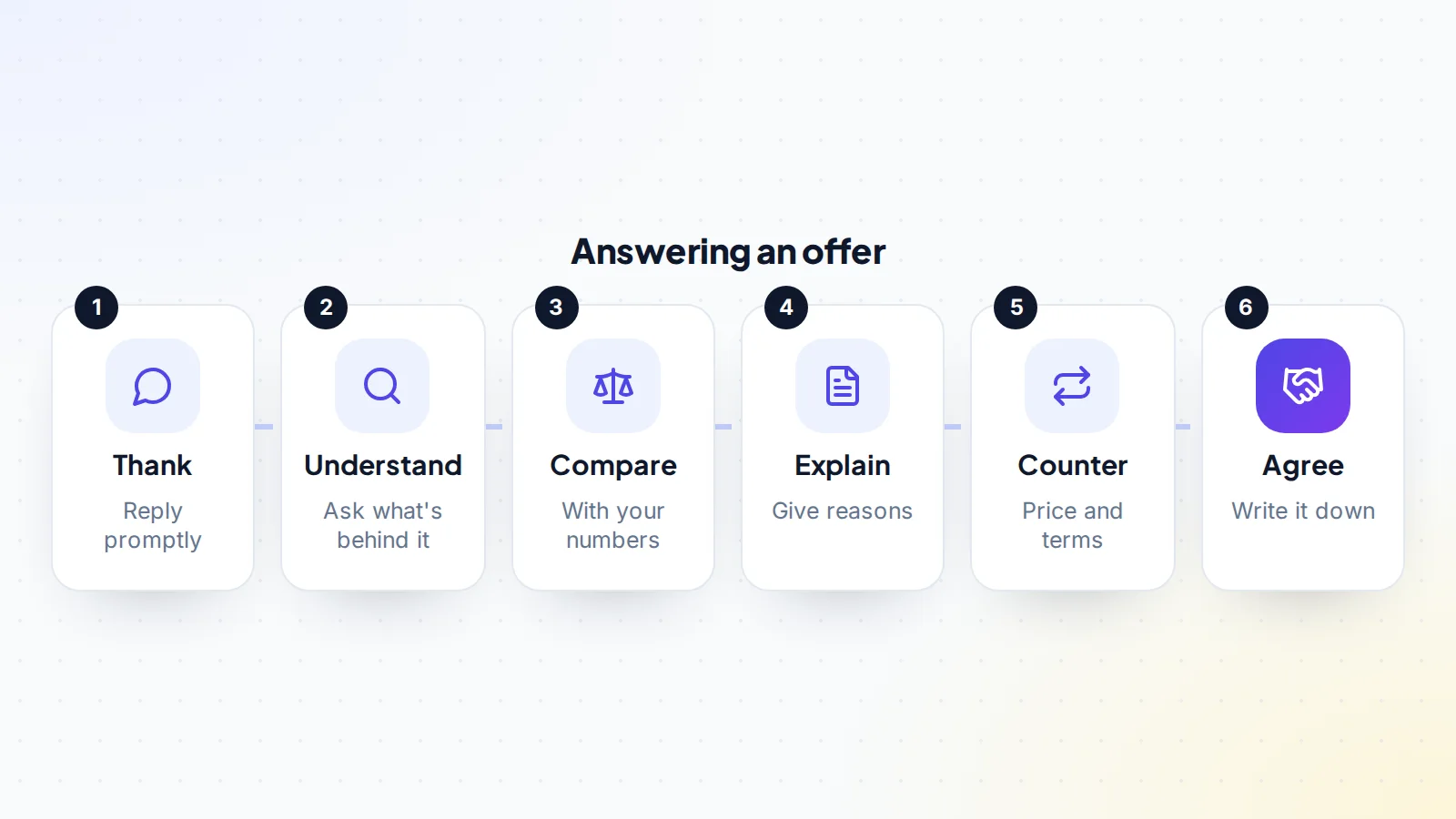
Reply promptly and politely, even if the offer is low. A buyer who feels respected stays at the table. Thank them, then ask what the offer is based on. Buyers often have a reason: a traffic dip, a cost they think you missed, a risk they’ve spotted. Understanding it tells you whether to correct a misunderstanding, address a real concern, or hold firm.
How offers work on digiflippers.com
On digiflippers.com, offers are made on the listing, so there’s a clear record. An offer stays open for 72 hours, offers can’t go below 30% of the asking price, and you can go back and forth for up to 6 rounds. Use the rounds well: each counter should move toward agreement with a reason, not just a smaller gap.
Counter with reasons
A counter-offer with a reason is more persuasive than a bare number. “My asking price reflects twelve months of verified profit and five hours of work a week; I can come down to X if we close within thirty days” gives the buyer something to agree with. Point to evidence: verified metrics, steady trends, documented processes. Read verified metrics.
Move in measured steps. Large early drops suggest the asking price wasn’t serious; tiny moves after a large gap can stall talks. Each move should feel like a response to something the buyer said.
Trade on terms, not just price
When you and a buyer are apart on price, terms can close the gap.
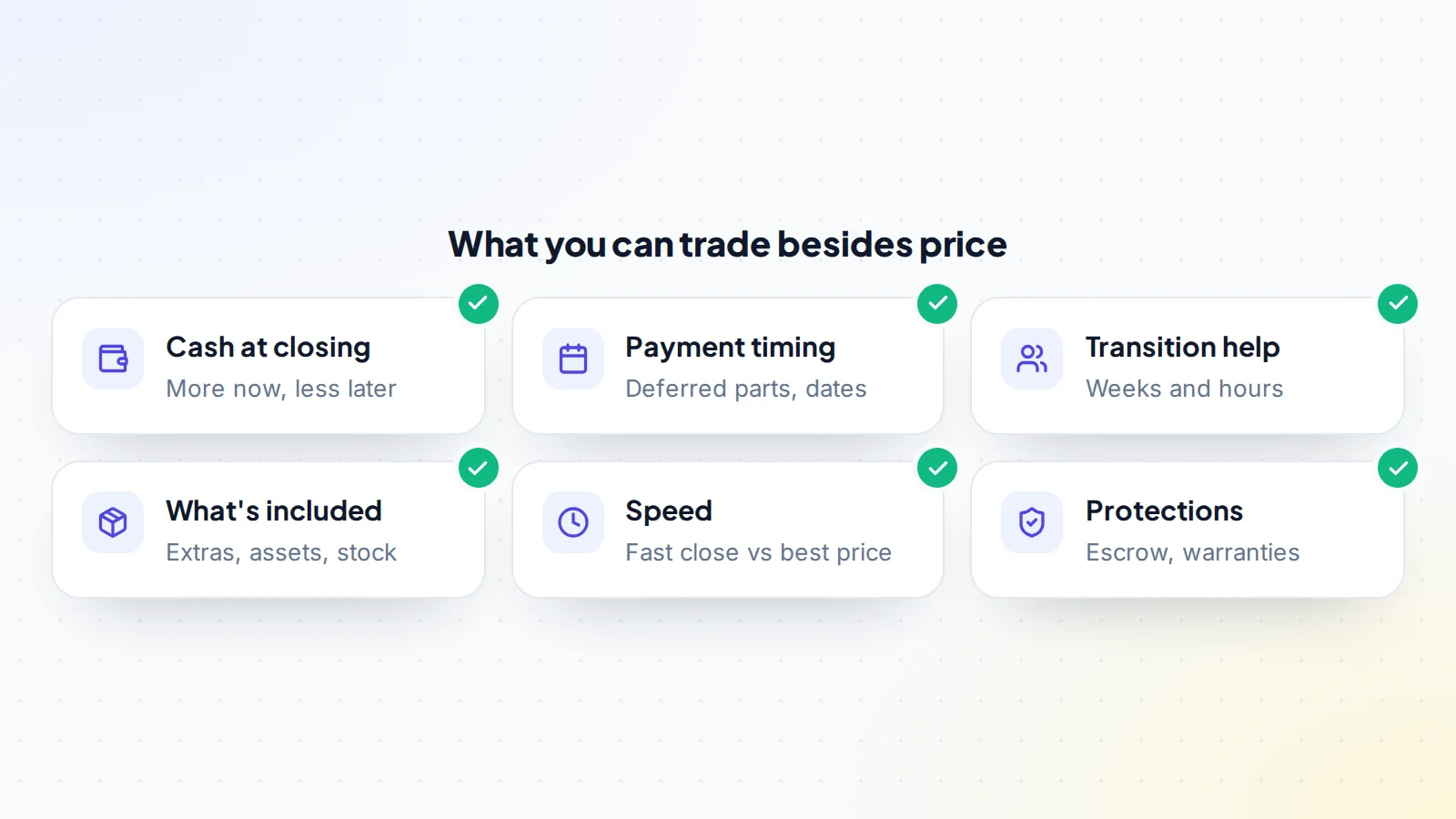
You might accept a slightly lower price for more cash at closing, a faster close or a shorter handover. Or you might hold your price and offer extra transition support, or include an asset the buyer wants. Every term has a value; trade the ones that matter less to you for the ones that matter more.
Comparing offers
When several offers arrive, compare them on what you’ll actually receive, when, and how certain it is.
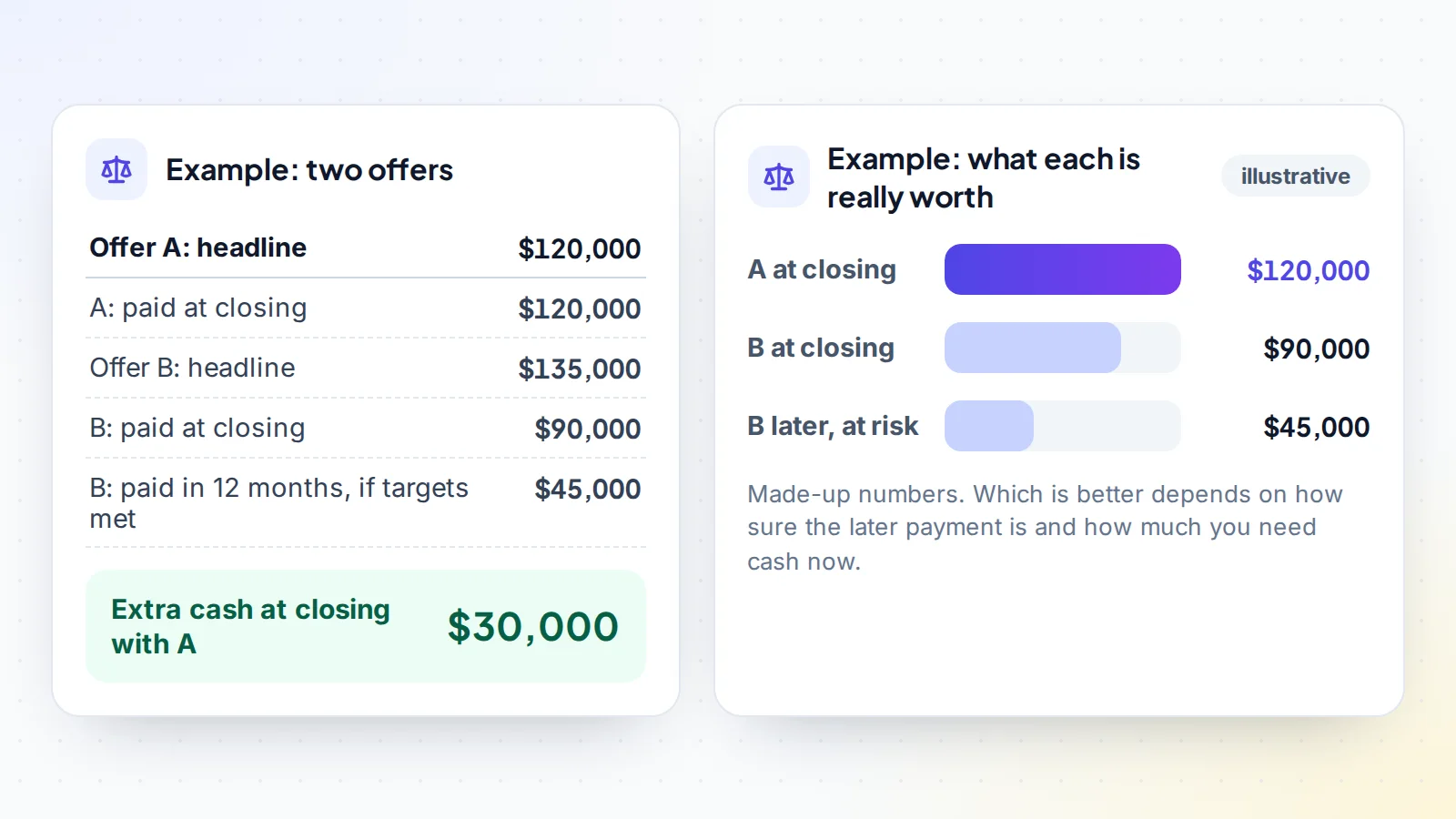
A higher headline with a large deferred part may be worth less than a lower all-cash offer, especially if the later payment depends on targets you won’t control after the sale. Read earn-outs before agreeing to one.
Handling low offers
Very low offers are common, and not always serious. Reply politely with your reasons and a counter, or say the offer is too far from your price to discuss and invite a revised one. Don’t take it personally, and don’t drop your price sharply to meet it. Some buyers start low to test you and come up quickly once they see you know your numbers.
More than one interested buyer
Interest from several buyers strengthens your position, but use it honestly. You can tell buyers others are interested and set a fair deadline for best offers. Don’t invent competing offers; buyers often sense it, and it damages trust if discovered. Treat every buyer with the same respect, because the one you turn down today may be the one who comes back if another deal falls through.
Holding your price through due diligence
Agreeing a price is only the first stage. During due diligence, the buyer checks your numbers. If they hold, your price usually holds too. If they don’t, expect the buyer to ask for a reduction. The best protection is listing accurate figures and disclosing known issues up front. If a buyer raises something new, answer with evidence. If they find a real problem you missed, a fair adjustment often saves the deal. Read inspection periods for the stage after transfer.
Keep emotion out of it
Many sellers built their business themselves, and criticism of it can sting. Buyers aren’t attacking you; they’re managing their risk. Answer questions factually, take a day before replying to anything that annoys you, and keep the conversation on numbers and terms. Calm sellers get better deals.
Control the pace
Reply quickly to keep momentum, but don’t let a buyer rush you into terms you haven’t thought through. If a buyer sets an unrealistic deadline, it’s fine to say you need a day or two. Equally, set your own reasonable deadlines so talks don’t drift for weeks.
Keep it on the platform
Negotiate and agree terms on the marketplace, not in private chats. It gives both sides a record, keeps protections like escrow available, and avoids a common scam pattern where a fake buyer moves the conversation elsewhere. Read off-platform payment scams.
Think about tax and fees
What you keep matters more than the headline. How the price is allocated across assets, whether part is paid later, and who pays which fees all affect your net proceeds. In the US, the IRS explains how buyers and sellers report a business asset sale in its instructions for Form 8594. Read taxes when selling a website, and speak to an accountant before you agree terms. On digiflippers.com, sellers can list with 0% success fee up to $10,000, then 5% (max $5,000); check marketplace fees when comparing where to sell.
Negotiating yourself or with a broker
Brokers negotiate on your behalf and can help with larger, more complex sales, at a cost. Selling directly on a marketplace means you negotiate yourself, keep more of the price, and stay in control. Read marketplace vs broker to decide which suits you, and auction vs fixed price for how the format affects negotiation.
Make every concession count
When you give something, ask for something back. If you lower the price, ask for a faster close or more cash at closing. If you add transition help, ask the buyer to move toward your price. Concessions given for nothing teach the buyer to keep asking; concessions traded for something keep the negotiation balanced. It’s the simplest habit that helps you negotiate as a seller without giving away more than you intended.
Closing the deal
When you agree, write everything down: price, payment schedule, what’s included, transition help, the inspection period, and any warranties. Use escrow so the buyer’s money is held and your handover is protected. Then deliver exactly what you agreed, promptly. A smooth close is the last part of a good negotiation. Read seller protection.
Questions buyers will ask
Expect the same handful of questions in almost every sale: why are you selling, how many hours do you work on it, what would you do next with more time, what are the biggest risks, and how did the numbers change over the last year. Prepare short, honest answers in advance. A seller who answers these clearly and consistently earns trust, and trust is what lets you negotiate as a seller from a position of strength rather than defending every number. Read questions buyers ask for the full list.
When a buyer goes quiet
Buyers sometimes stop replying mid-negotiation. Send one friendly follow-up after a few days, restating where things stand and what you’d need to move forward. If there’s still no answer, carry on with other buyers. Don’t chase repeatedly or cut your price to win back attention; a buyer who returns will do so on their own timeline.
If this is your first sale
First-time sellers often worry they’ll get it wrong. Keep it simple: know your numbers, keep everything on the platform, reply politely, give reasons, and don’t agree to anything you haven’t written down. Read a few completed listings and their outcomes to see what normal looks like. Most buyers are reasonable people trying to make a sound purchase, and a calm, prepared seller is exactly who they want to deal with.
Common mistakes
- No walk-away price decided in advance.
- Ignoring or reacting angrily to low offers.
- Countering with numbers but no reasons.
- Comparing offers only on the headline price.
- Inventing competing offers.
- Numbers that change in due diligence.
- Moving talks to private chats.
A worked example
The details below are made up to show the method.
Rowan lists a newsletter business at $150,000, with a fair value of $140,000 and a walk-away price of $125,000. Two offers arrive. The first is $120,000 all cash. The second is $145,000, with $95,000 at closing and $50,000 in a year if subscriber numbers hold.
Rowan asks the first buyer what the offer is based on; the buyer is worried about a dip in open rates. Rowan shares data showing the dip followed a change in how the email platform counts opens, and that clicks stayed steady. Rowan counters at $140,000 all cash with a closing date within thirty days. The buyer comes back at $134,000 with four weeks of transition help. Rowan compares it with the second offer: $134,000 now beats $95,000 now plus an uncertain $50,000 later. Rowan accepts, they agree terms in writing, and the deal closes through escrow on time.
Negotiate as a seller: the checklist
- Fair value, asking price and walk-away price written down.
- Your priorities on price, cash, speed and handover decided.
- Financials and verified data ready to share.
- Every offer answered promptly with reasons.
- Offers compared on cash, timing and risk.
- Terms used to close gaps on price.
- Talks and agreement kept on the platform.
- Final terms written down and closed through escrow.
Ready to sell? List your business on digiflippers.com, and read how trust and safety protect both sides.
Ready to sell?
List it on digiflippers.com with verified numbers, answer buyers in one place and agree every step in a free Deal Room. 0% success fee up to $10,000, then 5% (max $5,000).
Frequently asked questions
Should I accept the first offer?
Only if it meets your goals. Many first offers leave room to improve through a reasoned counter.
How should I answer a low offer?
Politely, with reasons and a counter, or by inviting a revised offer. Don’t drop your price sharply to meet it.
How many counter-offers are normal?
Often two or three. On digiflippers.com, up to 6 rounds are possible.
Is a higher headline always better?
No. Compare cash at closing, deferred amounts, their conditions and timing.
Can I tell buyers about other offers?
Yes, honestly. Never invent offers that don’t exist.
What if the buyer asks for a lower price after due diligence?
Answer with evidence. If they found a real issue, a fair adjustment can save the deal.
Should I use a broker?
For larger, complex sales it can help. Many sellers negotiate directly on a marketplace.
How do I protect myself at closing?
Write down every term and use escrow so the buyer’s funds are held during the handover.