40 Questions to Ask Before Buying an Online Business
A practical list of questions to ask when buying an online business, grouped by topic: the seller and sale, revenue and costs, traffic and customers, operations, legal and the handover, plus how to judge the answers.

Buying an online business is mostly about asking good questions and checking the answers. The numbers in a listing are a starting point; the conversation with the seller fills in what the numbers can’t show: why the business is for sale, how it really runs, what could go wrong and what moves to you. This guide gives you the questions to ask when buying a business, grouped by topic, explains what good answers look like, and shows how to turn the answers into a price and an agreement.
These questions sit inside a wider review; see our guide to due diligence for online businesses. For warning signs to watch for while you ask, read red flags when buying an online business.
Key takeaways
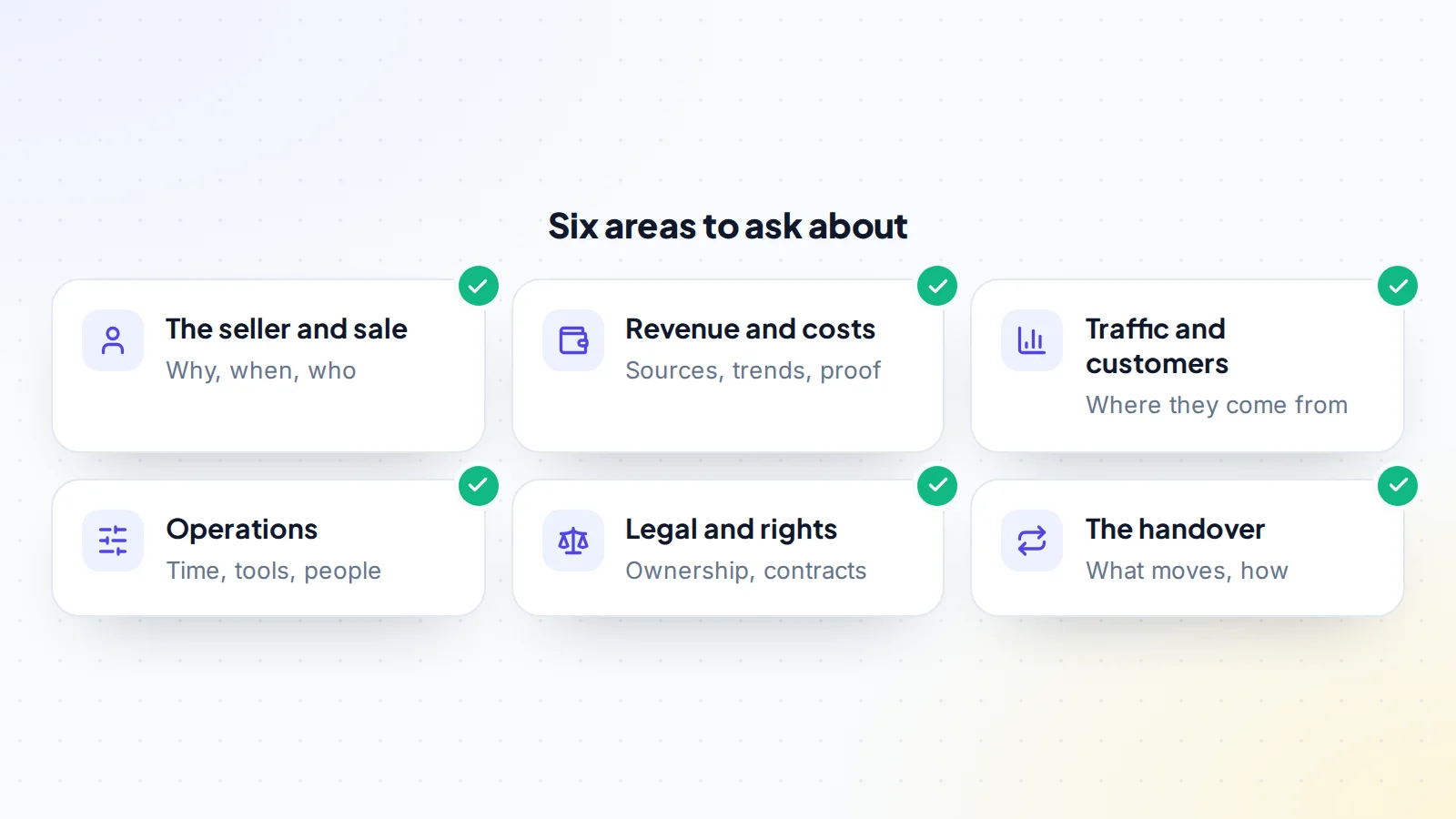
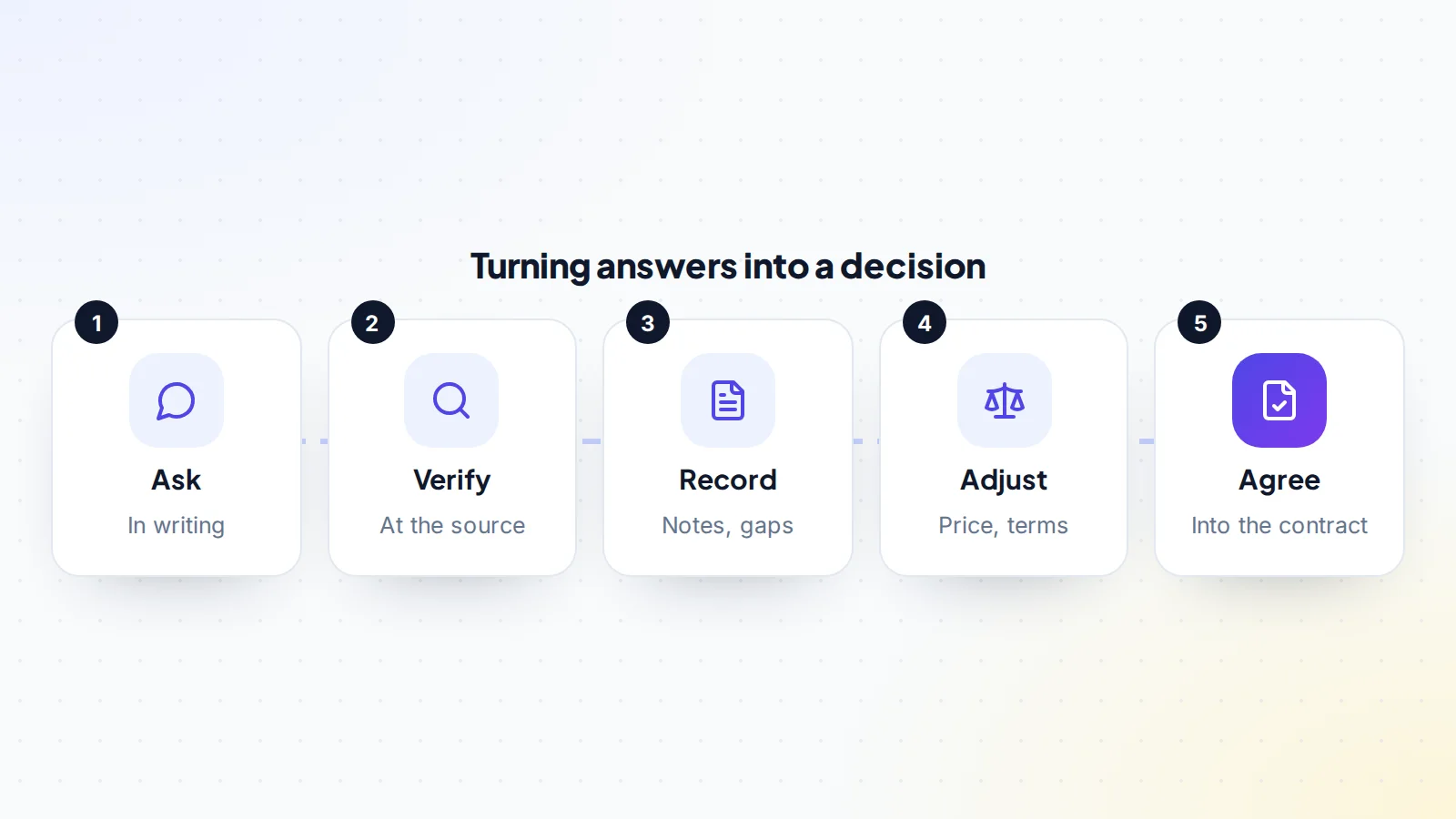
- Ask about six areas: the seller and sale, revenue and costs, traffic and customers, operations, legal matters and the handover.
- Ask in writing on the platform, so the answers form a record.
- Verify every important answer at the source.
- Good answers are specific, consistent and honest about weaknesses.
- Put key answers into the purchase agreement.
Why the questions matter
A listing is written by the seller, for buyers. It highlights strengths and summarises the rest. Questions let you see the parts a summary leaves out: the effort behind the numbers, the risks, the dependencies and the reasons for selling. They also show you how the seller works: whether they’re open, organised and consistent. That matters, because you’ll rely on the same person for the handover and any support afterwards. Asking the right questions when buying a business protects your money and often leads to a fairer price, because both sides end up with the same understanding of what’s being sold.
Prepare before you ask
The best questions come from homework. Before contacting the seller, read the listing carefully, look at the public side of the business, such as the website, social accounts and reviews, and note anything that doesn’t add up. Prepare your questions to ask when buying a business in a simple document, grouped by topic, and tick them off as you go. Preparation saves time for both sides and shows the seller you’re a serious buyer.
How to ask
Before diving in, set yourself up to get useful answers. If detailed data is involved, a short non-disclosure agreement may be appropriate. Keep questions on the platform’s messaging, so there’s a written record; on digiflippers.com, deal messages stay with the deal. Ask a few questions at a time rather than sending a long list at once, and follow up where answers are unclear. Be polite: sellers are more open with buyers who are respectful and organised. Thank them for detailed answers, and explain why you’re asking when a question might seem intrusive.
Questions about the seller and the sale
- Why are you selling, and why now?
- How long have you owned the business, and did you start it or buy it?
- Who else has been involved: partners, co-founders, investors?
- Have you tried to sell it before? What happened?
- What will you do after the sale? Will you start something similar?
- How quickly do you want to close, and is there flexibility?
A clear, believable reason for selling, such as moving on to another project, lack of time or wanting to focus on something else, is reassuring. Reluctance to explain, or a reason that doesn’t match the numbers, deserves gentle follow-up.
Questions about revenue and costs
- Where does each part of the revenue come from, month by month?
- Can you show each source live in its own dashboard?
- How do payouts match bank deposits?
- Has any revenue been one-off, such as a single large deal?
- What are all the monthly costs, including tools, staff and your own time?
- Have prices, commissions or fees changed recently?
- What’s the trend over the last 12 to 24 months, and why?
Our guides to verifying revenue and revenue vs profit explain how to check the answers.
Questions about traffic and customers
- Where do visitors or customers come from, and in what proportions?
- Can you give read-only access to analytics and Search Console?
- Have there been any big changes in traffic, and what caused them?
- Have you ever bought traffic, links or followers?
- Who are the biggest customers or partners, and what share do they bring?
- How many customers come back, renew or buy again?
Questions about operations
- How many hours a week does the business take, and on what?
- Who else works on it: contractors, staff, agencies? Will they stay?
- Which tools, services and suppliers does it depend on?
- Are processes written down?
- What’s the most time-consuming or fragile part of running it?
- What would you improve if you kept it?
Our guide to operational due diligence covers how to check the answers.
Questions about legal matters and rights
- Do you own all the content, code, designs and the domain?
- Were contractors’ rights assigned in writing?
- Are there contracts with suppliers, partners or sponsors that need to transfer?
- Have there been any disputes, complaints, chargebacks or legal notices?
- Are there any platform warnings, manual actions or policy issues?
- Which accounts can change hands, and which can’t?
Our guide to legal due diligence explains the documents to ask for.
Questions about growth and the future
- What opportunities have you not had time to pursue?
- Which ideas did you try that didn’t work, and why?
- Who are the main competitors, and how has competition changed?
- Are there any upcoming changes, such as platform rule updates or price rises, that could affect the business?
- If you were buying it, what would worry you most?
That last question often brings out the most useful answer of all, so leave room for it near the end of the conversation. Sellers know their businesses better than anyone, and many will tell you honestly what keeps them up at night if you ask directly.
Questions about customers and support
- How many support requests come in each month, and who handles them?
- What do customers complain about most?
- What are refund and cancellation rates?
- Are there any unhappy customers or open disputes right now?
- How are reviews and ratings trending?
Customer questions tell you what running the business will feel like day to day, and whether income is at risk from dissatisfaction you can’t see in the numbers.
Questions about the handover
- What exactly is included: domains, accounts, content, lists, tools?
- How will each account and asset move to me?
- How long will the handover take?
- Will you provide support after the sale, and for how long?
- What payment method and protection do you prefer?
- Are you happy with an inspection period before the payment is released?
How to judge the answers
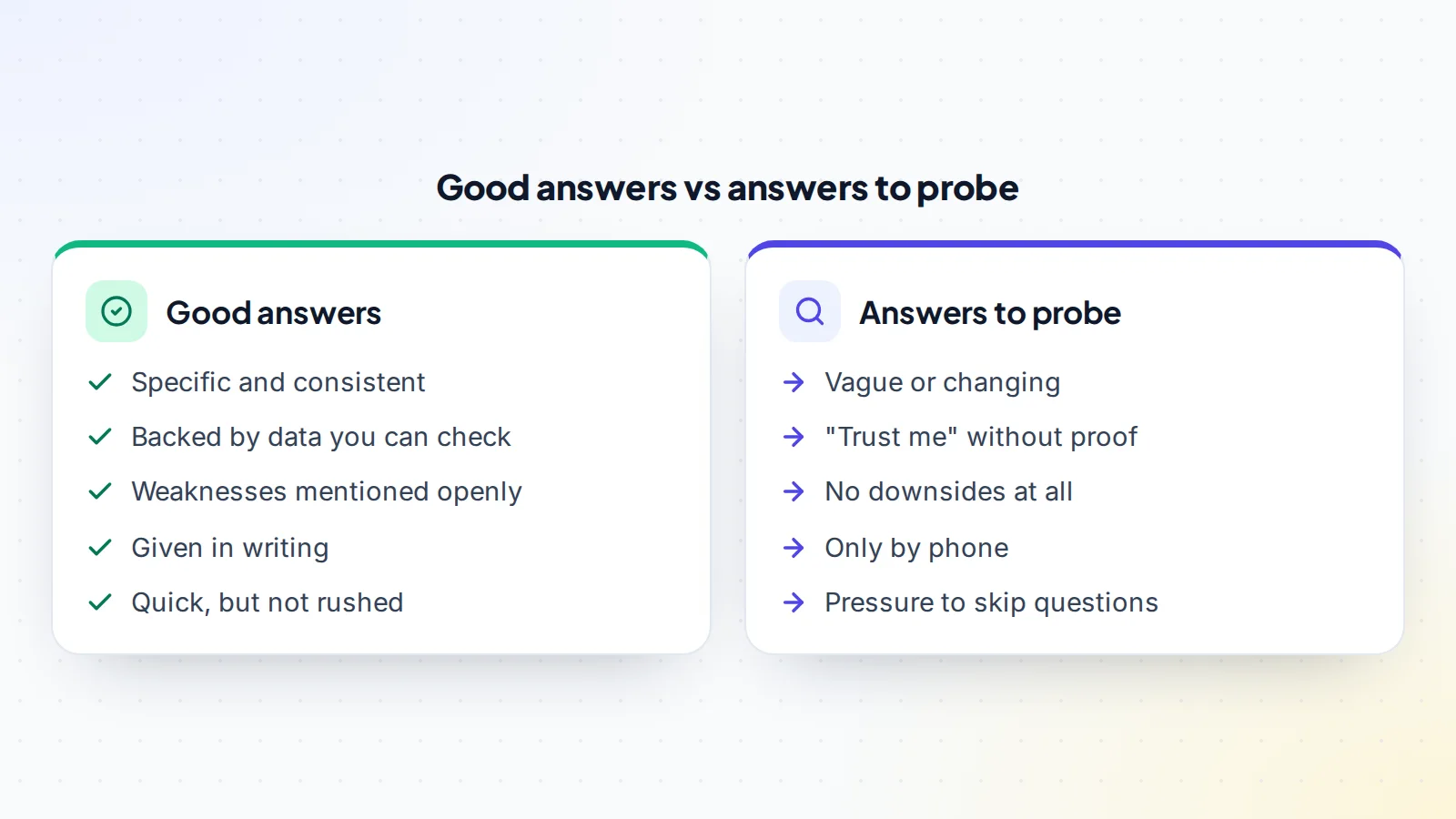
Good answers are specific, consistent across messages, and backed by data you can check. They include weaknesses as well as strengths: every business has some, and a seller who mentions them openly is usually more trustworthy than one who claims none. Answers to probe are vague, change over time, rely on “trust me”, or come with pressure to stop asking. These don’t always mean something is wrong, but each deserves a follow-up and a check at the source.
Watch for answers that push the conversation off the platform or ask you to pay in unusual ways. Our guide to the off-platform payment scam explains why that’s a serious warning sign.
Questions to keep for after closing
Some questions only become useful once you’re running the business. Keep a list for the seller’s support period: how to handle a particular supplier, where a setting lives, why a certain process works the way it does. Agree in advance how and when you can ask, for example a few weeks of email support or a set number of calls. Sellers are usually happy to help when the scope is clear. Our guide to transition support after a sale explains how to agree this.
Verify, don’t just ask
Asking is only half the job. For each important answer, find a way to confirm it: a live dashboard, a bank statement, a contract, an analytics report, a public record. Make a simple note of each question, the answer, how you checked it and what you found. Where you can’t check something, note that too, and decide how much weight to give it. Unverified answers aren’t worthless, but they shouldn’t carry the price on their own, and you may want them written into the agreement as the seller’s confirmed statements. On digiflippers.com, some details can be verified; see how verification works.
Turning answers into a decision
Once you’ve asked and verified, sort what you found into three groups: things that confirm the price, things that should lower it or change the terms, and things that end the deal. Concentrated income, a recent traffic drop or heavy owner time might lower the price. Unclear ownership or a refusal to verify might end the deal. Our guide to pre-revenue valuation shows how evidence shapes price when there’s little profit yet. Then put the key answers into the purchase agreement, as statements the seller confirms are true.
Extra questions by business type
- Content sites: How is content produced, and what does each article cost? Which pages earn most?
- E-commerce: Who are the suppliers, and will they continue? What are return and chargeback rates?
- SaaS and apps: What’s monthly churn? Who maintains the code? How do store transfers work?
- Newsletters and communities: How engaged are members? Which sponsors book repeatedly?
- Social accounts: Where is the audience, and who creates the content?
- Domains: Any trademark conflicts? Is the domain locked or recently transferred?
Common mistakes
- Asking everything by phone, leaving no written record.
- Accepting answers without checking them.
- Sending a huge list of questions at once and getting rushed replies.
- Forgetting to ask why the seller is selling.
- Not putting key answers into the agreement.
A worked example
The details below are made up to show the method.
Kim is buying a small online store selling eco-friendly kitchen products. Over two weeks, Kim asks questions in batches on the platform. The seller explains the sale is to focus on a new job, shows sales in the store dashboard and payouts in the bank, and lists all costs. When asked about suppliers, the seller shares the two main supplier agreements and confirms both have agreed to continue with a new owner.
One answer needs follow-up: traffic from one social platform fell by a third in the spring. The seller explains a change in posting frequency and shows the data. Kim records each question, answer and check, lowers the offer slightly to reflect the social decline, and asks for the supplier confirmations and the seller’s statement about no past chargeback disputes to go into the agreement. The seller agrees, and the deal proceeds through escrow.
Questions to ask when buying a business: the checklist
- Reason for selling asked and understood.
- Revenue sources and costs explained and verified.
- Traffic and customer sources explained and verified.
- Owner time, staff and suppliers understood.
- Ownership, contracts and disputes covered.
- Handover steps and support agreed.
- Answers kept in writing on the platform.
- Key answers written into the purchase agreement.
Use the free valuation tool to sense-check the price once you have the answers.
Ready to find your next asset?
Browse listings with verified numbers, ask sellers your questions before you offer, and agree every step in a free Deal Room.
Frequently asked questions
What should I ask first when buying a business?
Why the seller is selling, how long they’ve owned it, and where the revenue comes from.
Should I ask questions in writing?
Yes. Written answers on the platform form a record you can rely on later.
How do I know if an answer is true?
Verify it at the source: a live dashboard, a bank statement, a contract or an analytics report.
What if the seller won’t answer?
Ask why. A refusal to share basic information, especially about revenue or ownership, is a strong reason to pause.
How many questions should I ask?
Enough to understand every important part of the business. Ask in batches so answers stay thoughtful.
Should answers go into the agreement?
Key ones should, as statements the seller confirms are true.
Are there questions specific to each business type?
Yes. Content sites, stores, SaaS, newsletters, social accounts and domains each have their own extra questions.