Valuing Pre-Revenue Assets: Domains, Audiences and Code
How to value an online asset that doesn't earn yet: cost to rebuild, comparable sales, traffic and audience value, user traction and asset value, the evidence buyers trust, and how sellers can present a pre-revenue project.

Most online businesses are valued as a multiple of profit. But what if there isn’t any profit yet? New content sites, apps in early growth, communities, tools and side projects often have real value before they earn: traffic, users, content, code and a head start that would take a buyer months to build. Pre-revenue valuation is about pricing that value fairly, without inventing income that doesn’t exist. This guide explains the methods buyers use, the evidence they trust, and how sellers can present a pre-revenue project so it sells.
For the basics of pricing businesses that already earn, see our guide to online business valuation. When you’re ready to set a number, read how to price a business listing.
Key takeaways
- Pre-revenue assets are valued on what a buyer saves and what the evidence shows, not projected income.
- Common methods: cost to rebuild, comparable sales, traffic value, user traction and asset value.
- Use two or three methods and compare them to find a fair range.
- Live analytics, real users and a clear trend count far more than forecasts.
- Prices are usually much lower than for earning businesses, because the risk is higher.
Why pre-revenue assets have value
Building an online asset takes time and money. A buyer who purchases a site with 100 good articles, steady search traffic and a clean design skips months of work. A buyer who purchases an app with a growing user base skips the slow early stage where most apps fail. Those savings, and the head start they bring, are real value even before the first sale.
Pre-revenue assets also appeal to buyers who already know how to earn from them. An experienced affiliate marketer may see a content site with traffic but no monetisation as an opportunity; a software company may see an early tool as a feature for its own product. The asset is worth more to some buyers than others, which is why finding the right buyer matters. A listing that explains clearly who the asset suits helps the right buyers recognise it quickly.
How it differs from valuing an earning business
When a business earns, buyers pay a multiple of verified profit, adjusted for risk. Without profit, there’s nothing to multiply. Pre-revenue valuation replaces the profit figure with other evidence: cost, comparable sales, traffic and users. Because there’s no proof the asset can earn, buyers carry more risk, so prices are usually far lower than for a business with the same traffic and steady income.
That’s not a reason to undervalue a good project. It’s a reason to present the evidence well and to choose the methods that fit the asset.
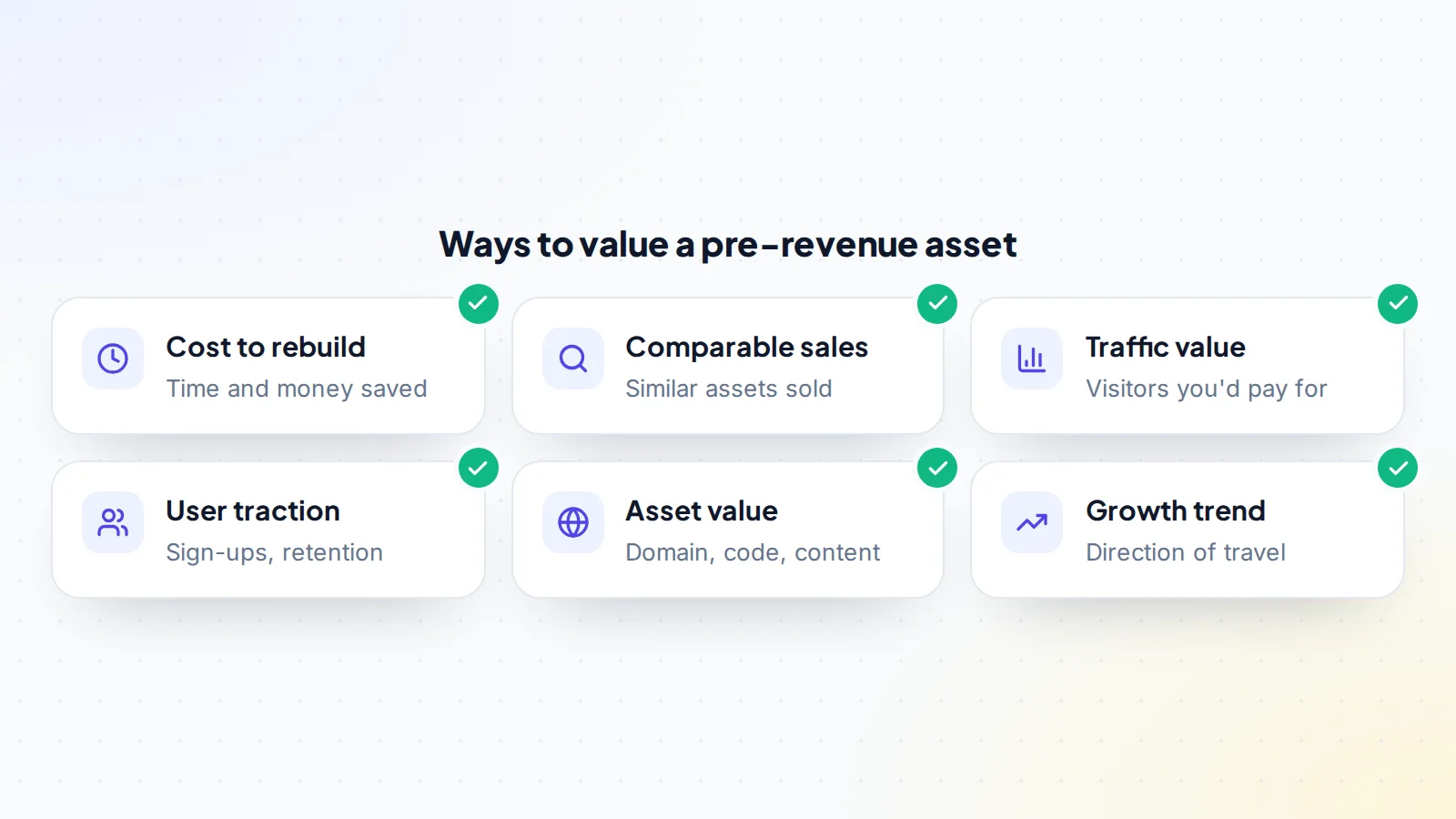
Method 1: Cost to rebuild
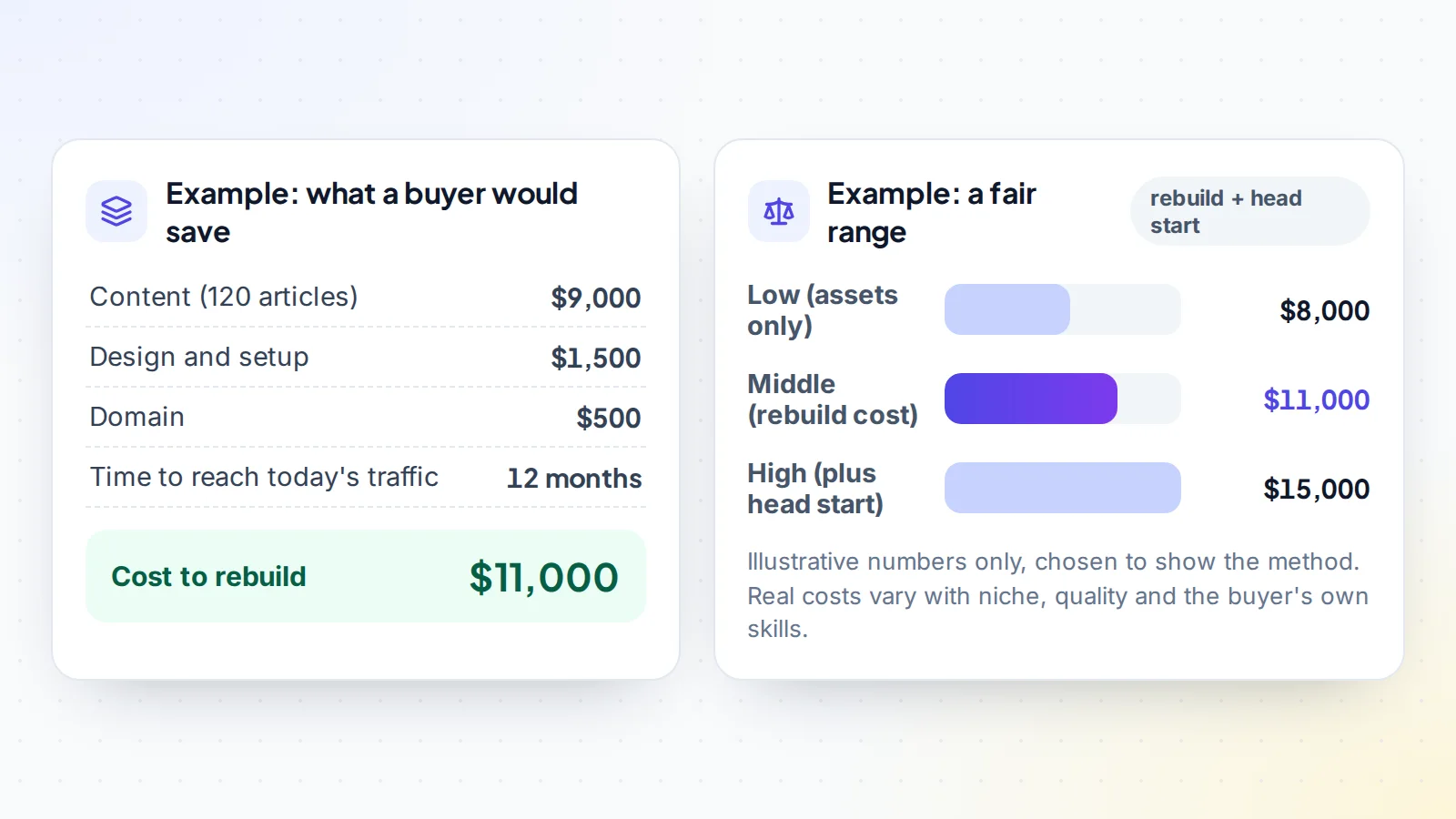
The simplest approach asks what it would cost a buyer to build the same thing from scratch: content, design, development, setup, the domain and any tools. Add a value for time, because even with money, reaching the same traffic or users takes months. This method sets a sensible floor: most buyers won’t pay much more than it would cost to build, unless the asset has something hard to replicate, such as a great domain, rankings or a community.
Be realistic about costs. Use typical market rates for writers or developers in the niche, not the most expensive ones, and don’t count work that doesn’t contribute to the asset’s value.
Method 2: Comparable sales
Look at what similar pre-revenue assets have sold for: sites of a similar size and niche, apps with similar user numbers, communities with similar membership. Marketplaces often show sold or recently listed assets. Comparables are useful because they reflect what buyers actually pay, but they need judgement: no two assets are identical, and listing prices aren’t the same as sale prices. Our guide to the growth trend in valuation explains how to adjust for momentum when comparing.
Method 3: Traffic and audience value
For content sites, communities and social accounts, traffic or audience can be valued by what it would cost to get the same visitors another way, for example through paid advertising, or by what similar audiences earn once monetised. Treat this carefully: it shows potential, not income. Buyers will want to see that traffic is real, steady and relevant before they give it much weight. Our guide to SEO due diligence explains how buyers check search traffic.
Method 4: User traction
For apps, tools and SaaS products, users are the main evidence. Buyers look at sign-ups over time, active users, retention after a week and a month, and how users engage. A product with a small but loyal user base, where people keep coming back, can be worth more than one with many sign-ups who never return, because loyal users are the clearest sign that people would eventually pay. Growing waiting lists, user feedback and early paying intentions, such as pre-orders, also count as evidence.
Method 5: Asset value
Some pre-revenue projects are mainly valued for their parts: a strong domain name, a codebase that saves development time, a library of content, designs or a brand. A premium domain alone can be worth more than the site built on it. Our guide to WordPress plugin businesses shows how code and an established listing carry value even before strong revenue.
Combining the methods
No single method is perfect, so use two or three and compare the results. If cost to rebuild suggests $10,000 and comparable sales suggest $8,000 to $14,000, a range around $9,000 to $13,000 is easier to defend than either number alone. Write down how you reached each figure, including the rates and sources you used. Buyers trust a range they can follow more than a single number they can’t.
The evidence buyers trust
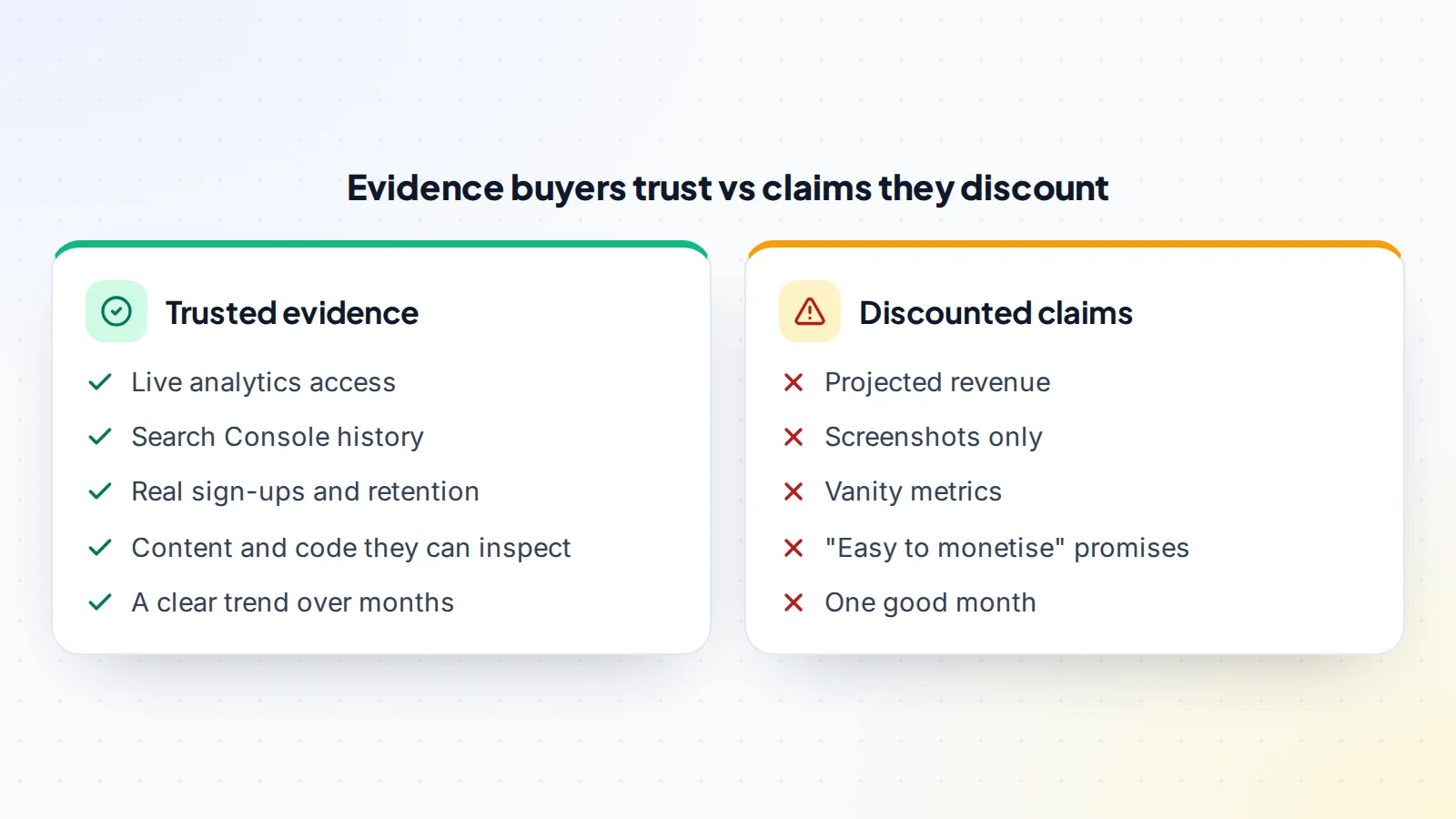
Without profit to verify, the quality of the evidence carries the price. Buyers trust live access to analytics, Search Console history, real user numbers in the product’s own dashboard, and content or code they can inspect. They discount projections, screenshots without live access, vanity metrics and promises that the asset will be “easy to monetise”. On digiflippers.com, some metrics can be verified; see how it works.
Why the trend matters so much
For a pre-revenue asset, the direction of travel is often more important than today’s numbers. A site gaining traffic every month, or an app with retention improving, suggests the asset is getting stronger. A flat or falling trend suggests the opposite. Show at least six months of history, ideally more, and explain any jumps or dips. Our guide to revenue diversification explains why buyers also look at how many sources traffic comes from.
Showing monetisation potential honestly
Sellers often want buyers to see the earning potential. That’s fair, as long as it’s presented as potential, not income. Good ways to do it include listing realistic monetisation routes for the niche, showing any small tests that have been run, such as a few affiliate links or a waiting list for a paid feature, and pointing to comparable assets that earn. Avoid putting projected revenue at the centre of the listing or in the headline; buyers will discount it, and it can make the rest of the listing look less credible.
Who buys pre-revenue assets
- Experienced operators who know how to monetise the niche and want a head start.
- Portfolio builders adding sites or apps that fit what they already own.
- Businesses buying a tool, audience or domain that complements their product.
- First-time buyers who want a smaller, lower-risk project to learn on.
Knowing which buyers fit your asset helps you present it in the right way and set a realistic price.
How the methods apply by asset type
- Content sites: cost to rebuild and comparable sales usually lead, with traffic value as support. Search history matters a great deal.
- Apps and SaaS tools: user traction and retention lead, supported by the value of the code and any early paying intentions.
- Communities and newsletters: engaged members or subscribers lead, judged by activity rather than size.
- Social accounts: audience quality and engagement lead, compared with similar accounts.
- Domains with a basic site: the domain’s own value usually dominates.
Choosing the right lead method for the asset type keeps a pre-revenue valuation grounded in the evidence that matters most for that kind of asset.
Deal terms that share the risk
Because pre-revenue assets carry more uncertainty, deal terms can help buyer and seller meet in the middle. A lower upfront price with a bonus if the asset reaches agreed milestones, such as a traffic level or first revenue, rewards the seller if the potential is real. A longer inspection period gives the buyer time to confirm traffic and users after the handover. Keep any such terms simple and measurable, and write them into the agreement.
Setting the price
Start from the range your methods produce, then adjust for quality and risk: the strength of the evidence, the trend, the niche, how much work the buyer will need to do, and how hard the asset would be to replicate. Price within the range so that buyers who check your evidence see a fair deal. For a quick starting point, try the free valuation tool, then refine it with your own evidence.
For sellers: presenting a pre-revenue project
- Offer read-only access to analytics and other dashboards.
- Show at least six months of history and explain the trend.
- List what’s included: domain, content, code, designs, accounts.
- Describe realistic monetisation routes, clearly labelled as potential.
- Explain why you’re selling and how much time the project takes.
When you’re ready, list your project on digiflippers.com with 0% success fee up to $10,000, then 5% (max $5,000).
For buyers: what to check
- Traffic or users seen live, with sources and trend.
- Content, code or designs inspected directly.
- Domain history and any trademark conflicts.
- The time and money you’d need to start earning.
- How the asset transfers and what you’ll need to set up.
Common mistakes
- Pricing on projected revenue as if it were real.
- Relying on one valuation method.
- Counting every hour spent as value, even unproductive ones.
- Showing only the best month instead of the trend.
- Ignoring how much work a buyer needs to earn from the asset.
A worked example
The details below are made up to show the method.
Noah has built a site about indoor plant care with 120 articles and about 15,000 monthly visitors from search, growing steadily for eight months. It hasn’t been monetised. Noah estimates the cost to rebuild at about $11,000: $9,000 for content at typical rates, $1,500 for design and setup, and $500 for the domain. Similar unmonetised sites listed recently in the same niche ranged from about $8,000 to $14,000.
Noah sets a range of $10,000 to $13,000, lists the site at $12,500 with read-only analytics access and a short note on realistic monetisation routes, clearly labelled as potential. An affiliate marketer checks the traffic, reads the articles and offers $11,500, which Noah accepts. The payment is held in escrow while the site moves.
Pre-revenue valuation: the checklist
- Cost to rebuild estimated at realistic rates.
- Comparable sales gathered and adjusted.
- Traffic or user traction shown live, with trend.
- Asset value of domain, code and content considered.
- Two or three methods compared to find a range.
- Monetisation potential described honestly.
- Price set within the range, adjusted for quality and risk.
- Payment through escrow when the deal is agreed.
Ready to find your next asset?
Browse listings with verified numbers, ask sellers your questions before you offer, and agree every step in a free Deal Room.
Frequently asked questions
How do you value a website with no revenue?
Use methods such as cost to rebuild, comparable sales, traffic value and asset value, then compare them to find a fair range.
Do pre-revenue assets sell for less?
Usually, yes. Without proof of earnings, buyers carry more risk, so prices are lower than for earning businesses with similar traffic.
What evidence do buyers trust most?
Live analytics, Search Console history, real user data, content and code they can inspect, and a clear trend over months.
Should I include projected revenue?
Only as clearly labelled potential. Buyers discount projections, and leaning on them can weaken the listing.
How long a history should I show?
At least six months, ideally more, so buyers can see the trend.
Who buys pre-revenue projects?
Experienced operators, portfolio builders, businesses looking for a complement to their product, and first-time buyers.
What’s the most common mistake?
Pricing as if projected income were already real.