How Long Should a SaaS Founder Stay After the Sale?
A guide to the SaaS transition period: knowledge transfer, technical handover, customers and billing, support, how long it should last, paid vs included support, milestones, and how it links to earn-outs.

Buying a SaaS business means taking over a living product: code that needs deploying, servers that need watching, customers who need answers and subscriptions that need billing. Even with good documentation, a new owner benefits from the seller’s help in the first weeks. That’s the SaaS transition period: an agreed time in which the seller helps the buyer take over smoothly. This guide explains what it covers, how long it should last, how to structure it, and how it protects customers and revenue during the change.
For the seller’s side of the sale, see how to sell a SaaS business. Transitions often link to deferred payments; read about the earn-out.
Key takeaways
- A transition period is the seller’s agreed help after closing.
- It covers code, infrastructure, billing, customers, processes and relationships.
- Length depends on complexity, from a couple of weeks to a few months.
- Clear terms: length, hours, deliverables, response times and a rate for extra help.
- A good transition protects revenue, customers and the buyer’s confidence.
Why SaaS needs a transition period
Software businesses have more moving parts than most online businesses. There’s a codebase with its own quirks, infrastructure that must stay up, deployment processes, third-party services, a billing system tied to customer subscriptions, and customers who rely on the product every day. Documentation helps, but some knowledge only comes from experience: why a setting is configured a certain way, which alerts matter, how to handle a particular customer. A transition period lets that knowledge pass from seller to buyer without disrupting customers. It also gives the buyer a safety net: if something unexpected happens in the first weeks, the person who knows the product best is still on hand to help.
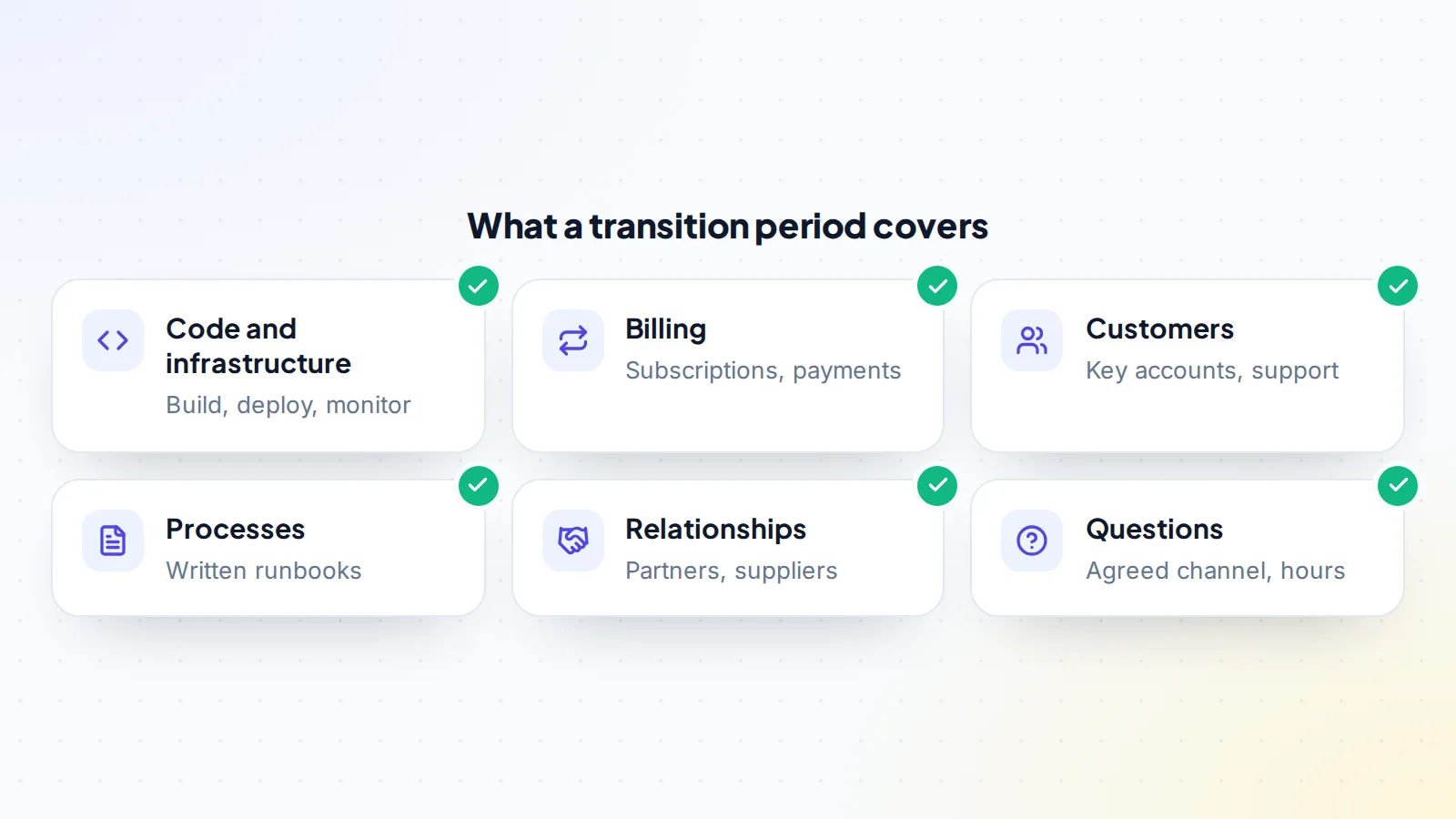
What it usually covers
- Code and infrastructure: how to build, test, deploy and monitor the product; where everything is hosted; how to handle incidents.
- Billing: how subscriptions and payments work, and how they’re moving to the buyer’s accounts.
- Customers: introductions to key accounts, support processes and common questions.
- Processes: written runbooks for regular tasks, from releases to renewals.
- Relationships: introductions to partners, suppliers, contractors and integration providers.
- Questions: an agreed way for the buyer to ask, with response times.
How long it should last
There’s no single right length. A small, well-documented tool with few customers might need two to four weeks. A larger product with complex infrastructure, enterprise customers or a small team might need a few months. Base the length on complexity, the buyer’s experience and how much is already documented. Many deals combine a shorter intensive period with a lighter “on call” period afterwards. That keeps the seller’s commitment manageable while giving the buyer a safety net for the less common tasks that only come up once a month or once a quarter.
Structuring the transition
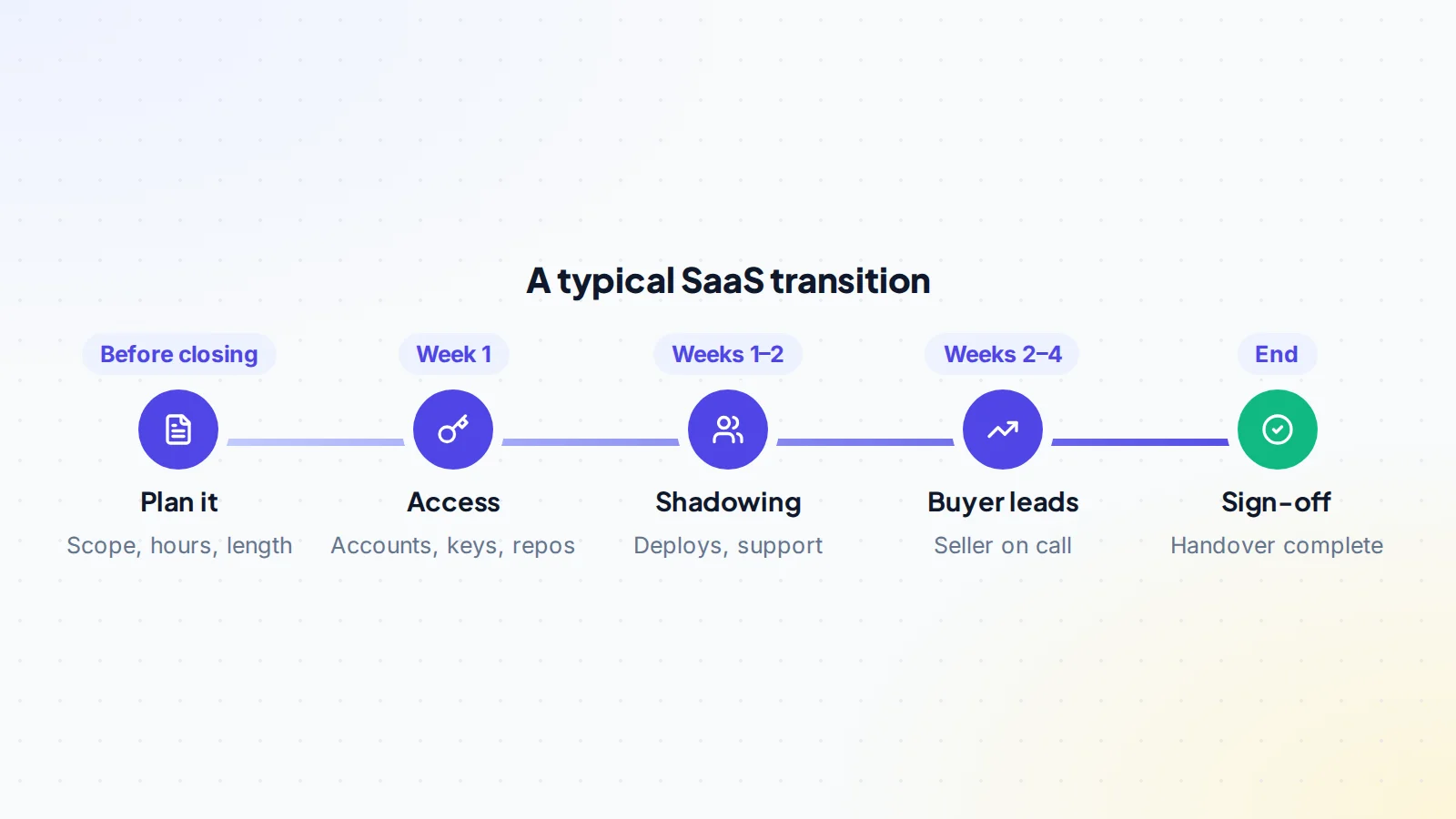
A typical structure runs in phases. Before closing, both sides agree the scope, hours and length. In the first week, access moves: accounts, keys, repositories and admin panels. Next, the buyer shadows the seller: watching deployments, support and routine tasks. Then the buyer takes the lead, with the seller available for questions. Finally, both sides sign off that the handover is complete. Write the phases and deliverables into the agreement so there’s no confusion later.
Billing and subscriptions
Billing is often the most sensitive part of a SaaS handover, because it’s where revenue lives. Plan how subscriptions will continue: whether the payment account itself moves, or customers and payment methods are copied to a new account. Stripe, for example, has guidance on transferring an account when a business is sold, and on which data can be copied between accounts; subscriptions and payment history don’t always copy automatically, so a migration may need rebuilding subscriptions. Our guide to transferring Stripe subscriptions explains the options. The seller’s help during the transition is often essential here.
Documentation to ask for
The more is written down before the transition starts, the more the seller’s time can go on judgement rather than basics. Useful documents include a system overview showing how the parts fit together, setup instructions for a development environment, deployment and rollback steps, a list of third-party services with their purpose and cost, an incident guide for common problems, and notes on the billing setup. Ask for them during due diligence, so gaps are clear before closing. Missing documentation isn’t a deal-breaker, but filling it in should be part of the transition’s deliverables.
Handling incidents during the handover
Things sometimes break during a transition: a deployment fails, a server runs out of space, a payment provider flags an account. Agree in advance how urgent problems are handled: who’s on call, how quickly the seller will respond, and when the buyer should act alone. A simple shared contact channel for urgent issues, and a short list of what counts as urgent, prevent panic and protect customers. Incidents during the transition are also excellent learning moments, so record what happened and how it was fixed.
Customers during the transition
Customers should notice as little change as possible. Keep the product, pricing and support standards steady. For key accounts, a short introduction from the seller to the new owner helps maintain trust. Decide together whether and how to announce the change publicly. Watch churn and support tickets closely during the transition; a rise is an early sign something needs attention, and the seller can often explain it quickly while still involved.
Writing clear terms
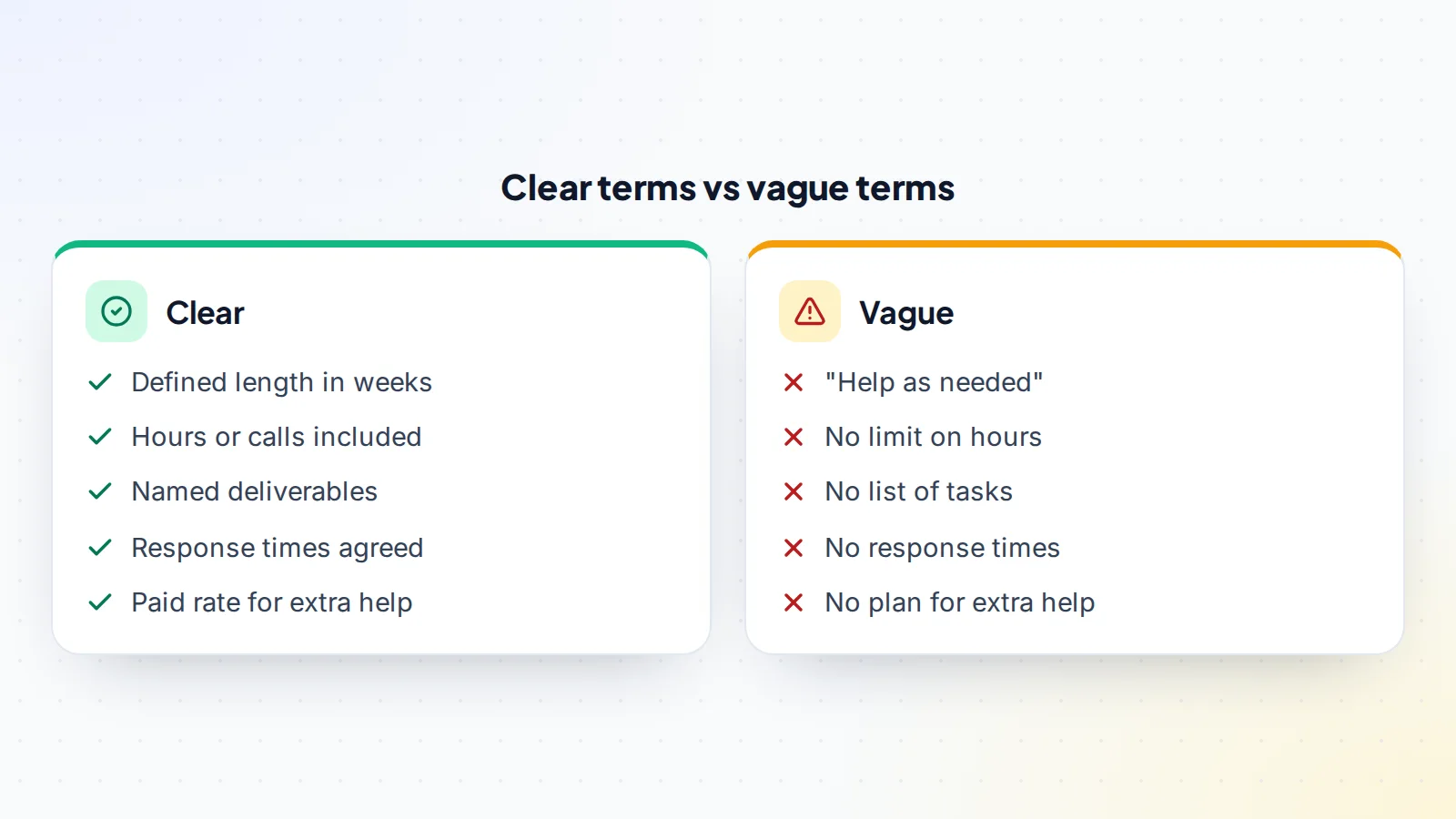
Vague terms such as “the seller will help as needed” cause frustration on both sides: the buyer expects more, the seller expects less. Clear terms include:
- The length in weeks, with a start and end date.
- The hours or number of calls included.
- Named deliverables, such as documentation, introductions and specific handover tasks.
- Response times for questions, and how urgent issues are handled.
- A paid hourly or daily rate for help beyond the included amount.
Included vs paid support
Some transition support is usually included in the price, because it’s part of handing over what was sold. Longer or more intensive support, such as ongoing development work, is often paid separately, at an agreed rate or as a short consulting arrangement. Agree where the line is in advance. If the seller is also receiving an earn-out, they have their own reasons to help the business succeed, but the earn-out shouldn’t replace clear transition terms.
If there’s a team
Many small SaaS businesses rely on contractors or a small team: developers, support staff, designers. Find out who they are, what they do and whether they’ll continue. Introductions during the transition, and clear agreements about their future roles, protect continuity. If key people won’t stay, plan how their knowledge will be captured before they leave. Our guide to supplier due diligence covers checking the people and services a business depends on.
The seller’s point of view
Sellers often have their own plans after a sale: a new job, a new project or simply a break. A well-defined transition lets them help properly without an open-ended commitment. Sellers should prepare documentation before closing, block time in their calendar for the agreed period, and be clear about availability, especially across time zones. A seller who delivers a smooth transition protects their reputation, which matters if they sell again, and often receives any deferred payment sooner and with less friction.
Working across time zones
Buyers and sellers are often in different countries. Agree a few overlapping hours each week for calls, use written handover notes for everything else, and record key sessions such as a walkthrough of the deployment process so the buyer can watch them again. Clear written communication reduces the need for constant calls and gives the buyer a lasting reference.
Security during the handover
Moving access is a security moment. Change passwords and keys as accounts move, rotate API keys and secrets the seller knew, review who has access to servers, repositories and admin panels, and remove the seller’s access once their help is no longer needed. Keep a written list of every credential that changed. Our guide to transferring accounts with two-factor authentication explains how to move second factors cleanly.
How buyers can prepare
- Set up the accounts you’ll need before closing: hosting, payments, email and tools.
- Read the documentation and list questions in advance.
- Plan who on your side will handle development and support.
- Book the transition calls in your calendar for the whole period.
- Keep notes as you learn, building your own runbook.
Buyers who prepare get far more from the seller’s time, and finish the SaaS transition period ready to run the product with confidence.
How the transition affects value
A strong transition plan supports the price, because it reduces the risk of losing customers or revenue after the sale. Businesses that depend heavily on the seller are usually discounted unless the transition is solid. Our guide to SaaS valuation multiples explains how owner dependence affects the multiple, and our guide to add-backs covers how the seller’s own time is treated in profit.
AI products and fast-moving tools
Products built on fast-changing technology, such as AI tools that depend on third-party models and APIs, often need a longer or more technical transition, because model changes, usage costs and prompt designs can affect both quality and margins. Our guide to AI SaaS businesses for sale covers the extra checks for these products.
Signing off the transition
At the end, confirm in writing that the agreed deliverables are complete: access moved, documentation delivered, billing working, introductions made, and the buyer running releases and support independently. If anything is outstanding, agree a short extension with a clear list. A formal sign-off gives both sides closure, and if part of the price depends on the handover, it marks the point where that payment can be released.
Common mistakes
- Agreeing “help as needed” without limits or deliverables.
- Starting the transition without a plan for billing.
- Leaving key contractors’ plans unclear.
- Not rotating keys and passwords after access moves.
- Ending the transition without a written sign-off.
A worked example
The details below are made up to show the method.
Robin buys a scheduling SaaS with 600 paying customers, built and run by its founder with one part-time support contractor. They agree a six-week transition: two weeks of daily calls, then four weeks with the founder on call for up to five hours a week, with a paid rate for anything beyond that.
In week one, access to the code repository, hosting, monitoring and billing moves to Robin, and keys are rotated. In weeks one and two, Robin shadows two releases and the support inbox. By week three, Robin is releasing updates with the founder watching. The support contractor agrees to stay. The founder introduces Robin to the five largest customers. At the end of week six, both sign off, and churn has stayed at its usual level.
SaaS transition period: the checklist
- Length, hours and deliverables agreed in writing.
- Paid rate for extra help agreed.
- Access to code, hosting, billing and tools moved.
- Keys and passwords rotated.
- Billing and subscriptions plan in place.
- Key customers and partners introduced.
- Team and contractors’ roles confirmed.
- Runbooks and documentation delivered.
- Written sign-off at the end.
Browse SaaS businesses for sale, or list your SaaS with 0% success fee up to $10,000, then 5% (max $5,000). Read how it works on digiflippers.com.
Ready to find your next asset?
Browse listings with verified numbers, ask sellers your questions before you offer, and agree every step in a free Deal Room.
Frequently asked questions
What is a SaaS transition period?
An agreed time after closing in which the seller helps the buyer take over the product, customers and operations.
How long should it last?
From a couple of weeks for simple products to a few months for complex ones.
Is transition support included in the price?
Usually some is. Extra or ongoing help is often paid separately at an agreed rate.
What’s the hardest part of a SaaS handover?
Often billing and subscriptions, because that’s where revenue lives.
Should customers be told about the sale?
It depends. Key accounts usually benefit from an introduction; a public announcement is a judgement call.
How does it relate to an earn-out?
An earn-out gives the seller a reason to help, but clear transition terms are still needed.
When is the transition complete?
When agreed deliverables are done and both sides sign off in writing.