How to Sell a Domain Name: Pricing, Listing and Transfer
Pricing, listing, negotiating and transferring: how to sell a domain name for a fair price and get paid without risk.

Most domain names are bought to be used, but a good one can be worth far more to someone else than the few dollars a year it costs you. Whether you own a single name you never built on or a portfolio of hundreds, selling well comes down to the same things: a sensible price, the right place to list, a buyer who’s serious and a sale process that protects you.
This guide explains how to sell a domain name from start to finish. You’ll learn what drives domain prices, where buyers look, how to write a listing and handle enquiries, how to negotiate, and exactly how payment and transfer work so you never hand a name over before you’re paid.
It applies to the common generic extensions such as .com, .net and .org. Country-code domains work in much the same way but can have their own transfer rules, so check your registry’s terms before you agree a timeline.
Key takeaways
- Price on evidence: length, extension, meaning, brandability, comparable public sales and a clean history.
- List where buyers already look, and make it easy to buy: a clear price or a clear way to make an offer.
- Check that your domain isn’t locked by a recent change and that you know how to get the transfer code.
- Negotiate patiently. Most domain sales take time, and the first offer is rarely the best.
- Only transfer once payment is secured, through escrow or another protected method.
Step 1: Make sure the domain is ready to sell
Before you look for buyers, check that nothing will slow the sale down later. Look your domain up with ICANN’s free ICANN Lookup tool, which shows the current registration data, and confirm:
- You control the registrar account the domain sits in, with two-factor authentication on.
- The expiry date isn’t close. A buyer will hesitate over a name that’s about to lapse.
- There are no recent changes that could block a transfer. Registrars can refuse a transfer for a period after a domain is registered or transferred, and some apply a lock after a change of registrant details. Our guide to the domain transfer lock explains when this applies.
- You know how to get the transfer code. ICANN’s rules say your registrar must provide the authorisation code within five calendar days of your request, and many registrars let you generate it yourself.
Also check the domain’s history on the Internet Archive’s Wayback Machine. If it was once used for spam, buyers who check will find it too, and it’s better to know first.
Step 2: Work out a realistic price
Domain prices don’t come from a formula. They come from what a buyer is willing to pay for a name, which depends on how useful and how scarce it is. Look honestly at these factors:
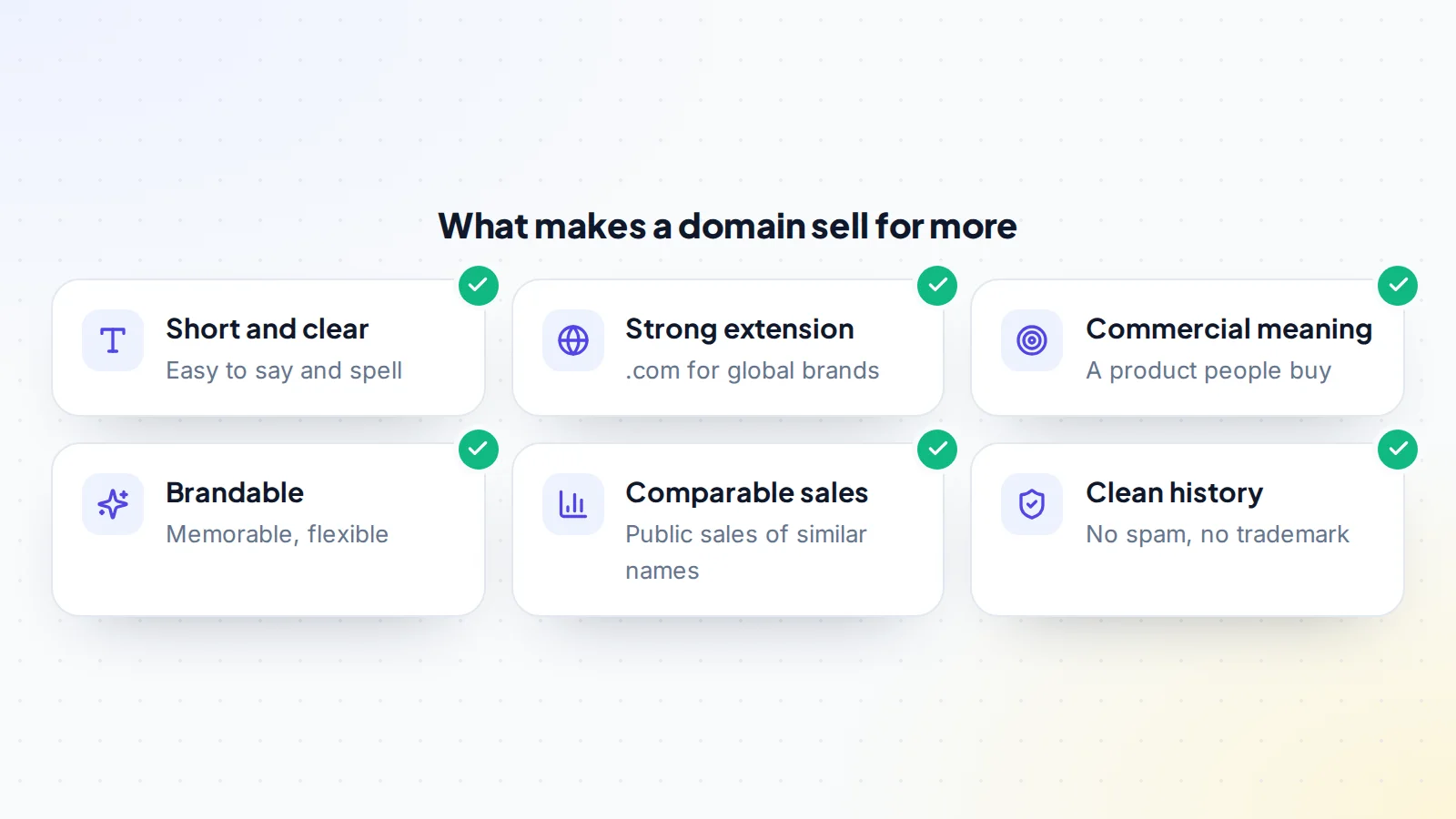
- Length and clarity. Shorter names that are easy to say, spell and remember are worth more.
- Extension. .com remains the default for global brands. Other extensions can sell well when they fit the use, but usually for less. See domain extensions explained.
- Commercial meaning. A name that matches a product or service people spend money on has a bigger pool of buyers.
- Brandability. Invented or brandable names can be worth a lot to the right startup, even with no dictionary meaning.
- Comparable sales. Public sales of similar names are the best evidence you have. Use them to anchor your price.
- Trademark safety. A name that copies an existing brand is a liability, not an asset, and can be taken under ICANN’s UDRP. Read trademarks and domains before you list a name like that.
Be careful with automated appraisals. They can give you a rough idea, but they often disagree with each other and with real sales. Our guide to how much a domain is worth goes through each factor with examples, and the free valuation tool gives you a quick range.
Step 3: Choose how to price the listing
You have three common options:
- A fixed price (“buy now”). Buyers who are ready can act immediately, which is how many domain sales happen. Set it at a level you’d be happy to accept without negotiation.
- A price with offers allowed. Shows your expectation and invites conversation. Good for names where you’re less sure of the market.
- Offers only. Works for very strong names where you expect competing interest, but many buyers skip listings without a price.
If you own many names, a mix works well: fixed prices on names you’d sell quickly and offers on your best ones. Our guide to domain investing explains how portfolio owners think about pricing.
Step 4: List the domain where buyers look
Buyers find domains in a few places:
- Marketplaces, where people browse and search for names. On digiflippers.com, you can list your domain for free, show buyers verified details and agree the sale in a Deal Room, with 0% success fee up to $10,000, then 5% (max $5,000). See sell a domain.
- A “for sale” page on the domain itself. Point the domain at a simple page with your price or an offer form, so anyone who types it can contact you. See domain parking for options.
- Direct outreach to businesses that could use the name. It works best when the name clearly fits what they do; keep messages short and never pushy.
Write a short, useful listing
Domain listings don’t need to be long, but they should help the buyer imagine using the name. Include the exact domain, the asking price or offer terms, the age of the registration, a sentence or two on who it suits, and any history worth knowing, such as an old project that used it. If you’ve owned it for years, say so; long ownership reassures buyers.
Step 5: Handle enquiries and negotiate
When an enquiry comes in, reply promptly and politely, even if the first offer is low. Many buyers open low to test you. A short reply with your price and a reason (“similar names have sold in this range”) keeps the conversation going.
Practical negotiation tips:
- Know your minimum before you reply, and don’t reveal it.
- Counter with a reason, not just a number.
- Move in smaller steps as you get closer.
- Agree everything at once: price, who pays the escrow fee, how the transfer will happen and by when.
- Put it in writing before anything moves.
Patience matters. Domains don’t spoil, and a name that’s right for someone will usually find them. Our domain negotiation guide is written for buyers, but it’s useful to see the other side’s playbook.
Step 6: Get paid safely
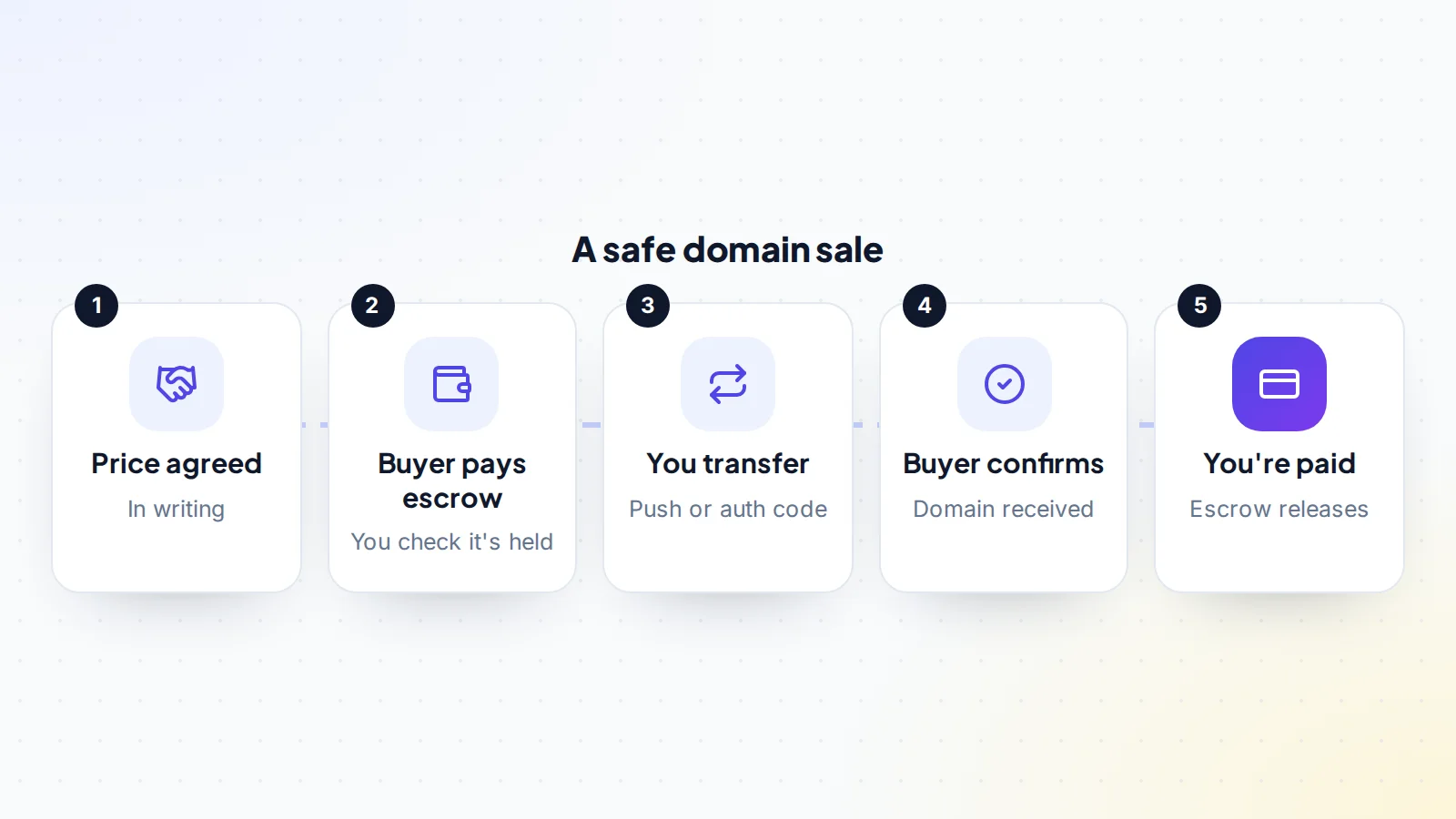
The golden rule for domain sellers: transfer only after the payment is secured. Escrow is the standard way to do that. The buyer pays a licensed escrow company, you confirm the funds are held, you transfer the domain, the buyer confirms they have it, and the escrow company pays you.
On digiflippers.com, the ways to pay in a deal are: directly to the seller, through escrow. Our escrow partner is Escrow.com, a licensed escrow company, and the platform never holds the money itself. Read how domain escrow works for the details.
Payment scams aimed at sellers
- Fake escrow sites suggested by the buyer. Use an escrow company you’ve checked yourself and type its address directly.
- Fake payment confirmations by email. Always log in to the escrow or payment account yourself to check.
- Reversible payments. Some payment methods can be reversed weeks later. That’s exactly why escrow exists.
- Paid appraisal tricks. A “buyer” offers a big price but asks you to pay for an appraisal from a site they choose first. Real buyers don’t do that.
Step 7: Transfer the domain
Once the payment is secured, move the domain to the buyer. There are two ways; our guide to push vs transfer compares them.
- Push. If the buyer has an account at the same registrar, you can move the domain into their account directly. It’s quick and keeps the expiry date.
- Registrar transfer. Unlock the domain, get the authorisation code and send it to the buyer, who starts the transfer at their registrar. For many generic domains, a transfer between registrars adds a year to the registration.
Turn off any privacy setting that would block transfer emails if your registrar requires it, and keep an eye on your email for the transfer confirmation. Step-by-step instructions are in the domain transfer process and how to get your auth code.
When the buyer confirms the domain is in their account, the escrow company releases your payment and the sale is complete. Remove the domain from any parking service and update your records.
Selling several domains or a whole portfolio
If you own many names, selling them one by one usually brings the highest total, but it takes the longest. Selling a group together is faster, and the price per name is lower. A few ways to approach it:
- Sort your names into tiers. Put your strongest names on their own listings with considered prices, and group weaker names into themed bundles.
- Keep a simple spreadsheet of each name’s registrar, expiry date, renewal cost and asking price. Buyers of portfolios will ask for it, and it stops renewals from catching you out.
- Drop what won’t sell. Renewal costs add up. If a name has had no interest in years and doesn’t fit a clear buyer, letting it expire can be the most profitable decision.
- Price bundles on the best names in them, not on the count. A buyer pays for the few names they actually want.
Our guide to domain investing covers how investors build and trim portfolios over time.
While you wait for a buyer
Domain sales often take time, so make the waiting work for you. Point the domain at a clean “for sale” page rather than leaving it blank, so anyone who types it can reach you. Keep it renewed well ahead of expiry, and make sure the contact details on your registrar account are current, so you never miss a transfer or renewal email. If you’ve owned the name for years and it still gets no interest, revisit the price: the market is telling you something. Anyone learning how to sell a domain name quickly discovers that a fair price and an easy way to buy do more than any amount of promotion.
Mistakes that cost domain sellers money
- Pricing on hope. A price far above comparable sales means your listing gets ignored.
- Ignoring low offers. A polite counter-offer turns many low openers into real sales.
- Letting the domain expire during a sale. Renew it if the expiry date is near.
- Changing registrant details right before a sale, which can trigger a transfer lock at some registrars.
- Transferring first because the buyer seems nice. Friendly people use escrow too.
How to sell a domain name: the checklist
- Registrar account secured with two-factor authentication.
- Expiry date comfortable; no recent changes that could lock transfers.
- History checked; no trademark conflict.
- Price based on length, extension, meaning, brandability and comparable sales.
- Pricing model chosen: fixed, price with offers, or offers only.
- Listed on a marketplace and with a “for sale” page on the domain.
- Price, fees, transfer method and timing agreed in writing.
- Payment secured through escrow on an escrow site you checked yourself.
- Domain pushed or transferred; buyer confirms receipt.
- Payment released; parking and records updated.
Ready to sell?
List it on digiflippers.com with verified numbers, answer buyers in one place and agree every step in a free Deal Room. 0% success fee up to $10,000, then 5% (max $5,000).
Frequently asked questions
How much can I sell my domain name for?
It depends on length, extension, commercial meaning, brandability, comparable sales and how badly a particular buyer wants it. Most domains sell for modest amounts; a few short, meaningful names sell for much more.
Where is the best place to sell a domain name?
Where buyers already look: domain marketplaces, plus a “for sale” page on the domain itself. Listing in more than one place increases the chance the right buyer sees it.
How long does it take to sell a domain?
It can be days or years. Well-priced names with clear commercial meaning sell faster. Once a buyer agrees, payment and transfer usually take a few days.
Do I pay tax when I sell a domain?
Often, yes, because a sale can be income or a capital gain depending on where you live and how you hold the domain. Ask an accountant in your country.
Can I sell a domain I registered recently?
Yes, but registrars can refuse a transfer to another registrar for a period after registration. A push to the buyer’s account at the same registrar may still be possible. Check your registrar’s rules before agreeing a date.
Should I use a domain broker?
A broker can help with very valuable names or when you want someone to approach companies on your behalf. They usually charge a commission on the sale. For most names, listing on a marketplace and handling enquiries yourself works well and keeps the full price in your pocket.
What is the safest way to get paid for a domain?
Escrow. The buyer’s money is secured before you transfer anything, and it’s released to you once the buyer confirms they have the domain.