Supplier and Vendor Checks When Buying an Ecommerce Business
How to check the suppliers behind an e-commerce business before you buy: contracts, pricing, lead times, quality, compliance and a smooth supplier handover.

An e-commerce business is only as reliable as the people who make, store and ship its products. A store can have great reviews, strong traffic and healthy margins, and still struggle if its main supplier raises prices, misses deliveries or declines to work with a new owner. Supplier due diligence is how a buyer checks that the supply side is as solid as the sales side before money changes hands.
This guide explains what to check with each supplier, how to read contracts and records, which compliance documents matter, and how to plan a smooth supplier handover. It’s part of a full due diligence process for online businesses.
Key takeaways
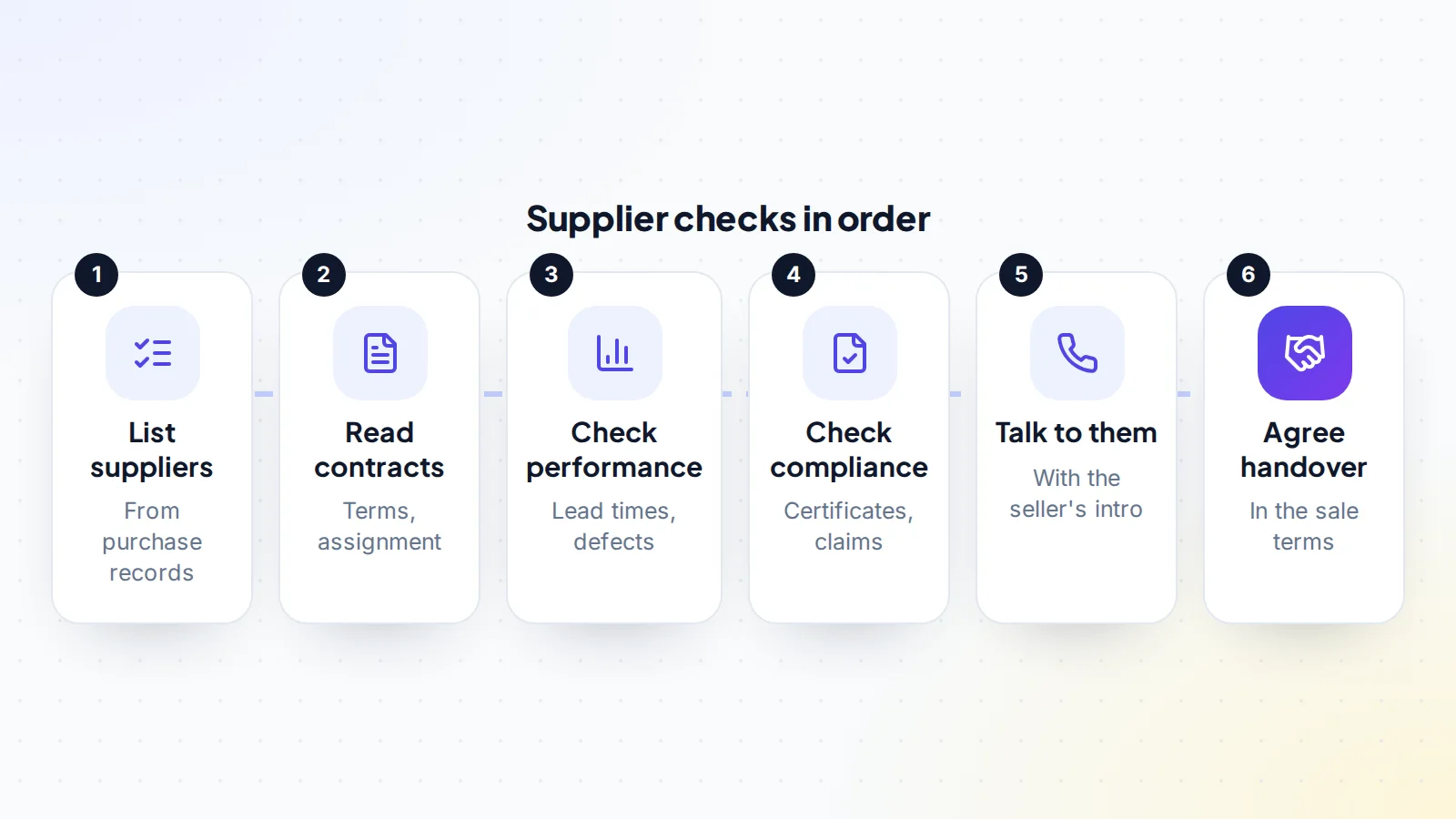
- List every supplier from purchase records, with each one’s share of stock and spend.
- Read contracts for pricing, minimum orders, exclusivity and whether they can pass to a new owner.
- Check lead times, defect rates and returns over at least 12 months.
- Confirm compliance documents and product claims, especially for children’s products and origin claims.
- Speak to the main suppliers, with the seller’s introduction, before the sale closes.
Why supplier checks matter
Most of an e-commerce store’s costs and risks sit with its suppliers. Product cost sets the margin. Lead times decide whether customers get orders on time. Quality drives reviews and returns. And the relationship itself, often built over years by the seller, may or may not continue after the sale.
Shipping promises have legal weight too. In the US, the FTC’s Mail, Internet, or Telephone Order Merchandise Rule says sellers must have a reasonable basis to expect they can ship within the time they advertise, or within 30 days if they don’t state a time, and must ask customers’ consent to delays or offer refunds. A store with a slow or unreliable supplier can struggle to meet that standard.
Start with a full supplier list
Ask the seller for purchase records for the last 12 to 24 months, and build a list of every supplier:
- Name, location and what they supply.
- Share of total spend and of units bought.
- How long the seller has worked with them.
- How orders are placed and paid, and in which currency.
- Whether there’s a written contract.
Cross-check the list against bank and card statements, not just the seller’s spreadsheet. A payment to a supplier that isn’t on the list may point to a product, service or cost you’d otherwise miss, such as a design agency, a photographer or a packaging printer that the business relies on.
Include everyone in the chain: manufacturers, wholesalers, dropshipping partners, packaging suppliers, warehouses and fulfilment centres, and shipping carriers with negotiated rates.
Check how concentrated supply is
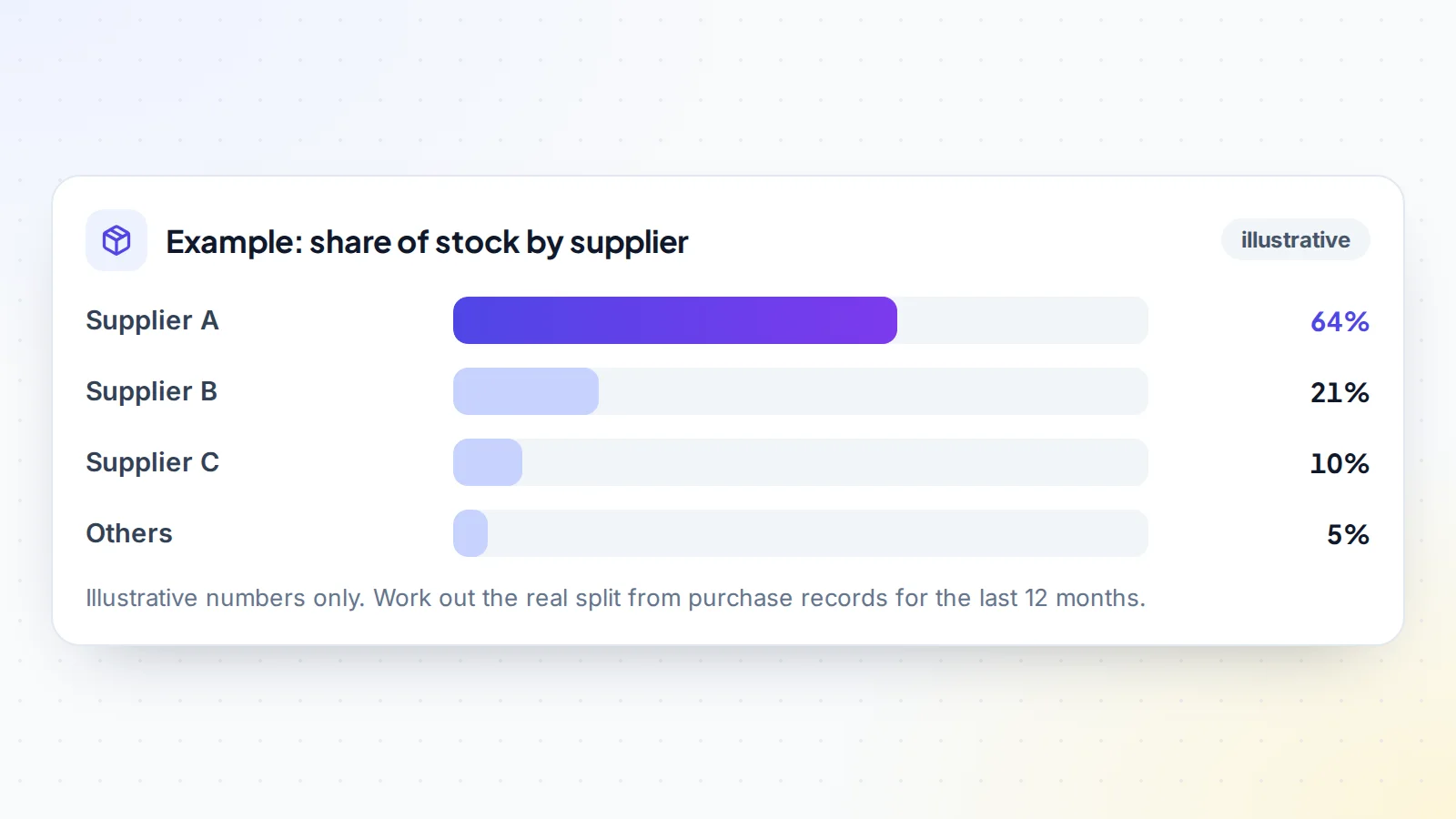
If one supplier provides most of the stock, the business depends on that relationship. That’s common and not necessarily a problem, but it raises the stakes of every other check. Ask whether there’s a backup supplier for key products, how long it would take to switch, and whether the products are custom-made or widely available. Our guide to concentration risk explains how buyers price dependence on one source.
Read the contracts
Where there are written agreements, read each one for:
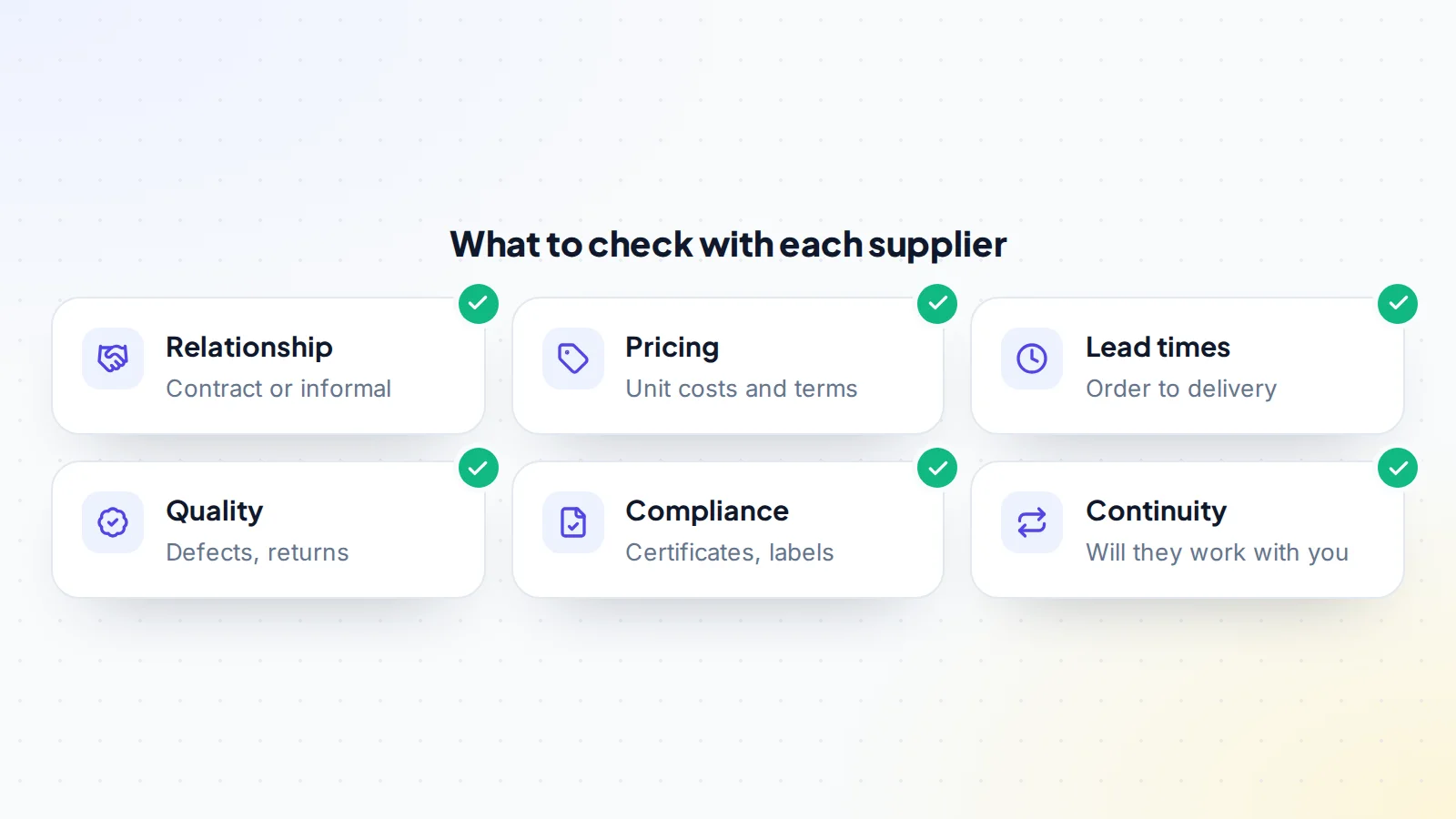
- Pricing and price changes: fixed prices, notice periods and how increases are handled.
- Minimum order quantities and payment terms.
- Exclusivity: whether the store has exclusive rights to a product or design, and in which markets.
- Assignment and change of control: whether the agreement can pass to a new owner, and whether the supplier must agree.
- Termination: notice periods and what happens to stock and moulds or tooling.
- Intellectual property: who owns designs, moulds, packaging artwork and product photos.
Many small stores work without written contracts. That doesn’t rule out a deal, but it makes the supplier’s own willingness to continue more important. Our guide to legal due diligence covers contract review in more depth.
Check performance over time
Records tell you how the supplier actually performs. Look for:
- Lead times: how long from order to delivery, and how much that varies.
- Stock-outs: how often products sold out because supply didn’t arrive.
- Defects and returns: return reasons and reviews that mention quality.
- Price history: unit costs over the last two years, and how increases affected margins.
- Communication: a sample of messages shows how problems were handled.
Compare the store’s shipping promises with real delivery times. A gap between the two shows up in reviews, refund rates and chargebacks.
Compliance and product claims
Products must meet the rules of the markets they’re sold in, and the seller of record carries responsibility. Examples from the US:
- Children’s products: the US Consumer Product Safety Commission says domestic manufacturers and importers of children’s products must certify compliance in a Children’s Product Certificate, based on testing by a CPSC-accepted third-party lab.
- Other regulated products: for many non-children’s products subject to a CPSC rule, manufacturers and importers must issue a General Certificate of Conformity.
- Origin claims: the FTC’s Made in USA standard says products advertised as made in the USA must be “all or virtually all” made there, and marketers need evidence to back up the claim.
Ask for certificates, test reports and the evidence behind any claims on product pages, such as materials, origin or safety. Other countries have their own rules, so check each market the store sells into.
Dropshipping and print-on-demand
When products ship directly from a supplier, the supplier controls much of the customer experience. Check the same things, with extra attention to:
- Delivery times to each main market, and tracking quality.
- How returns and damaged items are handled.
- Whether products are unique to the store or sold by many others.
- How the supplier’s app or account connects to the store, and whether it can move to you.
Our guide to buying a dropshipping store has more on this model.
Talk to the suppliers
Records show the past; a conversation shows the future. It’s also the step where supplier due diligence can turn up something new, such as a planned price rise or a product being discontinued. Once terms are close, ask the seller to introduce you to the main suppliers. Many sellers prefer to do this late in the process, which is reasonable. Use the call to confirm:
- That the supplier will continue on similar terms with a new owner.
- Current prices, minimum orders and lead times.
- Any planned changes, such as price rises or discontinued products.
- How handover of the account and any stock or tooling would work.
Costs, margins and currency
Supplier prices flow straight into the profit you’re paying for. Rebuild the cost of each main product from purchase records: unit price, shipping to the warehouse, duties and taxes where they apply, packaging and fulfilment. Compare that with the cost the seller uses in their profit figures. If the store buys in a different currency from the one it sells in, look at how exchange rates moved margins over the last two years.
Also check for one-off discounts. A large bulk order at a special price can make one year’s margins look better than the store can repeat. Our guide to revenue vs profit explains why buyers price on the profit that will continue.
Warehouses and fulfilment partners
If stock sits with a third-party warehouse or fulfilment centre, treat it like any other supplier. Ask for the agreement, monthly invoices, the current stock report and any fees for storage, picking and returns. Check how the warehouse account connects to the store and whether it can move to you, and agree a stock count close to the handover date, so you know exactly what you’re receiving. Stock that’s old, damaged or slow-moving should be valued accordingly.
Questions to ask the seller
- Which suppliers would be hardest to replace, and why?
- Have any suppliers raised prices, missed deliveries or changed terms in the last year?
- Are there backup suppliers you’ve tested for key products?
- Who owns the product designs, moulds and packaging artwork?
- Which product claims are on the site, and what evidence supports them?
- When can you introduce me to the main suppliers?
- Will you help with the supplier handover after the sale?
Plan the supplier handover
Write the supplier plan into the sale agreement. Include which supplier accounts move to you, which contracts are assigned, who pays for stock in transit, how open orders are handled and how long the seller will help with introductions. Hold part of the payment, through escrow or a middleman, until the key accounts are in your name. Our asset transfer checklist covers the wider handover.
For sellers: preparing your supplier file
If you’re selling, a tidy supplier file makes supplier due diligence quick and builds trust. Prepare a list of suppliers with each one’s share of spend, copies of any agreements, a two-year price history for your main products, average lead times, certificates and test reports, and notes on any backup suppliers you’ve tried. Decide in advance when you’re comfortable introducing a buyer to your suppliers, and tell buyers early that the introduction will come once terms are agreed.
Buyers pay more for businesses they understand. A clear supplier file answers most questions before they’re asked and shortens the time to close. Our guide to increasing business value before a sale has more preparation tips.
A worked example
The details below are made up to show the method.
Tom is buying a store that sells kitchen tools. Purchase records show three suppliers, with one providing 64% of stock. There’s a written agreement with that supplier, which allows assignment with the supplier’s consent. Lead times averaged 21 days, with two stock-outs last year during a holiday rush. Return reasons rarely mention quality.
The store’s product pages say “BPA-free”, so Tom asks for the test reports behind the claim, which the seller provides. Once terms are agreed, the seller introduces Tom to the main supplier, who confirms current prices and agrees to the assignment. Tom and the seller agree that 10% of the price will be held in escrow until the supplier account is in Tom’s name. The handover takes a week, and the funds are released.
Supplier due diligence: the checklist
- Every supplier listed with share of spend and units.
- Concentration checked, with backup options for key products.
- Contracts read for pricing, minimums, exclusivity and assignment.
- Ownership of designs, moulds and artwork confirmed.
- Lead times, stock-outs, defects and returns reviewed.
- Shipping promises compared with real delivery times.
- Compliance certificates and product claims checked for each market.
- Main suppliers contacted with the seller’s introduction.
- Supplier handover written into the sale terms.
- Payment held until key accounts are transferred.
Ready to find your next asset?
Browse listings with verified numbers, ask sellers your questions before you offer, and agree every step in a free Deal Room.
Frequently asked questions
What is supplier due diligence?
The checks a buyer makes on the suppliers behind an e-commerce business: who they are, the terms, how they perform, whether products comply with the rules, and whether they’ll keep working with a new owner.
What if there’s no written contract with the supplier?
That’s common for small stores. Rely more on records and on a direct conversation with the supplier, and consider holding part of the price until the account is transferred.
When should I contact the suppliers?
Usually once the main terms are agreed, with an introduction from the seller. Sellers often prefer not to disclose a sale to suppliers too early.
Which compliance documents should I ask for?
Certificates and test reports for regulated products, such as Children’s Product Certificates and General Certificates of Conformity in the US, plus evidence for any claims on product pages.
Is relying on one supplier a deal-breaker?
No, but it makes that supplier’s terms and willingness to continue central to the deal, and buyers often reflect the risk in the price or terms.
How do I protect the payment?
Use escrow or a middleman, and hold part of the payment until the key supplier accounts are in your name. On digiflippers.com, the ways to pay in a deal are: directly to the seller, through escrow, and the platform never holds the money itself.
Should stock be included in the price?
Often stock is valued separately, at cost, based on a count near the handover date. Agree the method in writing, and exclude stock that’s damaged or unlikely to sell.