How Much Money Do You Need to Buy Your First Online Business?
What your first online business purchase really costs: the price, deal costs, working capital and a reserve, plus how buyers pay with savings, seller financing or loans.
“How much do I need?” is the first question most new buyers ask, and the honest answer is: more than the price on the listing, but often less than people expect. Online businesses are sold at almost every size, from small content sites and digital product stores to established SaaS companies. Setting a realistic budget to buy online business assets means adding up the price, the costs of the deal itself, the money to run the business while income settles, and a reserve for surprises.
This guide breaks down each part of the budget, explains how prices are set, shows ways to fund a purchase, and walks through a worked example. If you’re still deciding whether to buy at all, start with our guide to buying vs starting an online business.
Key takeaways
- Your budget covers the purchase price, deal costs, working capital and a reserve, not just the price.
- Online businesses are usually priced as a multiple of monthly profit, so your budget sets the profit you can buy.
- Deal costs include your share of escrow fees and any accountant or lawyer you use.
- Keep money aside for running costs, stock and the unexpected after the handover.
- Most first purchases are funded from savings; larger deals may add seller financing or loans.
How online businesses are priced
Most profitable online businesses are valued as a multiple of their average monthly net profit, usually over the last 12 months. The multiple depends on the type of business, its age, how steady its income is, how much time it needs and how many risks it carries. Our guide to valuation multiples explains how they’re set.
That means your budget really sets the size of the business you can buy. If you have a certain amount for the purchase price, divide it by a realistic multiple for the kind of business you want, and you’ll know roughly how much monthly profit that budget buys. Use the valuation tool on digiflippers.com to try different numbers.
Remember that the multiple and the profit are both estimates until you’ve checked them. A business listed at a price that looks generous for its profit may have risks that explain it, and one that looks expensive may have strengths worth paying for. Your due diligence turns those estimates into numbers you trust.
Not every asset is priced on profit. Domains, social accounts and early-stage sites without steady income are often priced on comparable sales, audience or potential instead.
The parts of a full budget
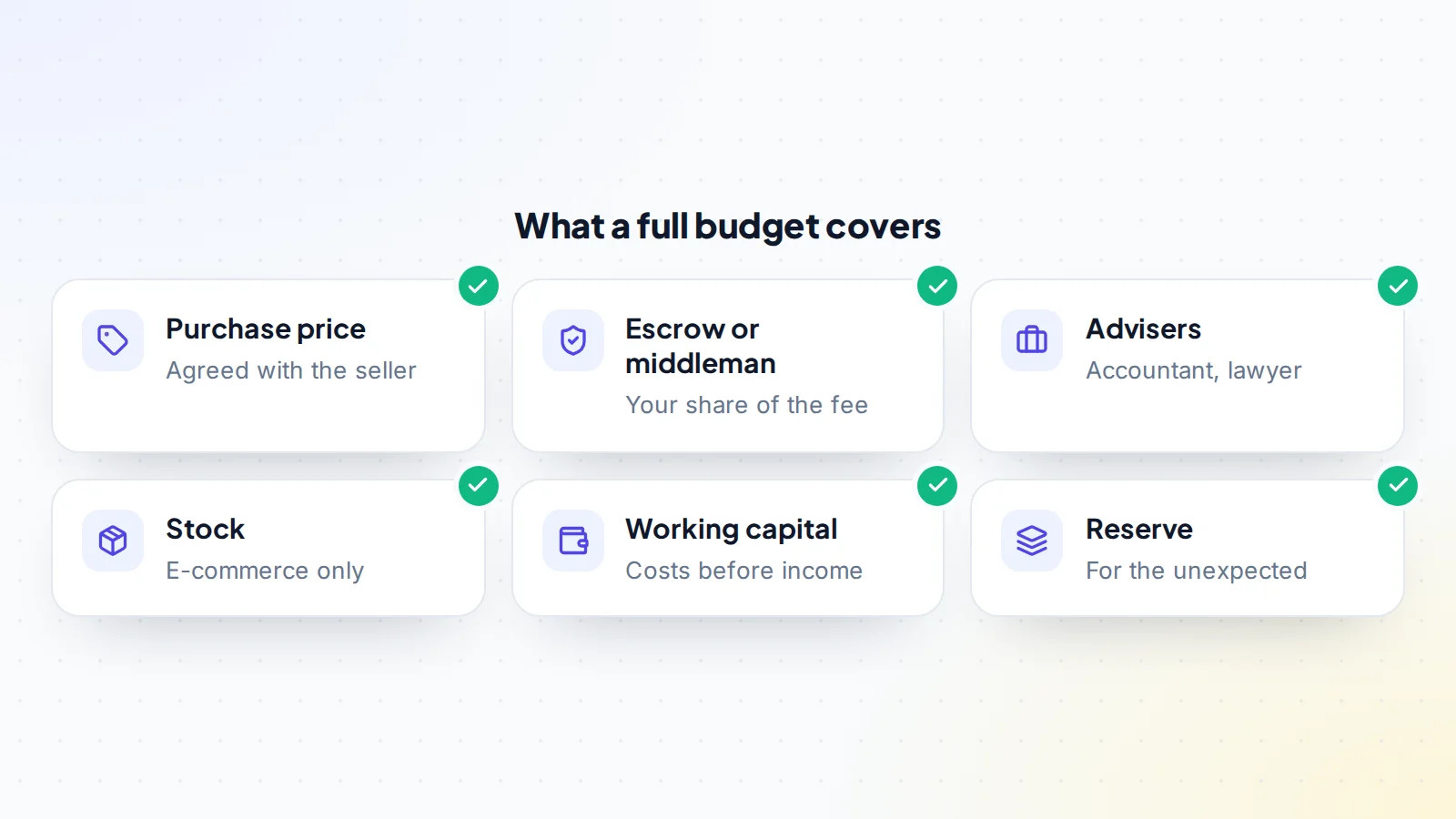
1. The purchase price
The amount agreed with the seller. It may be paid in one go or split, for example with part paid later if results hold. Leave room to negotiate: decide your walk-away price before you make an offer.
2. Escrow or middleman fees
Using escrow or a middleman protects your money during the handover. Fees vary by provider and deal size. On digiflippers.com, the ways to pay in a deal are: directly to the seller, through escrow, and the platform never holds the money itself. When escrow is used, the escrow fee is normally paid by the seller, and you can agree a different split in the deal. Escrow providers publish calculators, so you can check the cost for your price in advance.
3. Advisers and checks
For smaller deals, many buyers do their own due diligence. For larger ones, an accountant to check the figures and a lawyer to review the agreement are worth budgeting for. Paid tools for checking traffic or code may add a little more.
4. Stock and transfer costs
E-commerce businesses usually come with stock, which is often valued separately from the business. Other costs can include domain transfer fees, new subscriptions to tools the seller used, and setting up your own payment and email accounts.
5. Working capital
The money to run the business while income settles in your name. Payouts from ad networks, affiliate programmes and payment processors often arrive weeks after the sales that earned them, while costs such as hosting, writers or ads start at once. Covering two to three months of running costs is a sensible starting point.
6. A reserve
Something will surprise you: a plugin that needs replacing, a supplier price rise, a dip in traffic. A reserve lets you handle it calmly rather than in a hurry.
What different budgets can buy
There’s no fixed price list, but broadly:
- Smaller budgets often go to starter sites, domains, social and game accounts, small digital product stores and newsletters. These can be a good way to learn, with more of the growth work on you.
- Mid-sized budgets open up established content sites, small e-commerce stores and micro-SaaS products with a track record of profit.
- Larger budgets reach businesses with teams, several income streams and more structured due diligence, where advisers and formal agreements become normal.
Browse the marketplace to see current asking prices for assets that interest you; it’s the quickest way to calibrate your budget.
How to fund a purchase
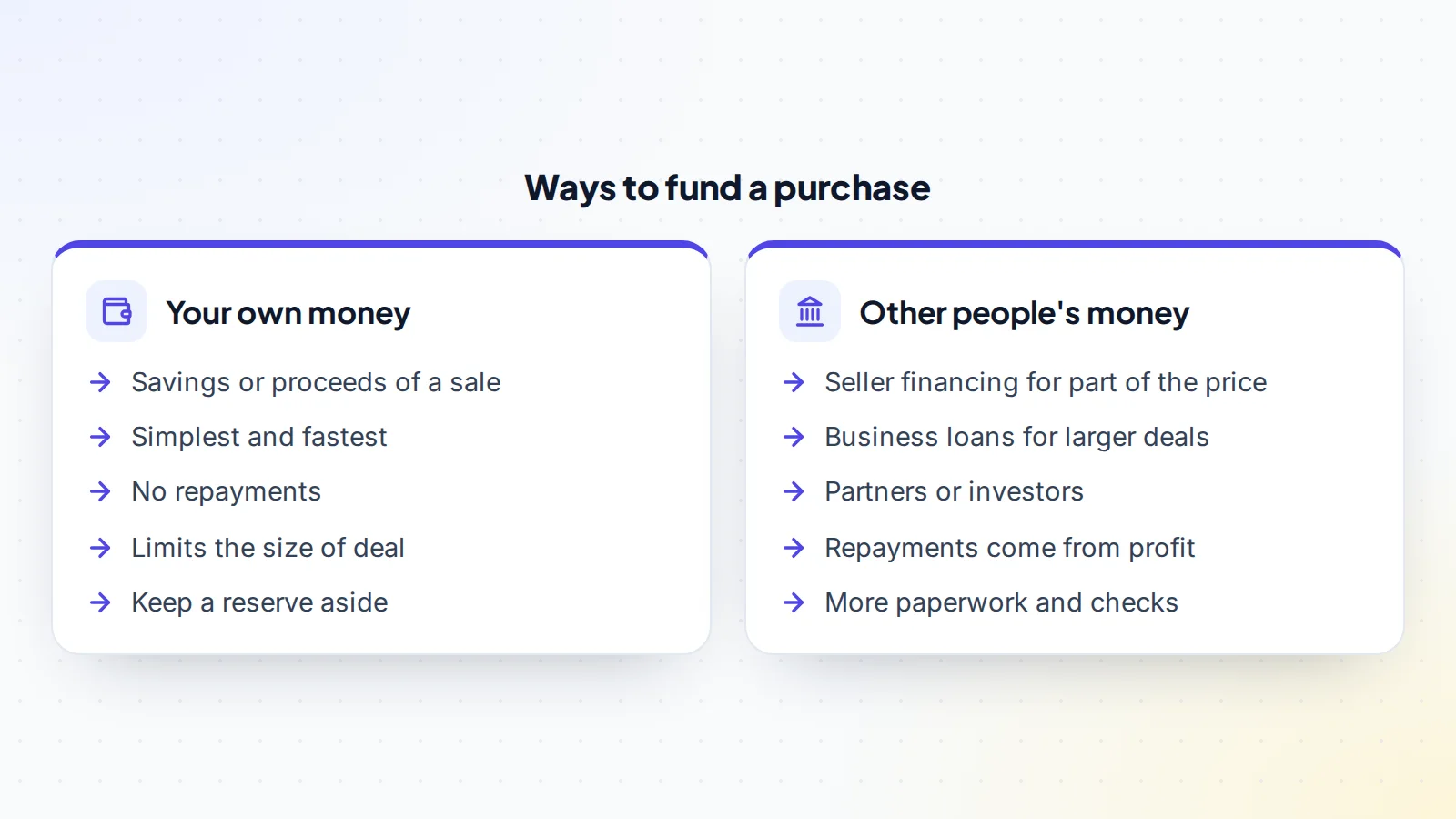
Savings. Most first purchases are paid from the buyer’s own money. It’s simple and fast, and you keep all the profit. Never use money you can’t afford to have tied up.
Seller financing. Some sellers accept part of the price in instalments after the sale. It lowers your upfront cost and shows the seller’s confidence, but needs a clear written agreement covering payments, security and what happens if payments stop.
Business loans. For larger acquisitions, loans may be an option. In the US, the SBA says its 7(a) loans can be used for a change of ownership, and its lender guidance describes an equity injection of at least 10% of project costs for a complete change of ownership. Lenders have their own requirements for online businesses, so ask early.
Partners. Buying with a partner shares the cost and the work. Agree roles, ownership and an exit plan in writing first.
Costs buyers often forget
- Your time: most small online businesses need some hours each week. Price that in, or budget for help.
- Tools in the seller’s name: software subscriptions that need new accounts at full price.
- Payment delays: the gap between income earned and income received.
- Taxes: how the purchase and income are taxed where you live. Ask a local accountant.
- Growth spending: new content, ads or product work to grow the business.
Setting your budget, step by step
- Start with what you can invest. Count only money you can afford to have tied up for a few years, without touching your emergency savings.
- Take off your reserve and working capital. Around a fifth of the total is a sensible starting point for a first purchase; adjust for the type of business.
- Take off deal costs. Check the escrow fee for your price and get quotes from any advisers.
- What’s left is your maximum price. Divide it by a realistic multiple to see the monthly profit it buys.
- Set a walk-away price a little below your maximum, so you have room to negotiate.
Writing your budget to buy online business assets down in this order stops the purchase price from quietly eating the money you’ll need afterwards.
Budgeting for growth
Many buyers plan to grow the business, not just run it. If that’s you, set aside a separate growth budget: new content, product improvements, advertising tests or a freelancer for a few hours a week. Treat it as an experiment with a limit, and measure the results month by month. A growth budget that’s separate from your reserve means a slow experiment never puts the core business at risk.
Questions to ask yourself first
- How many hours a week can I give the business, and for how long?
- Which kinds of business do I understand well enough to run?
- Could I cope if income dropped by a third for a few months?
- Do I want income now, or growth over a few years?
- Who will I ask for help with figures, contracts and technology?
Honest answers narrow the search as much as the budget does.
A worked example
The numbers below are made up to show the method.
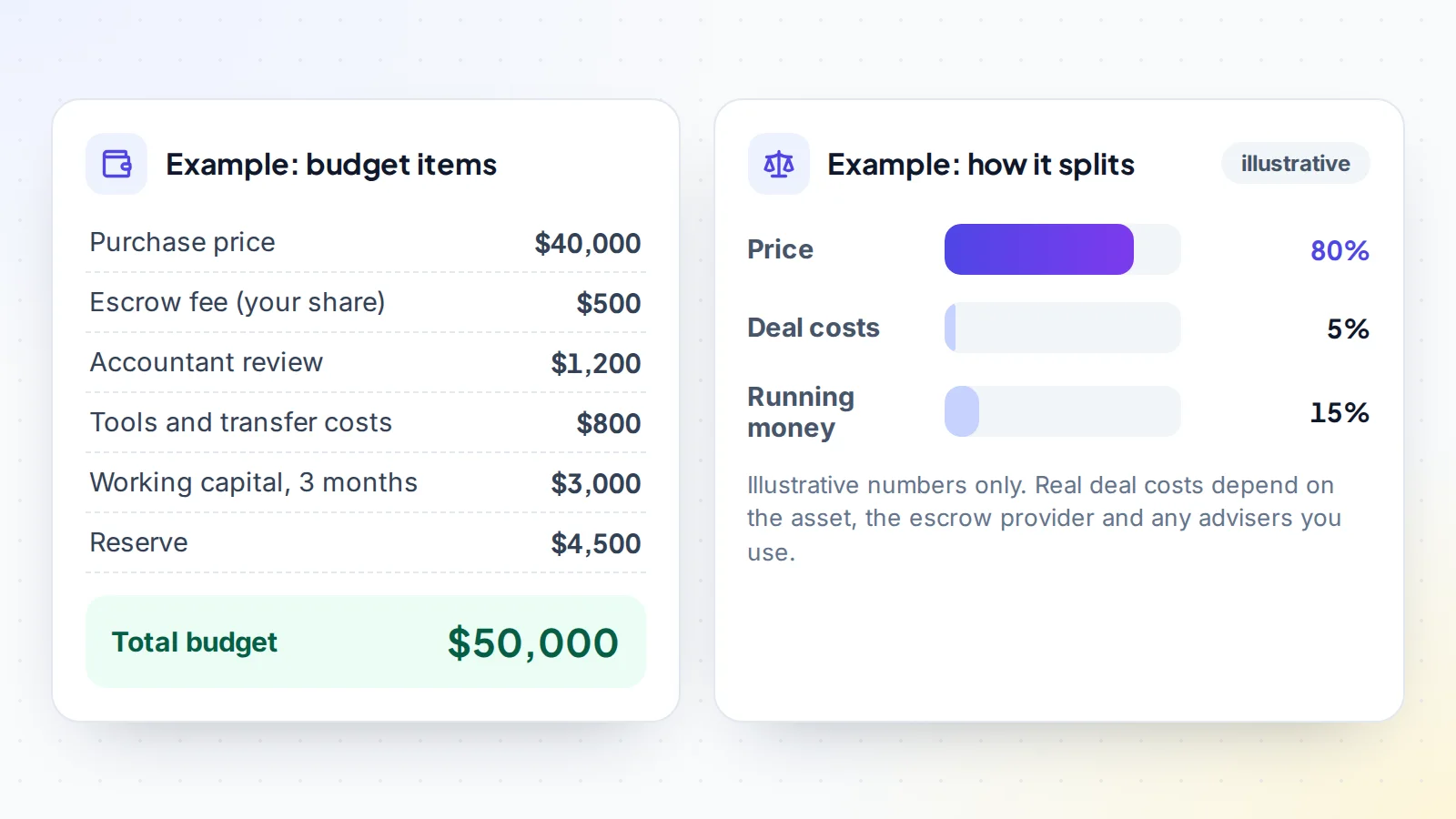
Aisha has $50,000 to invest and decides not to spend it all on the price. The maximum purchase price is set at $40,000, with the rest kept for deal costs and running money: $500 for Aisha’s share of the escrow fee, $1,200 for an accountant to check the figures, $800 for tools and transfer costs, $3,000 for three months of running costs and $4,500 as a reserve.
At a multiple Aisha thinks is realistic for a content site, $40,000 buys around $1,100 to $1,400 a month in profit. Aisha short-lists three sites in that range, checks each one’s traffic sources and finds that one relies heavily on a single search query. The choice falls on another site with income spread across many pages: Aisha offers $37,000 and agrees $38,500. The money left unspent goes into the reserve.
Protect the money you’ve budgeted
A careful budget can be undone by one unsafe payment. Never send the purchase price straight to a seller you don’t know, by wire, crypto or gift card, before you control the asset. Use escrow or a middleman, sign in to the escrow account yourself to check the transaction, and only accept the deal once every account and asset is in your name. Our guide to digital asset scams lists the warning signs, and checking the seller’s verified profile and reviews before you pay takes only a few minutes.
Keep your deal costs, receipts and agreement together after the purchase. They’re part of your records for tax and help if any question about the sale ever comes up.
Match the budget to your risk
Every business has risks, and buyers on a tight budget feel them most. Spread the risk where you can: prefer businesses with several traffic and income sources, verified numbers and a seller willing to help after the sale. Our guide to traffic concentration risk explains how to spot a business that depends too much on one source. And never put all your savings into one asset; a reserve is part of the budget, not a luxury.
Budget to buy online business assets: the checklist
- Total amount you can invest set, with money you can afford to tie up.
- Maximum purchase price decided, below the total.
- Escrow or middleman fee checked for your price.
- Adviser and tool costs estimated.
- Stock and transfer costs included where relevant.
- Two to three months of working capital set aside.
- Reserve kept for the unexpected.
- Funding sources agreed in writing if not using savings.
- Walk-away price decided before making offers.
Ready to find your next asset?
Browse listings with verified numbers, ask sellers your questions before you offer, and agree every step in a free Deal Room.
Frequently asked questions
How much money do I need to buy an online business?
It depends on what you buy. Add the purchase price, deal costs such as escrow and advisers, working capital for the first months and a reserve. Browsing current listings is the quickest way to see real prices.
How are online businesses priced?
Profitable ones are usually priced as a multiple of average monthly net profit. Assets without steady income are often priced on comparable sales, audience or potential.
Can I buy an online business with a loan?
Sometimes. In the US, SBA 7(a) loans can be used for a change of ownership, and lenders set their own requirements. Many smaller purchases are paid from savings or with seller financing.
What is working capital, and why do I need it?
Money to run the business while income settles in your name. Payouts often arrive weeks after sales, while costs start straight away.
Should I spend my whole budget on the price?
No. Keep part of it for deal costs, running costs and a reserve, so one surprise doesn’t put the business at risk.
What’s a good first purchase on a small budget?
A small business with steady income, several traffic sources, verified numbers and a seller willing to help after the sale.
How much should I keep as a reserve?
Enough to cover a few months of costs and a surprise repair, without selling the business in a hurry. A simple starting point for a first purchase is to keep reserve and working capital together at around a fifth of your total budget.