How to Buy an Ecommerce Store Without Inheriting Its Problems
What to check before you buy an online store: real margins, suppliers, stock, advertising, returns and the platform transfer, with a worked example and a handover plan.
An online store can look impressive from the outside: thousands of orders, a polished site, strong revenue. But ecommerce has more moving parts than most online businesses: products, suppliers, stock, shipping, advertising and returns. If you plan to buy an ecommerce store, the job is to see past revenue to what the business really earns, what it depends on, and what you’ll inherit along with it.
This guide covers what to check before you pay: margins, suppliers, stock, advertising, customers, returns, the platform and payments, plus how stores are valued and how the handover works. For the general process, see how to buy a website.
Key takeaways
- Value a store on net profit after product, shipping, advertising, fees, apps and staff, not on revenue.
- Check suppliers carefully: who they are, whether agreements transfer and what happens if one fails.
- Count stock separately: its value, age and location, and whether it’s included in the price.
- Look at how dependent sales are on paid advertising, and whether cost per sale is rising.
- Plan the platform transfer, payment processor move and supplier introductions before you sign.
Types of ecommerce stores
- Own-brand stores sell products made for the business, often with a recognisable brand and loyal customers.
- Dropshipping stores sell products shipped directly by suppliers, with no stock held. Easier to run, but often lower margins and more supplier risk; see dropshipping store for sale.
- Print-on-demand stores sell designs printed and shipped by a partner when ordered.
- Resellers buy stock from brands or wholesalers and sell it online.
- Hybrid stores sell on their own site and on marketplaces.
Each type carries different risks: own-brand stores depend on manufacturing and brand strength, dropshipping and print-on-demand on partners, resellers on supply and pricing. Identify the model first and focus your checks on its weak points.
Step 1: Find the real margins
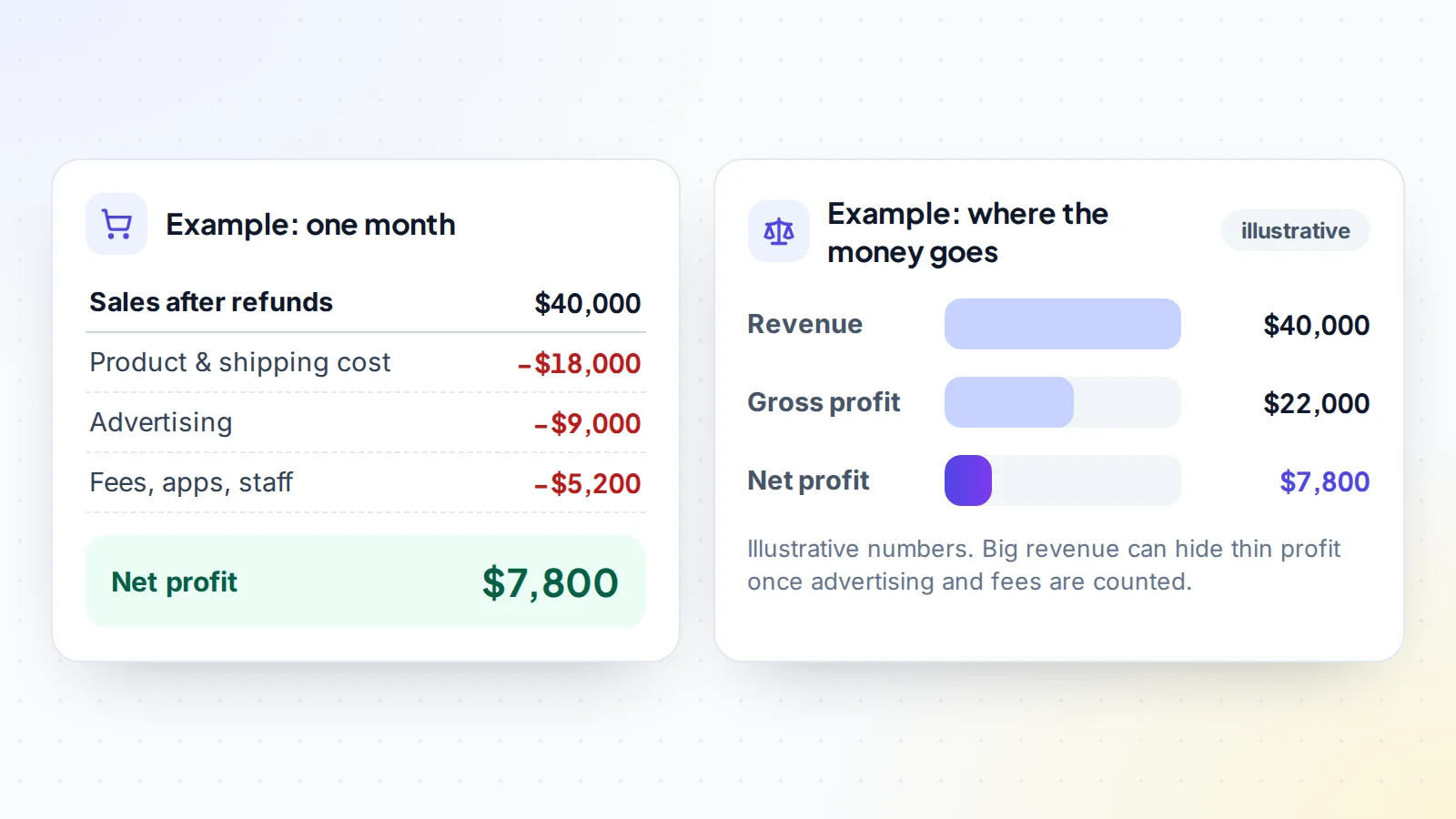
Ecommerce revenue can be large while profit is small. Work through every cost, for at least 12 months:
- Product cost and how it has changed.
- Shipping and fulfilment, including packaging.
- Advertising across every channel.
- Platform, app and payment fees.
- Returns, refunds and chargebacks.
- Staff and contractors, including the owner’s own time if a buyer would pay for it.
Then calculate net profit by month. Buyers usually work from trailing twelve months profit, and should be clear whether the seller’s figures are revenue or profit.
Step 2: Check the suppliers
Suppliers are often the biggest hidden risk. Ask:
- Who makes or supplies each main product, and where are they?
- Is there a written agreement, and can it be transferred to a new owner?
- Are there backup suppliers?
- Have there been quality problems, delays or price rises?
- Are any products exclusive to this store?
Ask to be introduced to the main suppliers before signing, and confirm they’ll work with you. Our guide to supplier due diligence covers this in detail.
Step 3: Count the stock
If the store holds inventory, agree how it’s handled. Stock is often priced separately from the business, at cost, based on a count on handover day. Check:
- How much stock there is, at what cost, and where it’s kept (warehouse, fulfilment centre, home).
- How old it is, and whether any is slow-moving or out of date.
- Whether the price includes stock, or stock is paid for on top.
- How stock will be counted and confirmed on handover day.
Step 4: Understand advertising dependence
Many stores rely on paid advertising. That isn’t a problem in itself, but it changes the risk. Look at:
- Share of sales from paid ads versus search, email, social and repeat customers.
- Cost per sale over time: rising costs can squeeze profit quickly.
- Return on ad spend by channel and by product.
- Ad account history: whether accounts can transfer or need rebuilding.
A store with strong organic traffic, a healthy email list and repeat customers is less exposed than one that stops selling the day ads stop.
Step 5: Customers, returns and reviews
- Repeat purchase rate: loyal customers make revenue more predictable.
- Email list: size, engagement and how subscribers joined; see the email deliverability check.
- Returns and refunds by product, which signal quality problems.
- Reviews on the store and elsewhere, and how complaints were handled.
The six things that make or break a store
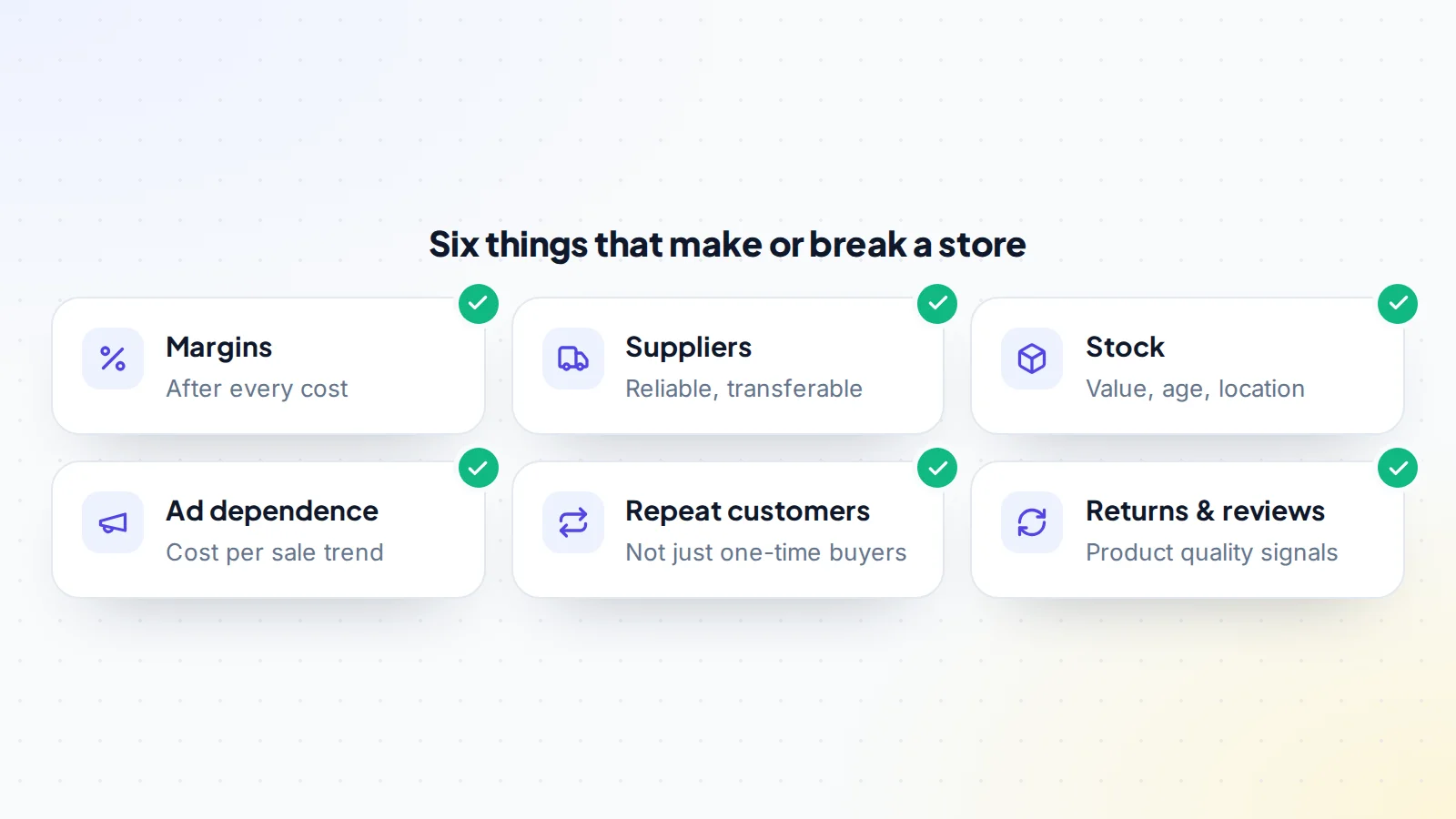
Before you buy an ecommerce store, score it against these six points. A weakness in one isn’t a reason to walk away, but it should be reflected in the price or fixed in your plan for the first months. Weaknesses in several at once usually mean the business is worth less than its revenue suggests.
Step 6: The platform and payments
Most stores run on a hosted platform or on a website with an ecommerce plugin. Find out how ownership moves. Shopify’s help centre, for example, explains how a store owner can transfer the store to a new owner outside their business from the store settings, with the new owner accepting by email. Other platforms have their own processes, and self-hosted stores move like other websites.
Payment processors need separate planning. Stripe’s support says that when a business is sold, the account holder should contact Stripe first, because what can change depends on the situation. Many buyers connect their own processor account during the handover.
Step 7: Legal and compliance
- Trademarks for the brand, and rights to product designs and photos.
- Product compliance: safety standards and labelling for the markets you sell to.
- Customer data handled under the privacy rules that apply, such as the GDPR for EU customers.
- Sales tax or VAT registrations and how they’ll change with the new owner.
See legal due diligence for the documents to ask for.
Plan for working capital
Unlike most online businesses, stores often need cash to keep running: stock must be bought before it’s sold, advertising is paid before sales come in, and suppliers may want payment up front. When you budget to buy a store, include working capital on top of the purchase price, enough to cover a few months of stock and advertising. Ask the seller how much cash the business typically needs, and when in the year the biggest purchases happen. Buyers who spend everything on the purchase price can find themselves unable to restock before a busy season.
Seasonality
Many stores sell far more in certain months, such as before holidays. Look at sales month by month for at least a year, and ideally two, so you know when the peaks come and how much stock and advertising they need. Buying just before a peak means preparing quickly; buying just after it means waiting for the next one. Either can work if you plan for it.
How stores are valued
Ecommerce stores are usually priced as a multiple of average monthly net profit, with stock often added separately at cost. The multiple rises with a strong brand, repeat customers, several traffic sources, reliable suppliers and steady margins. It falls with heavy ad dependence, a single supplier, a single product, rising costs and high returns. Try the free valuation tool for a quick range.
A worked example
The numbers below are made up to show the method, not market data.
Riley looks at a store selling ergonomic desk accessories, with $40,000 of monthly sales after refunds. Product and shipping cost $18,000, advertising $9,000, and fees, apps and a part-time assistant $5,200, leaving $7,800 a month in net profit.
Riley checks the details. Two suppliers make the main products; one has a written agreement that can be assigned, the other works informally. Advertising brings 55% of sales, and cost per sale has risen 15% over the year. A third of customers have bought more than once, and the email list has 14,000 engaged subscribers. Stock worth $22,000 at cost sits in a fulfilment centre.
Riley offers a price based on net profit, adjusted for the rising ad costs and the informal supplier, plus stock at cost on handover day. Before signing, Riley speaks with both suppliers, who agree to continue. The deal closes with a clear plan for the store, payments, stock and supplier introductions.
The handover
- Payment secured by escrow or a trusted middleman. On digiflippers.com, the ways to pay in a deal are: directly to the seller, through escrow, and the platform never holds the money itself.
- Store transferred through the platform’s own process.
- Payment processor connected under the buyer’s account.
- Suppliers and fulfilment introduced and accounts updated.
- Stock counted and confirmed.
- Domain, email, ad and social accounts moved.
- Test orders placed and fulfilled before confirming.
Our asset transfer checklist lists every item. For Shopify specifically, see buying a Shopify store.
Stores that also sell on marketplaces
Many stores also sell through online marketplaces. Marketplace seller accounts often have their own rules on changes of ownership, and some can’t simply be handed to a new owner. For each marketplace, check its seller terms and find out whether the account, its reviews and its listings can move, or whether you’ll need your own account and to relist. As with any platform you can’t fully transfer, value that part of the income with the rebuild in mind.
Questions to ask the seller
- What are net margins by product after every cost, including advertising?
- Which suppliers do you use, and will they work with a new owner?
- How much stock is there, where is it, and how old is it?
- What share of sales comes from paid ads, and how has cost per sale changed?
- How many customers buy again, and how big is the email list?
- What are the most common reasons for returns?
- Which accounts and tools can transfer, and which need replacing?
- How many hours a week do you and any staff spend on the store?
Good answers, backed by records, are the clearest sign you can buy an ecommerce store with confidence.
The first 90 days
- Keep operations steady: same suppliers, shipping times and customer service standards.
- Watch cash flow: stock purchases and advertising need money up front.
- Review ad accounts and pause campaigns that don’t pay back.
- Talk to customers through the email list and reviews to understand what they value.
- Reduce single points of failure: a backup supplier, a second traffic source.
Red flags
- Revenue shown without costs, or profit without advertising.
- One supplier with no agreement and no backup.
- Rising refunds or many negative reviews.
- Sales that collapse when ads pause.
- Stock that’s old, damaged or hard to locate.
- Products that may infringe someone else’s brand or design.
Checklist: how to buy an ecommerce store
- 12 months of revenue and every cost, by month.
- Net profit verified against platform, processor and bank records.
- Suppliers identified, agreements checked, introductions made.
- Stock counted, valued and agreed.
- Advertising share and cost trend reviewed.
- Repeat customers, returns and reviews checked.
- Platform transfer and payment plan confirmed.
- Legal and compliance documents gathered.
- Payment secured before the handover.
Ready to find your next asset?
Browse listings with verified numbers, ask sellers your questions before you offer, and agree every step in a free Deal Room.
Frequently asked questions
How are ecommerce stores valued?
Usually as a multiple of average monthly net profit, with stock often added separately at cost.
Is stock included in the price?
It depends on the deal. Many buyers and sellers agree a price for the business plus stock at cost, counted on handover day.
Can a Shopify store be transferred?
Yes. Shopify’s help centre explains how an owner can transfer a store to a new owner, who accepts by email.
What’s the biggest risk when buying a store?
Often supplier dependence or advertising dependence. Check both carefully and reflect them in the price.
Do I need to keep the same suppliers?
Not necessarily, but switching suppliers can affect quality, delivery times and reviews. Keep them at first, and change carefully once you know the business well.
How much cash do I need besides the purchase price?
Enough working capital for a few months of stock and advertising. Ask the seller how much the business typically ties up, and when.
Should I buy an ecommerce store or start one?
Buying gives you suppliers, customers and sales from day one; starting costs less but takes longer to reach profit. See buying vs starting an online business.