Community Health Metrics: Active Members vs Total Members
Why total members can mislead, the engagement metrics that show a community's real health, where to find them on Discord, Telegram and newsletters, and how they affect value.

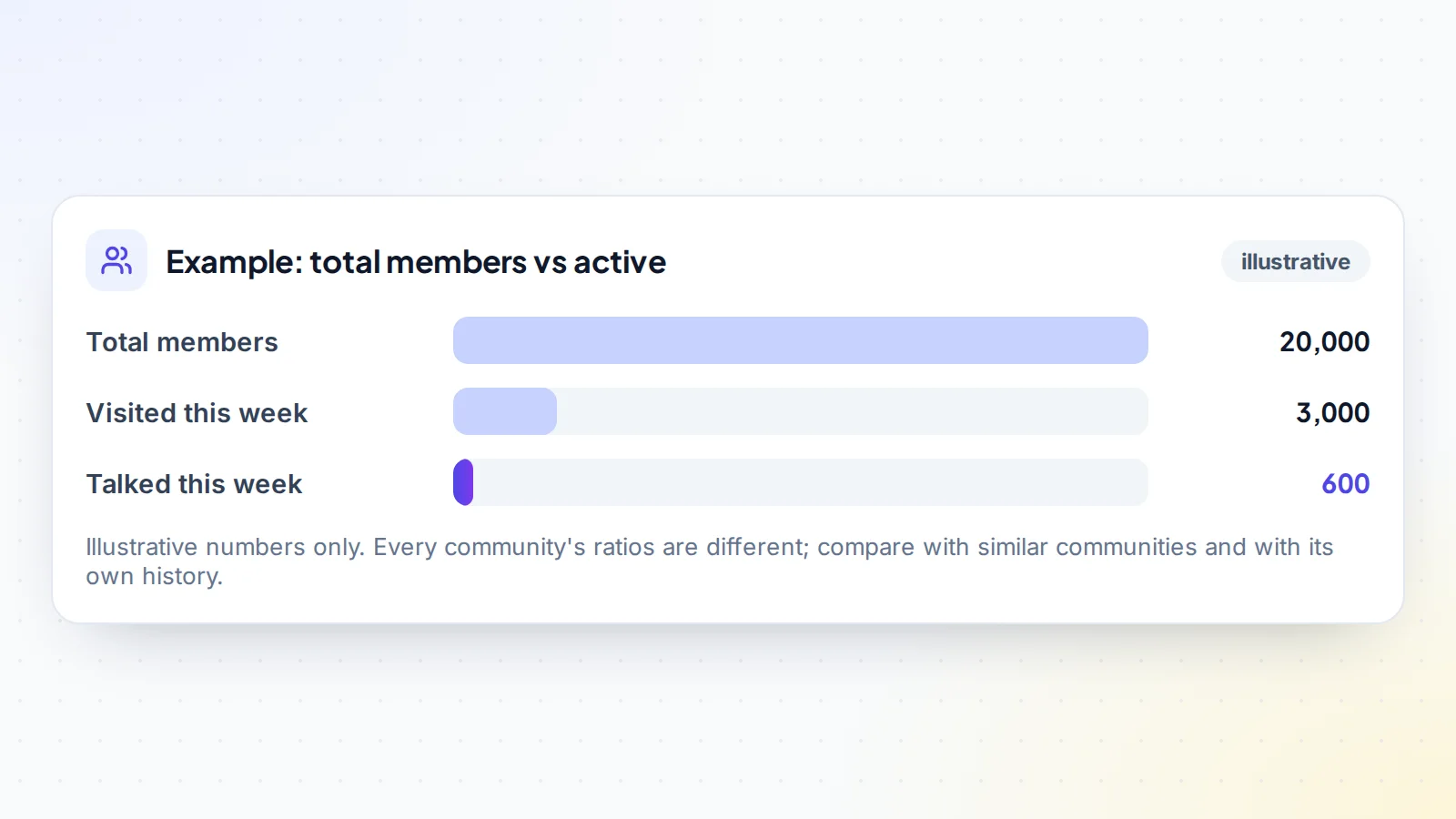
A community with 20,000 members sounds impressive. But if only a few hundred read the posts and a few dozen ever talk, the real community is far smaller than the headline. Community engagement metrics show what’s really there: how many members are active, whether new members stay, and whether people talk to each other or only listen. This guide explains which metrics matter, where to find them on Discord, Telegram and newsletters, and how they shape what a community is worth.
Whether you’re buying or selling, these are the numbers that move the price. For the selling side, see our guides to selling a newsletter and selling a Telegram channel.
Key takeaways
- Total members is a ceiling, not a measure of health; active members matter more.
- Look at weekly active and talking members, retention of new members, and views or clicks per post.
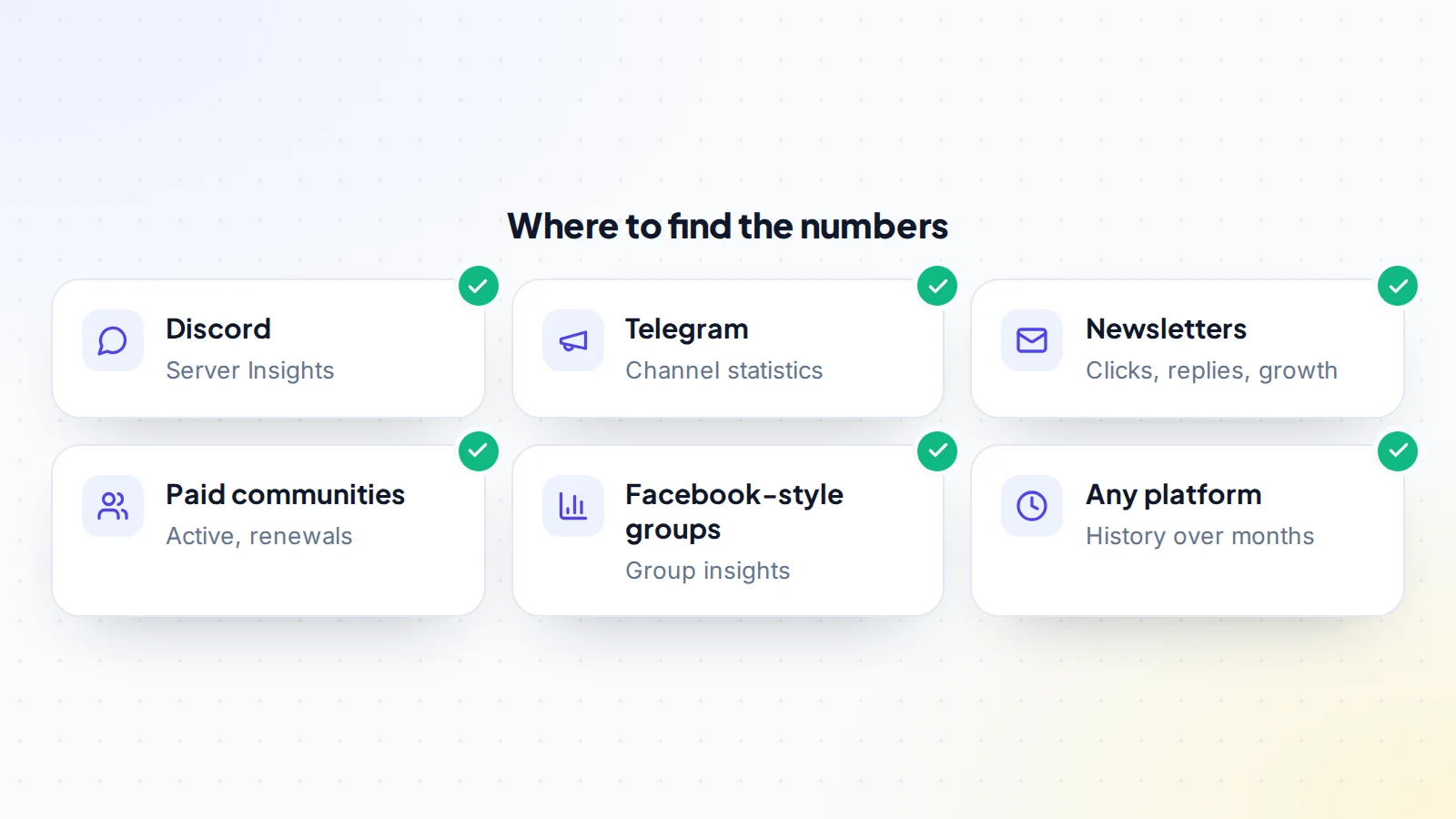
- Discord’s Server Insights and Telegram’s channel statistics show most of what you need.
- For newsletters, clicks and replies are more reliable than opens.
- Buyers value the active core and its trend, so price on engagement, not totals.
Why total members mislead
Members join for many reasons: an invite, a giveaway, a one-off question, a link shared in another community. Many stop visiting, but they stay on the member list. Over time, the gap between total and active grows. That’s normal, but it means the total says little about how many people a new owner would actually reach. Community engagement metrics fill that gap.
The metrics that matter
- Weekly active members: people who visited or read in the last week.
- Weekly talking members: people who posted, reacted or replied.
- New-member retention: the share of new members still around after their first week or month.
- Views per post: for broadcast formats such as channels.
- Clicks and replies: for newsletters and announcements.
- Member-to-member conversation: how much talk happens between members rather than with the owner.
- Trend: how each of these has changed over the last six to twelve months.
Discord: Server Insights
Discord offers Server Insights to people who help run eligible Community servers. Discord’s FAQ describes insights on growth and activation, such as where new members come from and how many stay; engagement, such as how many people are talking and which channels are used most; and audience, such as where members are and how long they’ve been in the server. Discord also uses “communicators”, people who actively talk, and members who visit or read, in its partnership requirements, which shows how much weight it puts on active participation rather than totals.
Ask the owner to open Server Insights on a screen-share. Our guide to buying a Discord server covers the rest of the checks.
Telegram: channel statistics
For larger channels, Telegram’s statistics show follower growth, views and shares per post, and the share of subscribers with notifications turned on, according to its developer documentation. Views per post compared with subscribers is the key ratio, and shares show content readers find worth passing on. Our guide to buying a Telegram channel explains how to read them.
Newsletters: clicks over opens
Open rates used to be the headline newsletter metric, but they’ve become less reliable. Apple’s Mail Privacy Protection, for example, can load email content in the background whether or not the reader opens the message, and prevents senders from seeing whether a message was opened. That can inflate open rates for subscribers using Apple Mail. Clicks, replies, growth from organic sources and income per subscriber are more dependable signals. Our guide to newsletter sponsorship revenue explains how sponsors judge a list.
Paid communities
For paid communities and memberships, look at active paying members, renewal rates, cancellations and how many members take part in the community each week. A paid community where members renew but rarely visit may be relying on content rather than community, which is fine, but it changes what a buyer is taking on. Our guide to paid communities for sale covers the specifics.
Compare with similar communities and with history
There’s no universal “good” ratio of active to total members. A support community for a software product behaves differently from a fan server or a paid mastermind. The most useful comparisons are with similar communities, where you can find them, and with the community’s own history. A community whose weekly talking members have grown steadily for a year is healthier than one with a higher ratio that’s been falling for months. Ask for monthly figures, not just the latest week.
Signs engagement has been inflated
- A sudden rise in members or messages just before listing, with no event to explain it.
- Many messages from a small number of new accounts.
- Repetitive, low-effort messages or reactions that don’t match the conversation.
- Views per post far out of line with shares, replies or clicks.
- Numbers shown only as screenshots, never live.
Any one of these may have an innocent explanation. Several together are a reason to look harder before agreeing a price. Our guide to spotting fake followers covers similar checks for social accounts.
Reading the conversation
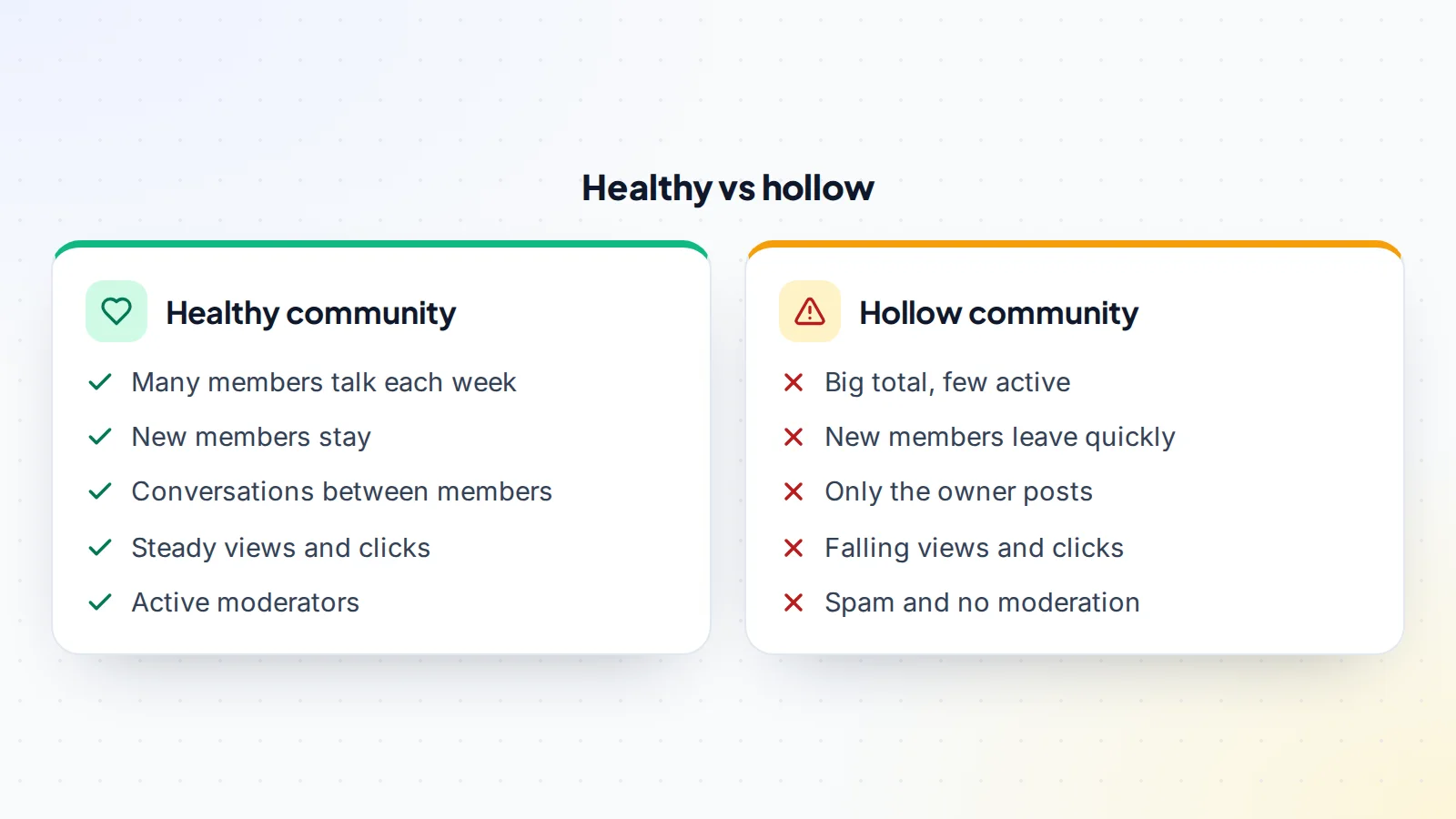
Numbers tell you how much activity there is; reading the community tells you what kind. Scroll through recent conversations. Are members helping each other, sharing work, debating? Or is it mostly announcements from the owner and a few short replies? Communities where members talk to each other tend to keep going through a change of owner, because the value lives in the members’ relationships, not just in the person running it.
Moderation and safety
Healthy engagement depends on good moderation. Look at who moderates, how long they’ve been active, the community’s rules and how spam and conflicts are handled. Communities with a stable moderation team usually stay healthy through a change of owner; communities moderated only by the founder can struggle when the founder leaves. Agree which moderators will stay and whether they’re paid.
Engagement after a change of owner
Members notice changes. Communities tend to keep their engagement when the new owner keeps the rhythm, rules and tone familiar for a while, introduces themselves openly and keeps the moderation team. Sudden changes to rules, heavy promotion or a quiet owner can cost active members quickly. Buyers should plan the first few months around continuity, and sellers can help by staying visible for a short transition.
Questions to ask the owner
- How many members visit and how many talk each week, and how has that changed?
- What share of new members are still active after a month?
- What events or routines drive the most activity?
- Who moderates, and will they stay?
- Have you run promotions or giveaways, and when?
- Can you show the platform’s statistics live?
The answers, checked against the platform’s own dashboard, turn community engagement metrics from a headline into a clear picture.
Different kinds of communities
- Support and product communities: activity rises with product launches and problems; look at how quickly questions are answered and by whom.
- Interest and hobby communities: steady, member-driven conversation is the best sign; events and shared projects keep them going.
- Broadcast channels and newsletters: most members read rather than talk, so views, shares, clicks and replies matter more than messages.
- Paid groups: renewals and participation in sessions or threads show whether members feel they’re getting value.
Judge each community against what it’s for, not against a single standard. A quiet announcement channel can be just as valuable as a busy chat, if its readers act on what they read.
Engagement and income
Where a community earns money, from memberships, sponsorships, products or ads, engagement is what keeps that income alive. Sponsors look at clicks and active readers; members renew when they feel part of something. Compare the trend in engagement with the trend in income. If engagement is falling while income holds, income may follow soon; if engagement is rising, income often has room to grow. Buyers usually value earning communities on continuing profit, with engagement deciding the multiple.
Tracking your own numbers
If you run a community, a simple monthly record makes a big difference when you come to sell. Note total members, weekly active and talking members, new-member retention, views or clicks per post, and any income, along with what happened that month: an event, a change of rules, a promotion. After a year, you’ll have a clear story that buyers can check against the platform’s own data, and you’ll know which activities really move engagement.
Checking the numbers yourself
When you’re buying, ask to see the statistics live on a screen-share, in the platform’s own dashboard, rather than in exported reports or screenshots. For Discord, the owner can open Server Insights; for Telegram, the channel’s Statistics; for newsletters, the sending platform’s reports, with clicks by issue. Pick a few weeks at random and ask the owner to open them, so you’re not only seeing the best periods. Join the community yourself for a while if you can, and watch how it behaves on an ordinary day. Write the key figures you relied on into your offer, so there’s a clear record of what the deal was based on.
How engagement affects value
Buyers price communities on what they’ll actually get: an active core of members, a trend that’s steady or rising, and, where it exists, income that will continue. A smaller community with a large active share can be worth more than a bigger one with a quiet majority. Falling activity, poor retention of new members or a community that depends entirely on its founder all reduce value.
How sellers can improve the numbers
- Welcome new members personally or with a clear onboarding flow, so more of them stay.
- Run regular, predictable events: weekly threads, live sessions or challenges.
- Build a moderation team, so activity doesn’t depend on you alone.
- Prune dead channels and focus conversation where people actually talk.
- Track metrics monthly and note what changed, so buyers can see cause and effect.
Our guide to revenue diversification covers how communities can earn from more than one source.
A worked example
The numbers below are made up to show the method.
A Discord server for indie game developers has 20,000 members. Server Insights show about 3,000 visiting each week and 600 talking, with 35% of new members still active after their first week. Conversations are mostly members sharing work and helping each other, and five moderators have been active for over a year.
A second server has 50,000 members but only 400 talking each week, mostly replying to the owner’s announcements, with poor retention. A buyer looking at both values the first more highly, despite its smaller total, because its active community is larger and doesn’t depend on one person.
Community engagement metrics: the checklist
- Total, weekly active and weekly talking members recorded.
- New-member retention checked.
- Views and shares per post, or clicks and replies, reviewed.
- Trends over six to twelve months compared.
- Recent conversations read for member-to-member activity.
- Moderators and their activity noted.
- Numbers seen live in the platform’s own dashboard.
- Value based on the active core and its trend.
Ready to find your next asset?
Browse listings with verified numbers, ask sellers your questions before you offer, and agree every step in a free Deal Room.
Browse newsletters & communities Sell your newsletter or community
Frequently asked questions
What are community engagement metrics?
Measures of how active a community really is: weekly active and talking members, retention of new members, views or clicks per post, and how much members talk to each other.
Why isn’t the total member count enough?
Many members stop visiting but stay on the list. The total shows the ceiling, not how many people a new owner would actually reach.
Where do I find these numbers on Discord?
In Server Insights, available for eligible Community servers to people with permission to view them.
Are newsletter open rates reliable?
Less than they were. Features such as Apple’s Mail Privacy Protection can inflate opens, so clicks, replies and income per subscriber are better signals.
What makes a community valuable to a buyer?
A large active core, good retention, conversation between members, a steady or rising trend, and income that will continue.
How can I raise engagement before selling?
Improve onboarding, run regular events, build a moderation team, prune dead channels and track your metrics monthly.
Is there a good ratio of active to total members?
Not a universal one. Compare with similar communities and, above all, with the community’s own history over months.