How to Sell a Telegram Channel Safely
A seller's guide to Telegram channels: getting statistics ready, pricing, listing, protected payment and the ownership transfer, including Telegram's security conditions.

A Telegram channel with an engaged audience is a real asset: a direct line to readers who chose to hear from you. When it’s time to move on, selling it rewards your work and gives your readers a new owner to keep the channel going. This guide explains how to sell a Telegram channel safely, from preparing statistics and setting a price to protected payment and Telegram’s own ownership transfer, including the security conditions you’ll need to plan for.
For the buyer’s side of the same deal, see our guide to buying a Telegram channel. Knowing what buyers check helps you prepare.
Key takeaways
- Turn on Two-Step Verification well before the sale; Telegram applies security conditions to ownership transfers.
- Buyers judge channels on views and shares per post, growth and income, so prepare your statistics.
- List exactly what’s included: the channel, linked groups, bots, content and partners.
- Use escrow or a middleman, so the payment is secured before you transfer.
- Transfer ownership with Telegram’s built-in tool, then review admins together.
First: set up Two-Step Verification early
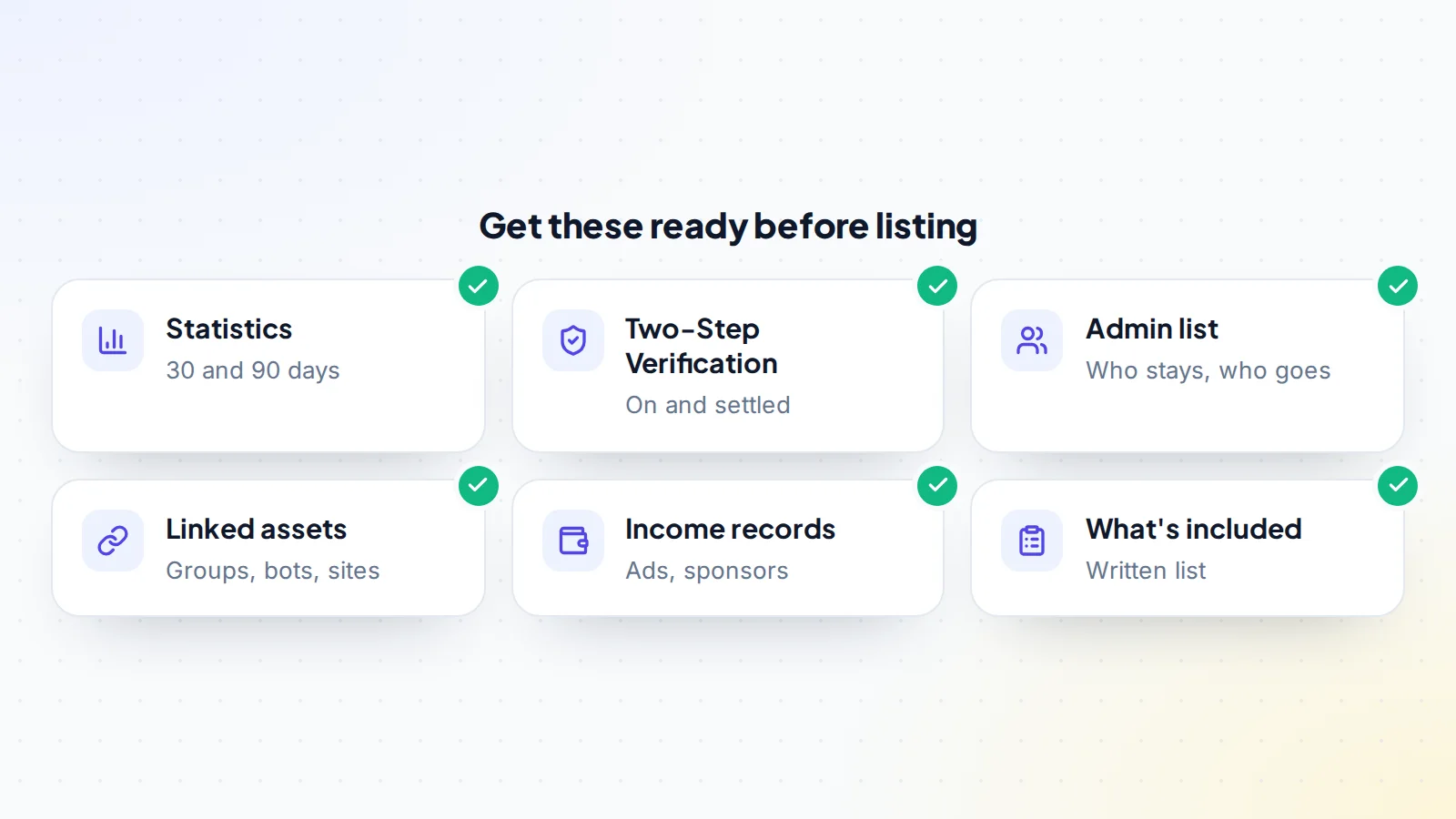
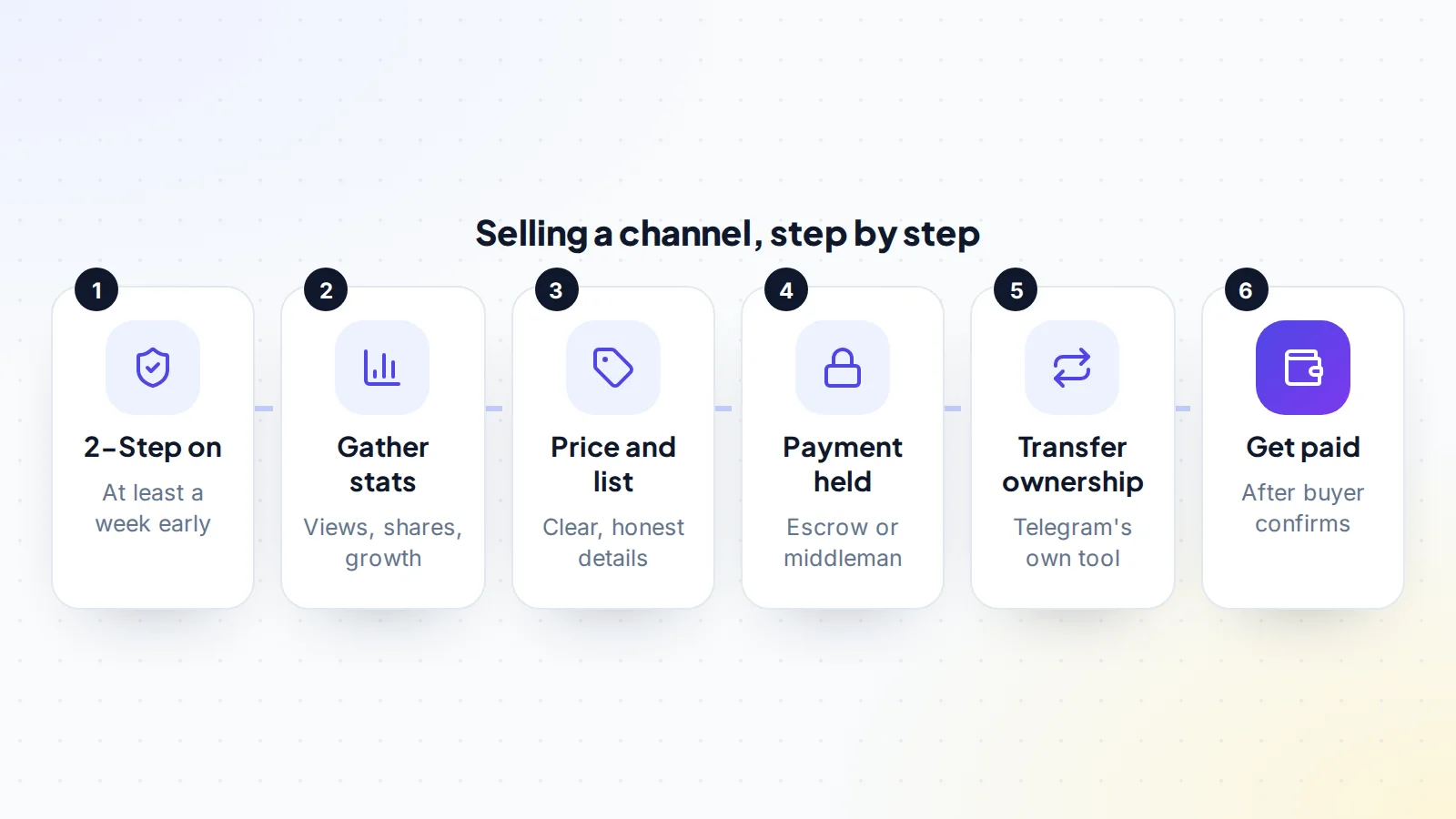
Telegram has a built-in way to transfer ownership of a channel, and it applies security conditions. According to Telegram’s developer documentation, the owner needs Two-Step Verification turned on, and the transfer can be refused if the password or the session on your device is too new. In practice, turn on Two-Step Verification at least a week before you plan to transfer, don’t change the password in that time, and do the transfer from a device you’ve been logged in on for a while.
Doing this at the start avoids a common delay on handover day, and it protects your channel while it’s listed. Save your Two-Step Verification password and recovery email somewhere safe; you’ll need the password to confirm the transfer, and losing it close to the sale would hold everything up.
Prepare your channel
Telegram provides statistics for larger channels, which you’ll find under the channel’s info, then Edit, then Statistics and Boosts. Telegram’s documentation describes channel statistics such as follower growth, views and shares per post, and the share of subscribers with notifications turned on. Note the figures for the last 30 and 90 days.
Then gather everything else a buyer will ask about:
- Admins: who has which rights, and who will stay after the sale.
- Linked assets: discussion groups, bots, websites and other social pages.
- Income records: ad revenue, sponsor invoices and affiliate dashboards.
- Content: templates, sources, scheduled posts and your posting rhythm.
Raise the value before you sell
If you have a few months, some focused work can lift the price:
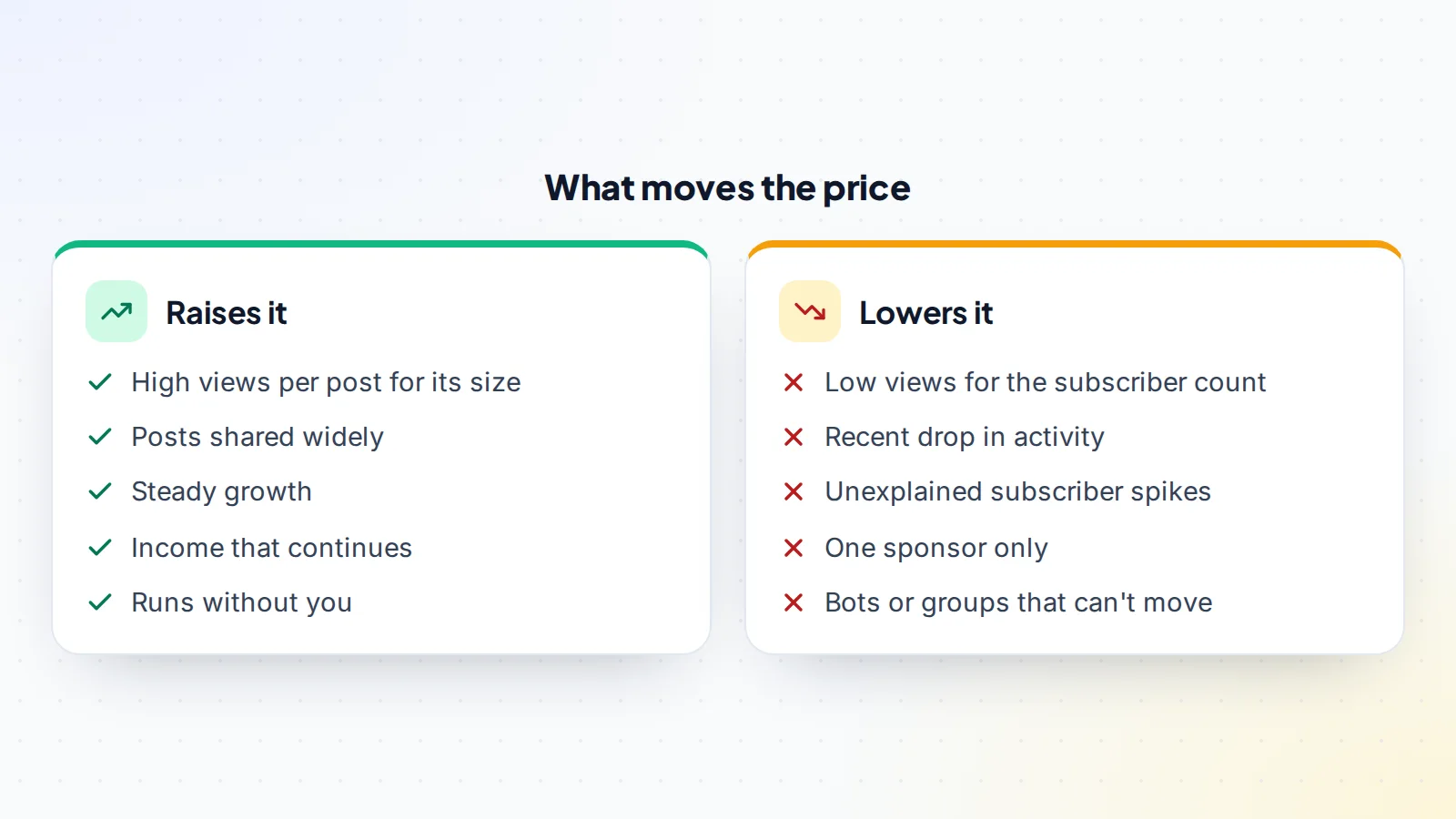
- Post consistently, so recent views reflect the channel at its best.
- Document your system: where content comes from, a posting calendar and templates a new owner can follow.
- Add income sources, such as a second sponsor, so the channel doesn’t rely on one.
- Build a team of editors who can stay, so the channel doesn’t depend on you alone.
- Keep the audience engaged with polls, questions and a discussion group.
Buyers pay most for channels that are healthy, predictable and easy to run. Our guide to increasing value before a sale has more ideas.
How to price your channel
Channels are usually priced in one of two ways, or a mix:
- Earning channels: a multiple of average monthly net profit from income that will continue for a new owner, such as ad revenue, recurring sponsors or affiliate income.
- Growing channels: priced on reach, meaning average views and shares per post, growth, niche and language, compared with similar channels that have sold.
Telegram has said that owners of public channels with at least 1,000 subscribers can receive a share of ad revenue from ads shown in their channels. If yours earns this way, show the figures in the channel’s own screens. Income that depends on you personally, such as a sponsor who works with you because of your reputation, may not continue, and buyers will price that in. Try the valuation tool on digiflippers.com for a quick range.
Write a clear listing
Answer buyers’ questions before they ask:
- Topic and language of the channel, and the main regions of readers.
- Subscribers, views and shares per post over 30 and 90 days.
- Growth: how the channel grew, including any promotions.
- Income: each source, monthly average and whether it continues.
- Time needed: hours per week and how content is produced.
- What’s included: the channel, linked groups, bots, content files and partner introductions.
- Why you’re selling.
Screenshots help buyers browse. For serious buyers, offer to show statistics live on a screen-share. Our guide to community engagement metrics explains how buyers read these numbers.
Choosing where to sell
Part of knowing how to sell a Telegram channel well is choosing a place where buyers can find it and the deal is protected. Look for a marketplace with buyers interested in communities, clear fees, escrow or middleman options and messages kept on the platform. On digiflippers.com, you can list your channel, and selling comes with 0% success fee up to $10,000, then 5% (max $5,000), so you keep 100% of the price on sales up to $10,000.
Talking to buyers
Expect serious buyers to ask for a screen-share of your statistics, your admin list and your income screens. Keep conversations on the marketplace so there’s a record. Be cautious with anyone who asks to be added as an admin before payment, wants to move to a private chat to “speed things up”, or offers to pay extra if you skip escrow. A genuine buyer is happy to follow a clear, protected process.
Questions buyers will ask
- How did the channel grow? Were there paid promotions, giveaways or cross-posts?
- What do typical posts get in views and shares, compared with the best?
- Where does content come from, and is it original?
- Which sponsors have you worked with, and will they continue?
- Which admins, groups and bots are part of the deal?
- How many hours a week does the channel take?
- When can the ownership transfer happen?
Have short, honest answers ready. If you’re working out how to sell a Telegram channel quickly at a fair price, prepared answers are one of the most effective things you can do.
Selling a group instead of a channel
Groups are conversations rather than broadcasts, so buyers look more at active members, message volume and moderation than at views. The ownership transfer works in a similar way, from the new owner’s admin settings, with the same security conditions. List the moderators who’ll stay, the group’s rules and any bots that help run it, and agree how members will be told about the change.
Timing the sale
Sell while the channel is active and its numbers are steady or rising. Buyers price on recent statistics, so a long pause in posting before listing usually lowers the price. Keep posting at your usual rhythm until the transfer, and allow a few weeks from listing to handover, plus the week you need for Two-Step Verification.
Getting paid safely
Agree the price, what’s included, the transfer date, admin changes and the buyer’s checking period in writing. Then use escrow or a middleman: the buyer pays, you confirm the funds are held by signing in to the escrow account yourself, you transfer the channel, the buyer confirms, and the money is released to you.
On digiflippers.com, the ways to pay in a deal are: directly to the seller, through escrow, and the platform never holds the money itself. Avoid accepting a direct card or payment-app transfer for the channel, because it can be disputed after you’ve handed over; our guide to chargeback risk explains why.
Transferring ownership
Once the payment is held, transfer on a call with the buyer:
- Add the buyer as an admin of the channel.
- Open the buyer’s admin settings and choose to transfer ownership.
- Enter your Two-Step Verification password when Telegram asks.
- Confirm the transfer. The buyer becomes the owner.
- Review admins together: the buyer decides who stays, including whether you keep any role during a transition.
- Linked groups and bots: transfer each one as agreed, or help the buyer set up replacements.
The buyer then confirms in escrow, and your payment is released to you in cleared funds, with a full record of the deal.
Telling your readers
Readers stay for content they trust, so think about how the change will feel to them. Some sellers post a short, friendly note introducing the new owner; others let the new owner introduce themselves after a few weeks of familiar posts. Agree with the buyer which approach you’ll use, what the note will say and when it will go out. Avoid surprising readers with a sudden change of tone or topic on the day of the transfer, because it can cost subscribers that both of you would rather keep.
Keep good records
Keep a copy of the agreement, the escrow transaction summary, your statistics at the time of sale and the messages with the buyer. They’re useful for your own tax records and answer any later question about what was sold and when. Ask a local adviser how the sale is treated where you live.
After the sale
If you agreed to help during a transition, answer questions promptly and introduce the buyer to sponsors. Remove the channel from any scheduling or analytics tools you used, or hand those over if they were included. If the buyer asks you to stay on as an editor for a while, agree the role and its end date in writing. Our guide to asset transfers helps you make sure nothing is missed.
Common mistakes to avoid
- Leaving Two-Step Verification until the day of the transfer.
- Adding the buyer as an admin before the payment is secured.
- Forgetting linked discussion groups or bots in the deal.
- Promising sponsor income that depends on you personally.
- Accepting a payment method that can be reversed after the handover.
A worked example
The details below are made up to show the method.
Marco runs a Telegram channel about remote jobs with 40,000 subscribers. Marco turns on Two-Step Verification and gathers statistics: posts average about 9,000 views and 150 shares over 90 days, growth is steady, and the channel earns from two job boards that sponsor weekly posts. Marco lists the channel with these figures, a linked discussion group and introductions to both sponsors.
A buyer asks for a screen-share; Marco opens Statistics live. They agree a price based on the sponsor income, use escrow and set the transfer for the following week. Marco confirms the funds are held, adds the buyer as an admin and transfers ownership, then transfers the discussion group. The buyer confirms, and the payment is released.
How to sell a Telegram channel: the checklist
- Two-Step Verification on at least a week before the transfer.
- Statistics for 30 and 90 days noted.
- Admins, linked groups and bots listed.
- Income records gathered.
- Price set from continuing income or reach and niche.
- Listing with clear figures and what’s included.
- Terms agreed in writing; payment held by escrow or a middleman.
- Ownership transferred with Telegram’s tool on a call.
- Admins reviewed and linked assets moved.
Ready to sell?
List it on digiflippers.com with verified numbers, answer buyers in one place and agree every step in a free Deal Room. 0% success fee up to $10,000, then 5% (max $5,000).
Sell your newsletter or community Browse newsletters & communities
Frequently asked questions
How do I transfer ownership of a Telegram channel?
Add the buyer as an admin, open their admin settings, choose to transfer ownership and confirm with your Two-Step Verification password.
Why can’t I transfer ownership yet?
Telegram applies security conditions: you need Two-Step Verification, and the transfer can be refused if your password or session is too new. Wait and try again from a device you’ve used for a while.
How much is my Telegram channel worth?
Earning channels are often priced on continuing monthly profit; growing channels on views and shares per post, growth and niche compared with similar sales.
Should I add the buyer as an admin before payment?
No. Secure the payment with escrow or a middleman first, then add the buyer and transfer.
Do linked groups and bots transfer automatically?
No. Each needs its own transfer or replacement, so list them in the deal.
What do buyers look at most?
Views and shares per post, growth, income and how much time the channel needs.
Can I stay on as an admin after selling?
Only if the buyer agrees. Many buyers welcome a short transition period; agree the role and its end date in writing.