How to Value a Digital Product Business
How to value a business that sells ebooks, courses, templates or software downloads: measuring real profit, adjusting for launches and refunds, valuing the email list and IP, and choosing a fair multiple.

Businesses that sell digital products, such as ebooks, online courses, templates, presets, fonts or downloadable software, can be wonderfully efficient. There’s no stock, no shipping, and a product made once can sell for years. But that efficiency also makes them tricky to value. Income can swing between launches, much of it may depend on an email list or one creator’s audience, and the product’s value rests on rights that need checking. This guide explains digital product business valuation step by step: finding real profit, adjusting for how sales happen, valuing the audience and rights, and choosing a fair multiple.
For the buying process, see our guide to buying a digital product business. If the business sells on Gumroad, Lemon Squeezy or Payhip, read about transferring a digital product store.
Key takeaways
- Start with 12 months of net profit after refunds, fees and all costs.
- Evergreen monthly sales are worth more than income from occasional launches.
- An owned email list that buys is often a major part of the value.
- Confirm the seller owns or has rights to all content and assets.
- Choose the multiple based on stability, diversity, dependence and growth.
What counts as a digital product business?
A digital product business sells files or access rather than physical goods. Common examples include ebooks and guides, online courses and memberships, design templates, presets and graphics, fonts, stock media, printables, and downloadable software or plugins. Many sell through platforms such as course hosts or digital storefronts; others sell from their own websites with a payment processor.
These businesses often have high margins, because each extra sale costs little. That’s attractive to buyers, and a careful digital product business valuation looks at why. The same features that make them efficient, such as low costs and reliance on an audience, are the ones to examine most closely.
Step 1: Find the real profit
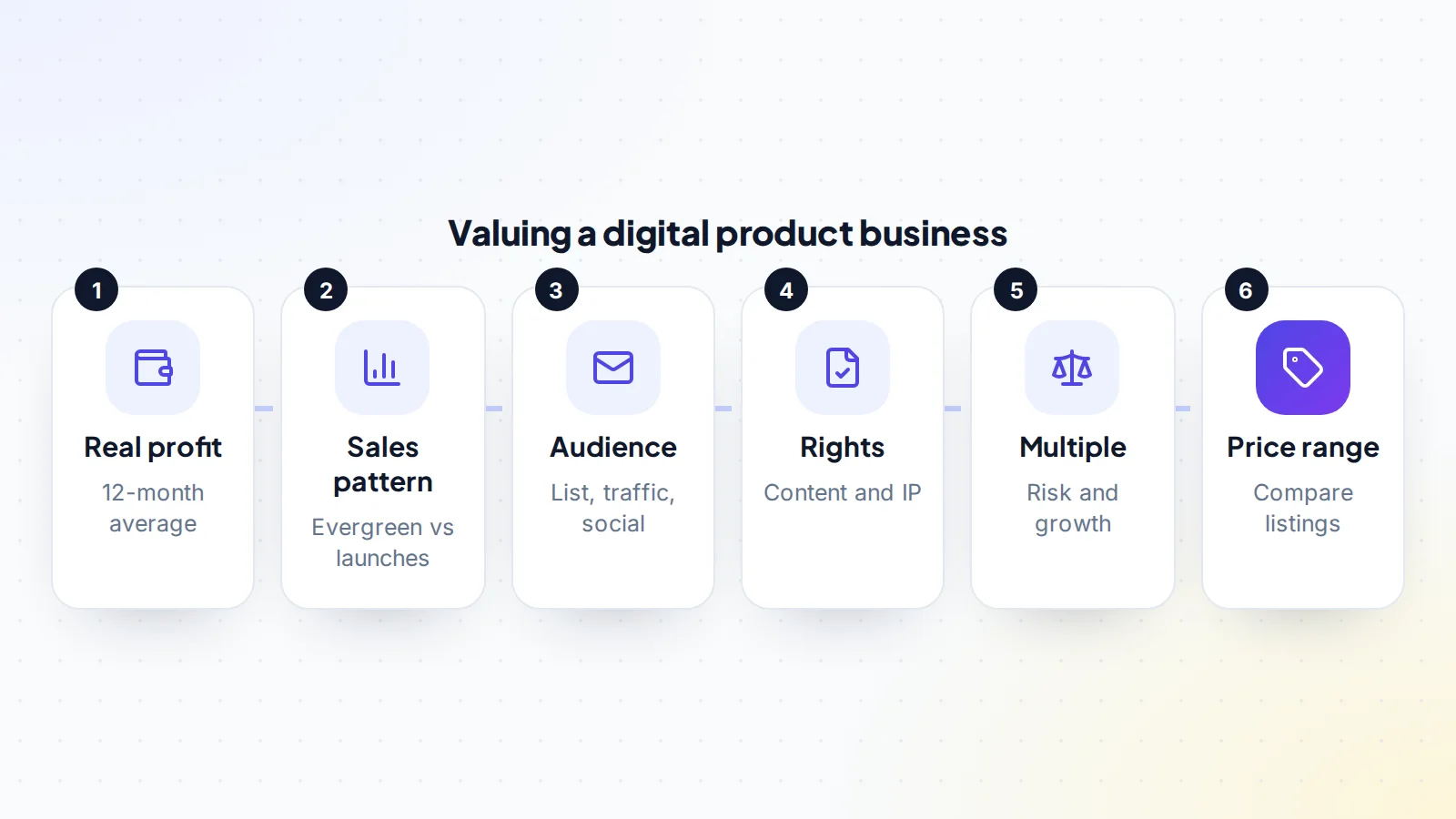
Most small online businesses are priced as a multiple of profit, so profit must be right. Gather 12 months of sales from every platform and processor, then subtract:
- Refunds and chargebacks.
- Platform and payment fees.
- Tools and hosting, such as course platforms, email software and file storage.
- Advertising and affiliate commissions paid to partners.
- Contractors, such as designers, editors or support staff.
Match the sales reports to payouts and bank deposits. Our guide to verifying revenue shows how to follow the money, and our guide to revenue vs profit explains why the difference matters so much.
Count the owner’s time
Many digital product businesses are run by one person who creates products, answers emails and runs launches. If that person takes no salary, profit looks higher than it would be for a buyer who has to pay someone to do the same work. Ask how many hours the owner spends each week and on what. Then decide whether to subtract the cost of replacing that time. Our guide to owner hours and valuation explains how buyers adjust for this.

Step 2: Look at how sales happen
Digital products sell in two main patterns. Evergreen sales come in steadily every month, from search traffic, email sequences, platform discovery or ads. Launch sales come in bursts, when a new product or a promotion is announced to an audience. Both can be profitable, but they’re valued differently.
Evergreen income is easier to predict and usually less dependent on the owner, so it supports a higher multiple. Launch-driven income depends on someone planning and running launches, often with the founder’s personal voice, and the next launch may not repeat the last one. When valuing, average profit over a full 12 months so a strong launch month doesn’t inflate the price, and note how much income came from launches versus steady sales.
Step 3: Assess the product catalogue
Look at how many products sell and how sales are spread among them. A business where one product brings in most of the income is more fragile than one with several steady sellers. Check each product’s age and whether it needs updating: a course about a fast-changing tool may need re-recording, while a set of timeless templates may sell for years unchanged.
Also check product quality through reviews, refund reasons and support emails. High refund rates or repeated complaints point to problems that a buyer would need to fix. Low refunds and positive reviews support value.
Step 4: Value the audience
For many digital product businesses, the audience is the engine. An email list that opens, clicks and buys is often a major part of the value, because it lets the owner sell directly without paying for each visitor. Look at the list’s size, how it was built, engagement over recent months and how much revenue comes from email. Our guide to email list value explains how buyers assess a list.
Search traffic, platform discovery and social accounts matter too. Check where buyers come from and how much each source contributes. Audiences built around a topic usually transfer better than those built around one person’s personality.
Step 5: Confirm rights and ownership
A digital product is only valuable if the business has the right to sell it. Ask who created each product and under what agreement. Content made by contractors may need a written assignment or licence to belong to the business. The US Copyright Office explains that work made by an independent contractor counts as a “work made for hire” only in certain cases and with a written agreement, so a contractor’s work may otherwise still belong to the contractor.
Check fonts, images, music and other assets used in products, and confirm the licences allow commercial resale. A problem here doesn’t always end a deal, but it needs fixing before closing or reflecting in the price. Our guide to digital product intellectual property covers this in detail.

Step 6: Consider platform risk
If the business sells mainly through one platform, its rules and fees matter. Check what the platform charges, whether its terms allow the store or account to change hands and how, and what happens to customer data and past purchases. Some platforms make transfers straightforward; others require contacting support or setting up a new account. Selling through the business’s own website with a payment processor gives more control, but brings its own setup.
Payment disputes are another risk. Stripe’s documentation explains that when a customer disputes a payment, the disputed amount and a fee are withdrawn while the dispute is reviewed, and the business can respond with evidence. Ask for refund and dispute rates by month, and how the seller handles them.
Memberships and subscriptions
Some digital product businesses sell memberships or subscriptions rather than one-off products, such as a monthly template club or a course community. Recurring income is often valued more highly, because it’s more predictable, but it needs its own checks. Look at the number of active members, how many cancel each month, how long members stay on average and whether prices have changed recently. Check how billing will move to a new owner: subscriptions run through a payment processor or platform, and each has its own rules on transferring customers. A membership with low churn and a clear billing handover can lift the whole business’s multiple.
Customer data and past buyers
Past buyers are valuable: they may buy again, need updates or recommend products to others. Ask how customer records are stored, whether buyers agreed to receive marketing emails, and how download access for past purchases will continue after the sale. A buyer inherits responsibility for customers who already paid, so make sure their access keeps working. Treat the data carefully during the handover, moving it directly between accounts rather than by email.
Step 7: Choose the multiple
With real profit and the risk factors in view, choose a multiple. Digital product businesses are often priced on a multiple of monthly net profit, and the multiple moves with:
- Stability: steady evergreen income supports a higher multiple than launch-driven income.
- Diversity: several products and traffic sources reduce risk.
- Dependence: businesses that rely heavily on the founder’s name or time are discounted.
- Rights: clean ownership of all content supports value.
- Growth: a rising trend in sales and audience lifts the multiple.
There’s no official table of multiples, so compare with similar businesses that have been listed or sold, and keep your reasoning written down. For a starting range, try the free valuation tool. Early-stage businesses with little profit are valued differently; our guide to pre-revenue valuation explains how.
Common adjustments buyers make
- Removing one-off income, such as a single large licensing deal.
- Averaging out launch spikes over the year.
- Subtracting the cost of the owner’s time if a buyer would need to pay for it.
- Allowing for products that need updating soon.
- Discounting income tied to the founder personally, such as coaching sold alongside products.
- Reflecting any content rights that still need to be cleaned up.
How sellers can raise value
Sellers can increase their business’s value before a sale by building evergreen sales channels, such as email sequences and search content, spreading income across more products, documenting how products are made and launched, getting written assignments from contractors, and reducing refunds through clearer product pages. These steps take time, so start them months before listing. Our guide to increasing business value before a sale has more ideas.
When you’re ready, list your business on digiflippers.com with 0% success fee up to $10,000, then 5% (max $5,000).
From valuation to deal
Once buyer and seller agree a price range, the next step is usually a letter of intent covering price, what’s included and the timeline, followed by due diligence and a purchase agreement. Use escrow so the payment is held while the products, platforms, email list, website and files move to the buyer. On digiflippers.com, the ways to pay in a deal are: directly to the seller, through escrow, and the platform never holds the money itself. Read how escrow works before you start.
A worked example
The details below are made up to show the method.
Elena runs a business selling design templates and a short course. Over 12 months, templates averaged $4,200 a month and the course $1,300. Refunds and fees averaged $450 a month, and tools, hosting and a small ad budget $650, leaving $4,400 a month in net profit. Sales are mostly evergreen, from search and an email sequence, with one small launch in the year.
A buyer reviews the sales reports against payouts, checks the email list’s engagement, and finds that Elena designed most templates personally and has written assignments from the two freelancers who made the rest. Refunds are low. The main risks are that templates bring most of the income and that Elena spends about ten hours a week on support and new designs.
They agree a multiple in the middle of the range for similar businesses, reflecting stable income and clean rights, discounted slightly for the owner’s time. The price lands near $132,000. A letter of intent follows, and the payment is held in escrow during the handover.
Digital product business valuation: the checklist
- 12 months of sales matched to payouts and bank deposits.
- Refunds, fees and every cost subtracted.
- Owner’s time measured and costed.
- Evergreen and launch income separated.
- Sales spread across products reviewed.
- Email list engagement and revenue share checked.
- Rights to all content and assets confirmed in writing.
- Platform terms, fees and transfer process checked.
- Multiple chosen with reasons written down.
Looking to buy? Browse digital product businesses for sale.
Ready to find your next asset?
Browse listings with verified numbers, ask sellers your questions before you offer, and agree every step in a free Deal Room.
Frequently asked questions
How is a digital product business valued?
Usually as a multiple of monthly or annual net profit, adjusted for how stable sales are, how diverse the products and traffic are, owner dependence, content rights and growth.
Are launches counted in the valuation?
Yes, but average them over 12 months and note how much income relies on launches, because future launches may not repeat past results.
How much is an email list worth?
It depends on engagement and how much revenue it drives. A list that opens, clicks and buys can be a large part of the value.
Why do content rights matter?
The business can only sell products it has the right to sell. Work by contractors may need a written assignment or licence.
Does selling on a platform lower the value?
It can add risk, depending on the platform’s fees, rules and transfer process. Check these early.
What multiple should I use?
There’s no official table. Compare similar businesses that have sold, and adjust for the factors above.
Can a business with one product be valuable?
Yes, if it sells steadily and the rights are clear, but the dependence on one product usually lowers the multiple.