Buying an AI SaaS: API Costs, Model Risk and Moats
A buyer's guide to AI software businesses: how API costs shape margins, what happens when models are retired, provider accounts and terms, data and privacy, what makes a moat, and how to value and hand over an AI product.

AI products are among the newest listings on any marketplace. An AI SaaS for sale can look like an ideal buy: fast growth, modern technology and a product people talk about. But these businesses carry risks that older software doesn’t: costs that rise with every customer request, models that get retired on someone else’s schedule, and competitors who can copy a simple product quickly. This guide explains what to check, how to judge the margin and the moat, and how to take one over safely.
Every AI SaaS for sale is still a software business first, so start with the basics in how to buy a SaaS business; everything there still applies. This guide adds the checks that are specific to AI.
Key takeaways
- Model API costs grow with usage, so gross margin matters more than in classic SaaS.
- Model providers retire older models on their own timeline; the product must be able to switch.
- Provider accounts and API keys belong to the account holder; plan how they move.
- A real moat comes from data, workflows, integrations and customers who stay.
- Value it on profit and retention, not on hype or growth alone.
What counts as an AI SaaS
Most AI software businesses for sale fall into a few groups. Some call a model provider’s API to write, summarise, translate or classify text, images or audio, and wrap that in a product for a particular job. Some run open models on their own servers. Some add AI features to an existing tool, such as a writing app or a support desk. And a few train or fine-tune their own models on data they own.
The group matters, because it decides where the costs sit and how exposed the business is to changes it can’t control. A product that sends every request to one provider’s API depends on that provider’s prices, models and terms. A product that owns data and workflows depends on them far less.
API costs and gross margin
Classic SaaS has low costs per extra customer: once the software exists, serving one more user costs little. AI products are different. Every request to a model costs money, often priced per token of input and output, so costs rise with usage. A customer who uses the product heavily can cost more than they pay.
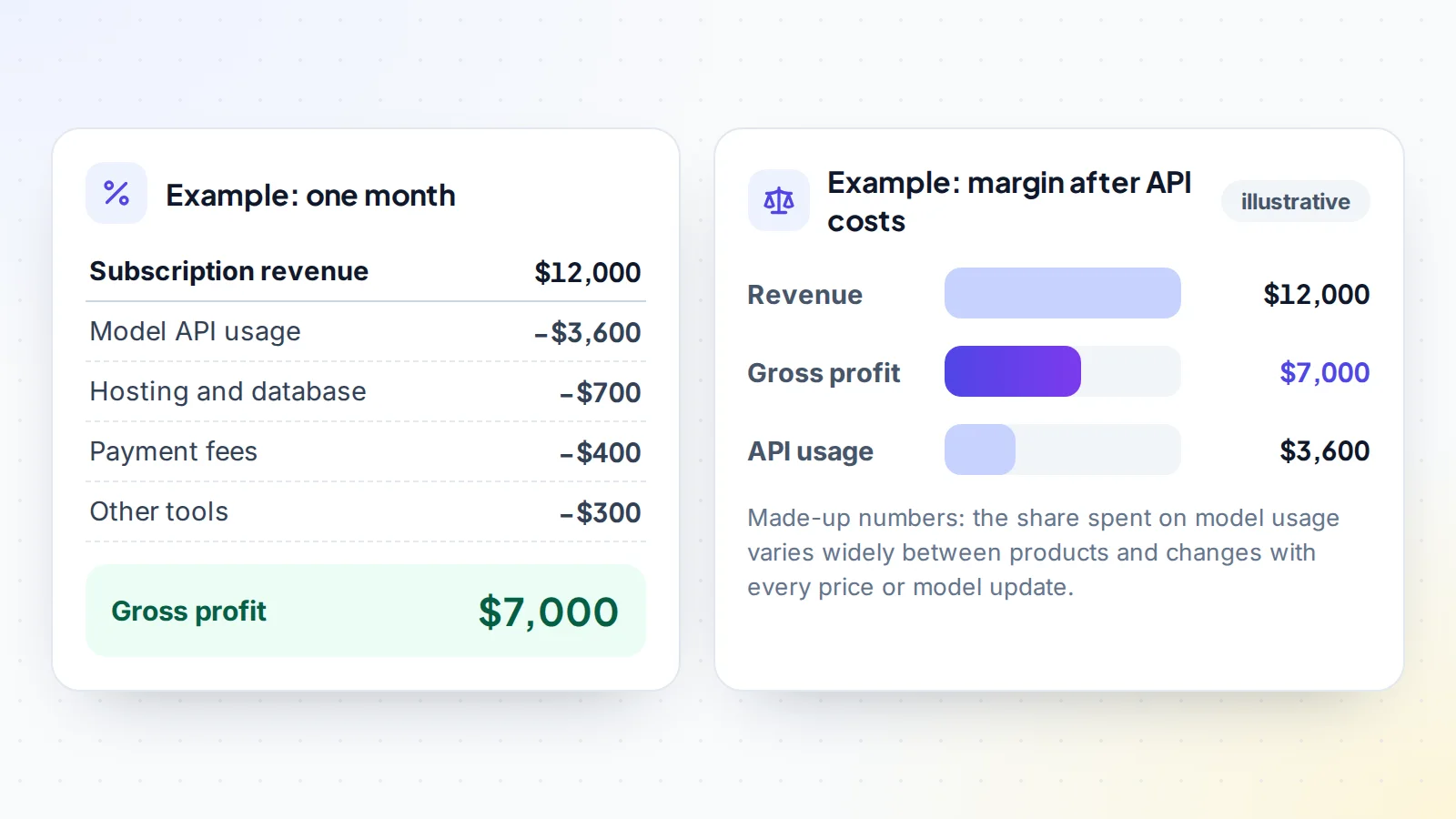
Ask for monthly invoices from every model provider for at least twelve months, and compare them with revenue. Work out the cost per active customer and how it has changed. Look at the heaviest users: are they on plans that cover their usage? Check whether the product limits usage, uses caching, or routes simple jobs to cheaper models. A business with healthy revenue and thin margins is far less valuable than one with the same revenue and strong margins. Read trailing twelve months profit for how to look at a full year rather than a good month.
How the product charges
Pricing tells you whether margins will hold. Flat monthly plans with unlimited use are risky if costs rise with usage. Plans with credits, usage limits or tiers tied to volume protect the margin better. Check whether prices have changed, how customers reacted, and whether there’s room to raise them. If the product’s price is far below what the model provider’s own app costs, ask how that’s sustainable.
Model retirement risk
Model providers retire older models as they release new ones. OpenAI publishes a deprecations page listing models and features with their shutdown dates and recommended replacements. Anthropic publishes a model deprecations page too, and states that it gives at least 60 days’ notice before retiring publicly released models. Both lists change regularly.
When a model is retired, every product built on it must move to a newer one. That can change output quality, prompt behaviour, speed and cost. Ask the seller which models the product uses today, when each is due to be retired, and how the last switch went. A product that has already moved between models without losing customers has shown it can adapt. One built tightly around a single older model may need real work soon after you buy.
Provider accounts, keys and terms
API accounts belong to the person or company that opened them, and their terms decide what you can do. Read the provider’s terms for the uses the product relies on, and check whether the account is in a company name that’s part of the sale or in the seller’s personal name. If it’s personal, plan for you to open your own account, add billing, generate new keys and switch the product over during the handover. Rotate every key after closing.
Check usage tier and rate limits too. A new account may start with lower limits than the seller’s account, which can slow the product for customers until limits rise. Plan the switch early and test it under real load.
Customer data and privacy
AI products often send customer content to a third party for processing. Find out exactly what’s sent, whether the provider keeps it, for how long, and whether it’s used for training. Check the product’s privacy policy and terms say this clearly. If the product has customers in the UK or EU, data protection law applies; read GDPR when buying or selling a SaaS.
Business customers often ask for this in writing. If the product has signed data processing agreements or passed security reviews with larger customers, ask for copies. That paperwork is part of what keeps those customers when ownership changes.
Is there a moat?
The hardest question for any AI product is what stops a competitor, or the model provider itself, from offering the same thing. A product that’s a prompt and a form can be copied quickly, and model providers keep adding features to their own apps that overlap with simple tools.
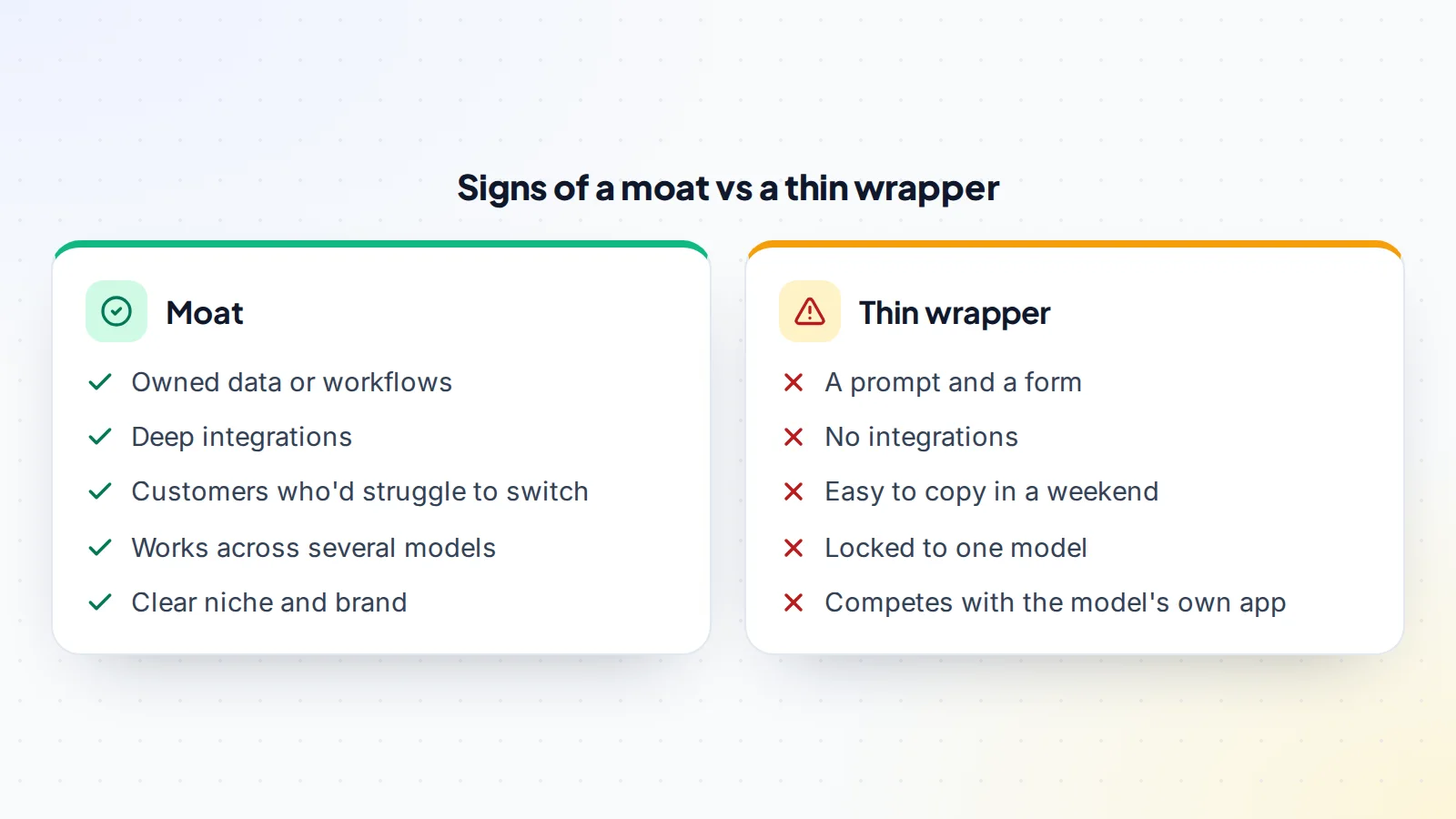
Real defences include data the business owns and improves over time, workflows built around a specific job, integrations with tools customers already use, a brand in a clear niche, and customers whose own processes depend on the product. Ask the seller who the main competitors are, how customers found the product, and why they stay.
Retention tells the truth
Many AI products grow fast on curiosity and then lose customers just as quickly. Monthly churn and revenue retention show whether customers find lasting value. Ask for cohort data: of the customers who joined in a given month, how many are still paying three, six and twelve months later? Read SaaS churn rate for how to measure it. Strong, stable retention is the best sign a product isn’t a passing trend.
Technical due diligence for AI
On top of a normal code review, look at how prompts and model settings are stored and versioned, whether there are tests that check output quality, how the product handles provider outages and errors, and whether it can switch between models or providers without a rewrite. Check how costs are logged and monitored, and whether there are limits that stop one customer running up a huge bill. See SaaS technical due diligence for the wider checks.
Who owns what
Confirm the business owns its code, prompts, data and brand, and that contractors assigned their work. Check the licences of any open models or datasets used; some limit commercial use. Ask whether the business has received any complaints about its outputs, such as copyright or accuracy claims, and how they were handled.
How to value it
Value an AI product on the same basis as other software: profit, growth and retention. What’s different is the extra risk. Thin or falling margins, dependence on one model, a short customer history or an easy-to-copy product all push the price down. Owned data, strong retention, healthy margins and the ability to switch models push it up. Read SaaS valuation multiples for the factors buyers weigh.
Be careful with growth-based pricing for very young products. Fast early growth with little history is the hardest thing to judge. Deal structures such as part of the price paid later on agreed targets can share that risk; see earn-outs.
Taking it over
An AI product needs a careful handover. Agree a transition period in which the seller helps you move provider accounts, keys, prompts, monitoring and billing, and explains why the product is set up the way it is. Switch provider accounts before the seller steps away, and watch costs and quality closely for the first weeks.
Move payment processing with care too, since that’s where revenue lives. Read how to transfer Stripe subscriptions.
Questions to ask the seller
Good sellers answer these readily. How did your model costs change over the last year, and why? Which models have you switched between, and what happened to quality and churn when you did? What would you build next with more time? Which customers use the product most, and what do they pay? Have you had outages at the provider, and how did customers react? Their answers, and how quickly they come with evidence, tell you as much as the numbers. Read questions to ask when buying a business for the general list.
After you buy
Set up cost alerts with every provider on day one. Watch the provider deprecation pages for the models you use. Keep a short list of alternative models you’ve tested, so a retirement or price change isn’t an emergency. And keep talking to customers: in a fast-moving field, their needs are the best guide to what to build next.
Red flags
When you review an AI SaaS for sale, a few signs suggest the numbers or the product won’t hold up after you take over. Any one of them is a reason to ask more questions; several together are a reason to walk away.
- No provider invoices, or invoices that don’t match the revenue story.
- Margins that only work because of free credits that are about to end.
- A product locked to one model due for retirement soon.
- Unlimited plans with a few customers using far more than they pay for.
- No clear answer on what customer data is sent where.
- Fast growth with no retention data.
A worked example
The details below are made up to show the method.
Sam looks at an AI writing assistant for lawyers with $12,000 in monthly revenue. The provider invoices show model costs of $3,600 a month, up from $2,000 six months earlier, while revenue grew more slowly. Sam finds a handful of customers on an unlimited plan using a large share of the tokens.
The product uses one model due to be retired within the year, but the code already supports switching, and the seller shows tests from a trial run on the newer model. Customers have stayed: about four in five of those who joined a year ago are still paying. The product integrates with two document systems law firms use, and stores templates customers have built over time.
Sam values it on twelve months of profit, discounts for the rising costs, and offers a price with part paid later if margins hold. The seller agrees to a six-week transition. Sam moves the provider account, adds usage limits to the unlimited plan with notice to customers, and switches to the newer model in month two.
AI SaaS for sale: the checklist
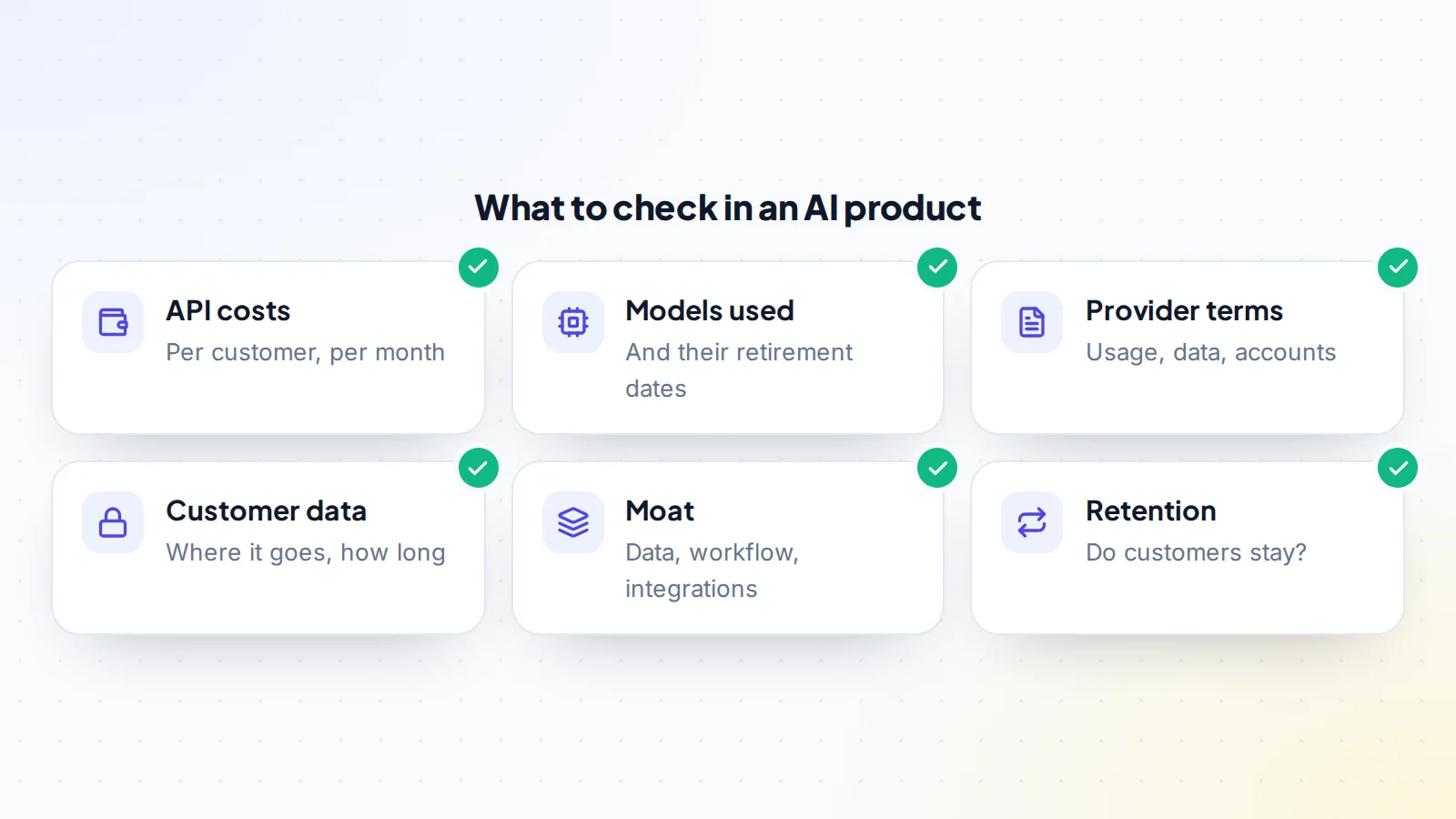
- Twelve months of model provider invoices compared with revenue.
- Cost per active customer and heaviest users reviewed.
- Models used, retirement dates and switching plan checked.
- Provider terms read and account ownership confirmed.
- Customer data flows and privacy terms documented.
- Retention by monthly cohort reviewed.
- Code, prompts, data and brand owned by the business.
- Transition plan for accounts, keys and billing agreed.
Browse SaaS and apps for sale, and read how digiflippers.com handles trust and safety.
Ready to find your next asset?
Browse listings with verified numbers, ask sellers your questions before you offer, and agree every step in a free Deal Room.
Frequently asked questions
Are AI software businesses good to buy?
Some are. The best have healthy margins, loyal customers and something hard to copy. Many are young, thin and exposed to changes they can’t control.
What’s the biggest risk?
Often a mix of rising model costs, model retirements and competition from the model providers’ own products.
Can model API accounts be transferred?
Check the provider’s terms. In practice, the buyer often opens a new account and the product switches to it during the handover.
How much notice do providers give before retiring a model?
It varies. Anthropic says at least 60 days for publicly released models. OpenAI lists shutdown dates on its deprecations page.
What’s an AI wrapper?
A product that mainly passes user input to a model and shows the result, with little else. It can work, but it’s easy to copy.
How should I value one?
On profit, growth and retention like other software, with a discount for the AI-specific risks.
What data should I ask for?
Provider invoices, revenue by month, cohort retention, usage by customer, the models used and the privacy terms.
Do I need technical skills to run one?
It helps. If you don’t have them, budget for a developer who understands model APIs, prompts and costs.