Transferring Email Subscribers the Right Way: Consent and GDPR
A practical guide to moving an email list when a business is sold: why consent is tied to who collected it, what UK and EU rules expect, privacy notices within one month, suppression lists, US CAN-SPAM, moving the email platform and records to keep.
An email list is often one of the most valuable parts of an online business. When the business is sold, the list usually goes with it. But subscribers gave their details to a particular sender for a particular reason, and the law in many places protects that choice. To transfer email subscribers properly, the buyer and seller need to know how the list was built, keep the purpose the same, tell subscribers, and carry over every opt-out. This guide explains how, with a focus on UK and EU rules and notes on the US.
This is general information, not legal advice. Rules differ by country and change over time, so speak to a data protection adviser about your own deal. For valuing the list itself, read how an email list is valued; for the full newsletter sale, see how to buy a newsletter.
Key takeaways
- Consent to marketing is given to a sender for a purpose; it doesn’t automatically pass to anyone else.
- Selling a list on its own is far riskier than selling the whole business with its brand.
- UK and EU guidance expects privacy information within one month of obtaining data from another source.
- Unsubscribes must move with the list and be honoured.
- Get consent records from the seller; they’re your evidence.
Why email lists need care in a sale
Personal data, including names and email addresses, is protected by law in many countries. In the UK and EU, the GDPR (and the UK GDPR) set the rules for handling it; you can read the EU regulation on EUR-Lex. Separate rules cover sending marketing emails: in the UK, the Privacy and Electronic Communications Regulations (PECR), and in EU countries, national laws based on the ePrivacy Directive.
A buyer who takes over a list takes on responsibility for how it’s used. If the list was built badly, or is used in a way subscribers didn’t expect, complaints, regulator attention and poor deliverability can follow. Doing it properly protects the list’s value.
Consent belongs to a sender
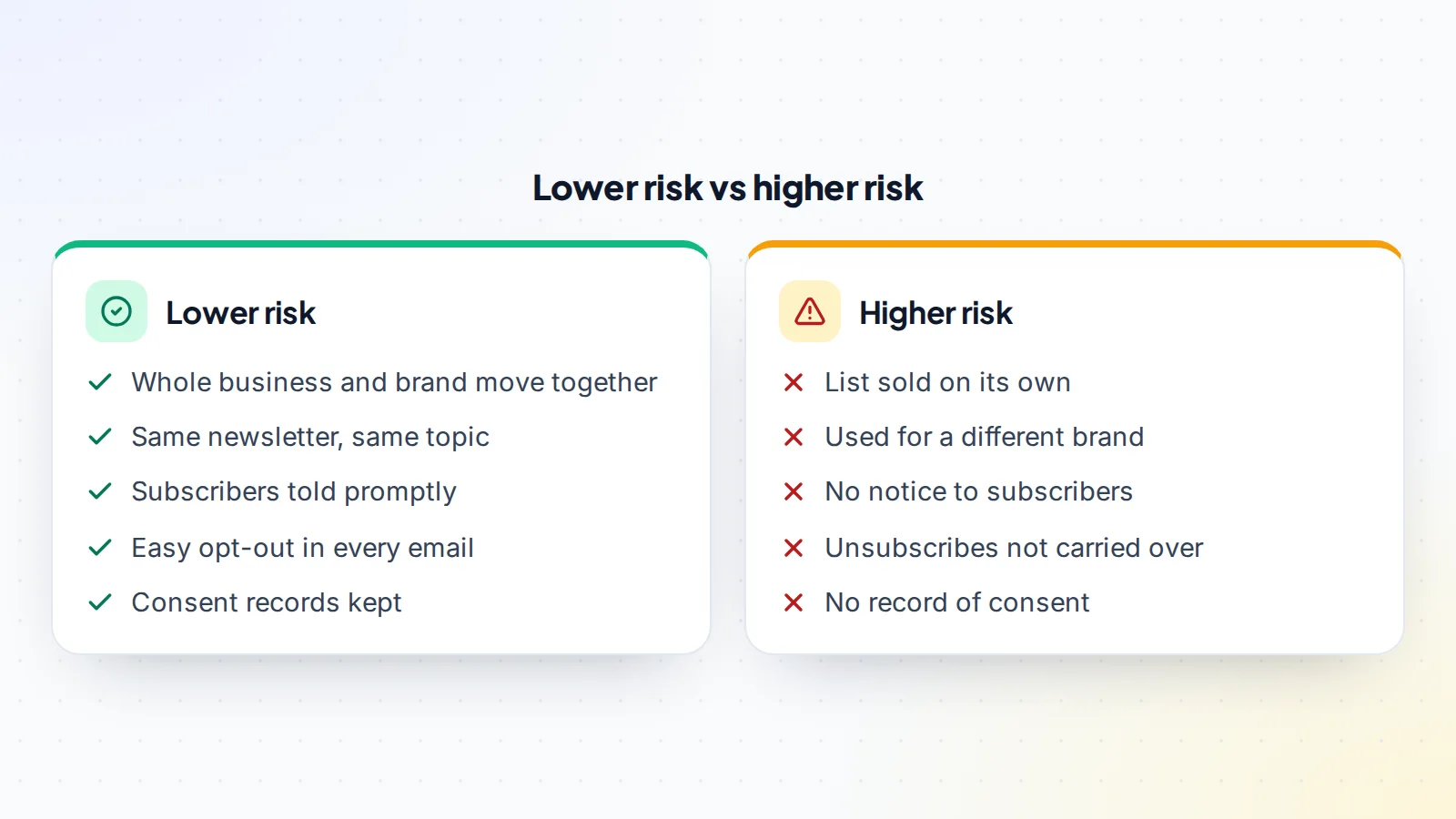
The UK regulator, the ICO, is clear that consent to email marketing is specific. Its guidance on using marketing lists says you can only sell a marketing list if the people on it consented to that, and that other businesses can only use it for emails if people specifically consented to receive that type of message from that company. In practice, a list collected by one brand can’t simply be used by a different brand.
That’s why the way the sale is structured matters so much.
Selling the whole business vs selling the list
When a whole business is sold, including its brand, website and newsletter, subscribers usually keep receiving the same emails from the same name about the same topic. From their point of view, little has changed except who runs it behind the scenes. The ICO’s guidance on due diligence when sharing data in mergers and acquisitions says to establish the purposes for which data was originally obtained, the lawful basis for sharing it, and whether these change after the deal. Keeping the purpose the same is the key.
Selling a list on its own, to be used by a different business, is much harder to do lawfully under these rules, because subscribers never agreed to hear from the new sender. The same applies if a buyer takes over a list and starts using it to promote a different brand or unrelated products. In those cases, fresh consent is usually needed.
Customer lists and the soft opt-in
Under PECR, a business can sometimes email its own customers about similar products without explicit consent, if it collected their details during a sale and gave them a chance to opt out. This is known as the soft opt-in. It’s tied to the business that made the sale and to similar products. If you buy a store and keep selling the same kind of products under the same name, ask your adviser how this applies to the customer list you take over. If you plan to market different products, don’t rely on it.
Telling subscribers
When personal data is obtained from someone other than the person it’s about, UK and EU law expects you to tell those people about it. The ICO explains in when should we provide privacy information that this must happen within a reasonable period and no later than one month, or at the first communication if that’s sooner.
A short email from the new owner works well: say the business has a new owner, who they are, that the newsletter will continue as before, where to find the updated privacy notice, and how to unsubscribe in one click. Many owners find this also helps engagement, because readers appreciate being told.
Unsubscribes must move too
Everyone who has unsubscribed or complained must stay unsubscribed. Get the full suppression list from the seller, not just the active subscribers, and load it into your email platform before you send anything. Under the GDPR, people have an absolute right to object to direct marketing, so an opt-out given to the old owner still counts.
In the US, the FTC’s CAN-SPAM compliance guide says opt-out requests must be honoured within 10 business days, that every commercial email needs a working opt-out, and that you can’t sell or transfer the email addresses of people who have opted out, except to a company you’ve hired to help you comply. If your list includes US subscribers, those rules apply too.
Records to ask for
The seller should be able to show how every subscriber joined. Ask for the following before you agree a price.
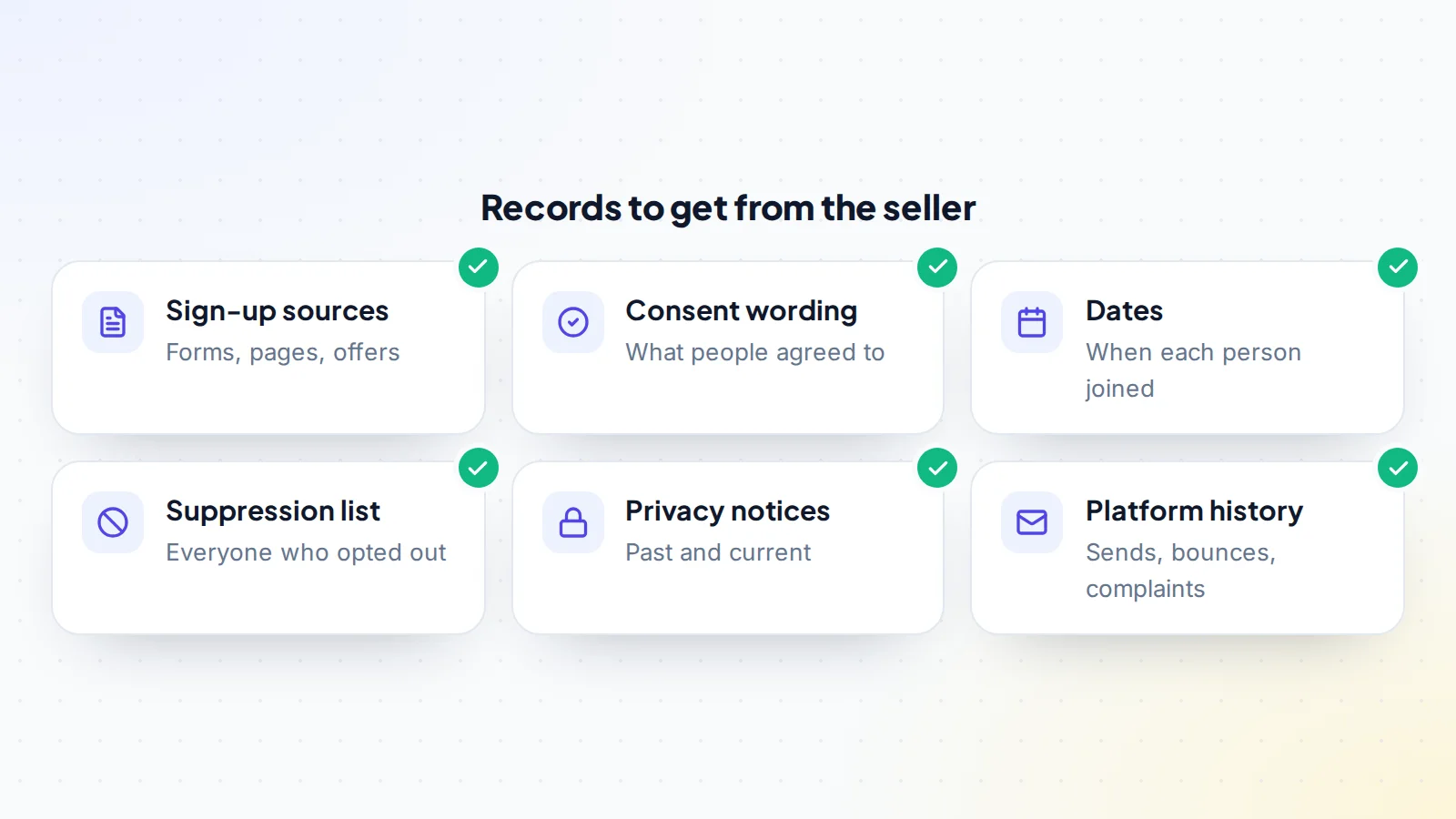
If the seller can’t explain how the list was built, or it includes bought or scraped addresses, treat it as a serious risk. Such lists often bring high bounce rates and spam complaints, which damage deliverability for the whole domain. Read how to check email deliverability.
Checking the list’s quality
Beyond the legal side, check that the list is healthy. Look at open and click rates over time, bounce and complaint rates, how many subscribers joined recently, and how many haven’t engaged in months. A smaller, active list is often worth more than a large, quiet one. Read newsletter sponsorship revenue for why engagement drives income, and growth trends and valuation for how buyers judge a list’s direction.
Moving the email platform
There are two ways to move the list technically. The cleaner one is to take over the seller’s email platform account, which keeps the history, automations, forms and sender reputation. Many platforms support this; Mailchimp, for example, lets an account owner transfer ownership to an admin user. The other is to export the list and import it into your own account. If you do that, import the suppression list too, and expect your platform to ask how the contacts were collected.
Moving the sending domain matters as well. Keep the same sender name and address the readers know, and set up authentication on your own domain records. Read how to transfer a newsletter.
Keeping the data secure
Never send the list as an email attachment or through a file-sharing link left open. Use the platform’s own transfer tools where possible, or a secure, private file transfer, and delete copies when the move is complete. Limit who on each side can see the data. The seller should delete their copies once the handover is confirmed, and the purchase agreement can say so.
What the agreement should say
The purchase agreement should describe the list as part of the assets, with the seller confirming how it was collected and that it complies with the law. It can include a promise to fix any problems found later, and set out how and when the seller deletes their copies. Read legal due diligence for the wider checks, and GDPR in a SaaS sale if the business also holds customer data in a product.
Communities and newsletters
Paid newsletters and communities often hold more than emails: payment details, membership data and message history. Each needs the same care. Payment data usually stays with the payment processor and moves through its own tools. Read monetizing a Discord server and growing a newsletter for community-specific advice.
After the transfer
Send your introduction email, watch unsubscribe and complaint rates closely for the first few sends, and keep the content close to what readers signed up for. If you want to change the topic or add new kinds of emails, tell subscribers and give them a clear choice. Keep all records from the sale in case a subscriber or regulator asks how you got their details.
When to plan it
Plan how you’ll transfer email subscribers early in the deal, not on closing day. The records check belongs in due diligence, the method belongs in the purchase agreement, and the introduction email should be drafted before closing so it goes out on time. Sellers can help by keeping consent records tidy from the start: a list with clear sign-up sources and a clean suppression list sells more easily and for a better price.
Subscribers in many countries
Most lists include people from several countries, each with its own rules. A simple approach many businesses take is to apply the strictest standard they’re subject to across the whole list: clear consent, prompt notice, and an easy opt-out for everyone. When you transfer email subscribers from many regions, that keeps the process simple and protects the list as a whole.
Common mistakes
- Buying a list on its own to use for a different brand.
- Not telling subscribers about the change of owner.
- Importing active subscribers but not the suppression list.
- Changing the newsletter’s topic straight after the sale.
- Sending the list in an unprotected spreadsheet.
- No consent records from the seller.
A worked example
The details below are made up to show the method.
Ellis buys a gardening newsletter with 12,000 subscribers, along with its brand and website. Before agreeing the price, Ellis asks for the sign-up forms, the consent wording, the dates people joined and the suppression list of 2,300 unsubscribes. The records show subscribers joined through the website’s sign-up form, which said they’d receive the weekly gardening newsletter.
The seller transfers ownership of the email platform account to Ellis. Ellis keeps the same newsletter name and topic, updates the privacy notice with the new owner’s details, and in the next send, two weeks after closing, introduces themselves as the new owner with a one-click unsubscribe link. Unsubscribes that week are only slightly above normal. The seller deletes their exported copies and confirms it in writing.
Transfer email subscribers safely: the checklist
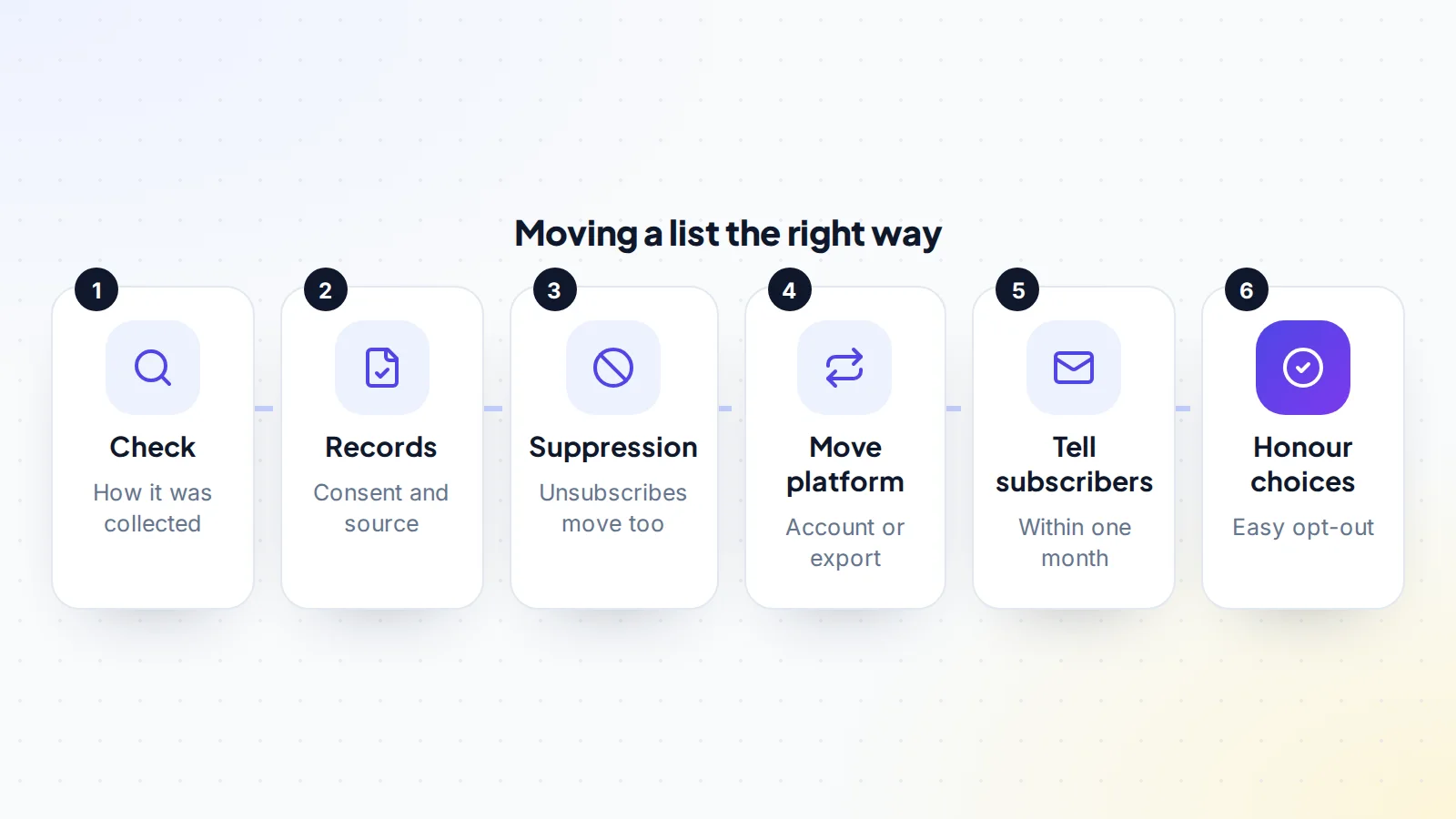
- Sign-up sources, consent wording and dates received.
- Sale structured so the brand and purpose stay the same.
- Suppression list received and loaded first.
- Platform account transferred or list moved securely.
- Privacy notice updated with the new owner’s details.
- Subscribers told within one month.
- Easy opt-out in every email.
- Seller’s copies deleted and confirmed in writing.
Browse newsletters and communities for sale, or list yours with 0% success fee up to $10,000, then 5% (max $5,000). Read how it works on digiflippers.com.
Ready to find your next asset?
Browse listings with verified numbers, ask sellers your questions before you offer, and agree every step in a free Deal Room.
Browse newsletters & communities Sell your newsletter or community
Frequently asked questions
Can I sell my email list?
Selling a list on its own is risky under UK and EU rules unless subscribers consented to it. Selling the whole business with its brand is more common.
Do subscribers need to be told about a new owner?
Under UK and EU rules, people should get privacy information within one month of the new owner obtaining their data.
Do unsubscribes carry over?
Yes. People who opted out must stay opted out, so the suppression list must move too.
Can I use the list for my other businesses?
Usually not without fresh consent, because subscribers agreed to hear from the original sender.
Does GDPR apply to US subscribers?
GDPR protects people in the EU, and UK GDPR people in the UK. US subscribers are covered by rules such as CAN-SPAM.
What if the seller has no consent records?
Treat the list as a serious risk and lower its value, or exclude it from the deal.
Should I export the list or take over the account?
Taking over the account keeps history and reputation. Exporting works if the suppression list moves too.
Is this legal advice?
No. It’s general information. Speak to a data protection adviser about your deal.