Newsletter Sponsorship Revenue: How Buyers Verify It
A buyer's guide to newsletter sponsorship revenue: placements and pricing models, verifying invoices and payments, the audience metrics sponsors care about, disclosure, concentration risk and keeping sponsors through a handover.

Many newsletters earn most of their money from sponsors: companies paying to put their message in front of a focused, engaged audience. For a buyer, newsletter sponsorship revenue can be an attractive income stream, often with high margins and loyal advertisers. But it also depends on relationships, audience quality and the way the newsletter has been run. This guide explains how sponsorships work, how to verify the revenue before you buy, what drives sponsor prices, and how to keep sponsors on board after the sale.
For the full buying process, see our guide to buying a newsletter. For other ways communities earn, read about paid communities for sale.
Key takeaways
- Sponsorships range from primary slots to dedicated sends, classifieds and performance deals.
- Verify revenue with a sponsor list, invoices, bank deposits and the published issues.
- Sponsors pay for a clear audience niche and real engagement, not raw list size.
- Repeat sponsors and a spread of advertisers make revenue more reliable.
- Plan introductions and continuity so sponsors stay after the handover.
How newsletter sponsorships work
A newsletter sponsorship is paid placement inside an email issue. A sponsor pays for a mention, a short ad, a featured section or a whole dedicated email, usually at an agreed price per placement. Some newsletters sell placements directly to advertisers, others work with agencies or ad networks, and many do both. Prices are often quoted per issue or per placement, sometimes based on the number of subscribers or past clicks, and sometimes tied to results such as clicks or sales.
Because sponsors are paying to reach the newsletter’s readers, the value of each placement depends on who those readers are and how closely they read. A small newsletter read closely by people in a valuable niche can earn more per subscriber than a much larger general one. That’s why buyers should look past the subscriber count to who is actually reading and acting.
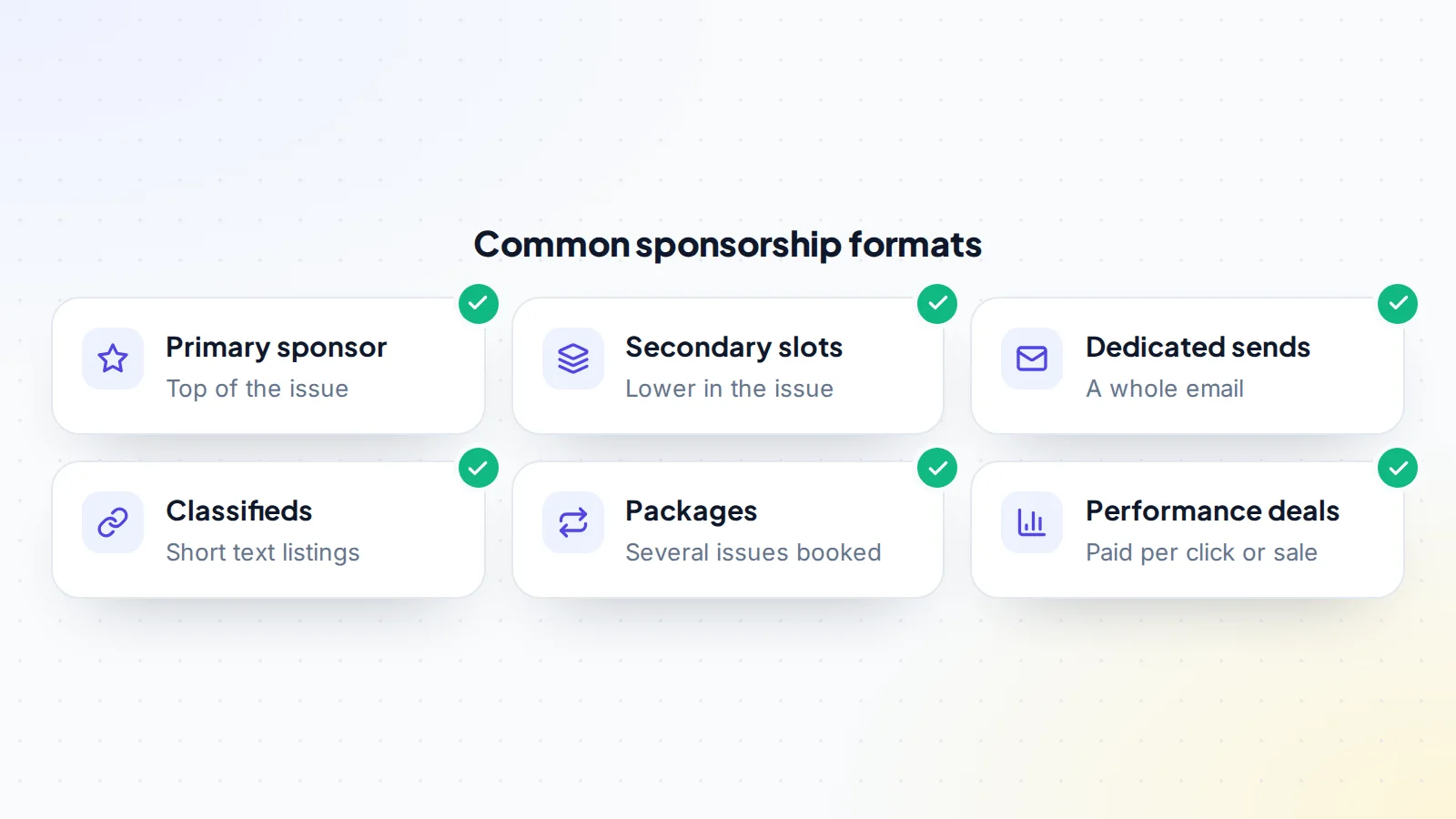
Sponsorship formats
- Primary sponsor: the most visible slot, usually near the top of the issue, at the highest price.
- Secondary slots: smaller placements lower in the issue, often sold to more sponsors.
- Dedicated sends: an entire email about one sponsor, usually priced well above a single slot.
- Classifieds: short text listings, often sold to smaller businesses.
- Packages: several issues booked together, sometimes at a discount.
- Performance deals: paid per click, sign-up or sale, which shifts risk to the newsletter.
Knowing the mix tells you how the revenue is built and how much depends on a few large deals.
Direct sales, agencies and ad networks
Sponsors reach newsletters in different ways, and each affects how reliable the income is. Direct sales, where the owner sells placements to advertisers, usually bring the highest prices but depend on relationships and effort. Agencies book placements for their clients and may take a share. Ad networks run by newsletter platforms or third parties fill slots automatically, which is less work but often pays less per placement and can change terms. Ask the seller how much newsletter sponsorship revenue came through each route. A mix is common; heavy reliance on one network or agency is a form of concentration risk.
Seasonality and booking patterns
Advertising budgets move through the year, and sponsorship bookings often follow. Some industries spend heavily before particular events or at the end of their financial year, and quieter months are normal. Look at revenue by month over two years if you can, and note how far in advance sponsors usually book. A calendar that’s already partly booked for the coming months is a strong sign of reliable income, and it tells you how much revenue is effectively secured at the point of sale.
Verifying the revenue
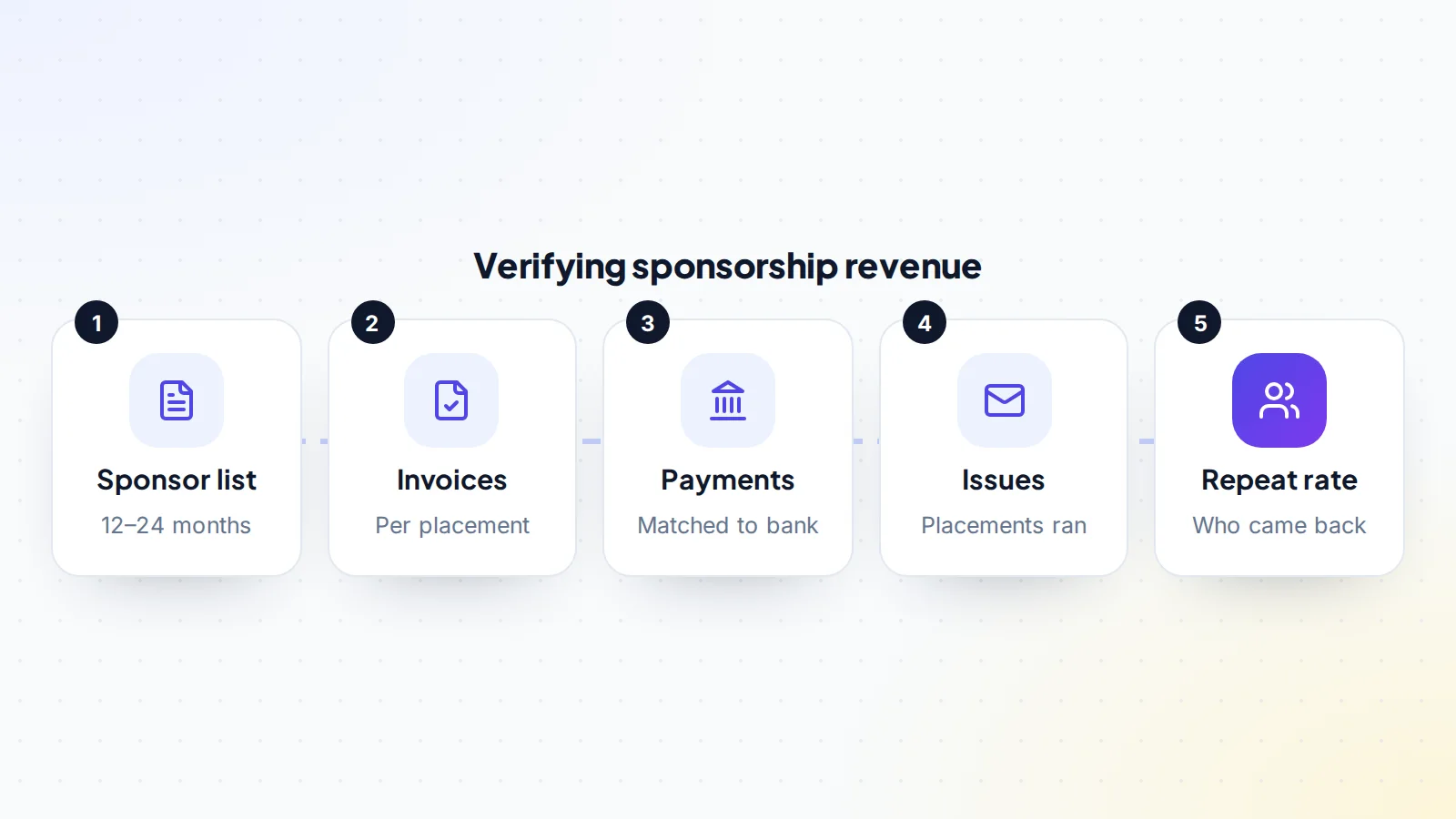
Ask the seller for a list of every sponsor over the last 12 to 24 months, with the dates, placements and prices. Then check:
- Invoices: one for each placement, matching the list.
- Payments: invoices matched to bank deposits or payment platform records.
- Issues: the placements actually ran in published issues.
- Repeat sponsors: how many advertisers booked more than once.
- Outstanding payments: any invoices still unpaid, and who keeps that money.
Our guide to verifying revenue explains the general method of following the money from source to bank.
The audience metrics sponsors care about
Sponsors want to know they’ll reach real, interested people. The metrics that matter most are clicks, replies, audience profile and results from past campaigns. Be careful with open rates: privacy features such as Apple’s Mail Privacy Protection can make opens look higher than real reading, so many sponsors now focus on clicks and outcomes. Ask the seller for click data on past sponsor placements and any results sponsors shared. Our guide to email list value explains how to judge list health and engagement.
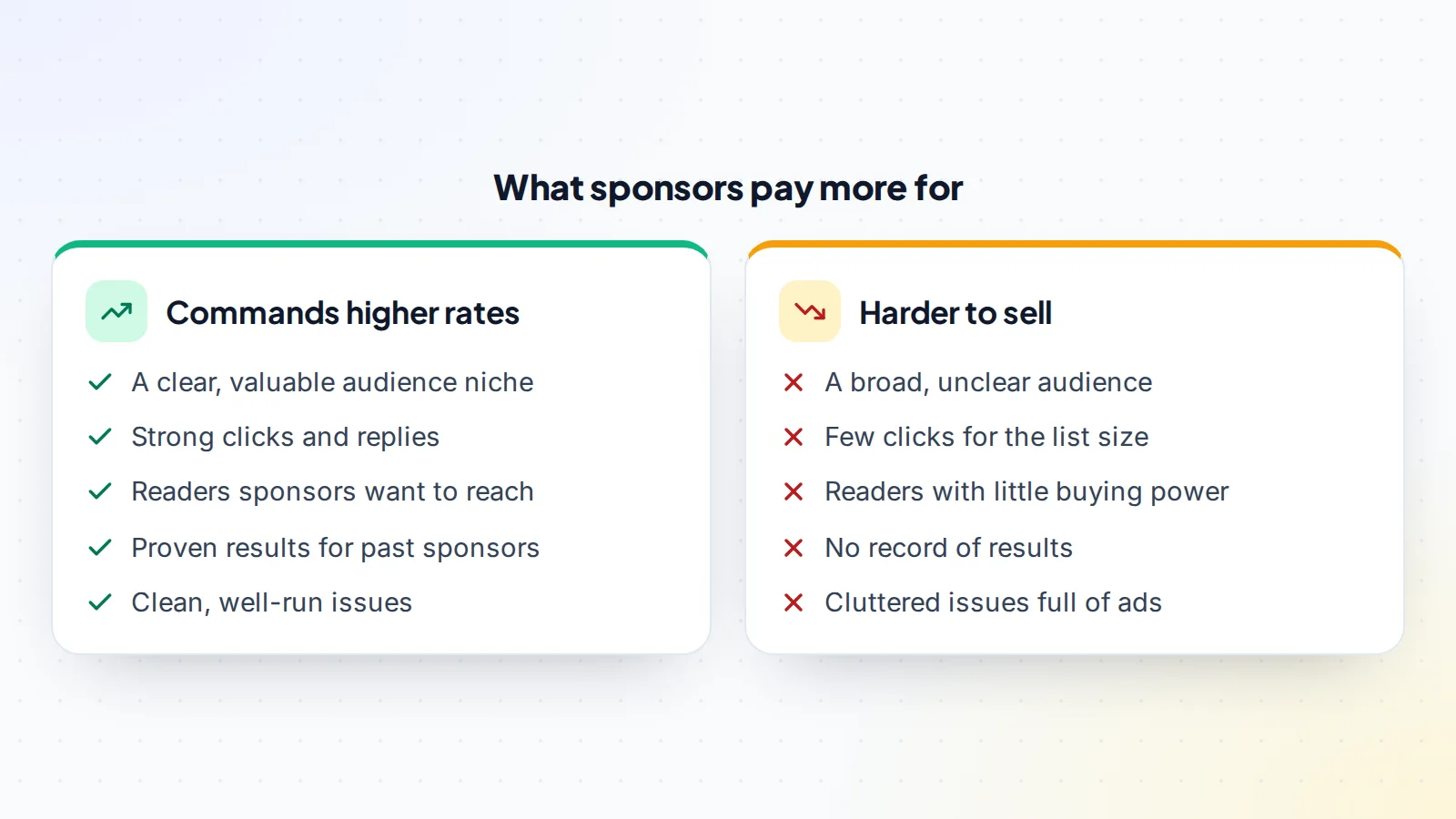
What drives sponsor prices
Sponsor prices depend on the audience and the results. A newsletter for people who make buying decisions in a valuable industry can charge much more per reader than one for a broad general audience. Strong click rates and good results for past sponsors justify higher prices. Clean, well-designed issues with a limited number of placements keep each placement valuable. When you assess a newsletter, compare its prices with what it delivers, and look for room to grow, such as underpriced slots or unsold inventory.
Concentration risk
If one or two sponsors make up most of the revenue, losing them would cut income sharply. Calculate the share from the largest sponsor and the top three. Look at contract terms: are bookings ongoing, or one-off? Do any contracts end soon, or depend on the seller personally? A newsletter with many repeat sponsors, none dominant, is far more resilient. Our guide to revenue diversification explains why spread matters for value.
Relationships and the seller
Sponsorship revenue often depends on the seller’s relationships: the contacts, trust and track record built over time. Ask who manages sponsor sales, how sponsors are found, and whether there’s a media kit, rate card and booking process. If the seller personally handles every deal, plan how those relationships will pass to you. Introductions before and during the handover matter, and a short transition period where the seller stays involved can help keep sponsors through the change.
Disclosure
Sponsored content should be clearly identified as such. The FTC’s guidance on endorsements explains that material connections between a publisher and an advertiser should be disclosed clearly. Clear labelling protects readers’ trust, which is the asset sponsors pay for. When reviewing a newsletter, check that past sponsored placements were labelled; it shows the newsletter has been run carefully and its sponsor relationships are on solid ground.
Email rules
Commercial email has rules too. In the US, the FTC’s CAN-SPAM guidance covers things like honest subject lines, identifying ads where relevant, including a physical address and honouring unsubscribe requests. Rules in the UK and EU focus on consent. A newsletter with clear sign-up records and working unsubscribe links is easier to buy and safer to run. Our guide to transferring email subscribers under GDPR covers the European rules for moving a list in a sale.
Questions to ask the seller
- Who are your current and recent sponsors, and how did you find them?
- How many booked more than once, and how far ahead do they book?
- What results have sponsors seen, and do you have their feedback?
- How are prices set, and when did they last change?
- Which bookings are confirmed for the coming months?
- Will you introduce me to sponsors before closing?
Clear answers, backed by records, make newsletter sponsorship revenue much easier to value with confidence.
How sponsorship revenue affects price
Newsletters with steady sponsorship income are usually priced as a multiple of profit. Sponsorship revenue that comes from many repeat advertisers, booked well in advance, supports a higher multiple. Revenue that depends on one sponsor, on the seller’s personal relationships or on a recent spike supports a lower one. Our guide to pricing a business listing explains how buyers and sellers arrive at a price, and the free valuation tool gives a quick starting range.
The media kit and rate card
A well-run newsletter usually has a media kit: a short document describing the audience, the formats on offer, prices, past results and how to book. It’s a useful window into how professionally sponsorships have been sold. Ask for the current version and compare it with the actual numbers. Are the subscriber counts and click rates accurate? Do the prices match the invoices? A media kit that’s out of date or flattering isn’t a reason to walk away, but it tells you what to update after the sale, and shows how sponsors have seen the newsletter so far.
Costs behind the revenue
Sponsorship income has costs too: the email platform, writers or editors, design tools, any sales help, agency commissions and the time spent finding and managing sponsors. Subtract them to see the real profit. If the seller does all the selling personally, add a cost for replacing that work, because you’ll need to do it yourself or pay someone.
Keeping sponsors after the sale
- Get the sponsor list, contacts, past campaign results and the rate card.
- Agree which bookings transfer and who keeps payments for issues already sent.
- Have the seller introduce you to active sponsors before closing.
- Keep the newsletter’s format, quality and schedule steady.
- Deliver the next few sponsored placements carefully and share results.
Some deals include a period in which the seller agrees not to start a competing newsletter for the same audience; our guide to non-competes in a sale explains how that works.
Growing sponsorship revenue
Once the newsletter is yours, there are practical ways to grow sponsor income: a clear media kit with audience details and results, a simple booking process, a calendar showing available slots, packages for repeat sponsors, and case studies from past campaigns. Grow the list with relevant readers rather than any readers, because sponsors pay for fit, and keep the number of placements per issue modest so each one stays valuable. Our guide to growing a newsletter covers audience growth in detail.
A worked example
The details below are made up to show the method.
Jess is buying a weekly newsletter for marketing managers at small software companies, with 18,000 subscribers. The seller shares a list of 26 sponsors over the last 12 months, invoices for every placement and bank statements showing the payments. Eleven sponsors booked more than once, and no single sponsor made up more than 15% of revenue. Click data shows strong engagement on sponsor links.
Jess checks published issues and finds every placement clearly labelled. The seller manages sales personally, so they agree a two-month transition in which the seller introduces Jess to every active sponsor. Escrow holds the payment until the newsletter platform, domain and sponsor bookings move. After the first month of issues under Jess, nine of the active sponsors have rebooked.
Newsletter sponsorship revenue: the checklist
- Sponsor list for 12–24 months obtained.
- Invoices matched to bank deposits.
- Placements confirmed in published issues.
- Repeat sponsor rate calculated.
- Largest sponsor’s share measured.
- Click data and past results reviewed.
- Sponsored content labelled clearly.
- Bookings, contacts and rate card included in the sale.
- Introductions and transition period agreed.
Browse newsletters and communities for sale on digiflippers.com.
Ready to find your next asset?
Browse listings with verified numbers, ask sellers your questions before you offer, and agree every step in a free Deal Room.
Browse newsletters & communities Sell your newsletter or community
Frequently asked questions
How do newsletters earn from sponsors?
Sponsors pay for placements such as primary slots, secondary ads, classifieds or dedicated sends, sometimes on a performance basis.
How do I verify sponsorship revenue?
Match a sponsor list to invoices, bank deposits and the published issues, and check how many sponsors rebooked.
Which metrics do sponsors care about?
Clicks, replies, audience profile and results from past campaigns. Open rates are less reliable because of privacy features.
What is concentration risk?
When a few sponsors make up most of the revenue, so losing one cuts income sharply.
Do sponsored placements need to be labelled?
The FTC says material connections should be disclosed clearly. Clear labelling also protects reader trust.
Will sponsors stay after a sale?
Many will with introductions, a steady format and good results. A short transition period with the seller helps.
How does sponsorship revenue affect price?
Steady income from many repeat sponsors supports a higher multiple than income from one sponsor or a recent spike.