Asking Price vs Final Price: How to Price Your Listing
A seller's guide to asking price vs final price: where the number comes from, why final prices differ, how much room to leave, how to justify the price in the listing, deal terms that change the real value, and when to adjust.

The asking price is the first thing buyers notice and often the reason they click, or scroll past. Set it too high and serious buyers never write; set it too low and you leave money on the table before the first conversation. Learning how to price a business listing means knowing where the number comes from, how much room to leave, how to explain it, and how to read what the market tells you once it’s live. This guide walks through each step, from verified profit to the final agreed price.
For the valuation itself, start with how to value an online business. For the full sale, see selling your business on digiflippers.com.
Key takeaways
- Start from verified profit and a fair multiple, not from what you hope to get.
- Final prices often land below asking prices, so leave reasonable room.
- Explain the price in the listing; reasons attract better offers.
- Deal terms change what a price is really worth.
- Watch the response in the first weeks and adjust if the market says so.
Asking price vs final price
The asking price is your opening position. The final price is what a buyer actually pays after questions, due diligence and negotiation. The gap between them depends on how well the asking price matches the business’s real value, how much competition there is among buyers, and what the checks turn up. A well-priced listing with clean records often sells close to its asking price; an over-priced one either sells far below it or doesn’t sell.
Most buyers expect some negotiation. That’s why many sellers build a little room into the asking price. The skill is leaving enough room to negotiate without pricing yourself out of serious buyers’ searches.
Know three numbers
Before you list, write down three numbers and keep the last one private:
- Fair value: what the business is worth based on verified profit and a fair multiple.
- Asking price: fair value plus some room to negotiate, rounded to a clean figure.
- Walk-away price: the lowest you’d accept, below which you’d rather keep the business.
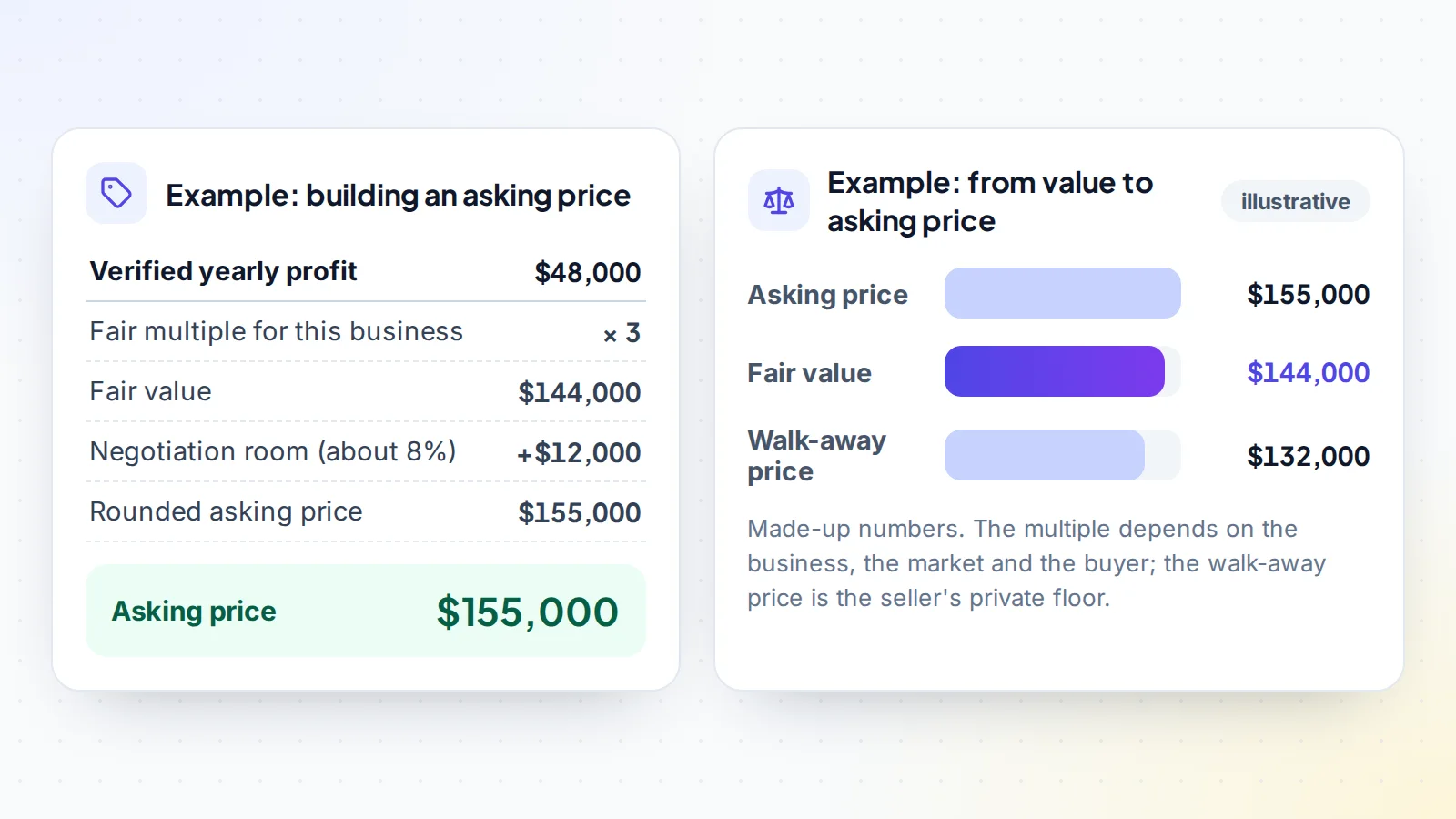
Having these written down before the first offer arrives keeps you calm and consistent. It stops you from accepting a low offer in a moment of doubt, or refusing a fair one out of pride.
Start from verified profit
Most small online businesses are priced as a multiple of profit, usually the last twelve months. Use the profit a buyer can verify, not a projection. If you add back personal costs or one-off expenses, list each one with evidence; buyers will check them. Read revenue vs profit valuation, trailing twelve months profit and add-backs for how buyers look at the numbers.
If profit has been rising or falling, the trend matters too. Buyers pay more for steady growth and less for a decline; read how growth trends affect valuation.
Choose a fair multiple
The multiple reflects risk and quality. Businesses with long track records, several income sources, low owner time, clean records and steady growth earn higher multiples. Young businesses, heavy dependence on one platform or customer, recent traffic drops and lots of owner work push it down. Read valuation multiples for the factors, and check recent sales of similar businesses where you can find them.
Be honest about your business’s weaknesses. Buyers will find them in due diligence, and a price that ignored them will come down then, often with more friction than if you’d priced them in from the start.
How much room to leave
There’s no fixed rule, but leaving a modest margin above fair value, rather than a large one, tends to work best. A small margin keeps the listing within the range serious buyers search, while still allowing a counter-offer or two. A large margin attracts fewer serious enquiries and signals that you may be hard to deal with. If you’d rather not negotiate much at all, price close to fair value and say the price is firm.
Round, but don’t hide
Clean, rounded numbers are easier to search and remember. Some sellers use slightly lower numbers so the listing appears in more filtered searches, for example just under a round threshold. That’s fine, as long as the price still reflects value. Avoid prices that look random or overly precise; they invite questions rather than offers.
Fixed price, offers or auction
Part of deciding how to price a business listing is choosing the format. A fixed price with “no offers” suits sellers who’ve priced close to value and want a quick, simple sale. A price with offers welcome is the most common choice: it sets expectations while leaving room to talk. An auction can work when demand is strong and the business is easy to understand, but it carries the risk of selling below value if few bidders appear. Read auction vs fixed price for the trade-offs.
Who you’re pricing for
Different buyers think about price differently. First-time buyers often focus on the headline number and how much cash they need at closing. Experienced buyers and small holding companies look closely at the multiple and the risks. A competitor may pay more because the business fits theirs. Think about who is most likely to buy, and when you work out how to price a business listing, make sure the price and the explanation speak to that buyer’s main questions.
Explain the price in the listing
A bare number makes buyers guess. A price with reasons invites them to agree. Next to the price, show the profit it’s based on, the multiple it implies, the evidence behind the figures, and what’s included.
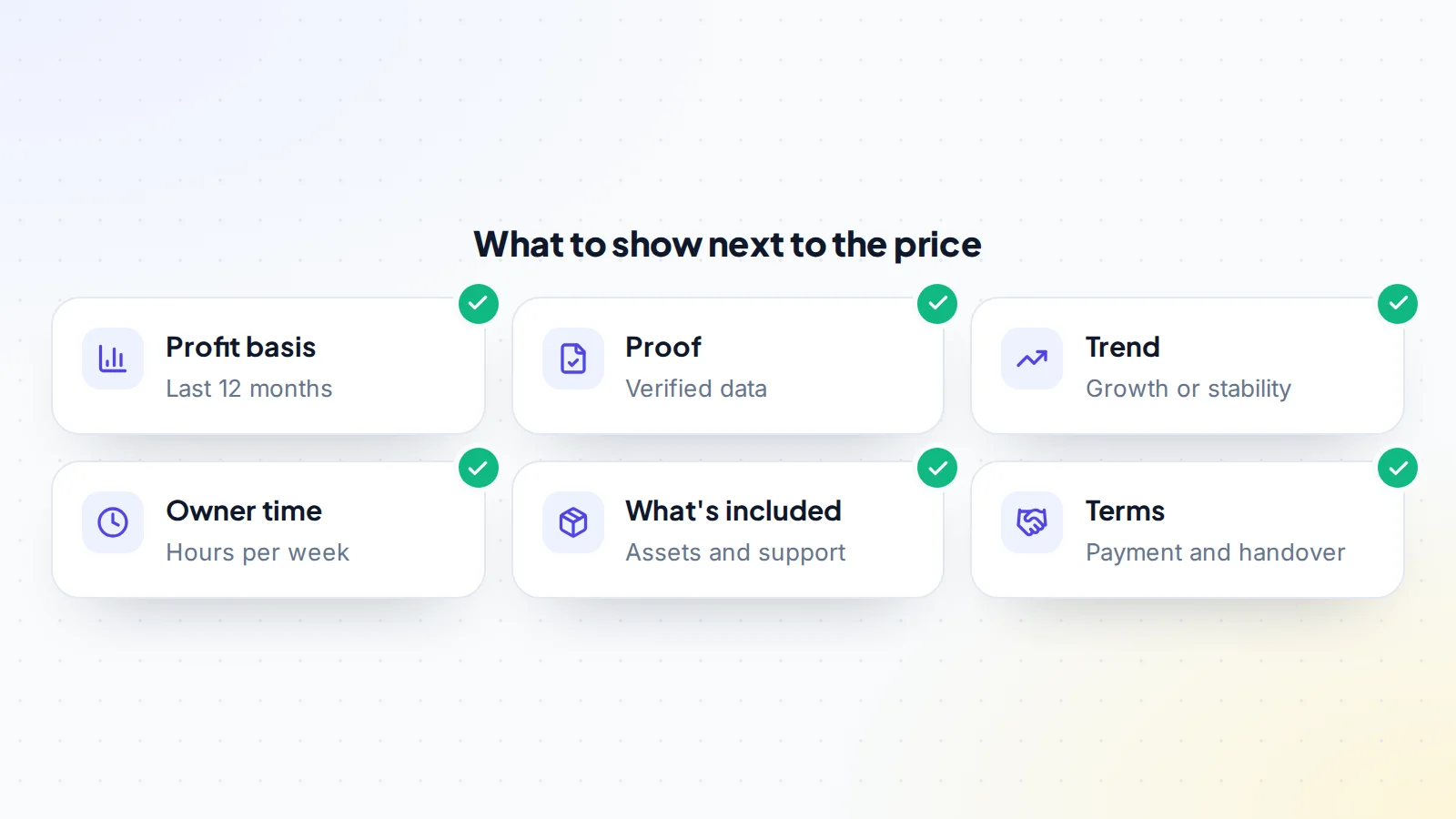
Verified metrics help most. When a marketplace has checked traffic or revenue, buyers trust the numbers sooner and argue less about price. Read verified metrics, and see how trust and verification work on digiflippers.com.
Terms change the real price
A headline price says little on its own. The same number paid fully at closing is worth more than one with a large part paid later on targets. Decide in advance which terms you’d accept: how much must be paid at closing, whether you’d consider a deferred payment or earn-out, how long you’ll support the buyer after the sale, and who pays which fees. Mention your preferences in the listing so buyers can shape offers around them.
Reading the offers
The offers you receive tell you how the market sees your price. On digiflippers.com, offers are made on the listing, stay open for 72 hours, can’t go below 30% of the asking price, and can go back and forth for up to 6 rounds. That structure keeps negotiations clear and recorded.
Compare each offer with your fair value and walk-away price, not just with your asking price. Ask what’s behind a low offer: a buyer may have spotted a real risk, or may simply be testing. Respond with reasons, not just a number. Read how to negotiate as a seller.
Is the price right?
The first few weeks after listing are the best test of your price.
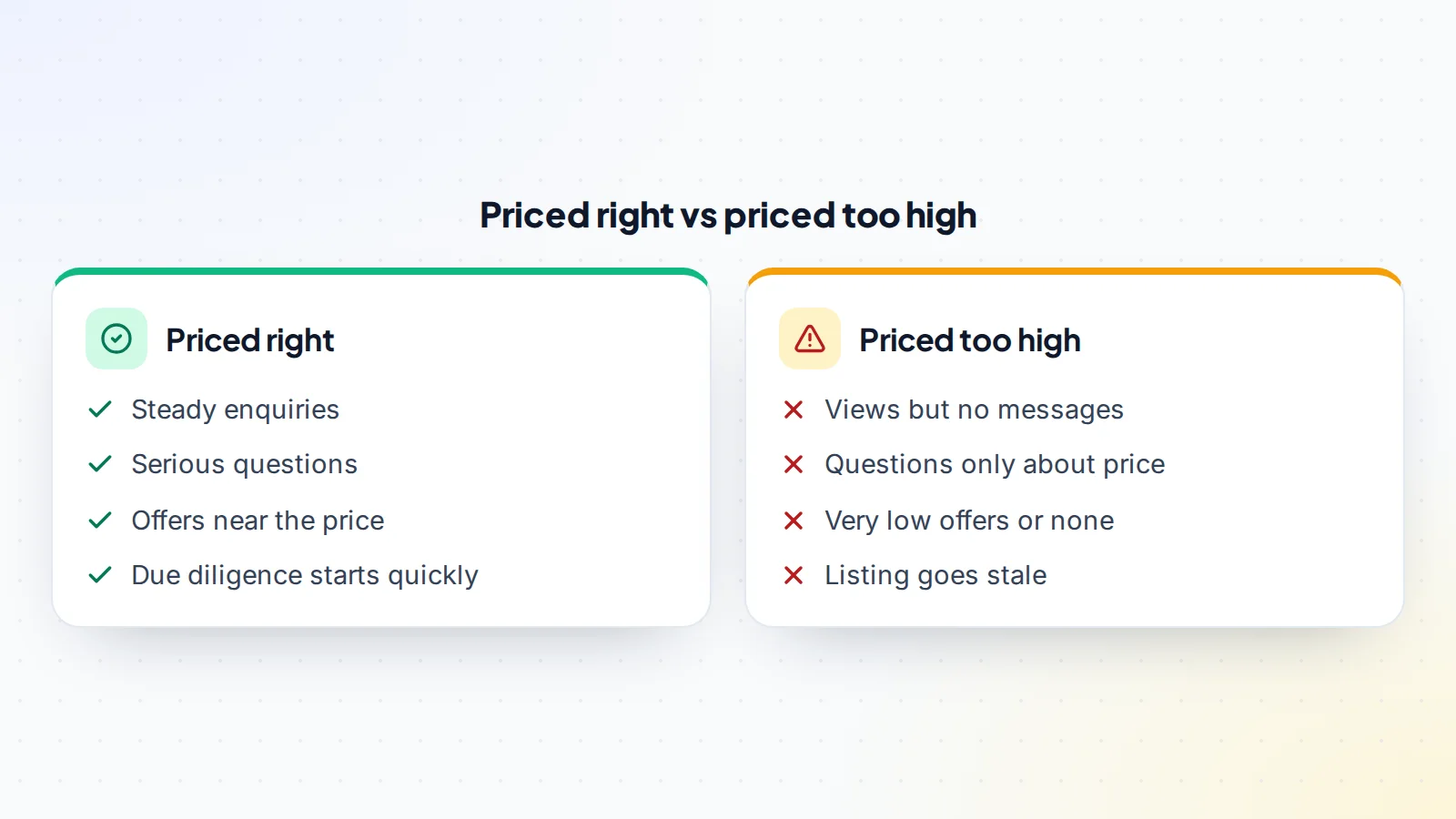
If a listing gets views but few messages, the price or the first lines are probably the problem. If it gets messages that only ask whether you’ll take less, buyers think it’s over-priced. If serious buyers start due diligence quickly, you’re close.
When and how to adjust
If the response is weak after a few weeks, review the price against fresh data: has profit changed, has the market moved, are similar businesses listed for less? A clear, single price reduction with an updated explanation usually works better than many small cuts, which can make buyers wait for the next one. Before cutting the price, check the listing itself: a weak description or missing proof can stall a fairly priced business. Read how long it takes to sell a website.
Price and due diligence
An agreed price is usually conditional on due diligence. If the buyer finds that profit is lower than claimed or a risk wasn’t disclosed, expect the price to be renegotiated. The best protection is accurate numbers from the start. A seller whose figures survive checks unchanged keeps the agreed price; one whose figures shrink often loses more than the difference, because trust has gone.
Special cases
- No profit yet. Pricing is based on assets, build cost or traction instead; read pre-revenue valuation.
- Recent traffic drop. Price on the recent level, not the old peak, and explain the cause; read algorithm update risk.
- SaaS. Recurring revenue, churn and retention shape the price; read SaaS pricing strategy and SaaS valuation multiples.
- Seasonal businesses. Use a full year of data and explain the season.
Using a valuation report
An independent or tool-based valuation gives you a starting range and a reference you can share with buyers. It won’t set the price for you, but it shows that the number has a basis. Read what a business valuation report includes, or try the digiflippers.com valuation tool to see a range.
Think about tax before you price
What you keep after tax matters more than the headline. In the US, buyers and sellers of a business’s assets generally report how the price is split across asset classes; the IRS explains this in its instructions for Form 8594. How the price is allocated, and whether part is paid later, can affect the tax on your gain. Speak to an accountant before agreeing terms.
Common mistakes
- Pricing on hopes, projections or what you’ve invested.
- Leaving so much room that serious buyers skip the listing.
- A bare number with no explanation.
- Comparing offers only with the asking price.
- Many small price cuts instead of one clear adjustment.
- Numbers that change during due diligence.
A worked example
The details below are made up to show the method.
Harper runs a recipe website with $48,000 of verified profit over the last twelve months, steady traffic and about five hours of work a week. Similar sites with comparable records have sold at around three times profit, giving a fair value of $144,000. Harper adds a modest margin, rounds to $155,000, and sets a private walk-away price of $132,000.
The listing shows the twelve-month profit, verified traffic, the five hours of work, and that Harper prefers at least 80% paid at closing. In the first week, it gets four serious enquiries. One buyer offers $135,000, pointing to a dip in traffic two months earlier. Harper explains the dip was seasonal, with data from the previous two years, and counters at $148,000. They agree at $144,000 with 85% at closing, and the price holds through due diligence because every number checks out.
How to price a business listing: the checklist
- Twelve months of verified profit worked out.
- Fair multiple chosen with strengths and weaknesses in mind.
- Fair value, asking price and walk-away price written down.
- Price explained in the listing with evidence.
- Preferred terms decided and stated.
- Offers compared with fair value, not only the asking price.
- Response reviewed after the first few weeks.
- Numbers ready to survive due diligence unchanged.
Ready to list? Sell your business on digiflippers.com with 0% success fee up to $10,000, then 5% (max $5,000), and read how trust and verification work.
Ready to sell?
List it on digiflippers.com with verified numbers, answer buyers in one place and agree every step in a free Deal Room. 0% success fee up to $10,000, then 5% (max $5,000).
Frequently asked questions
How do I set an asking price?
Start from verified profit, apply a fair multiple for your business, and add modest room to negotiate.
Do businesses sell at the asking price?
Sometimes. Well-priced listings with clean records often sell close to it; over-priced ones sell well below or not at all.
How much room should I leave?
A modest margin above fair value usually works best. Too much keeps serious buyers away.
Should I say the price is firm?
If you’ve priced close to fair value and won’t move much, yes. It saves time on both sides.
When should I lower the price?
If the response is weak after a few weeks and the listing itself is strong, make one clear adjustment with an updated explanation.
Why do prices change in due diligence?
Because buyers find differences between claimed and verified figures, or risks that weren’t disclosed.
Does the payment structure matter?
Yes. Money at closing is worth more than money paid later on conditions.
Can a valuation tool set my price?
It gives a starting range. The final price comes from your data, the market and negotiation.