How Online Businesses Make Money: Revenue Models Explained
How online businesses actually make money, model by model: what each one needs, where the risks are, and why buyers value some models more than others.

Every online business sells something, but not always to the person reading the page. Some earn from advertisers, some from commissions, some from customers who pay every month. Understanding online business models is the first step to judging any business you might buy, sell or build, because the model decides where the money comes from, what can go wrong and how buyers will value it.
This guide explains the main models one by one: how each makes money, what it needs to work, the risks to watch, and how it tends to be valued. It’s written for both buyers and sellers, and for anyone deciding what kind of digital asset suits them.
If you’re new to the subject, start with what a digital asset is, and keep our online business glossary open for the terms.
Key takeaways
- The main models are advertising, affiliate, subscription, digital products, e-commerce, and services or lead generation.
- Each model has a different main risk: traffic for ads and affiliate, churn for subscriptions, suppliers for e-commerce, the owner for services.
- Predictable, recurring income usually earns a higher valuation multiple.
- Combining models, such as content with an email list and a product, makes a business sturdier.
- When buying, check that the model will still work without the current owner.
Six models at a glance
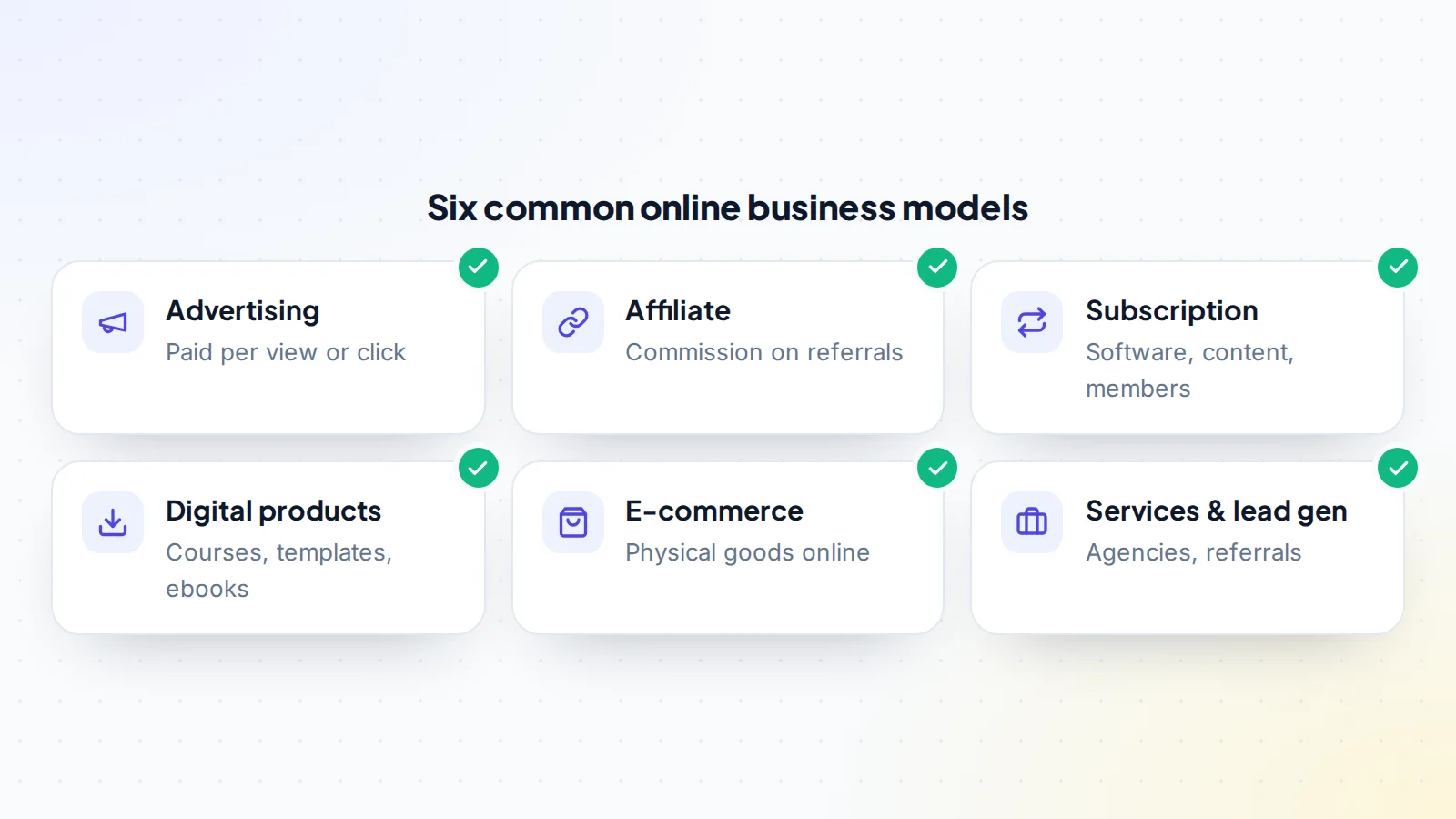
Most online businesses fit one of six models, or combine several. Below, each one is explained with its strengths, risks and what a buyer checks.
Advertising
Content sites, YouTube channels, podcasts and newsletters can earn by showing ads. Income depends on how many people see the ads and how much advertisers pay to reach that audience, which varies a lot by topic and by country. Ads usually arrive through an ad network, or directly as sponsorships.
- Needs: a steady flow of visitors or viewers.
- Main risk: traffic. A search algorithm change or a platform’s recommendation shift can cut income quickly.
- Buyers check: traffic sources over at least 12 months, earnings per thousand visits, and how many pages or videos earn most of the money.
Affiliate
Affiliate sites recommend products and earn a commission when readers buy through their links. They’re often review sites, comparison guides or tutorials. Income depends on traffic, how well the content turns readers into buyers, and the commission rates of the programmes used.
- Needs: search or social traffic from people close to buying, and trustworthy content.
- Main risks: traffic changes, and programmes changing commission rates or closing.
- Rules: in the United States, the FTC’s Endorsement Guides say readers should be told clearly when a site earns from links; a plain statement such as “I get commissions for purchases made through links in this post” is the kind of disclosure the FTC describes.
- Buyers check: earnings by programme, whether accounts can be transferred, and how concentrated income is. See our guide to buying an affiliate website.
Subscription
Subscription businesses charge customers regularly, usually every month or year. This includes software (SaaS), paid newsletters, memberships and online communities. Stripe describes monthly recurring revenue as the predictable revenue a business expects from subscriptions each month, which is exactly what makes these businesses attractive.
- Needs: a product people keep using, and a way to keep acquiring new subscribers.
- Main risk: churn, the share of customers or revenue lost each month.
- Buyers check: recurring revenue, churn, growth and the cost of acquiring customers. See MRR vs ARR.
Digital products
Digital product businesses sell things made once and delivered many times: online courses, templates, ebooks, stock assets, plugins and printables. Margins can be high because each extra sale costs very little.
- Needs: a product people want, and a way to reach them, often email, search or a marketplace.
- Main risks: dependence on the creator’s personal brand, products going out of date, and reliance on one marketplace.
- Buyers check: sales by product, refunds, traffic sources and content rights.
E-commerce
E-commerce businesses sell physical products online, either holding their own stock, using a fulfilment service or shipping directly from suppliers. They have more moving parts than other models: stock, suppliers, shipping and returns.
- Needs: products with healthy margins, reliable suppliers and a way to attract customers.
- Main risks: supplier problems, rising advertising costs and cash tied up in stock.
- Buyers check: margins after all costs, supplier agreements, stock levels and repeat-customer rates.
Services and lead generation
Service businesses sell work: design, writing, marketing, development or support, often run online as agencies. Lead generation sites collect enquiries for local or specialist businesses and are paid per lead or per customer.
- Needs: skilled people or a reliable stream of enquiries.
- Main risk: dependence on the owner’s skills or relationships.
- Buyers check: client concentration, contracts, who does the work and whether clients will stay after a sale.
Marketplaces and communities
Some online businesses connect two groups and earn from the connection: marketplaces taking a fee, job boards charging for listings, or communities charging for membership or sponsorships. They’re harder to build because both sides need to grow together, but once established they can be durable. Communities on platforms such as Discord combine several models: memberships, sponsors and products.
The numbers that matter for each model
Each model has a few figures that tell you most of what you need to know. When you read a listing or prepare your own, start with these:
- Advertising: monthly visitors or views, earnings per thousand visits (often called RPM), and the share of traffic from each source.
- Affiliate: earnings by programme, conversion rate from clicks to sales, and the share of income from the top few pages.
- Subscription: monthly recurring revenue, churn, growth in new subscribers, and how much it costs to acquire one. See SaaS churn rate.
- Digital products: sales by product, refund rate, conversion rate on sales pages and the size of the email list.
- E-commerce: gross margin after product and shipping costs, advertising cost per sale, repeat-customer rate and stock levels.
- Services and lead generation: revenue by client, contract lengths, leads per month and the price paid per lead.
If a seller can’t provide the core numbers for their model, that’s a gap to close before going further.
What moves when each model is sold
The model also decides what a handover involves:
- Advertising and affiliate sites move the domain, hosting, content, analytics and the relationships with ad networks and programmes. Some programme accounts can’t be transferred, so the buyer may need to reapply and swap links.
- Subscription businesses move the code or platform account, the customer database and the payment processor setup, ideally without customers having to re-enter card details.
- Digital product businesses move product files, the store or platform account, and the email list.
- E-commerce businesses add stock, supplier agreements and fulfilment arrangements to the list.
- Service businesses move contracts and, crucially, the people or processes that deliver the work.
The more parts a model has, the more carefully the handover needs planning. Our guide to transferring an online business covers each step.
Which models are most predictable?
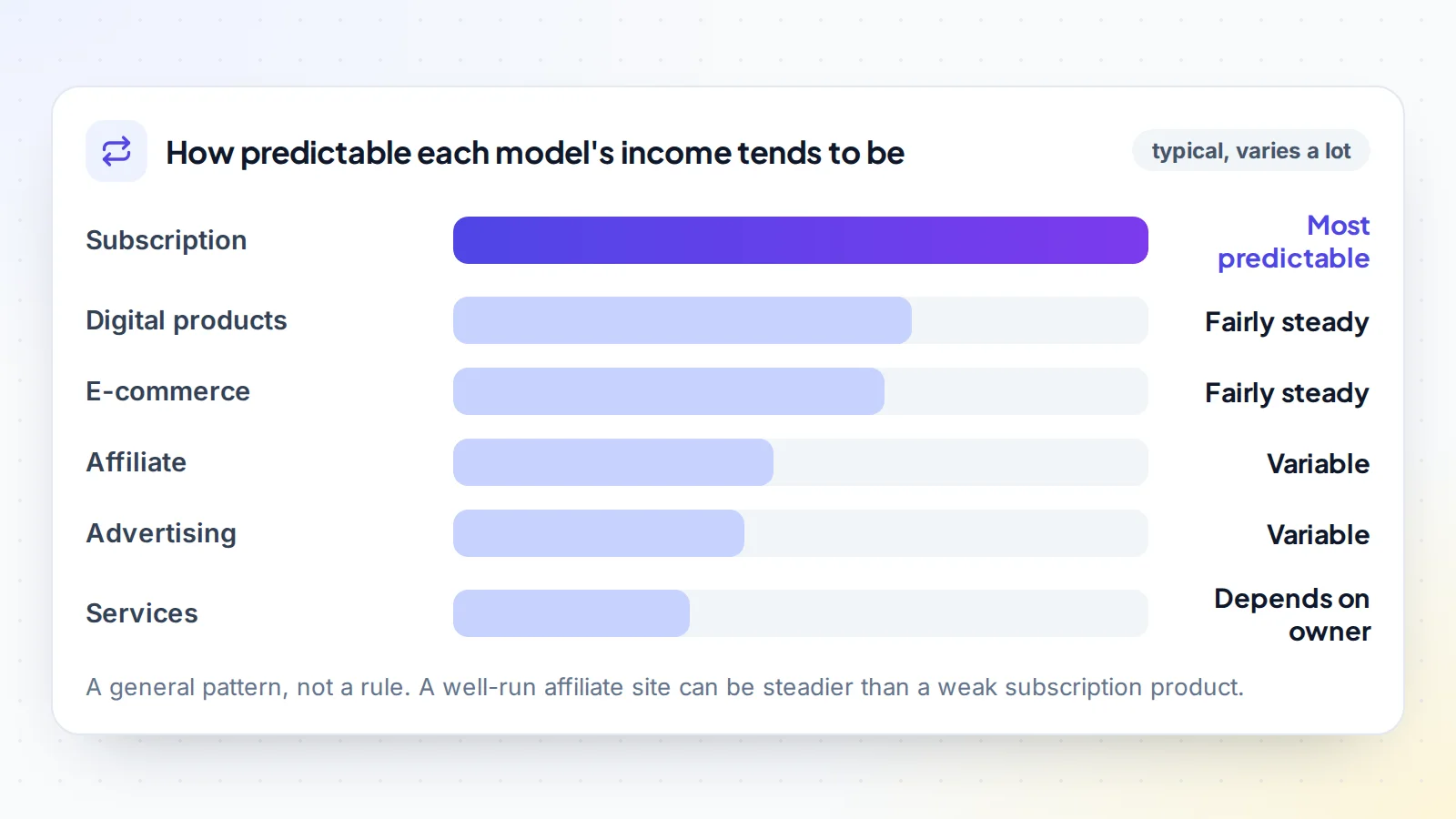
Buyers pay most for income they can rely on. Subscriptions tend to be the most predictable because customers pay automatically until they cancel. Digital products and e-commerce can be fairly steady when they have repeat customers and several traffic sources. Advertising and affiliate income tends to move with traffic. Services depend heavily on who does the work.
These are tendencies, not rules. What matters for any specific business is its record: how stable the last 12 months were, and why.
How the model affects valuation
Most small online businesses are priced as a multiple of their profit. The model influences that multiple through predictability, risk and how much work the business needs. Our guide to the online business valuation multiple explains how buyers think about it, and trailing twelve months profit explains which profit figure they use.
The same profit can be worth different amounts depending on the model. $3,000 a month from subscriptions with low churn is usually valued higher than $3,000 a month from one affiliate programme, because the buyer can be more confident it will continue.
Combining models
The strongest small businesses often combine models. A content site might earn from ads and affiliate links, collect emails, and sell its own product. A newsletter might combine sponsorships with paid subscriptions. Each extra model spreads risk: if one source falls, the others keep the business going. For buyers, a second model is also a growth opportunity: adding a product to an audience-based business is a common way to raise income after a purchase.
How models change over time
Online business models aren’t fixed. Businesses often move from one model to another as they grow: a blog that started with ads adds affiliate links, then an email list, then its own course. A free tool adds a paid plan. A newsletter that relied on sponsors launches paid subscriptions. Each step usually makes income steadier and the business more valuable, but it also changes the work involved.
For buyers, this is one of the clearest ways to add value after a purchase: find the next model the audience would pay for. For sellers, adding a second model a year before a sale can lift both income and the multiple buyers are willing to pay.
A worked example
The details below are made up to show how models affect a buyer’s view.
Sam is choosing between two businesses with similar profit. The first is a cooking website earning from display ads and one kitchenware affiliate programme, with 80% of traffic from search. The second is a meal-planning app with 900 monthly subscribers, low churn and traffic from search, social and word of mouth.
Looking at the models, Sam sees that the website’s income depends on two things outside its control: search traffic and one programme’s commission rates. The app’s income depends mainly on keeping subscribers happy, which Sam can influence directly. The app needs technical skills to maintain, though, while the website needs content. Sam decides the app’s model is the better fit and accepts a higher multiple for it, but only after checking churn, payment history and the code in due diligence.
Choosing a model that suits you
- Your skills: content and search for ads and affiliate; product and support for subscriptions; operations for e-commerce.
- Your time: some models run with a few hours a week; others need daily attention.
- Your budget: e-commerce often needs cash for stock; content sites need cash for writing.
- Your risk tolerance: concentrated traffic and income are cheaper to buy but riskier to own.
For a broader view, read buying vs starting an online business and how to set a budget to buy an online business.
Common mistakes
- Comparing profit across models without considering predictability.
- Ignoring the main risk of a model, such as churn or supplier dependence.
- Assuming a model will work without the owner when it depends on their skills.
- Overlooking disclosure rules for affiliate and sponsored content.
Online business models: the checklist
- Model or models identified, with income split by source.
- Main risk of each model named and checked.
- Predictability judged on 12 months of records.
- Owner dependence assessed.
- Disclosure and platform rules followed.
- Growth opportunities from adding a model noted.
Ready to find your next asset?
Browse listings with verified numbers, ask sellers your questions before you offer, and agree every step in a free Deal Room.
Frequently asked questions
What are the main online business models?
Advertising, affiliate commissions, subscriptions, digital products, e-commerce, and services or lead generation. Marketplaces and communities combine several of these.
Which online business model is best?
There’s no single best model. Subscriptions are often the most predictable, but they need a product people keep paying for. The best model is one whose risks you understand and whose work suits your skills.
Why are subscription businesses valued higher?
Because recurring income is more predictable. Buyers pay more for income they’re confident will continue.
Do affiliate sites need to disclose their links?
In the United States, the FTC’s Endorsement Guides say readers should be told clearly when a site earns from links. Other countries have similar rules.
Can a business use several models?
Yes, and many of the strongest small businesses do. Combining models spreads risk and creates room to grow.
Which model is easiest for a first-time buyer?
Many first-time buyers start with content sites or small digital product businesses, because they have fewer moving parts than e-commerce or software. Whatever you choose, pick a model whose work you understand.