Print-on-Demand Stores for Sale: What to Check
A buyer's checklist for print-on-demand stores: how they make money, margins after production and ads, design ownership and trademark risk, supplier accounts that don't transfer, sales channels, reviews and returns, and how to hand the store over.

Print-on-demand stores sell custom designs on shirts, mugs, posters and more, with a supplier printing and shipping each item only after it’s ordered. No stock, no warehouse, and designs that can sell for years: it’s easy to see the appeal. But when you look at a print on demand store for sale, the questions that matter are less obvious: how much profit is left after printing, shipping and ads; who owns the designs; and how the supplier connection moves to you. This guide walks through each check and the handover.
For digital product businesses in general, read how to buy a digital product business. For stores that ship stock, see buying an ecommerce store.
Key takeaways
- Profit per order is often thin once production, shipping, fees and ads are counted.
- Design rights are the core asset; check they’re owned and free of others’ trademarks.
- Supplier accounts such as Printful’s can’t be transferred; you’ll connect your own.
- Stores that rely entirely on paid ads are worth less than those with organic sales.
- Plan the supplier switch carefully so orders keep printing during the handover.
How these stores make money
A customer orders a product from the store. The order passes automatically to a print-on-demand supplier, which prints the design, packs the item and ships it. The store owner pays the supplier’s base price and keeps the difference. Most stores sell through their own website on a platform such as Shopify, through a marketplace such as Etsy or Amazon, or both. Traffic comes from search, social media, marketplace search and paid ads.
Because there’s no stock, the business is light to run. But it also means the store competes with many others selling similar products, and margins depend heavily on pricing and ad costs.
Real margins
Revenue figures can look impressive while profit per order is small. Production costs, shipping (often absorbed to offer free delivery), payment and platform fees and advertising all come out of each sale.
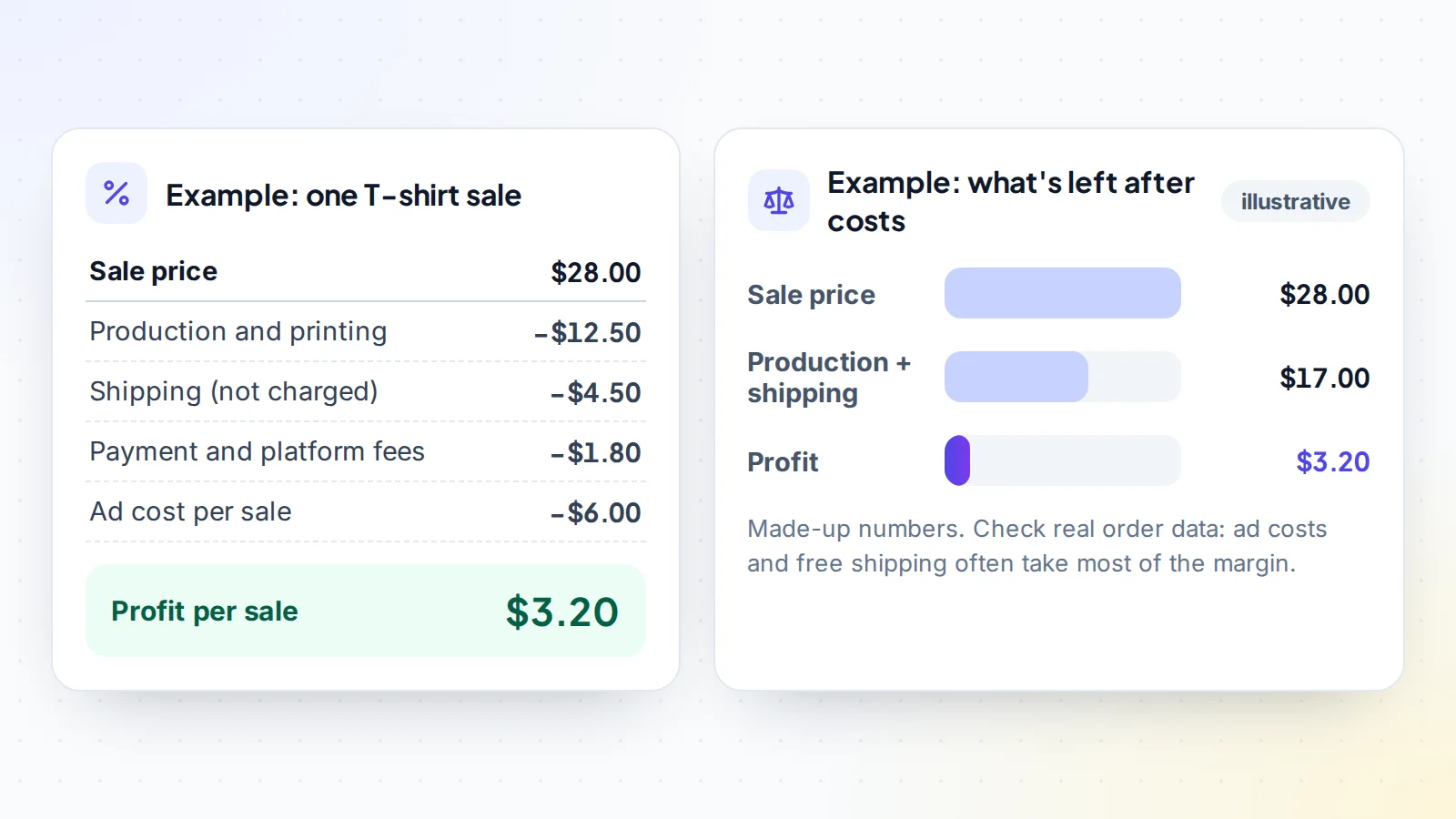
Ask for order-level data for at least twelve months: sale price, supplier cost, shipping, fees and refunds. Get supplier invoices and ad account reports. Work out profit per order and total monthly profit yourself. Read financial due diligence for how to check the numbers.
Who owns the designs
The designs are what you’re really buying. Find out who made each one: the seller, a freelance designer, or a licensed source. Ask for the original files and proof the seller has the rights to transfer them, such as contracts with designers that assign copyright. Designs made from stock images or fonts need licences that allow commercial use on products, and the licence must be one that can pass to you.
Check designs for other people’s trademarks, characters, logos and well-known phrases. Products that use them can be removed from marketplaces, and the store can face complaints. Read intellectual property in digital product sales.
Supplier accounts don’t transfer
Many print-on-demand suppliers tie accounts to the person who opened them. Printful states that accounts can’t be transferred to another person; instead, the seller disconnects the store and the new owner connects it to their own Printful account, re-adding products and print files. Printify explains how to disconnect a store, and warns that disconnecting can affect how existing products are linked.
This means the handover isn’t just a login change. Every product needs to be set up again in your supplier account with the right print files, placements and settings, then linked to the store’s listings. Plan for it, and get every print file in its original quality before you pay.
The sales channel
Where the store sells matters as much as what it sells. A store on its own platform, such as Shopify, can usually be moved to you through the platform’s ownership tools; Shopify explains how to change or transfer store ownership. Marketplace shops are different: Etsy states that Etsy accounts can’t be transferred to someone else. If most sales come from a marketplace shop that can’t move, what you can buy is the designs, files and know-how, not the shop’s sales history and reviews.
What moves and what’s rebuilt
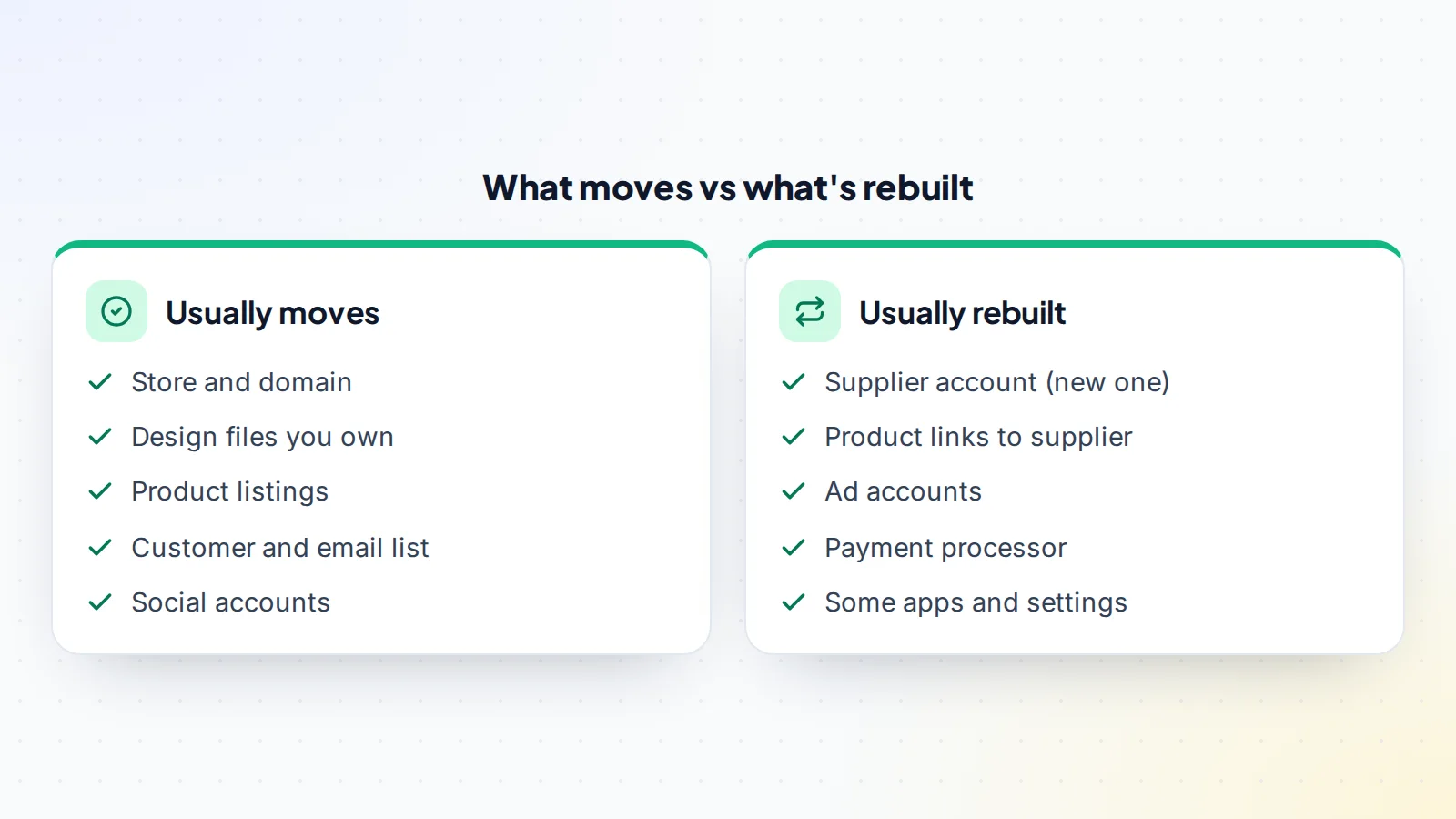
Agree a written list of everything included, and for each item, how it moves. That list becomes your handover plan.
Traffic and ads
Find out where sales come from. A store that gets most orders from paid social ads depends on ad costs that can rise quickly, and on ad accounts that belong to the seller. One with steady search traffic, repeat customers and an email list is more stable. Ask for analytics access and ad account reports, and look at what happens to sales when ads pause. Read traffic concentration risk.
Quality, reviews and returns
Customers judge the store on print quality and delivery time, both set by the supplier. Read reviews for complaints about fading prints, wrong sizes or slow delivery. Ask for the refund and reprint rate, and which supplier and print locations are used. Printify notes on its help page about production times that most orders ship within a few business days but times vary with season and stock. A switch to a new supplier can change quality, so order samples of best-sellers before and after.
Best-sellers and seasonality
Many stores earn most of their profit from a small number of designs. Find out which ones, how long they’ve sold, and whether demand is steady or tied to a season, holiday or trend. A store whose sales spike each December needs a full year of data to judge. Read how growth trends affect valuation.
Customer list and email
An email list of past customers is valuable, because it brings repeat orders at low cost. Check how the list was collected and that subscribers agreed to marketing. Moving personal data to a new owner has legal rules in many countries; read transferring email subscribers and GDPR, and how an email list is valued.
Apps, tools and running costs
Most stores run on a stack of paid apps: the store platform plan, design tools, review apps, email marketing, upsell tools and mockup generators. Ask for a list of every subscription and its monthly cost, and check them against the profit and loss statement. Some apps can move with the store; others are tied to the seller’s account and must be set up again. Small monthly costs add up and are easy to miss when you look at a print on demand store for sale for the first time.
One supplier or several?
Some stores use more than one supplier, choosing the best one for each product or region. That can improve quality and delivery times, but it means more accounts to set up and more product links to rebuild. Ask which supplier handles each product, why, and where each one prints. If a store relies on a single print location for all orders, a delay there affects every customer.
Questions to ask the seller
- Which designs sell best, and when did each start selling?
- Who made the designs, and where are the contracts?
- What happens to sales when ads are paused?
- What are the most common customer complaints?
- Which suppliers have you tried, and why did you choose this one?
- How many hours a week do you spend on the store, and on what?
Clear, quick answers backed by data are a good sign. Read questions to ask when buying a business for a wider list, and compare every print on demand store for sale you look at against the same questions.
How to value it
Value the store on verified profit over the last twelve months, not revenue. Adjust for risks: heavy reliance on ads, a marketplace shop that can’t move, unclear design rights, or a few designs carrying all the sales. Value can rise for owned designs with long sales histories, an email list, organic traffic and a store on a platform that transfers cleanly. Read digital product business valuation.
The handover, step by step
- Agree the list of included items and the handover plan in writing.
- Pay into escrow so the money is protected.
- Receive every design file in original quality, with licences and contracts.
- Take over the store and domain through the platform’s ownership tools.
- Open your own supplier account and set up each product with the correct files and settings.
- Relink products and test-order the best-sellers before switching fully.
- Move the email list, social accounts and any other included items.
- Confirm everything works, then release payment.
Agree how orders placed during the switch will be fulfilled, so no customer is left waiting. Read the asset transfer checklist.
After you buy
Watch order flow daily for the first weeks, check new reviews for quality issues, and compare supplier costs with what the seller paid. Then focus on what adds lasting value: more original designs, better product photos, organic traffic and growing the email list. Read how to market digital products for ideas.
Where growth usually comes from
New owners often grow these stores by adding designs in the niches that already sell, extending best-sellers to new products such as hoodies or posters, improving product photos and descriptions for search, and emailing past customers around seasons and holidays. Each of these builds on what the store has already proven, which is lower risk than chasing a new audience. Keep track of which changes lift profit, not just revenue.
Common mistakes
- Valuing the store on revenue instead of profit per order.
- Not getting original design files and proof of rights.
- Assuming the supplier account moves with the store.
- Buying a marketplace shop that can’t be transferred.
- Ignoring how much depends on paid ads.
- Switching suppliers without test orders.
A worked example
The details below are made up to show the method.
Jamie looks at a Shopify store selling hiking-themed shirts and mugs, with $9,000 of monthly revenue. Order data shows profit of about $3 per order after production, shipping, fees and ads, and most sales come from paid social ads. Search traffic and an email list of 4,000 customers account for about a third of orders.
The seller made most designs and has contracts assigning the rest from two freelance designers. Jamie finds three designs using a well-known park’s logo and asks for them to be removed from the sale. The store will move through Shopify’s ownership transfer; Jamie will open a Printful account and set up the 60 products again. Jamie values the store on twelve months of profit, discounts for ad dependence, and agrees a price with a two-week handover. Test orders of the top ten products come back matching the originals, and the switch happens without missed orders.
Print on demand store for sale: the checklist
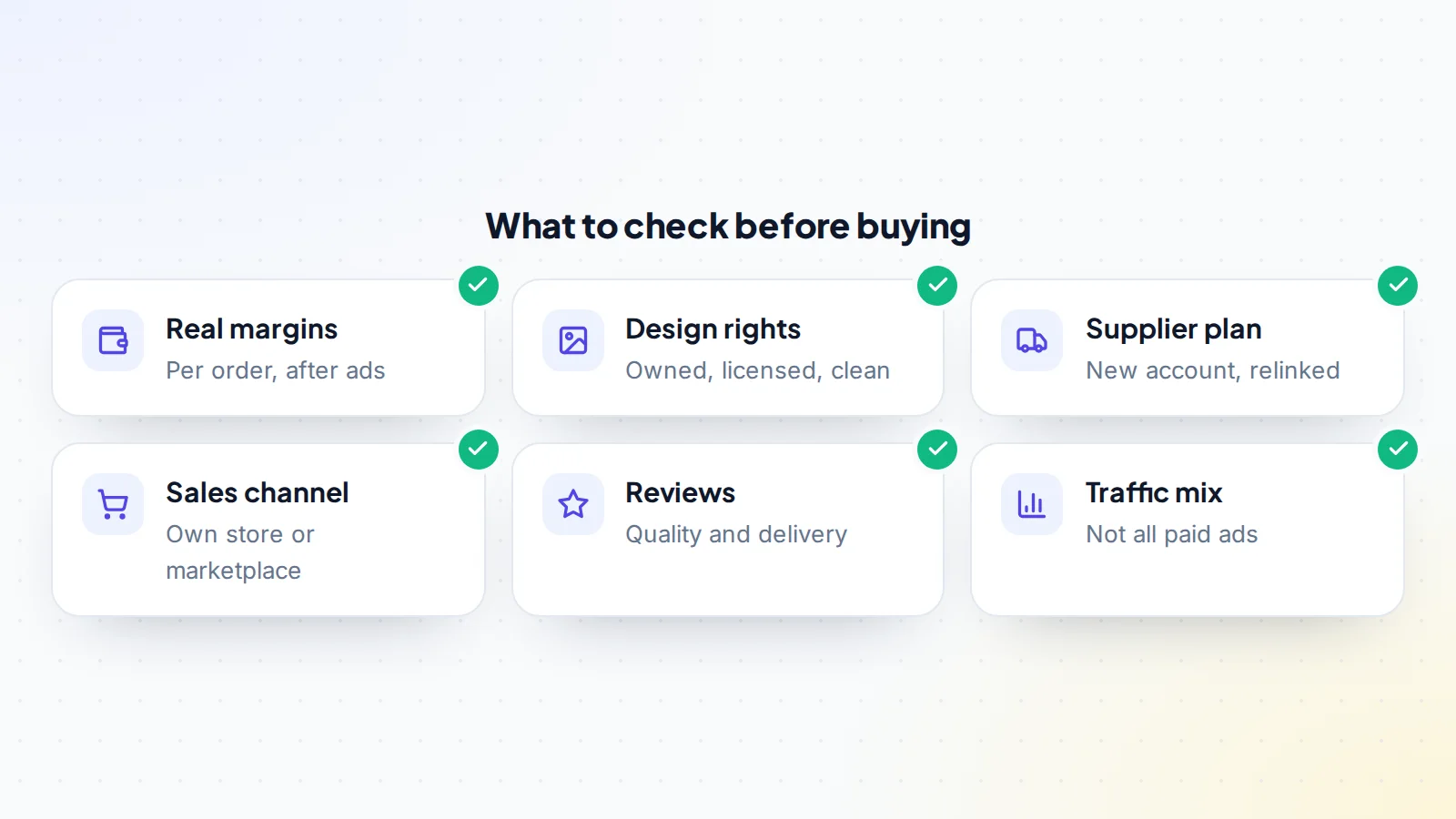
- Twelve months of order-level profit worked out.
- Design files, licences and assignment contracts received.
- Designs checked for others’ trademarks and characters.
- Supplier switch planned with your own account.
- Sales channel can be transferred to you.
- Traffic mix and ad dependence reviewed.
- Reviews and refund rate checked.
- Test orders placed before the full switch.
Browse digital product businesses for sale, and try the valuation tool on digiflippers.com.
Ready to find your next asset?
Browse listings with verified numbers, ask sellers your questions before you offer, and agree every step in a free Deal Room.
Frequently asked questions
Is a print-on-demand store a good business to buy?
It can be, if margins are healthy, designs are owned and sales don’t depend entirely on ads.
Can I take over the seller’s Printful account?
No. Printful accounts can’t be transferred; you connect the store to your own account and set up products again.
Can an Etsy print-on-demand shop be transferred?
Etsy states that accounts can’t be transferred. You can buy designs and files, but not the shop itself.
What’s the most important asset?
The designs, with clear rights to use and sell them.
How do I check profit?
Use order-level data with supplier invoices, shipping, fees, refunds and ad costs.
Will print quality change after a sale?
It can if the supplier or print location changes. Order samples of best-sellers to check.
How long does the handover take?
Often one to three weeks, depending on how many products need setting up again.
Do customers need to know about the sale?
Usually not, as long as quality and delivery stay the same.