How to Sell Your Online Course Business
Preparing course data buyers trust, reducing dependence on you, checking platform rules, pricing on profit and handing over without disrupting students.

Courses you made once can keep selling for years, which is exactly why buyers like them. If you want to sell an online course business, the work is in showing that the sales, the students and the content can carry on without you, and in planning a handover that existing students barely notice.
This guide covers the whole process from the seller’s side: when to sell, which data to prepare, how to document who owns the content, how course platforms handle a change of owner, how buyers will value the business, how to reduce dependence on you, and how to get paid safely.
It’s the companion to our guide for buyers of an online course business for sale. Reading both shows you exactly which questions to expect.
Key takeaways
- Prepare 12 months of sales, refunds and active students from your course platform and payment processor, with launch periods marked.
- Evergreen sales are valued more highly than launch spikes, so show them separately.
- Document ownership of every video, workbook and asset, including contractor work and licences.
- Check how your course platform moves ownership and keeps student access before you agree a plan.
- Start the handover only once payment is held by escrow or a trusted middleman.
When to sell
The best time to sell is while sales are steady and the content is current. Buyers look closely at the last few months and at how up to date the lessons are, so a course that teaches last year’s version of a tool, or a business whose sales are sliding, will attract lower offers.
Plan ahead: most sellers need three to six months to get records, rights and processes in order, and the best results come when you sell an online course business on your own timetable rather than in a hurry. A rushed sale usually means accepting the first reasonable offer, while a prepared one lets you compare several.
Common reasons to sell include wanting to focus on a new topic, being tired of answering student questions, or preferring a lump sum to a monthly income. Whatever the reason, buyers will ask, and an honest, simple answer builds trust.
Step 1: Prepare the numbers buyers trust
Buyers want to see what you see in your course platform and payment processor. Prepare at least 12 months, month by month, of:
- Revenue by product: each course, bundle, membership and coaching add-on.
- Refunds and chargebacks, with the refund policy that applied.
- Active students and members, and how many are on payment plans or subscriptions.
- Completion or engagement rates, if your platform shows them.
- Traffic and sales sources: email, search, social, affiliates, paid ads.
- Costs: platform, payment fees, tools, ads, assistants, editors and affiliates.
Mark every launch on the timeline. A buyer needs to see which revenue came from a launch and which arrived every month on its own; you’ll be paid much more for the second. Buyers usually work from trailing twelve months profit, so show the same view yourself.
The most convincing way to share the data is a live screen share where the buyer picks the date ranges, or a read-only connection. On digiflippers.com, you can connect supported accounts so your listing shows verified figures; see how verification works.
Step 2: Document who owns the content
A buyer is paying for the right to keep selling your content, so they’ll check that you own it. Gather:
- Contractor agreements for editors, designers, writers and guest instructors. In the United States, the Copyright Office explains when commissioned work counts as “work made for hire”; in other cases the creator may keep the copyright unless there’s a written assignment. If something is missing, ask for an assignment now, before a buyer asks.
- Licences for music, stock footage, images, fonts and software used in the lessons, confirming commercial use and whether they continue after a change of owner.
- Trademark records for the brand or course names, if you registered any.
- Source files: raw video, slides, workbooks and templates, organised so they can be handed over.
This is the area where course deals most often slow down, so fixing gaps early pays off. Our guide to legal due diligence lists the documents buyers usually request.
Step 3: Check how your platform handles a new owner
Course platforms move ownership in different ways, and the answer shapes the whole handover. Teachable’s help centre, for example, explains that a school’s primary owner can transfer primary ownership to another owner of the school, with the change confirmed by email. Kajabi’s help centre notes that sites generally can’t be moved between different Kajabi accounts outside its partner transfer process, so contact the platform before you promise a buyer a particular method. A course site on WordPress moves like any other website.
Find out, before you list:
- How the account or school changes owner.
- How existing students keep access to what they bought.
- Whether subscriptions and payment plans continue without students re-entering card details, or whether the payment processor account has to change.
- Whether reviews and ratings stay with the course if it’s sold on a marketplace.
Writing the answers into your listing removes one of the biggest worries a buyer has.
Step 4: Work out what it’s worth
Established course businesses are usually priced as a multiple of average monthly net profit over the last 6 to 12 months. Net profit is revenue minus all the costs of running the business, including the cost of work you currently do yourself if a buyer would have to pay someone to do it.
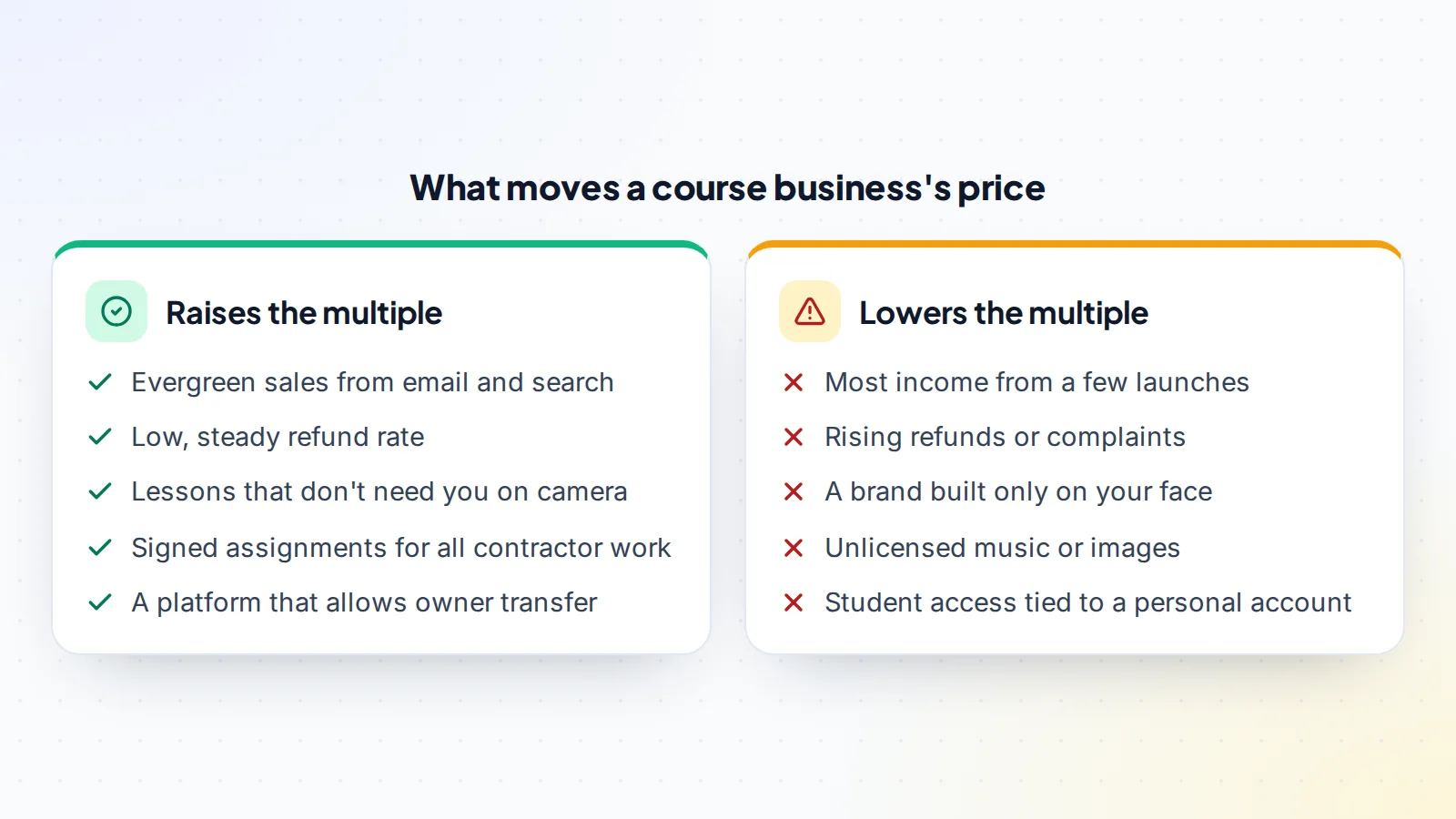
The multiple depends mostly on how predictable and how transferable the income is. Read our guide to online business valuation for the method, and use the free valuation tool for a quick range.
A worked example
The numbers below are made up to show the method, not market data.
Amira sells two self-paced courses on bookkeeping for freelancers, plus a small monthly membership. Over 12 months, revenue was $78,000 and costs were $21,000 (platform, payment fees, a part-time support assistant, ads and an editor), so net profit was $57,000, or $4,750 a month.
Marking the launches shows Amira that $30,000 of the revenue came from two launch weeks promoted on Amira’s personal social accounts, and $48,000 arrived steadily from the email sequence and search traffic. A buyer would discount the launch income, because it depends on Amira’s personal following. So, in the six months before listing, Amira:
- Strengthens the evergreen funnel with a new email sequence and two search-focused lessons, so the steady share of revenue grows.
- Re-records the introduction videos as screen recordings with a brand voice, so the courses no longer centre on Amira’s face.
- Gets a signed assignment from the editor who cut the early lessons.
- Confirms with the course platform how ownership and student access will move.
At listing time, most revenue is evergreen, the content is documented and the handover is clear. Buyers can see a business they can run, and the asking price sits toward the upper end of what comparable businesses fetch. The same business listed six months earlier would have been valued mainly on its steady income, with the launches heavily discounted.
Step 5: Reduce how much depends on you
The biggest risk a buyer sees in a course business is the founder. If students buy because of you, will they buy from someone else? You can lower that risk:
- Build a topic-led brand rather than one centred on your name.
- Move sales to owned channels, such as the email list and search, rather than your personal social accounts.
- Write down your processes: how you answer students, update lessons, run promotions and pay affiliates.
- Hand routine work to an assistant who can stay with the business after the sale.
- Offer transition support: a few months of help, a welcome video introducing the new owner, or introductions to affiliates and partners.
Step 6: Write a listing that attracts serious buyers
- The topic, the courses and who they’re for.
- Revenue, profit and refunds over 12 months, with launch and evergreen income shown separately.
- Active students, members and subscriptions.
- Traffic and sales sources.
- The platform, and how ownership and student access will move.
- Exactly what’s included: courses and source files, the domain and site, the email list, community spaces, affiliate relationships and brand assets.
- How many hours a week the business takes, and who helps.
- Why you’re selling and what transition support you’ll offer.
Be honest about weaknesses; buyers forgive what they’re told and discount what they discover. When you’re ready, you can list your course business on digiflippers.com for free, with 0% success fee up to $10,000, then 5% (max $5,000).
Step 7: Handle buyer questions
Answer in writing and keep every message in one place. Share data live or through a read-only connection, never with your passwords. Expect questions about refunds, launches, your role, content rights and the platform; having the documents ready makes the conversation short. Be cautious with anyone who wants the course files before paying, asks for logins “to check”, or suggests an escrow site you’ve never heard of; read how fake escrow scams work.
Step 8: Agree terms and get paid safely
Write down the price, the payment method, everything included, the handover order, how long the buyer has to check things, and the transition support you’ll provide. If the buyer asks you not to create competing courses, agree the topic and time period clearly.
Start the handover only once the payment is held by escrow or a trusted middleman. On digiflippers.com, the ways to pay in a deal are: directly to the seller, through escrow, and the platform never holds the money itself.
Step 9: Hand over without disrupting students
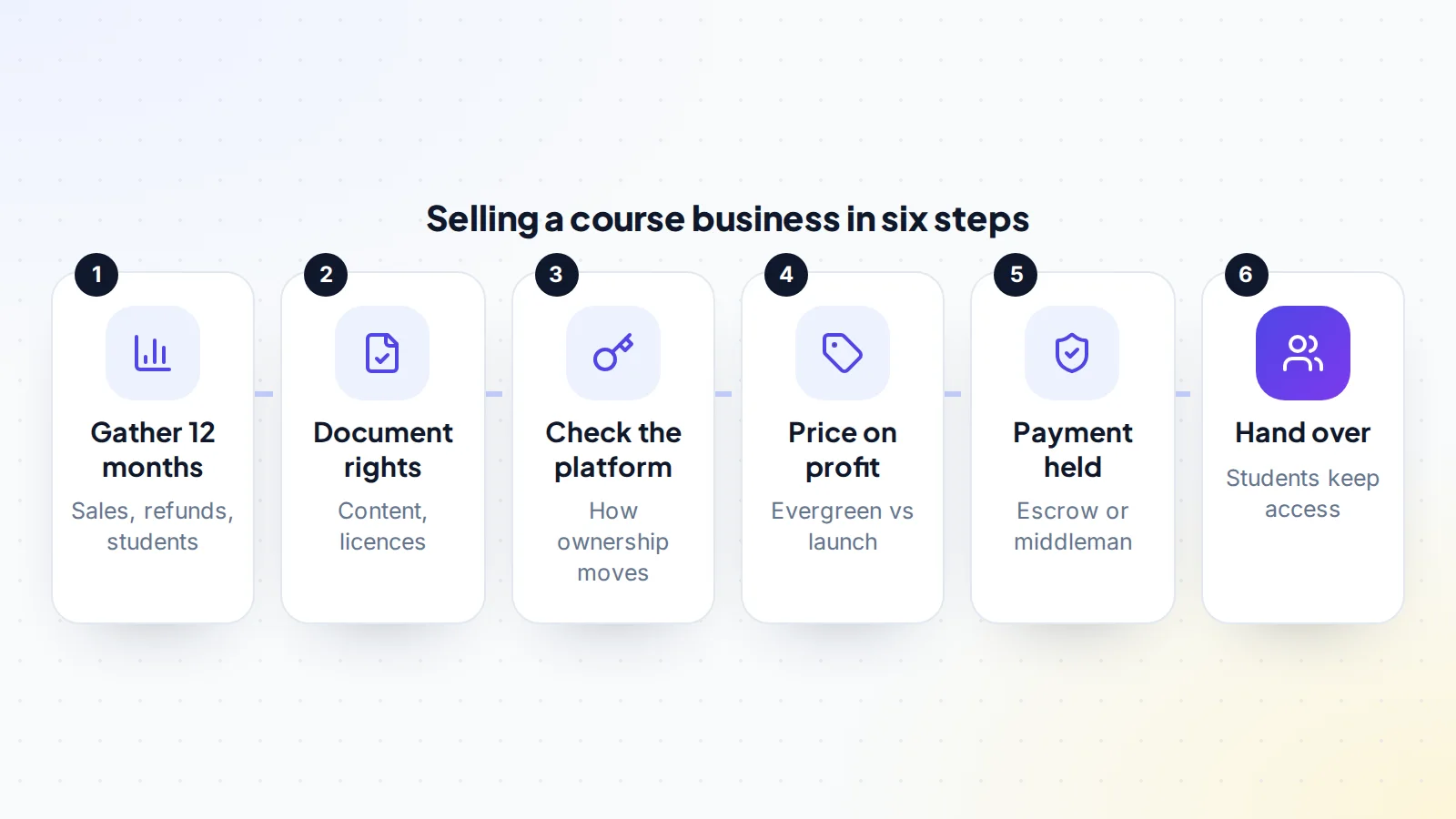
- Source files for every course delivered to the buyer’s storage.
- Platform ownership moved using the platform’s own process, with the buyer confirming student access.
- Payments switched to the buyer’s processor account, with active subscriptions checked.
- Email list and community moved, respecting subscribers’ consent.
- Domain, website and marketing tools transferred.
- An agreed announcement to students introducing the new owner and confirming nothing they bought changes.
- Your access removed and the payment released.
Our handover checklist covers the remaining steps.
Common mistakes when selling a course business
Most problems that appear when people sell an online course business are avoidable with preparation:
- Showing revenue only as totals. Buyers will assume the worst about launches; mark them yourself.
- Leaving rights gaps for contractor work or licences until a buyer finds them.
- Promising a handover the platform doesn’t allow. Check first.
- Letting the content go stale while the business is for sale.
- Handing over files before payment is held. Course files are the business; protect them until the money is secure.
How to sell an online course business: the checklist
- 12 months of revenue by product, refunds, students and sources, with launches marked.
- Costs listed, including the value of your own work.
- Contractor assignments and licences gathered.
- Source files organised for handover.
- Platform owner-transfer and student-access process confirmed.
- Value worked out on net profit, with evergreen and launch income separated.
- Founder dependence reduced and processes written down.
- Honest listing with what’s included and why you’re selling.
- Terms in writing, including transition support.
- Payment held by escrow or a middleman before the handover.
Ready to sell?
List it on digiflippers.com with verified numbers, answer buyers in one place and agree every step in a free Deal Room. 0% success fee up to $10,000, then 5% (max $5,000).
Frequently asked questions
How much is an online course business worth?
Established course businesses are usually priced as a multiple of average monthly net profit. The multiple rises with evergreen sales, low refunds and content that doesn’t depend on you, and falls with launch-driven income and founder dependence.
Can I sell a course business if I appear in every video?
Yes. Buyers will value the content and audience, but expect a lower multiple unless you offer transition support or the brand is built around the topic rather than you.
Do students keep access after the sale?
They should, and buyers will insist on it. How it works depends on your course platform, so confirm the process with the platform before you agree a plan.
Can I sell just one course rather than the whole business?
Yes. You can sell a single course with its content rights, sales history and students, as long as the platform allows it to be moved or the buyer can host it elsewhere.
What happens to subscriptions and payment plans?
That depends on your payment setup. Some can continue as they are; others need students to set up payment again with the new owner. Find out early so it’s in the terms.
Should I keep selling while the business is listed?
Yes. Keep running it as usual, including your normal promotions. A drop in sales during the sale process lowers offers.