How to Sell an Ecommerce Business: From Preparation to Handover
From profit and loss to suppliers, stock and the store transfer: what buyers check, how to raise the price before listing, and how to hand over without losing sales.

An online store is one of the most hands-on online businesses to own, which is exactly why many owners eventually want to pass it on. If you want to sell an ecommerce business for a good price, the work is in showing that profit is real after every cost, that suppliers and stock are under control, that sales don’t vanish when ads stop, and that a new owner can take over without disruption.
This guide covers the seller’s side from start to finish: when to sell, what to prepare, how to raise the value before listing, how stores are priced, how to write the listing and how to hand over the store, suppliers, stock and payments. It’s the companion to our guide on how to buy an ecommerce store.
Key takeaways
- Prepare a monthly profit and loss for 12 to 24 months, with every cost, matched to bank and platform records.
- Show margins by product after product, shipping, advertising, fees and returns.
- Document suppliers and agreements, and line up introductions; buyers need confidence supply will continue.
- Agree how stock is valued and counted, usually at cost on handover day.
- Transfer the store through the platform’s own process, with payment held by escrow or a middleman.
When to sell
The best time to sell is after a steady or rising year, not during a slump. Buyers look closely at recent months, so a store whose margins are improving and whose sales hold up without heavy advertising will attract stronger offers. Plan the sale away from your busiest season if you can, so you can focus on running the business through the peak and show those results in your figures.
Common reasons to sell include wanting to start something new, being tired of day-to-day operations, or recognising that the business needs more capital, stock or a team to reach its next stage. Whatever your reason, buyers will ask, so have a short, honest answer ready from the start.
Step 1: Prepare the numbers
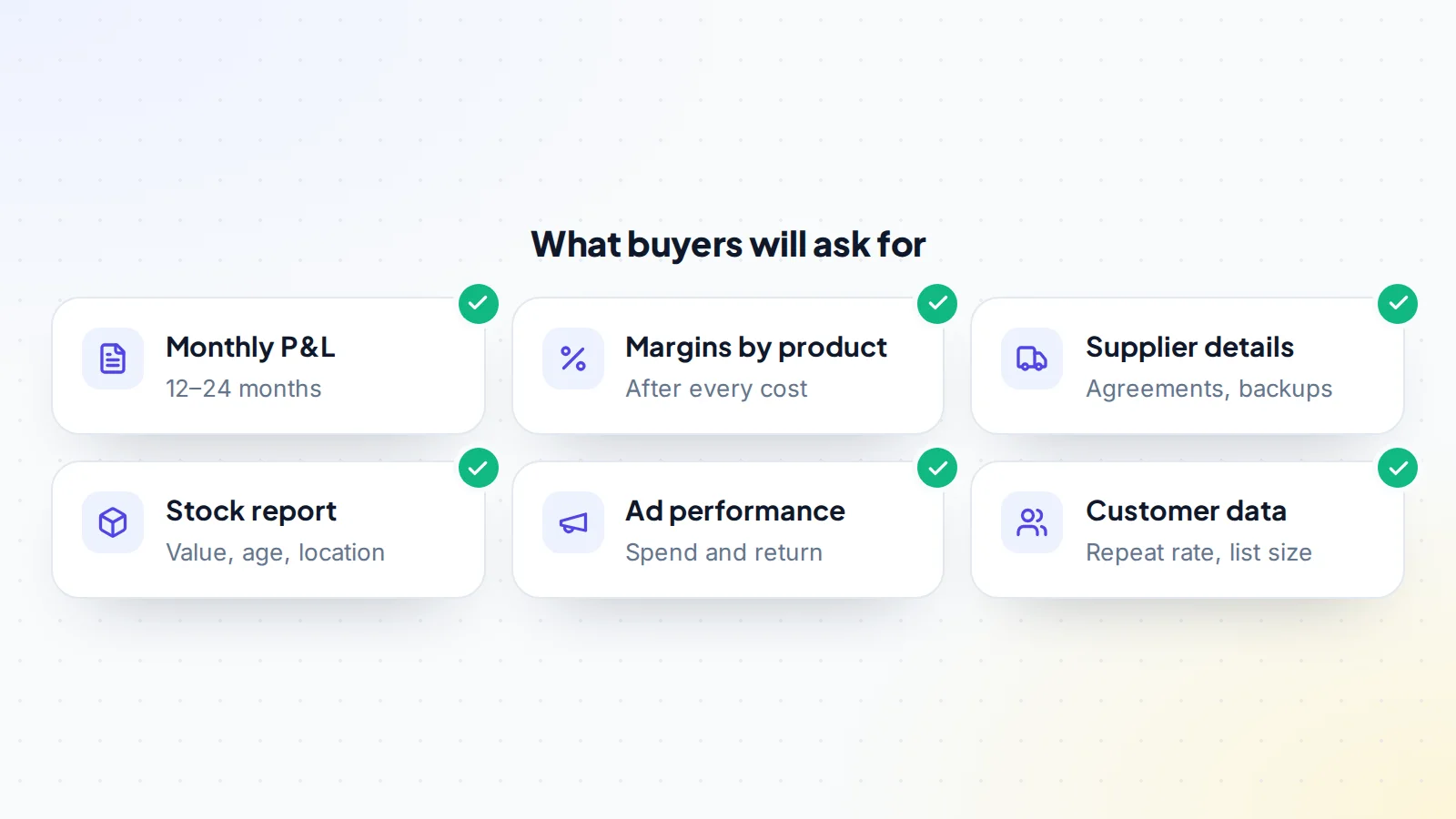
Ecommerce buyers are rightly cautious about revenue that hides thin margins. Prepare:
- A monthly profit and loss for 12 to 24 months: revenue after refunds, product cost, shipping and fulfilment, advertising, platform and payment fees, apps, staff and contractors.
- Margins by product, so buyers can see which products carry the business.
- Advertising performance: spend, sales and cost per sale by channel, over time.
- Customer data: repeat purchase rate, average order value and email list size and engagement.
- Bank and platform records that match the profit and loss.
Buyers usually work from trailing twelve months profit, so present the latest 12 complete months clearly.
Step 2: Document suppliers and stock
Suppliers are the part of an ecommerce business buyers worry about most. For each main supplier, list what they supply, how long you’ve worked together, the terms (written or informal), lead times, minimum orders and any quality issues. Ask suppliers in advance whether they’d be willing to work with a new owner, and whether written agreements can be transferred. Our guide to supplier due diligence shows what buyers will check.
For stock, prepare a current report: items, quantities, cost value, age and location. Most sales price stock separately at cost, based on a count on handover day, so agree the method early.
Step 3: Understand how stores are valued
Ecommerce businesses are usually priced as a multiple of average monthly net profit, with stock added separately. The multiple depends on how predictable and transferable the profit is: a recognisable brand, repeat customers, several traffic sources, reliable suppliers and steady margins push it up; heavy dependence on paid ads, a single supplier or product, rising costs and high returns push it down. Read our guide to revenue vs profit valuation and try the free valuation tool for a quick range.
Step 4: Raise the value before you list
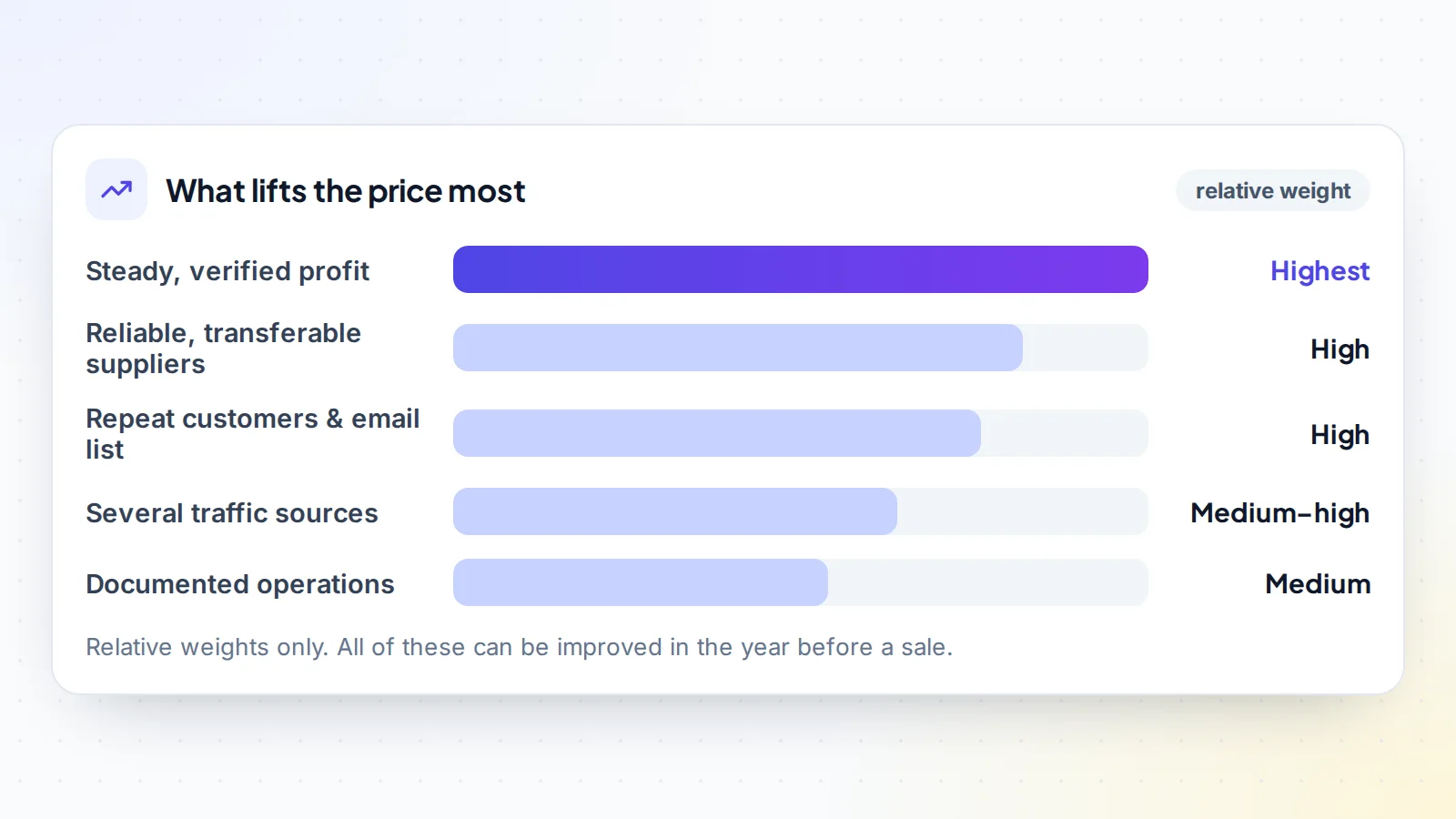
- Cut advertising that doesn’t pay back, lifting profit and showing sales hold up.
- Grow the email list and repeat purchases, which make revenue more predictable.
- Add a backup supplier for key products.
- Reduce returns by fixing the products or descriptions that cause them.
- Document operations: order handling, customer service, restocking, promotions.
- Clear slow-moving stock, so the stock you sell is fresh and easy to value.
Our guide to increasing business value before a sale covers more ideas.
A worked example
The numbers below are made up to show the method, not market data.
Jamie owns a store selling handmade-style ceramic homeware, with $55,000 of monthly sales after refunds and $9,500 of monthly net profit. Two-thirds of sales come from paid social ads, and cost per sale has risen over the year.
Twelve months before selling, Jamie starts an email programme and a loyalty discount for repeat buyers, pauses the weakest ad campaigns and adds a second supplier for the bestselling range. By the time Jamie lists, net profit has risen to $10,800 a month, paid ads bring under half of sales, and repeat customers make up a third of orders. Jamie prepares a 24-month profit and loss, supplier details with introductions agreed, and a stock report. Buyers see a business with steadier profit and lower risk, and the offers reflect it.
Different stores, different preparation
- Own-brand stores should document manufacturing, product specifications, trademarks and designs, because these are what a buyer is really acquiring.
- Dropshipping stores should show supplier reliability, delivery times and how product research is done; buyers know margins can be thin. See dropshipping store for sale.
- Print-on-demand stores should document design rights and the production partner’s terms.
- Resellers should show supplier terms, any authorised reseller agreements and pricing rules from brands.
- Stores also selling on marketplaces should check each marketplace’s rules on changes of ownership, which may differ from the store platform’s.
Questions buyers will ask
- What are the net margins by product, after advertising?
- Which suppliers do you use, and will they work with me?
- How much stock is there, and how will it be valued?
- What happens to sales if advertising is reduced?
- How many customers buy again, and how big is the email list?
- What are the main reasons for returns?
- How many hours a week does the store take?
Answering these before anyone asks is the clearest way to sell an ecommerce business quickly and keep negotiations focused on the price, not on doubts.
Step 5: Write the listing
- What you sell, to whom, and the brand.
- Revenue, costs and net profit over 12 months, with margins by product.
- Traffic and sales by channel, including advertising share.
- Suppliers, fulfilment and stock.
- Customers: repeat rate, email list, reviews.
- The platform and how the store will transfer.
- Hours a week and who helps.
- What’s included and why you’re selling.
Be honest about weaknesses; buyers forgive what they’re told and discount what they discover. When you’re ready, you can list your store on digiflippers.com with 0% success fee up to $10,000, then 5% (max $5,000).
Where to sell
Ecommerce businesses can be sold through online marketplaces, through brokers, or privately to a competitor, supplier or customer. Marketplaces suit most small and mid-size stores, letting you set the price and speak with buyers directly. Brokers suit larger businesses where a full service is worth the commission. Private sales can be quick but still need the same records, verification and protected payment. Compare costs with our guide to online business marketplace fees.
Step 6: Handle buyer questions
Expect questions about margins, advertising, suppliers, stock, returns and the platform transfer. Share data live through screen shares or read-only access rather than screenshots, and keep conversations on the marketplace. Be cautious with anyone who wants supplier contacts before agreeing terms, asks for logins “to check”, or suggests an escrow site you’ve never heard of; read how fake escrow scams work.
Step 7: Agree the terms
Write down the price for the business, how stock will be counted and paid for, the payment method, what’s included (store, domain, brand, email list, social accounts, supplier relationships, stock), the handover steps, any transition support and any non-compete. Agree how orders placed around the handover date are handled: who fulfils them and who receives the money.
Step 8: Hand over safely
- Payment secured by escrow or a trusted middleman. On digiflippers.com, the ways to pay in a deal are: directly to the seller, through escrow, and the platform never holds the money itself.
- Store transferred through the platform’s own process. Shopify’s help centre, for example, explains how to transfer a store to a new owner outside your business, who accepts by email.
- Payment processor switched to the buyer’s account. Stripe’s support says to contact them first when a business is sold.
- Suppliers and fulfilment partners introduced and accounts updated.
- Stock counted and confirmed on the agreed day.
- Domain, email, ad and social accounts moved.
- Test orders placed and fulfilled before the buyer confirms.
Our asset transfer checklist lists every item.
Working capital and the handover month
Stores carry money in motion: stock on order, supplier invoices due, customer payments in transit and refunds that may arrive after the sale. Agree how these are handled in the terms, for example that the seller pays supplier invoices for stock received before the handover, the buyer pays for stock received after, and refunds for orders placed before the handover are the seller’s responsibility. Clear rules prevent the most common arguments after an ecommerce sale.
Protecting customers and reviews
Customers rarely notice a change of owner if service stays the same. Keep shipping times, return policies and customer service standards steady through the handover, and make sure no orders are left unfulfilled. Agree whether and how to announce the change; for many stores, a short note in the next email is enough. Reviews and ratings are part of what the buyer is paying for, so a smooth handover protects the value of the business you’re selling.
After the sale
Provide any agreed support, answer questions about suppliers and operations, and keep your promises on non-competition. Keep the agreement and payment records, and speak to an accountant about tax on the sale. If customers contact you, point them to the new owner.
Common mistakes
- Quoting revenue instead of profit.
- Leaving out advertising or your own time from costs.
- Not asking suppliers whether they’ll work with a new owner.
- Vague stock terms that cause disputes on handover day.
- Handing over the store before payment is secured.
How to sell an ecommerce business: the checklist
- Monthly profit and loss for 12–24 months, matched to records.
- Margins by product and advertising performance by channel.
- Supplier details and introductions agreed.
- Stock report and counting method agreed.
- Customer data: repeat rate, email list, reviews.
- Platform transfer and payment processor plan confirmed.
- Honest listing with strengths and weaknesses.
- Terms in writing, including orders around handover.
- Payment secured before the handover.
Ready to sell?
List it on digiflippers.com with verified numbers, answer buyers in one place and agree every step in a free Deal Room. 0% success fee up to $10,000, then 5% (max $5,000).
Frequently asked questions
How are ecommerce businesses valued?
Usually as a multiple of average monthly net profit, with stock added separately at cost. The multiple depends on margins, supplier reliability, repeat customers and how dependent sales are on paid advertising.
Is stock included in the price?
Often it’s paid for separately, at cost, based on a count on handover day. Agree the method in writing.
Can I transfer my Shopify store to a buyer?
Yes. Shopify’s help centre explains how to transfer a store to a new owner outside your business, who accepts by email.
Will my suppliers work with the new owner?
Ask them before you list. Buyers will want introductions, and some written agreements need the supplier’s consent before they can be transferred.
How long does it take to sell an online store?
Preparation takes a few weeks; finding a buyer can take from weeks to months; due diligence and handover often take two to six weeks.
Should I keep running ads while the store is for sale?
Yes, at a sensible level. Sudden changes in advertising make the numbers harder to read. If you’ve cut wasteful campaigns, explain when and why.
How do I sell an ecommerce business without losing my suppliers’ goodwill?
Tell key suppliers early and privately, explain the plan, and introduce the buyer before the handover. Most suppliers want a smooth transition as much as you do.