Post-Sale Transition Support: What’s Normal?
What post-sale transition support looks like for online businesses, typical scope and length, how to write it into the agreement, and how to make the handover stick.
Buying an online business means taking over systems, relationships and know-how that the seller has built up over years. Even with good documentation, there are always questions in the first weeks. That’s why most deals include transition support after sale: a defined period in which the seller helps the buyer settle in. This guide explains what’s normal, how long it usually lasts, how to write it into the agreement, and how buyers can get the most from it.
For the handover itself, see our guide to transferring an online business.
Key takeaways
- Transition support is a defined period in which the seller helps the buyer take over.
- It usually covers questions, walkthroughs, introductions and help with accounts.
- Agree the length, hours, response times and tasks in writing.
- Buyers get more from it by preparing questions and shadowing key tasks early.
- Extra support beyond the agreed scope is usually paid separately.
Why transition support matters
A business’s results depend on how it’s run, and some of that lives only in the seller’s head, however good the documentation: why a process works the way it does, which partner to call about a late payment, how to fix a recurring bug. Transition support turns that knowledge into the buyer’s knowledge. It reduces the risk that results dip after the sale, which benefits the seller too, especially if part of the price depends on results after closing.
What it usually covers
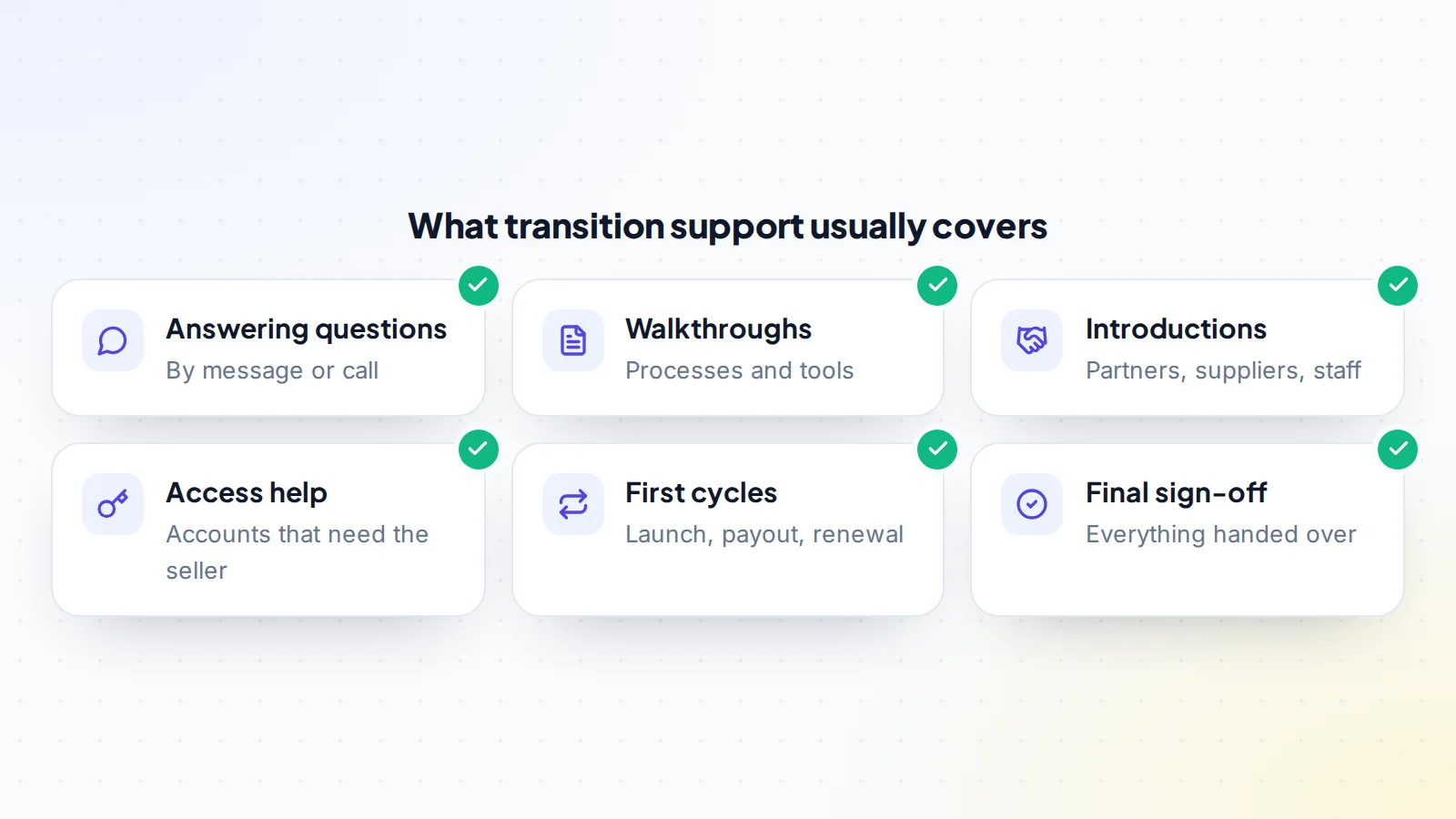
- Answering questions by message, email or scheduled calls.
- Walkthroughs of key processes and tools, ideally recorded.
- Introductions to suppliers, partners, sponsors, contractors and key customers.
- Help with accounts that need the seller’s confirmation during transfer.
- Support through first cycles, such as a payout, renewal batch, product launch or seasonal peak.
It usually doesn’t include running the business, creating new content or products, or open-ended consulting, unless the agreement says so and, typically, pays for it. Being clear about what’s out of scope is as important as listing what’s in it, because it stops small favours turning into an unpaid second job for the seller.
What it looks like by business type
- Content sites: walkthroughs of the content process, writer introductions, how updates and links are managed, and help with ad and affiliate accounts.
- E-commerce stores: supplier introductions, the first stock order, fulfilment, customer service routines and ad accounts.
- SaaS and apps: code walkthroughs, deployment, billing and support handover, and help with the first release from the buyer’s accounts.
- Social accounts and communities: content routines, moderator introductions, brand partner handover and, sometimes, a short period of co-posting.
- Domains: usually little or none beyond the transfer itself, unless a website or email comes with the name.
How long it usually lasts
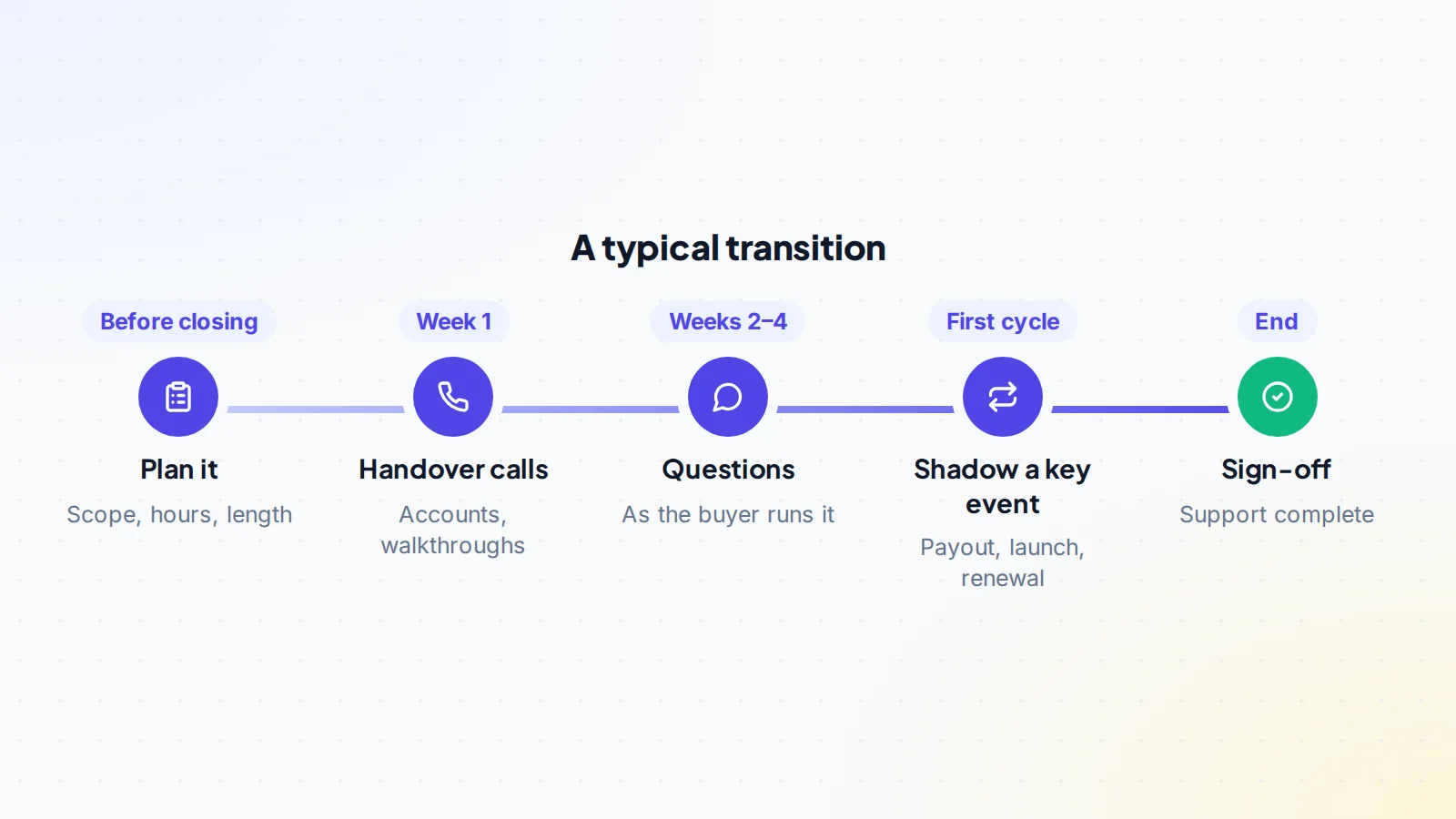
Length varies with the size and complexity of the business. Small content sites and accounts may need a couple of weeks of questions. Businesses with suppliers, staff, software or subscriptions often agree one to three months, sometimes longer for larger deals. The right length is the time it takes for the buyer to run one full cycle of the business with help on hand. Agree it in days or weeks, not “as long as needed”. If the business has a seasonal peak or a big monthly event soon after closing, consider extending support to cover it, because that’s when questions are most likely.
Writing it into the agreement
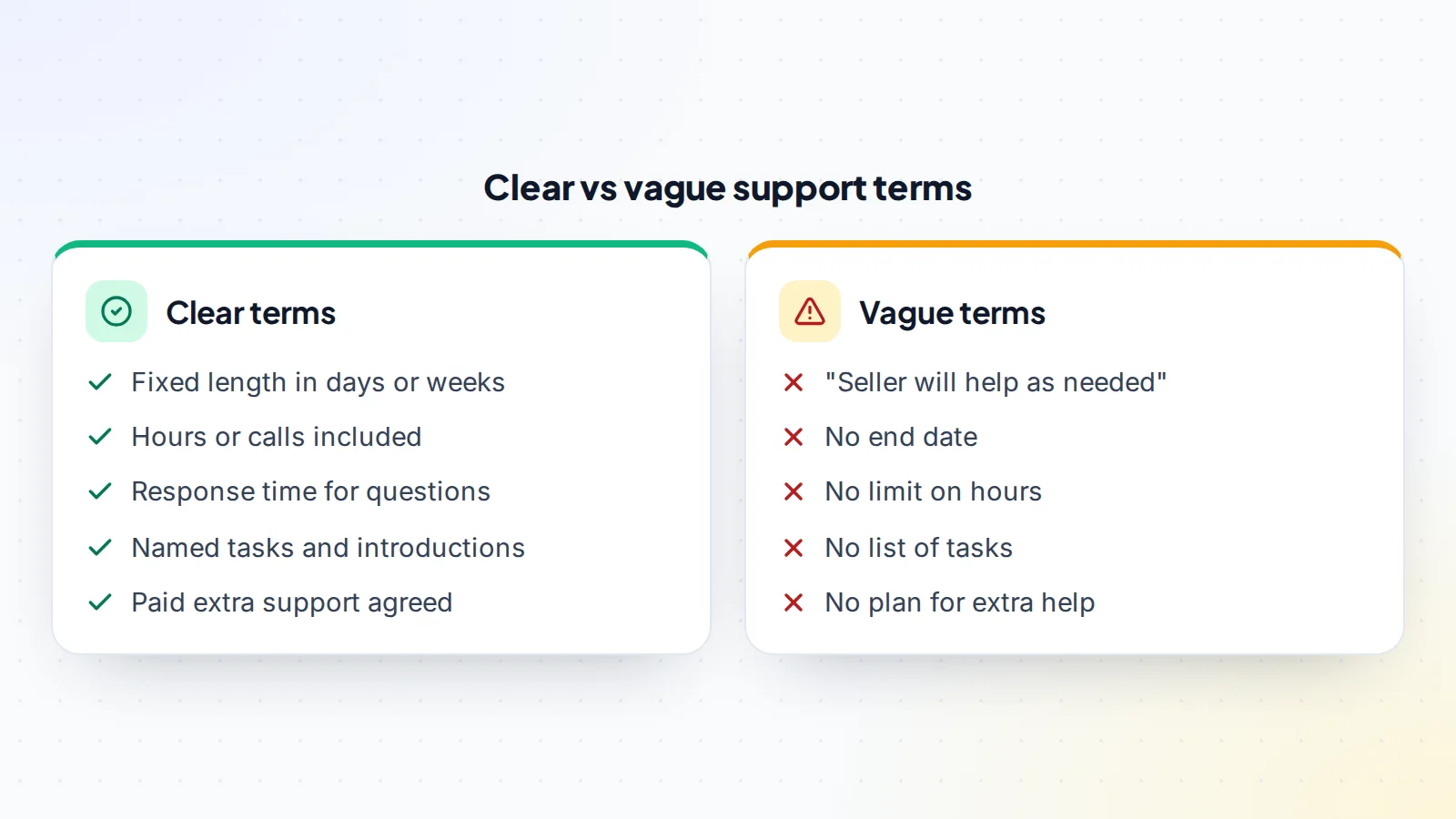
Clear terms protect both sides. The sale agreement should say:
- How long support lasts, with a start and end date.
- How much: a number of hours, calls or a reasonable-use limit.
- How: by message, email or scheduled calls, and in which time zone.
- How quickly the seller will respond to questions.
- Which specific tasks and introductions are included.
- What happens if more help is needed, such as an hourly rate.
Transition support is one of the clearest places where written detail prevents later disputes. The more specific the terms, the less room there is for different expectations.
How support links to payment
Many deals hold part of the price until the transition is complete, or until key accounts and relationships have moved. That gives the seller a clear reason to help and protects the buyer if something essential can’t be transferred. Use escrow or a middleman to hold that part, with release conditions written in the agreement. On digiflippers.com, the ways to pay in a deal are: directly to the seller, through escrow, and the platform never holds the money itself.
For buyers: getting the most from it
- Prepare questions in advance from your due diligence notes.
- Record walkthroughs with the seller’s agreement, so you can rewatch them.
- Do tasks yourself early, with the seller watching, rather than only watching them.
- Ask for introductions in the first week, while the seller’s relationships are fresh.
- Turn answers into procedures, so knowledge stays in the business.
- Schedule a final check before support ends, to catch anything missed.
For sellers: making it easy
- Write procedures before the sale, so support is about questions rather than explaining from scratch.
- Prepare a list of accounts, tools, contractors and partners with contact details.
- Record short videos of key tasks.
- Agree a clear end date, and stick to the promised response times.
- Be generous early: a smooth start protects your reputation and any part of the price tied to results.
Our guide to preparing a business for sale covers the documentation that makes transitions easier.
Staff and contractors
If the business has staff or regular contractors, the transition includes introducing them to the new owner, explaining roles and agreeing what continues. Personal data about them must be handled carefully; the UK ICO, for example, advises telling workers about a change of ownership and reminding them of their rights. Our guide to operational due diligence covers checking contractor arrangements before the sale.
When part of the price depends on results
Some deals pay part of the price later, if agreed results hold for a period after the sale. In those deals, transition support matters even more, because the seller has a direct interest in a smooth handover and the buyer wants to be sure results aren’t affected by anything the seller controls. Write down exactly how results will be measured, which data will be used, what the seller will and won’t do during the period, and what happens if the buyer makes big changes. Clear terms keep both sides aligned and avoid disputes about why results moved.
Telling customers and partners
Agree in advance whether and how customers, subscribers and partners will be told about the new owner. For some businesses, nothing visible changes and no announcement is needed. For others, especially communities, newsletters and businesses with a personal brand, a short introduction from the seller helps people trust the new owner. Plan the timing so it happens after the handover is complete, and keep the message friendly and simple. Our guide to buying an e-commerce store covers customer communication for stores.
Accounts that still need the seller
Some accounts can’t be fully moved on day one: a supplier portal that needs the original owner to confirm, a platform with a waiting period, or a payment account being transferred by the provider’s support team. List these in the agreement, with what the seller will do and by when, and keep part of the payment held until they’re done. Our guide to transferring Google Workspace covers one common example.
Non-compete and non-solicitation
Many agreements also include promises that the seller won’t start a competing business or approach customers and contractors for a period after the sale. These are separate from transition support but often agreed at the same time. Rules about such clauses vary by country and state, so take advice. Our guide to non-compete clauses explains the basics.
Buyers new to the niche
Buyers who are new to a business’s topic or model often need more support than experienced operators. If that’s you, say so before agreeing terms, and ask for a slightly longer period or more calls rather than relying on goodwill later. Sellers can price that extra time into the deal. Being honest about your experience at the start makes for a better transition than discovering a gap halfway through.
Remote and cross-border handovers
Many online business sales are between people in different countries. Agree a regular call slot that works in both time zones, use a shared document for questions and answers, and record calls where both sides agree. Written, asynchronous support often works better than ad hoc calls, because answers become documentation the buyer can keep.
Turn support into documentation
Every question answered during the transition is a piece of knowledge that should stay with the business. Keep a running document of questions and answers, link it to the relevant procedures, and update procedures as you go. By the end of the period, the business should depend less on the seller than it did at the start. That’s the real goal of transition support after sale.
Ending the transition well
Before support ends, hold a short final call. Go through the account list, contractors and suppliers to confirm everything has moved, and note any open questions. Agree how you’ll handle anything that comes up later, such as a rate for occasional help. If part of the payment is held, confirm that the release conditions have been met. A clear ending leaves both sides confident and on good terms.
When transition goes wrong
Common problems include a seller who becomes hard to reach, a buyer who expects far more help than agreed, and accounts that can’t be moved without the seller. Clear terms prevent most of these. If a problem arises, refer to the agreement, keep communication on the marketplace and, if part of the payment is held, follow the release conditions. Our guide to fake escrow scams is worth reading too, because scammers sometimes pose as sellers or escrow agents during handovers.
A worked example
The details below are made up to show the method.
Kim buys an e-commerce store with two suppliers and a part-time assistant. The agreement includes six weeks of support: two handover calls in week one, answers to questions within one working day, introductions to both suppliers and the assistant, and help through the first monthly supplier order. Ten percent of the price is held in escrow until the suppliers confirm the accounts have moved. Kim records the walkthroughs, turns them into procedures and places the first order with the seller watching. At the end of week six, both sign off, and the held amount is released.
Transition support after sale: the checklist
- Length agreed in days or weeks, with start and end dates.
- Hours, calls or limits agreed.
- Response time and time zone agreed.
- Tasks and introductions listed by name.
- Rate for extra support agreed.
- Part of the payment held until key handovers are complete, if appropriate.
- Walkthroughs recorded and turned into procedures.
- First key cycle completed with the seller’s help.
- Final sign-off at the end of the period.
Ready to find your next asset?
Browse listings with verified numbers, ask sellers your questions before you offer, and agree every step in a free Deal Room.
Frequently asked questions
What is transition support after a sale?
A defined period after closing in which the seller helps the buyer take over: answering questions, walking through processes, making introductions and helping with accounts.
How long should transition support last?
Long enough for the buyer to run one full cycle of the business with help on hand. For small sites that might be a couple of weeks; for more complex businesses, one to three months or more.
Is transition support free?
The agreed support is usually part of the price. Extra help beyond the agreed scope is often paid at an agreed rate.
What if the seller stops responding?
Refer to the agreement and keep communication on the marketplace. Holding part of the payment until the transition is complete gives sellers a clear reason to stay engaged.
Should transition support be in writing?
Yes. Length, hours, response times, tasks and extra rates should all be in the sale agreement.
Can transition support include training staff?
Yes, if agreed. Introductions and handover of staff relationships are common parts of the scope.
What should transition support after sale include for a small site?
Usually a handover call, answers to questions for a couple of weeks, help moving accounts and introductions to any writers or partners.