
How Much Is Your Game Account Worth?
What decides a game account's value, from rare skins and ranks to inventory, progress and email access, and a simple method to price yours.

Years of play leave more than memories. A locker full of skins from early seasons, a rank you fought for, a library of games and a stash of in-game currency all have real value to other players. If you’re wondering about your game account value, whether to sell it or simply to know what you’ve built, the answer comes down to a handful of factors you can check yourself.
This guide walks through those factors one by one, shows how they differ between competitive and cosmetic-driven games, and gives you a simple method to set a fair price range. It’s useful for buyers too: knowing what drives value is the best protection against overpaying.
For game-specific detail, see our guides to Fortnite account value, Roblox account value and Steam inventory value.
Key takeaways
- Rare and retired items usually carry the biggest share of an account’s value.
- In competitive games, current rank and recent stats matter as much as cosmetics.
- Full access, including the original email, is worth a lot; accounts without it sell for much less.
- Comparable listings are the best evidence of price; build a full item list before you compare.
- Set a range (ask, accept, walk away) rather than a single number.
What buyers are really paying for
Buyers of game accounts pay to skip something: the grind to a rank, the years of seasons they missed, or the cost of buying items one by one. The more of that an account saves, and the harder it is to get any other way, the more it’s worth. That’s why two accounts at the same level can be priced very differently: what matters is what’s on them and how unique it is.
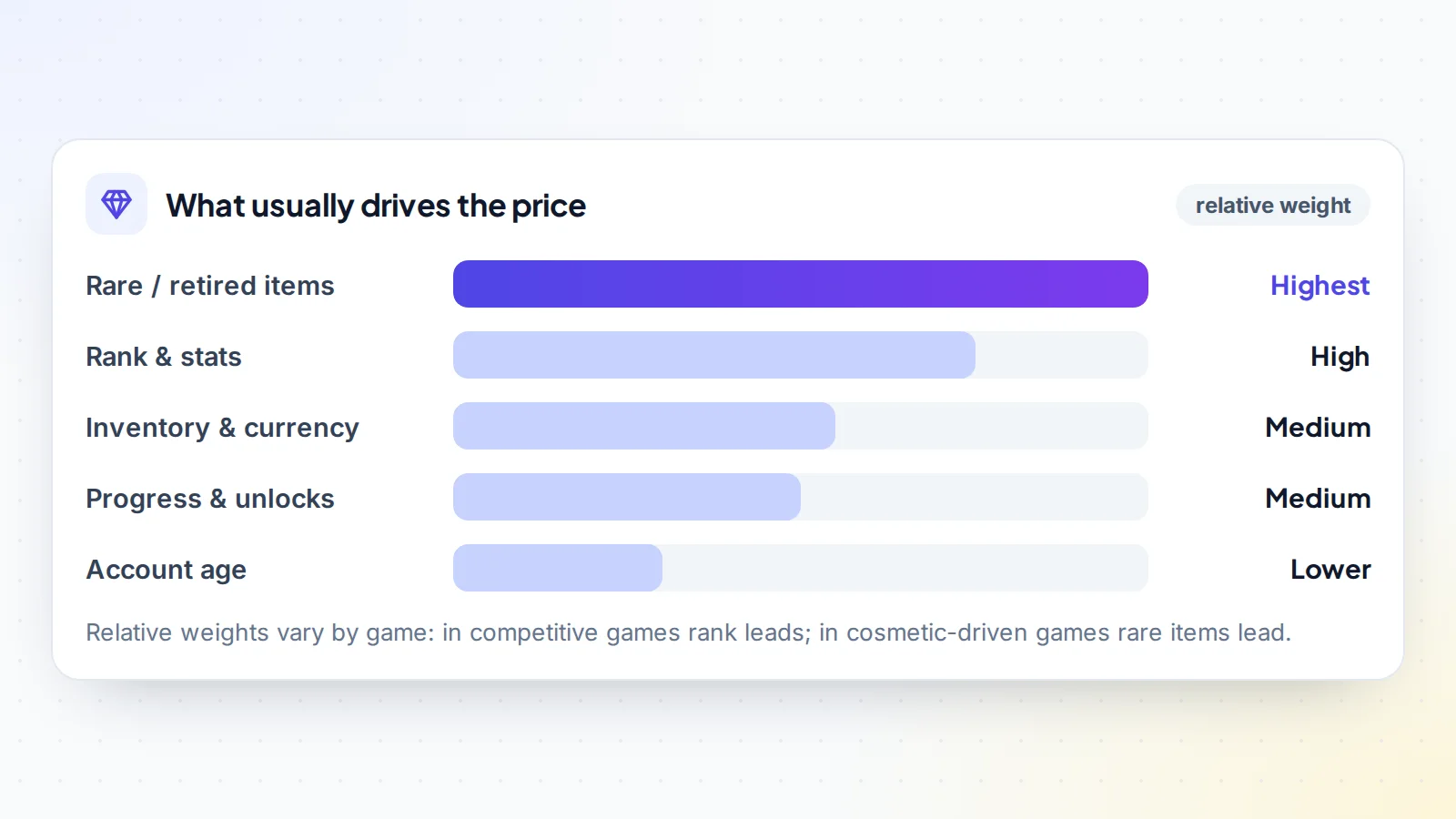
Rare and retired items
Cosmetics from early seasons, limited-time events, collaborations and battle passes that won’t return are often the single biggest driver of value. Their supply is fixed: no one can buy them any more. When a game’s community values them, demand stays high for years. Our guide to rare skins, ranks and items explains what makes an item rare in practice: how long it was available, how many players got it and whether it might return.
When you list your account, put the rarest items first and name the season or event they came from. Buyers searching for a specific skin will find you faster.
Rank and stats
In competitive games, rank is often what the buyer wants most: an account that lets them play at the level of their friends, or practise against stronger opponents. Current-season rank matters more than an old peak, because ranks reset or decay in many games. Match history, win rates and other stats help buyers judge whether the rank is genuine and stable. Read ranked account value for more.
Inventory, currency and libraries
Tradeable items, unspent in-game currency and owned games or DLC all add value. For platform accounts with large libraries, buyers compare the cost of the games on the account with what they’d pay to buy them separately. Currency is straightforward to value but can only be used in that game, which limits how much buyers will pay for it.
Progress and unlocks
Unlocked characters, maps, abilities, levels and achievements represent time. In games where progress is slow, an account that’s far along can be worth a lot to a player who wants to join friends at a higher level. In games where progress is quick, it adds less.
Account age and history
An older account that you created yourself, with a clean history, is generally more attractive than a newer one or one that’s changed hands several times. Buyers see an account with a long, stable history as one that’s likely to stay stable after the sale.
Access: the hidden multiplier
Whether the buyer gets full access changes the price more than many sellers expect. An account sold with its original email, or with the email changed to the buyer’s during the handover, is far more valuable than one where the seller keeps the email, because whoever controls the email can usually recover the account. Linked platforms matter too: some console or store links can be changed, some can’t, or only after a waiting period. Our guide to securing a game account explains what buyers check.
How value differs by type of game
- Cosmetic-driven games (many battle royales and sandbox games): rare skins and limited items lead the price.
- Competitive games (shooters, MOBAs, fighting games): rank and stats lead, with cosmetics as a bonus.
- Progression games (MMOs, RPGs): level, gear and unlocks lead.
- Platform accounts (game libraries): the value of owned games and tradeable items leads.
Our overview of game account market trends shows which games and items are in demand.
Timing and the wider market
Game account value moves with the game itself. When a game is growing, a new season brings players back, or a popular collaboration puts old items in the spotlight, demand for accounts rises and prices follow. When a game’s player base shrinks, or a big update changes what matters (a rank reset, a new progression system, the return of an item people thought was gone forever), prices can fall quickly. If you’re thinking of selling, watch the game’s news: selling during a period of high interest usually beats waiting for a better moment that may not come.
Regions, platforms and servers
Where an account was created and where it plays can change its value. Some games tie accounts to regional servers, so a buyer elsewhere may face higher latency or a different store. Some items or events were only available in certain regions, which can make them rarer. Platform matters too: in games where progress or purchases don’t carry across PC, console and mobile, an account is mainly valuable to players on the same platform. Always state region and platform clearly when you list, and check them when you buy.
How buyers check value claims
Buyers won’t pay for items they can’t see. The accounts that sell closest to their asking price come with a full item list and fresh proof: a short video or live screen share in which the seller logs in, opens the locker or inventory, shows the rank screen and the account settings, and types a word the buyer chose so the video is clearly new. Purchase history, where available, helps too. A seller who can only show old screenshots will usually have to accept a lower price, because the buyer is taking more risk. Our guide to proof for game accounts lists what to show in popular games.
Protecting the value while you own it
If you might sell one day, a few habits keep your account’s value intact. Turn on two-factor authentication, ideally with an authenticator app, and keep your backup codes safe. Keep the email account secure too, since it’s the key to the game account. Avoid sharing your login with friends or “boosting” services, which can lead to lost items or problems with the account’s standing. And keep a record of how and when you got your rarest items; buyers like a clear story.
A simple method to price your account
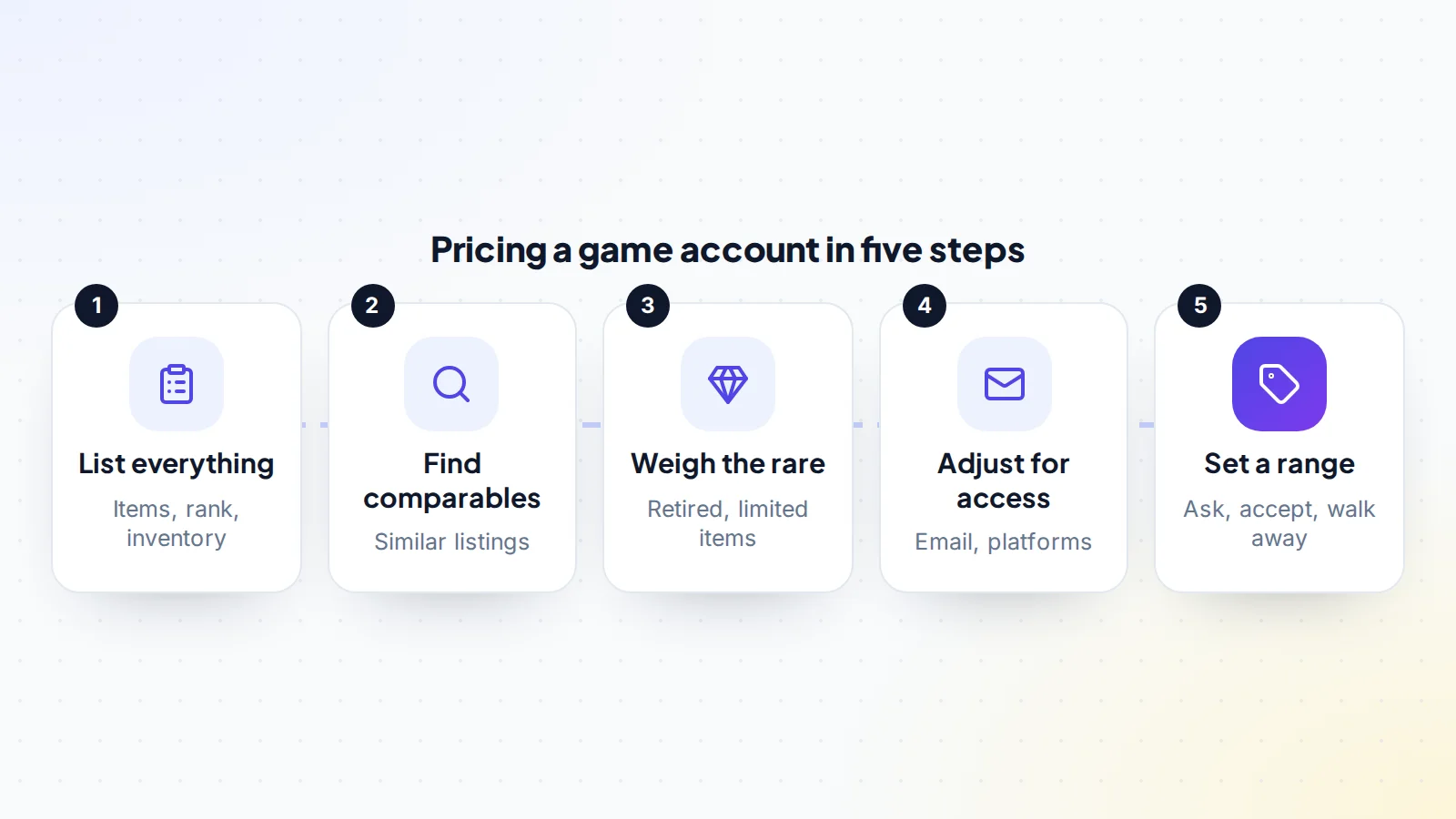
- List everything on the account: items (with seasons), rank and stats, inventory, currency, games and progress.
- Find comparable listings with similar items, ranks or libraries. Note their prices and how long they’ve been listed.
- Weigh the rare items: anything that can never return deserves extra weight.
- Adjust for access: up for an included email and changeable platform links, down for limitations.
- Set a range: an asking price, a price you’d happily accept, and a price below which you’d rather keep it.
For a quick starting point, try the free valuation tool.
A worked example
Imagine two accounts in the same battle royale. Both have about 150 cosmetics. The first includes eight skins from the earliest seasons that have never returned, comes with its original email and was created by the seller. The second has more recent items, including several from popular shop bundles, and the seller can’t hand over the email.
Looking at listings, accounts with several early-season skins and full access sell for noticeably more than accounts with only recent items. The first account sits near the top of the range; the second sits much lower, because recent items can still be bought and the missing email is a risk for the buyer. Same game, same item count, very different game account value.
If you decide to sell
Prepare a full item list, record fresh proof (a video showing the account, its items, rank and settings), decide how you’ll hand over the email, and use a middleman or escrow so the buyer’s payment is held before you hand anything over. Read how to sell a game account safely and how middleman services work. If the buyer asks you not to sell similar accounts for a while, agree it clearly; our guide to non-competes explains how they work in online sales.
If you’re buying
Use the same factors to judge whether a price is fair. Ask for a full item list and live proof, compare similar listings, insist on full access and pay through a middleman or escrow. If this is your first purchase, start with our short guide to buying your first game account, then the full buying guide.
Using value in a negotiation
Once you know what drives your account’s value, negotiation gets easier. When a buyer makes a low offer, point to specifics: the retired items, the current rank, the included email. When a buyer asks for a discount because of something real, such as a platform link that can’t be changed, a fair adjustment often closes the deal faster than holding out. Agree the price, the full item list and the handover method in writing, then let a middleman or escrow hold the payment while you hand over.
Common pricing mistakes
- Counting what you spent rather than what buyers will pay. Money spent on recent shop items rarely comes back in full.
- Ignoring access. Without the email, buyers discount heavily.
- Comparing with the wrong accounts: different regions, platforms or ranks.
- Waiting too long. Demand for a game can fall; accounts often sell best while the game is popular.
Game account value: the checklist
- Complete list of items with seasons, rank, stats, inventory and currency.
- Rare and retired items identified and highlighted.
- Current rank and recent stats checked.
- Email access and linked platforms confirmed.
- Region and platform noted.
- Several comparable listings reviewed.
- Price range set: ask, accept, walk away.
- Proof recorded for buyers.
Ready to find your next asset?
Browse listings with verified numbers, ask sellers your questions before you offer, and agree every step in a free Deal Room.
Frequently asked questions
How much is my game account worth?
It depends on the game, the rarity of your items, your rank, your inventory and whether full access, including the email, comes with it. Compare similar listings to find a realistic range.
What makes a game account valuable?
Rare and retired items, a high current rank, valuable inventory or libraries, long progress and full, clean access.
Does the money I spent decide the value?
Not directly. Buyers pay for what’s rare or time-saving. Items that can still be bought in the shop usually add less than they cost.
Is an account without the original email worth less?
Yes, often much less, because the buyer can’t be sure the account won’t be recovered by someone else.
Should I sell items or the whole account?
If your game lets you trade items and a few of them carry most of the value, selling items can bring more. Otherwise, selling the account is simpler. See selling items vs accounts.
Do online game account value calculators work?
They can give a rough idea for popular games, but they rarely account for access, region or how rare specific items really are. Use them alongside comparable listings.
Does a high level always mean a high price?
No. Level shows time spent, but buyers pay most for what’s rare or hard to get: retired items, high current ranks and valuable inventory.
Does region affect the price?
It can. Region decides servers and sometimes stores and items, so most buyers look for accounts in their own region.
When is the best time to sell?
While the game is popular and your rare items are in demand. Values often fall when a game’s player base shrinks.