From Side Project to Sale: When a Project Becomes Sellable
A guide for makers with side projects: the difference between a project and a sellable asset, what buyers value, how to make it transferable, records and verification, pricing small projects, listing, and a clean handover.
Many makers have a side project that’s quietly growing: a small app, a niche website, a browser extension, a template shop, a newsletter. At some point you might wonder whether someone would buy it. Often the answer is yes, but only once the project can show something real and can be handed over cleanly. If you want to sell a side project, this guide explains when it becomes sellable, what buyers actually pay for, how to untangle it from your personal accounts, what records to keep, and how to price, list and hand it over.
If you’re not sure what counts as a sellable asset, start with what a digital asset is. If your project already earns steadily, see the full guides for websites and SaaS.
Key takeaways
- A project becomes sellable when it shows real users, traffic or revenue and can be transferred.
- Buyers pay for proof: active users, organic traffic, steady income and low upkeep.
- Untangle the project from personal email, servers, code and cards before listing.
- Keep simple records from the start; they’re what buyers check.
- Small projects sell on fit and proof, so be clear about who they suit.
When a side project becomes sellable
Almost anything with a domain and some code can be sold, but the price depends on proof. A project that’s just an idea sells for close to the cost of its parts. One with real users, steady traffic or some revenue sells for more, because the buyer gets a head start that’s already working.
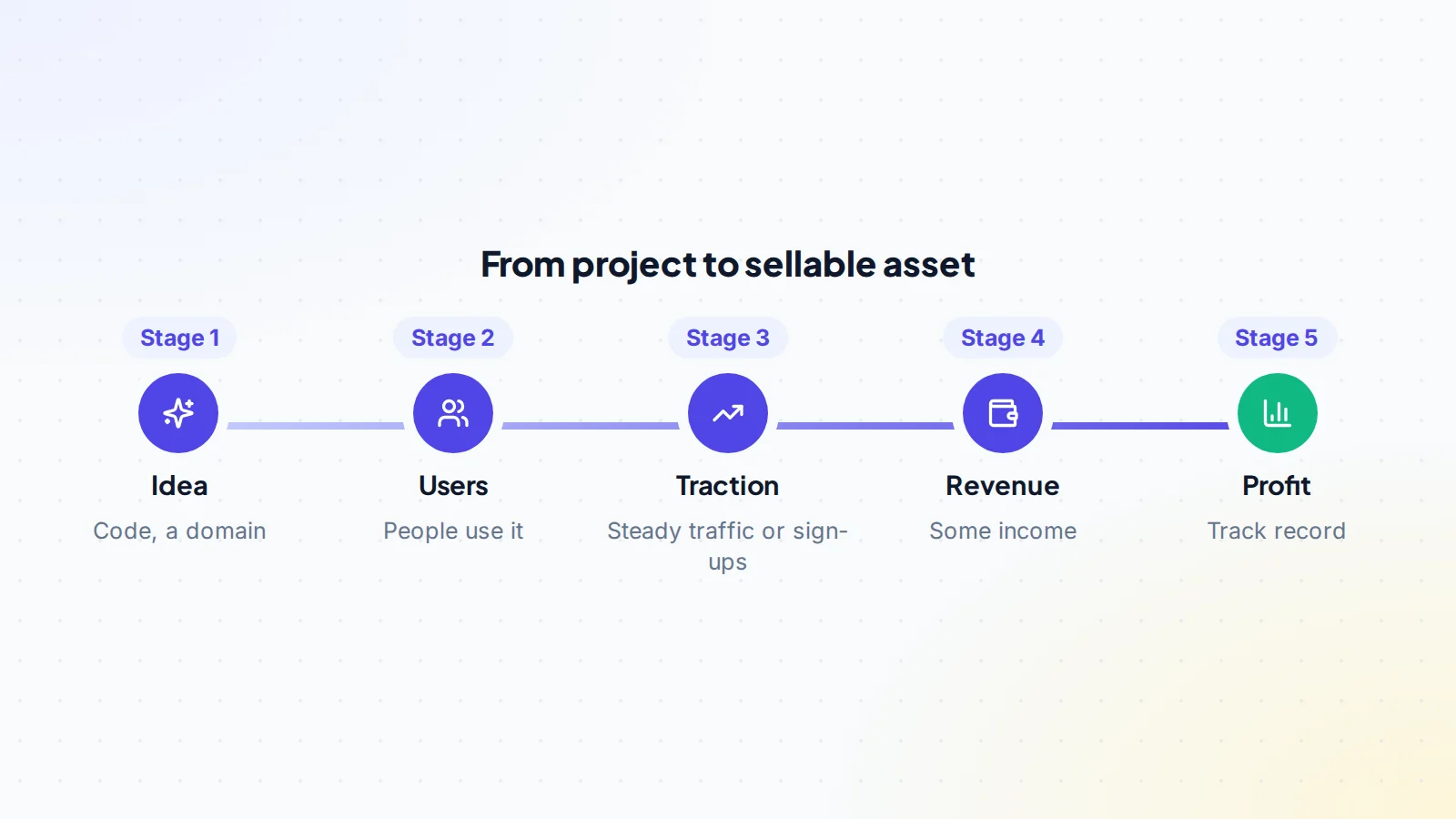
Ask yourself three questions. Is anyone using it regularly? Can a stranger verify that? Could someone else run it without you? If the answers are yes, you have something to sell. If not, a little more work may change the price a lot.
Good reasons to sell
Makers sell side projects for many reasons: a new job, a new idea, not enough time, or simply wanting to turn work into cash. Some sell to fund their next project; some because the project needs more attention than they can give. All are reasonable, and buyers will ask, so have an honest answer ready. “I’ve started a new role and can’t give it the time it deserves” is a reason buyers understand.
What buyers actually pay for
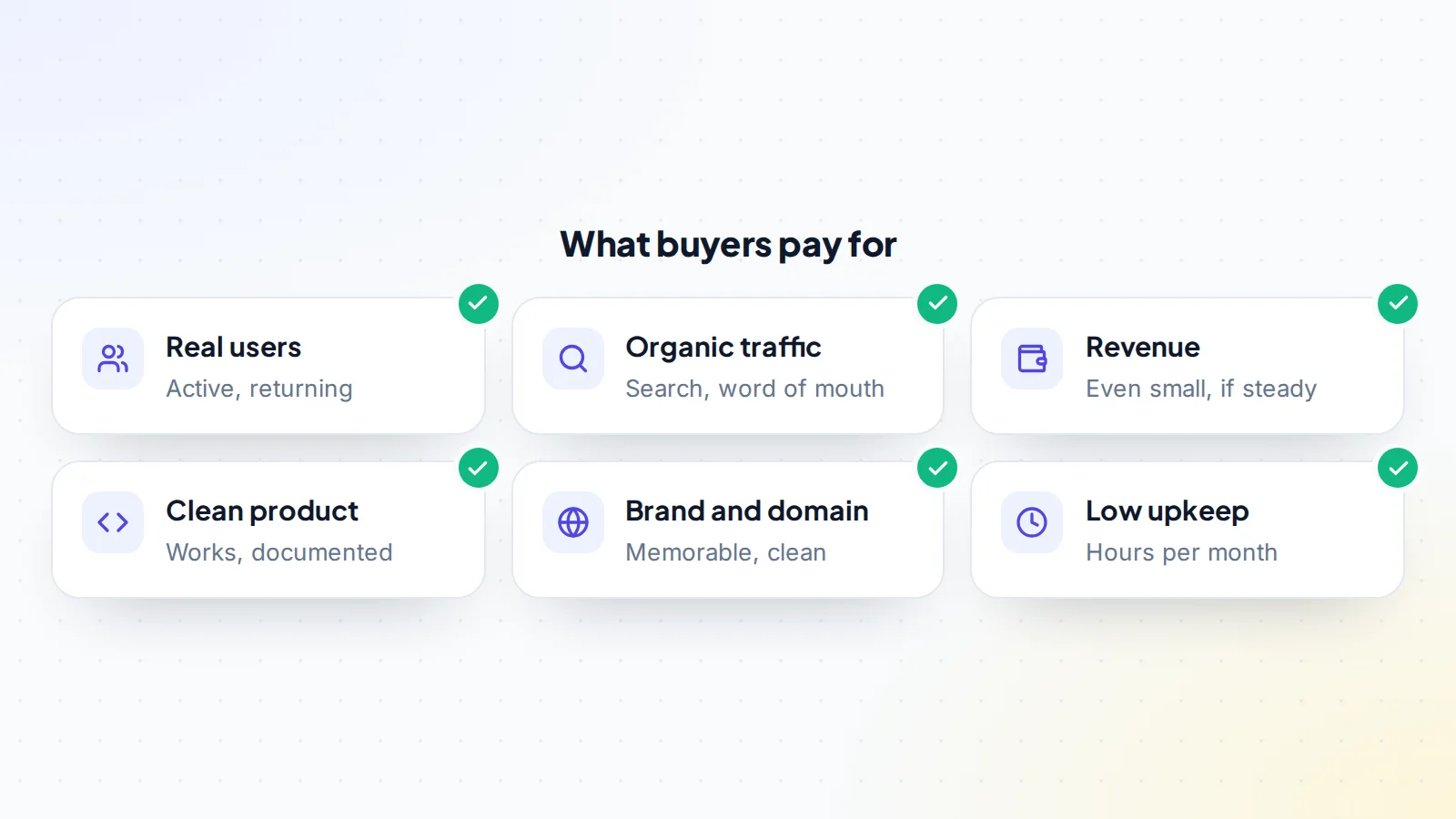
Buyers of small projects look for a few things: evidence that people use it, a source of traffic or users that isn’t paid ads, any revenue at all if it’s steady, a product that works without constant fixes, a clean brand and domain, and how much time it takes to run. Upkeep matters a lot for small projects, because many buyers want something they can run alongside a job too. Read how passive an online business really is for how buyers think about time.
Hobby or business?
How you’ve run the project affects both the sale and your taxes. The IRS explains how to tell the difference between a hobby and a business: factors include whether you run it in a businesslike way with accurate records and whether you’re trying to make a profit. Rules differ by country, so check locally, but the practical point is the same everywhere: keeping proper records helps the sale and your tax position. Speak to an accountant about how a sale will be taxed.
Untangle it from your life
Side projects are often built quickly with whatever accounts were handy: your personal email, a server shared with other projects, code in a personal repository, costs on your own card. Buyers can’t take over your personal accounts, so these need separating before you sell.
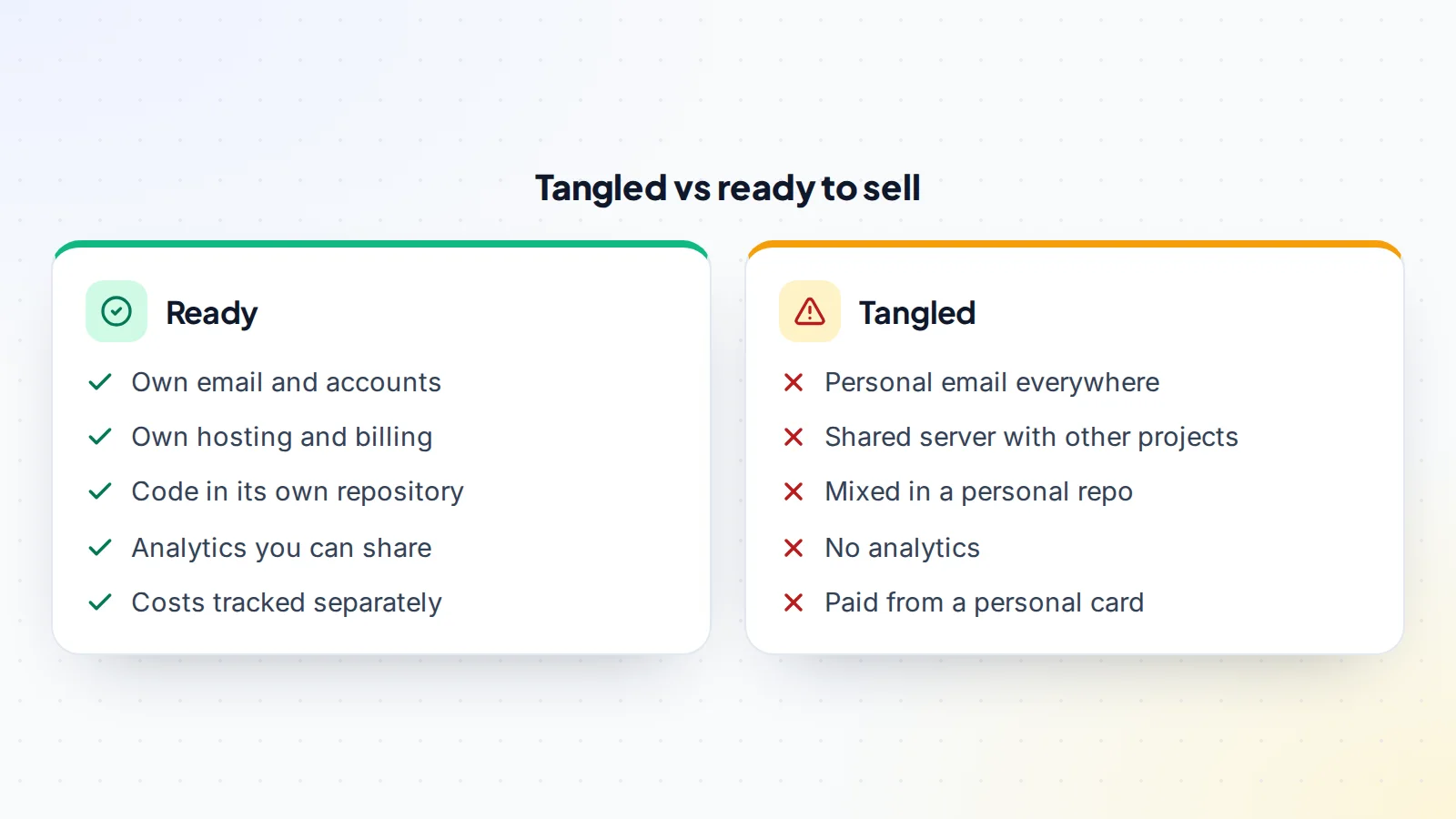
Create a dedicated email for the project, move logins to it, give the project its own hosting or at least its own account, put the code in its own repository, and track its costs separately. This takes a few evenings and makes the handover straightforward. Read the asset transfer checklist for everything that needs to move.
Records to keep from today
You don’t need accounting software for a small project. A simple spreadsheet works: monthly revenue, monthly costs, and a note of anything unusual. Add analytics if you haven’t, under the project’s own account, so you can share read access with buyers. Keep receipts for domain, hosting and tools. Even three to six months of clean records makes a project far easier to sell, and it takes only a few minutes a month to keep up. Read how buyers verify traffic.
Make the numbers checkable
Buyers trust what they can check themselves. Use an analytics tool that lets you add a viewer, so a serious buyer can see real data rather than screenshots; Google Analytics, for example, lets you add users with view permissions. If the project earns, keep income in a payment processor or platform you can show directly. On a marketplace, verification badges help buyers trust small listings faster; see how verification works on digiflippers.com.
Code and documentation
If the project includes code, make sure a developer other than you could run it. Write a short README: how to install it, deploy it, and where secrets and settings live. List the main dependencies and services. Update anything badly out of date. Remove hard-coded passwords and personal API keys. A buyer who can get it running in an hour will pay more than one who faces a week of guesswork. Ask a friend to follow the README on a fresh machine; whatever confuses them will confuse a buyer too.
Licences and rights
Check you own what you’re selling. Themes, plugins, fonts, images and code libraries all come with licences; make sure they allow commercial use and transfer, or that the buyer can buy their own. If friends or freelancers contributed, get written confirmation that their work belongs to the project. If you built it while employed, check your employment contract doesn’t claim side projects. Read intellectual property in digital sales.
Pricing a small project
If the project has steady profit, buyers usually value it as a multiple of that profit, often at the lower end for small, young projects. If it has users but little revenue, buyers weigh traction, growth and what it would cost them to build the same thing. If it’s very early, the price will sit close to the value of the domain, code and design. Be realistic: small projects often sell for modest amounts, and that can still be a good outcome for something built in spare time. Read pre-revenue valuation and how to price a listing.
Who buys side projects
Typical buyers include other makers who want a head start, people looking for a first small business, developers adding to a portfolio of tools, and businesses that want a feature, audience or domain. Think about who your project suits best and write the listing for them. A tool for designers will interest different buyers than a niche content site.
Small improvements before listing
A few hours can raise the price: fix obvious bugs, refresh the home page, add a pricing page if there’s a paid tier, collect a few user testimonials, and clean up the design. Don’t start big new features; buyers pay for what exists, not what you’re about to build. Read revenue diversification if you want to add a simple second income source first.
Writing the listing
Be clear and honest. Say what the project is, who uses it, how they find it, what it earns and costs, how many hours it takes, and why you’re selling. Include what’s included in the sale: domain, code, content, social accounts, email list, and any help you’ll offer. Show verified numbers where you can. Mention any weaknesses plainly; buyers of small projects value honesty because they know the risks are higher.
A clean handover
Use escrow so the buyer’s money is held while you transfer the project. Move the domain, hosting, code repository, email, analytics and any payment accounts that can be transferred. Accounts tied to your identity, such as some payment and ad accounts, will need the buyer to open their own. Offer a short period of help, such as a couple of calls or a week of email support. Read how to transfer an online business.
Selling from anywhere
Because everything is online, buyers and sellers are often in different countries. That’s normal. Agree on currency, payment method and time zones early, use escrow, and keep everything on the marketplace. If the project serves customers in a particular country, mention it, as some buyers look for that. Read location-independent businesses.
Keep, grow or sell?
Before you sell a side project, compare the options honestly. If it’s growing and you enjoy it, keeping it might be worth more over time. If it’s stalled and you’ve run out of ideas, a buyer with fresh energy may grow it faster than you could. If it costs you more time than it gives back, selling frees you for something new. There’s no wrong answer, but deciding clearly helps you negotiate calmly and accept a fair offer without second thoughts.
Timing the sale
Projects sell best when numbers are steady or rising, not right after a drop. If you’ve just had a good few months, that’s a sensible time to list. If you’ve had a dip, explain it with data, or wait until things recover. Avoid listing during a big change, such as a redesign or a pricing switch, because buyers prefer to see how changes settle before they pay for them.
Common mistakes
- Listing before untangling personal accounts.
- No analytics or records to show.
- Pricing on what it might earn, not what it does.
- Code nobody else could run.
- Leaving out weaknesses buyers will find anyway.
- Starting big new features just before selling.
A worked example
The details below are made up to show the method.
Sky built a small tool that turns spreadsheets into charts for blog posts. It has 900 monthly users, mostly from search, and earns $250 a month from a paid tier, with $40 a month in hosting costs. Everything ran on Sky’s personal email and a server shared with two other projects.
Over two weekends, Sky creates a project email, moves the domain and payment account to it, puts the tool on its own small server, moves the code to its own repository and writes a README. Sky adds analytics and waits three months to collect clean data. The listing shows verified users, $210 of monthly profit, two hours of upkeep a month and a two-week support offer. A developer who builds tools for bloggers buys it through escrow. The handover takes one evening, and Sky answers a few questions by email the following week.
Sell a side project: the checklist
- Real users, traffic or revenue you can show.
- Project email, accounts and hosting separated from personal ones.
- Code in its own repository with a short README.
- Three to six months of simple records.
- Analytics with viewer access for buyers.
- Licences and contributors’ rights checked.
- Honest listing with weaknesses mentioned.
- Escrow and a short support offer for the handover.
Ready to list? Start selling on digiflippers.com with 0% success fee up to $10,000, then 5% (max $5,000), and get your numbers verified.
Ready to sell?
List it on digiflippers.com with verified numbers, answer buyers in one place and agree every step in a free Deal Room. 0% success fee up to $10,000, then 5% (max $5,000).
Frequently asked questions
Can I sell a side project with no revenue?
Yes. Users, traffic and a good domain or product still have value, though the price will be lower than for a profitable project.
How much is my side project worth?
If it’s profitable, often a multiple of steady profit. If not, it depends on traction and what it would cost to build.
Do I need to set up a company to sell it?
Not always. Keep good records and ask an accountant about your situation.
What if it uses my personal email?
Move it to a dedicated project email before listing, so the buyer can take it over.
Will buyers want my code?
Yes, if the project includes software. Make sure someone else could run it.
How long does a small sale take?
Often a few weeks from listing to handover, depending on interest and preparation.
Should I offer support after the sale?
A short period of help reassures buyers and often leads to a quicker sale.
What if my employer owns my side project?
Check your employment contract before selling. If unsure, get advice.