Starter Sites: Are They Worth Buying?
A frank guide to buying a starter site: what the term means, what's included, why most new sites earn little or nothing, costs, risks, red flags in sales pitches, and when buying one still makes sense.

A starter site is a newly built website sold before it has an income or meaningful traffic. It usually comes with a domain, a theme, a handful of articles and a promise: grow it and it will pay. Some buyers get a useful head start; many find they’ve paid for a few days of setup work dressed up as a business. This guide explains what you really get, what it costs to make one earn, which claims to doubt, and when buying one can still be a fair deal.
If you want a site that already earns, read how to buy a website first. If you’re thinking of buying to grow and resell, see website flipping.
Key takeaways
- A starter site is a set-up website with no proven income.
- Its fair price is close to the cost of building it, not a multiple of profit.
- Most of the cost of making it earn comes after the purchase: content, time and patience.
- Income projections, “passive” claims and stock traffic screenshots deserve doubt.
- It can be worth it if you’d pay for the setup anyway and plan to do the work yourself.
What a starter site is
The term covers any website sold early in its life: a few weeks or months old, with some content in place and little or no income. A typical package includes a registered domain, hosting set up for a period, a content management system such as WordPress with a theme and plugins installed, somewhere between five and thirty articles, and sometimes a list of keywords to target next. Some come with an affiliate program application or a display ad account applied for; a few include social profiles with the same name.
What’s missing is the thing that gives most websites their value: a record of traffic and income over time. Without that record, there’s nothing to multiply. You’re buying the setup, the content and the idea, not a business that has shown it works.
How it differs from an established site
With an established site, you can check months of analytics, income statements and payout records. The price usually reflects average monthly profit times a multiple, and much of your work as a buyer is checking that the numbers are real. With a starter site, there’s little to check, so most of your work is judging whether the niche, the content and the plan are any good.
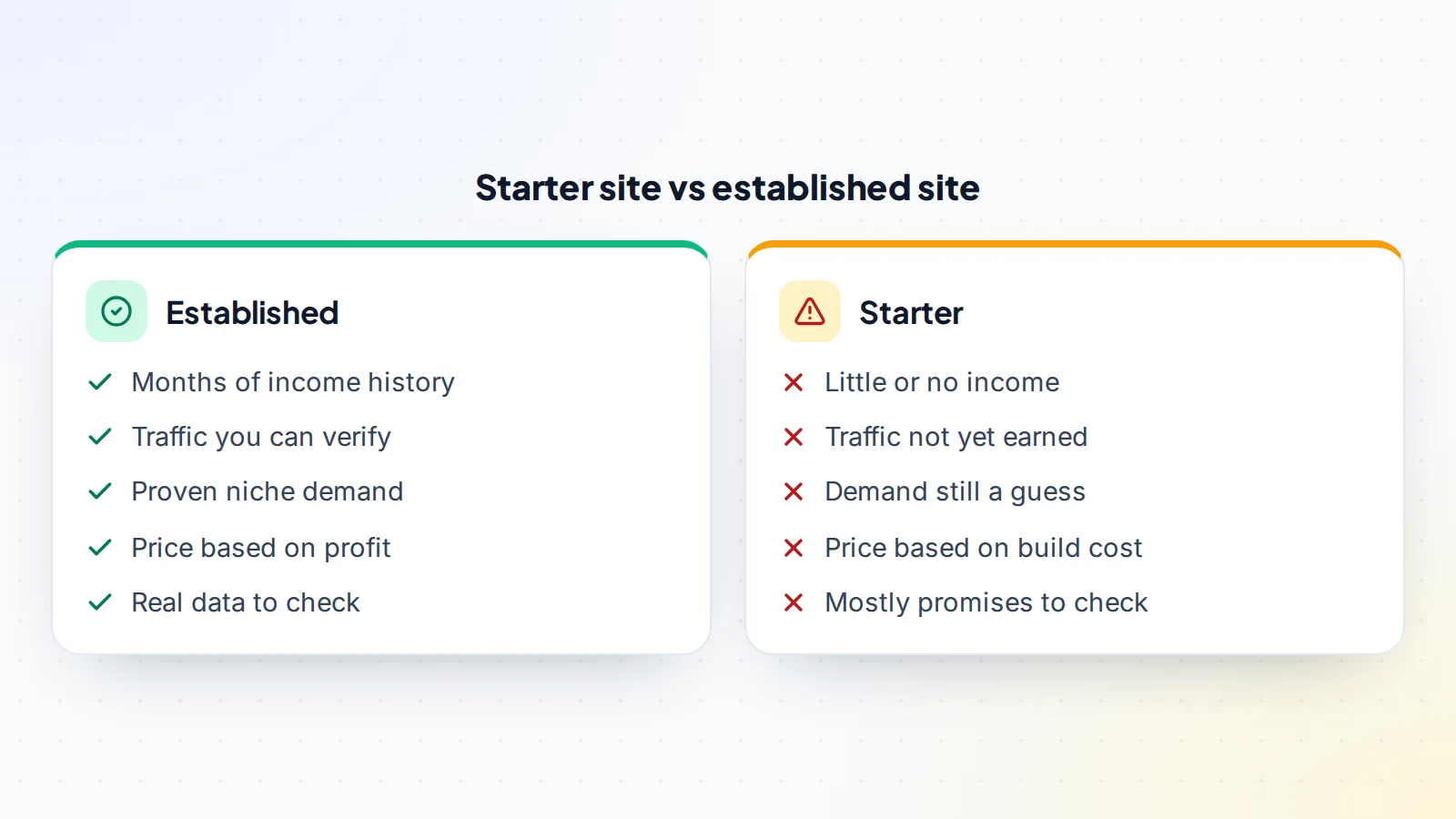
That difference changes the risk. An established site can lose traffic, but it starts from proven demand. A new site might never get traction at all, however well it’s built. Search engines take time to trust new pages, and competition in many niches is already heavy.
Why people sell them
Sellers fall into a few groups. Some are builders who set up sites as a service and sell them as a product; that’s a legitimate business, as long as the pitch is honest. Some started a site, lost interest, and want to recover part of their cost. Some are testing niches and sell the ones they won’t pursue. And a few use the starter label to sell low-effort sites with inflated promises, often in bulk.
Asking why the seller is selling, and how many similar sites they’ve sold, tells you a lot. A builder who sells dozens a month is selling a template, not a hand-picked opportunity. That can still be fine if the price matches.
Is a starter site worth buying?
It depends on what you’d do otherwise. If you were going to pay someone to research a niche, set up hosting, install a theme and write the first articles, buying a ready-made site at a similar price saves time. If you expected an income soon, it usually disappoints. New content sites often take many months before search traffic arrives, and some never earn enough to cover their costs.
The honest way to think about it: you’re buying a head start on a project, not an asset with a proven return. Price it like a service you’d pay for, and plan your budget and time as if you were building from scratch, minus the first few weeks.
What a fair price looks like
Because there’s no profit to multiply, the fair price of a new site is roughly what it would cost you to recreate it: domain registration, a theme, the hours of setup, and the content at market rates. If thirty articles of decent quality would cost a certain amount to commission, and setup is a day of work, add them up. That’s your ceiling.
A premium above build cost makes sense only for something you couldn’t easily recreate: an aged or brandable domain, a strong existing backlink profile you’ve verified, or early traffic that’s real and growing. Read revenue vs profit valuation to see why valuing a business on profit matters, and why that method doesn’t apply until there is one.
The costs after you buy
The purchase price is often the smallest part of what you’ll spend. Most new sites need far more content before they rank for enough searches to earn. Hosting and the domain must be renewed. Premium themes and plugins have yearly licences. And your time has value, even if you don’t pay yourself.
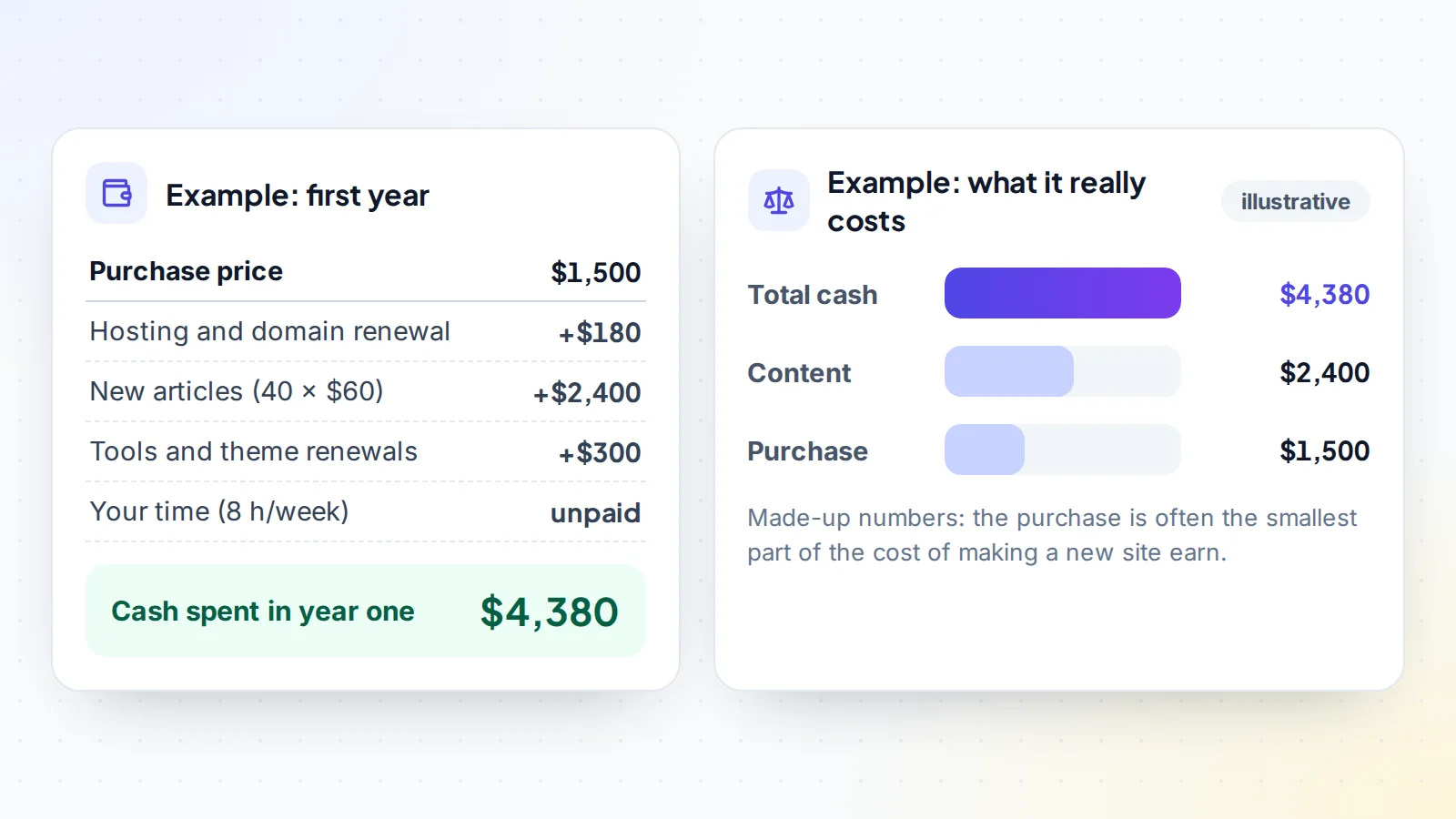
The example shows a common pattern: the content you add in year one costs more than the site itself. If that budget isn’t there, a starter site tends to stall at the same few articles it came with.
Claims to doubt
Starter site pitches often lean on a few familiar lines. Treat each one as something to check, not a fact:
- “Projected income.” A projection is a guess about the future. Ask what it’s based on and whether any site the seller built has reached it.
- “Passive income.” New sites need regular content, updates and promotion. Read how passive an online business really is.
- “Low competition niche.” Search the main keywords yourself and look at who ranks. Big brands and forums on page one are hard to beat.
- “Already getting traffic.” Ask for read access to analytics, not screenshots. Check where visits come from; bought or bot traffic is common on new sites.
- “Approved for ads.” Ad and affiliate accounts belong to the person who opened them. You’ll usually apply again under your own name.
The FTC warns about opportunities sold with promises of easy earnings; its guide to vetting a business or coaching opportunity is worth reading before any purchase that leans on income claims.
Judging the content
Content is most of what you’re paying for, so judge it properly. Read several articles in full. Are they accurate, useful and written for a reader, or padded to hit a word count? Paste a few paragraphs into a search engine in quotes to check they aren’t copied. Look for first-hand detail, sources and clear structure.
Google’s guidance on creating helpful, reliable, people-first content is a good benchmark. Its spam policies describe practices that can hurt a site’s search visibility, including scaled content abuse: many pages generated mainly to rank rather than to help people. A starter site built that way may never rank, or may lose what little it has.
Checking the domain
The domain is the one part of a new site that can carry real history. Check its age and past use in a web archive. A domain that once hosted something unrelated, or spam, may carry problems into the new site. Google’s spam policies also describe expired domain abuse: buying an old domain mainly to use its reputation for unrelated, low-value content. See how to check a domain’s history before you trust “aged domain” claims.
Make sure the domain will move to your own registrar account, not just be “managed” for you, and that it isn’t close to a trademark that could cause a dispute later.
Judging the niche
A starter site is a bet on a niche. Ask yourself whether people search for this topic with money to spend, whether there are products or services to recommend, and whether you could write about it for a year without running out of ideas. A niche you know well gives you an edge: better content, faster, at lower cost.
Be wary of niches that depend on a single affiliate program or a single trend. If one program changes its terms or the trend fades, there’s nothing to fall back on. Read about revenue diversification for how established sites spread that risk.
Technical basics to check
A new site should be technically clean. Check that pages load quickly on a phone, that the theme and plugins are up to date, that there are no nulled (pirated) themes or plugins, and that you’ll get full administrator access. Ask what hosting it’s on and whether it can move to your own account. Some sellers host many sites on one shared account and only “manage” yours, which leaves you dependent on them.
Getting full ownership
Ownership means you control every account, not that someone runs things on your behalf. Before paying in full, agree that you’ll receive the domain at your registrar, the site files and database (or hosting moved to your account), administrator access to the content system, and any email or social profiles included. Change every password and turn on two-factor sign-in when you take over.
Read the asset transfer checklist for a full list, and consider escrow so the money is only released once the transfer is complete.
When buying one makes sense
A starter site can be a reasonable buy when:
- You’d pay for the setup and first articles anyway, and the price is close to that cost.
- The niche is one you know and can keep writing about.
- You have a budget for months of content and the patience to wait for results.
- You want to learn how content sites work with a small, limited loss if it doesn’t take off.
- The domain or existing content has value you’ve checked yourself.
When to pass
Walk away when the price is based on projected income, when you need money from the site soon, when the content looks generated in bulk, when the seller won’t move the domain and hosting to you, or when you can’t explain why the niche will work. In each case, an established site with a real track record, or building your own, is the better choice.
Alternatives worth comparing
Before you buy, compare three paths. Building your own costs less cash and teaches you more, but takes longer to get started. Buying an established site costs more but gives you verifiable income from day one. Buying a starter site sits in between: a modest price for a head start, with all the uncertainty of a new project. Read buy vs start an online business for a full comparison.
Your first six months
If you buy, have a plan. Publish regularly to a content calendar built on real keyword research, not just the seller’s list. Build a few genuine links through outreach and useful resources. Set up analytics and search console under your own accounts on the first day, so you can see what’s working. Expect slow early progress and judge the site over months, not weeks.
Track a few simple numbers: pages published, pages indexed, search impressions, clicks and the first sign of income. Those tell you whether the site is moving in the right direction long before it pays its way.
Common mistakes
- Paying a multiple of projected income instead of the cost of the work.
- Expecting income in the first few months.
- Not budgeting for content after the purchase.
- Trusting traffic screenshots instead of analytics access.
- Leaving the domain or hosting in the seller’s account.
- Buying several cheap sites instead of growing one properly.
A worked example
The details below are made up to show the method.
Jordan is offered a four-month-old gardening site with twenty-five articles, a brandable domain and a list of one hundred keywords, for $1,500. The listing projects $500 a month within a year. Jordan ignores the projection and prices the work instead: commissioning twenty-five similar articles would cost around $1,250, and setup is worth a day. The domain is new, with no history in the web archive.
Jordan reads ten articles and finds them accurate but thin, checks a few paragraphs for copying, and asks for read access to analytics. It shows a few hundred visits a month, mostly from search. Jordan offers $1,100, which the seller accepts, and budgets $2,400 for forty more articles over the year. The domain moves to Jordan’s registrar and the site to Jordan’s hosting before the money is released. Twelve months later, the site earns a small amount from affiliate links. Jordan treats it as a project still growing, not a finished business.
Starter site: the checklist
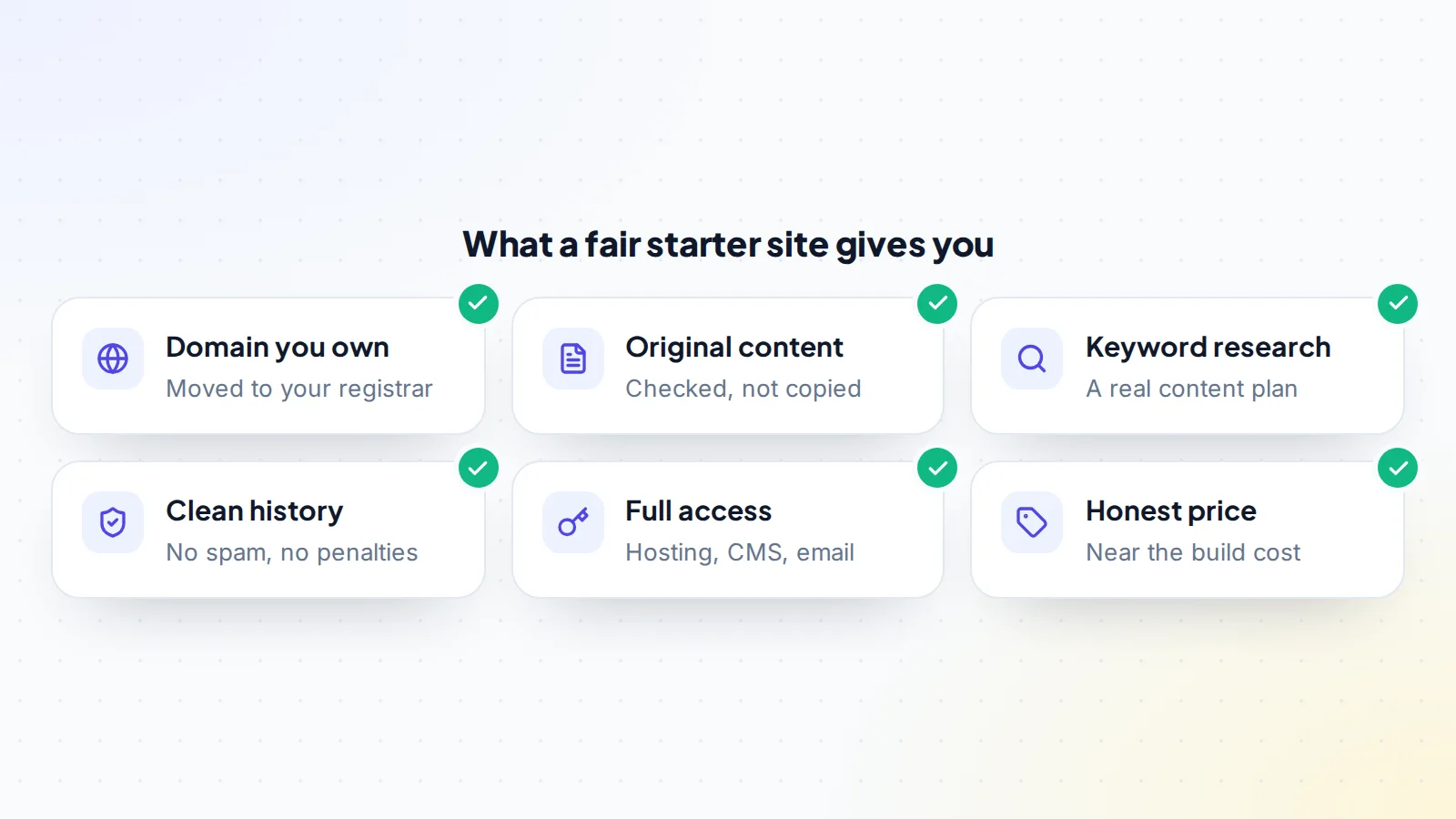
- Price compared with the cost of rebuilding the site.
- Several articles read in full and checked for copying.
- Domain history checked in a web archive.
- Niche checked: real searches, products and your own interest.
- Analytics access, not screenshots, for any traffic claim.
- Themes and plugins licensed and up to date.
- Domain, hosting and content system moved to your accounts.
- Budget and time set aside for months of new content.
Browse websites for sale to compare new sites with established ones, and read how it works on digiflippers.com.
Ready to find your next asset?
Browse listings with verified numbers, ask sellers your questions before you offer, and agree every step in a free Deal Room.
Frequently asked questions
What is a starter site?
A newly built website sold before it has a proven income, usually with a domain, theme, some content and a growth plan.
How much should I pay for one?
Roughly what it would cost to build the same thing yourself: domain, setup and content at market rates.
How long until a new site earns?
Often many months, and some never earn enough to cover their costs. It depends on the niche, the content and the work you put in.
Are income projections reliable?
No. A projection is a guess. Ask what it’s based on and judge the site on what you can check today.
Is it better than building my own?
It saves setup time. Building your own costs less cash and teaches you more. The right choice depends on your time and skills.
Do ad and affiliate accounts come with the site?
Usually not. They belong to the person who opened them, so you’ll normally apply under your own name.
How do I check traffic on a new site?
Ask for read access to its analytics and look at sources, locations and trends, not screenshots.
Can I resell it later?
Yes, once it has a record of traffic and income. That record is what lifts its value above the build cost.