What Is a Digital Asset? A Plain-English Guide
A plain-English guide to digital assets: the main types, how they earn money, what makes them valuable, how they're bought and sold, and how to start.
“Digital asset” is one of those phrases everyone uses and few people define. In everyday business, a digital asset is something that exists online, has value, can earn money and can be owned and transferred: a website, an app, a domain name, a YouTube channel, a newsletter, a template shop. So what is a digital asset in practical terms, and why do people buy and sell them like any other business?
This plain-English guide answers that. You’ll learn the main types of digital assets, how each one earns money, what makes one more valuable than another, how they’re bought and sold, the risks to understand, and how to get started whether you want to buy your first asset or sell one you’ve built.
One note before we begin: the term has a narrower meaning in some legal and tax contexts, which we explain below so you don’t mix them up.
Key takeaways
- In business, a digital asset is anything online that has value, can produce income and can change owners.
- The main types are websites and stores, SaaS and apps, domains, audiences (social accounts, newsletters, communities), digital products and game accounts.
- Value comes from attention, repeat use, income, durability and how easily the asset transfers.
- Most earning assets are priced as a multiple of profit; non-earning ones on what a buyer could build with them.
- Tax authorities sometimes use “digital asset” to mean crypto. Check which meaning applies when you read official guidance.
What is a digital asset?
A digital asset, in the sense marketplaces and investors use, is something that exists in digital form and has economic value to its owner. To be treated as an asset you can buy or sell, it usually needs three things:
- Value: people want it, because it attracts attention, saves time or earns money.
- Ownership: someone controls it, through an account, a registration or rights to the content and code.
- Transferability: that control can pass to someone else.
A blog that earns from ads, a domain name that a startup wants, a SaaS tool with paying customers, an Instagram account with an engaged audience: all of these fit. So do less obvious things, such as a library of stock photos or a set of spreadsheet templates sold online. Some people call this whole space “digital real estate”; our guide to digital real estate explains why the comparison works.
A different meaning: “digital assets” in tax rules
Be aware that some official bodies use “digital asset” much more narrowly. The U.S. Internal Revenue Service, for example, defines digital assets for tax purposes as digital representations of value recorded on a cryptographically secured distributed ledger (a blockchain) or similar technology, such as cryptocurrencies, stablecoins and NFTs. Under that definition, a website or a newsletter isn’t a “digital asset” at all; it’s a business asset or intellectual property.
That doesn’t change anything in this guide, but it matters when you read tax guidance or speak to an accountant: make sure you both mean the same thing. When you sell a website or an app, the tax treatment depends on where you live and how you own it, not on the crypto rules.
The main types of digital assets
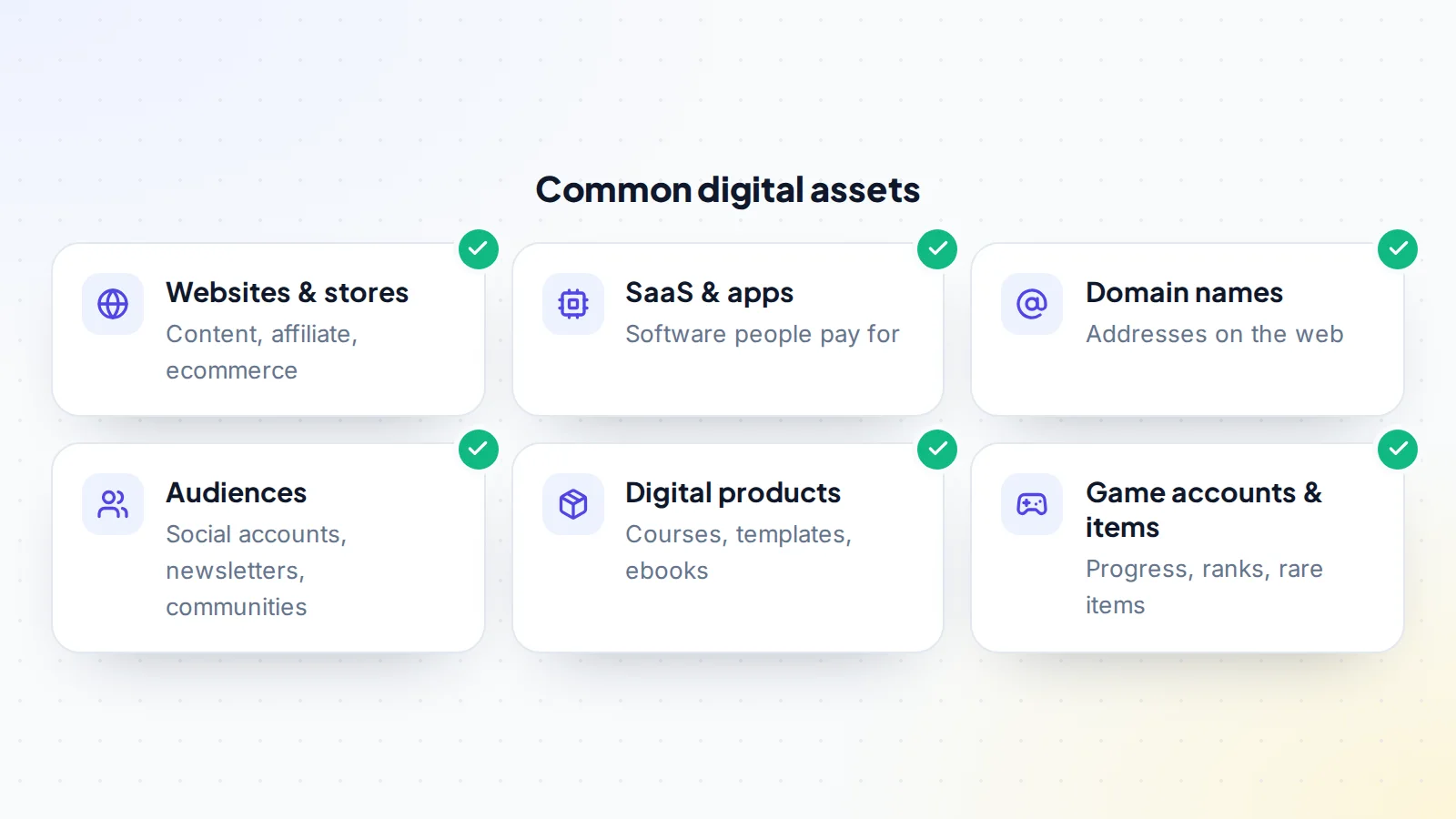
Websites and online stores
Content sites earn from ads and affiliate links; online stores sell physical or digital products; lead-generation sites pass enquiries to businesses. They’re the most traded category. See how to buy a website.
SaaS products and apps
Software people pay for every month, mobile apps, browser extensions and plugins. Recurring revenue makes them attractive; code and customers make them more complex to run. See buying a SaaS business.
Domain names
Short, memorable or meaningful domains can be valuable on their own, without any website. They’re bought by businesses building brands and by investors. See buying a domain that’s taken.
Audiences
YouTube channels, Instagram and TikTok accounts, newsletters, Discord servers and Telegram channels. Their value is the attention of an engaged group of people, often monetised through sponsors, subscriptions or affiliate links. See buying social media accounts and buying a newsletter.
Digital products
Courses, templates, ebooks, themes, stock libraries. No stock or shipping, high margins and catalogues that keep selling. See buying a digital product business.
Game accounts and items
Accounts with rare cosmetics, high ranks or large libraries, and in-game items. A large, active market of players. See buying a game account.
How digital assets earn money
Most digital assets turn attention into income through one or more of a handful of models: advertising, affiliate commissions, product sales, subscriptions, sponsorships, services and licensing. The healthiest assets usually combine several. Our guide to online business models explains each one with examples, and passive income and online businesses is an honest look at how hands-off they really are.
What makes a digital asset valuable
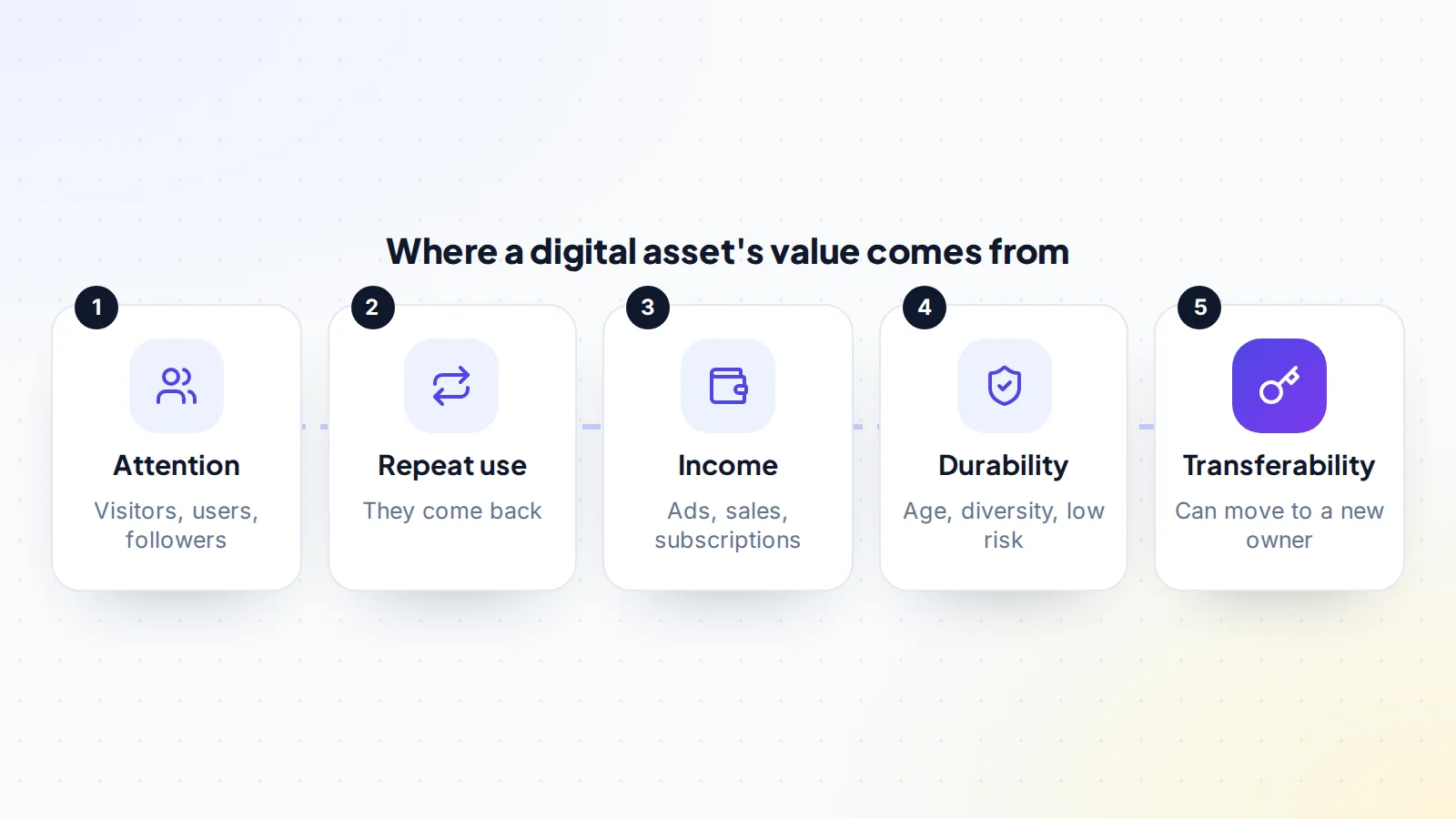
Five qualities explain most of the difference in value between two assets that look similar on the surface:
- Attention: how many people visit, use, follow or read it.
- Repeat use: whether they come back, which turns attention into a relationship.
- Income: how much it earns, and how reliably.
- Durability: age, diversity of traffic and income, and low dependence on one platform or person.
- Transferability: how cleanly accounts, rights and relationships move to a new owner.
Earning assets are usually priced as a multiple of their profit, with the multiple reflecting those qualities. Assets that don’t earn yet are valued on what it would cost to build them and what they could earn. Our guide to valuing an online business goes into detail, and the free valuation tool gives you a quick range.
Digital assets vs traditional assets
Digital assets share a lot with traditional ones, such as property or a small shop: they can produce income, they can grow in value, and they can be bought and sold. But a few differences shape how you should think about them.
- Lower entry costs. Many digital assets sell for a few thousand dollars, so people can start small and learn.
- Speed. A website or account can change hands in days rather than months.
- Location independence. You can own and run them from anywhere with an internet connection; see location-independent businesses.
- Dependence on platforms. Unlike a building, most digital assets rely on someone else’s infrastructure: search engines, app stores, social networks, payment processors.
- Easier to fake. Numbers live on screens, which is why verification at the source matters so much more than in many traditional deals.
A simple example
Imagine two digital assets for sale. The first is a recipe website, five years old, earning $1,200 a month from display ads and affiliate links after costs, with traffic from search, Pinterest and an email list. The second is an Instagram account about the same topic with 200,000 followers that has never earned anything.
The website has attention, repeat visitors through the email list, proven income, durability from several traffic sources and an easy transfer of domain, hosting and accounts. A buyer can price it on its profit. The Instagram account has attention, but its value depends on how engaged the followers are, whether they’re in places advertisers care about, and how much a new owner could earn from them. It’s priced on audience quality and potential, which makes it more debatable. Neither is “better” in general; they’re different assets for different buyers. Understanding what a digital asset is, and where its value comes from, is what lets you compare them sensibly.
Buy or build?
Building a digital asset from scratch is cheaper in money and much more expensive in time, and many new projects never reach the point of earning. Buying one gives you a head start and a record you can check before you commit, but costs more upfront and carries the risk of overpaying for numbers that don’t hold up. Many people do both: buy an asset that already works, then build on top of it. Read buying vs starting an online business for a side-by-side comparison.
How digital assets are bought and sold
Digital assets change hands in a few common ways: on marketplaces where sellers list and buyers make offers, through brokers who manage sales for a fee, and in private deals between people who already know each other. Whichever route you take, a safe deal follows the same pattern:
- Listing and discovery: the seller describes the asset and its numbers.
- Questions and due diligence: the buyer verifies revenue, traffic, accounts and rights at the source. See due diligence.
- Offer and agreement: price, what’s included, handover steps and an inspection period, all in writing.
- Protected payment: escrow or a trusted middleman holds the money. See how escrow works.
- Handover: domains, files and accounts move to the buyer. See the handover checklist.
- Release: once the buyer confirms, the seller is paid.
On digiflippers.com, you can browse the marketplace, ask sellers questions before you offer and agree every step in a free Deal Room. The ways to pay in a deal are: directly to the seller, through escrow, and the platform never holds the money itself.
Risks to understand
- Platform risk: rules and algorithms on Google, YouTube, app stores and social networks can change, and with them traffic or income.
- Numbers that don’t hold up: screenshots can be edited and growth can be bought. Always verify at the source.
- Dependence on one person: some assets rely on the seller’s face, voice or contacts.
- Transfer problems: not every account or platform allows a clean change of owner.
- Scams: fake escrow, fake sellers and off-platform payment requests. See common digital asset scams.
None of these make digital assets a bad idea; they make them assets that reward careful buyers and well-prepared sellers.
What it’s like to own one
Owning a digital asset is closer to owning a small business than to owning a share. Someone has to publish content, answer customers, fix things that break, renew domains, pay for hosting and watch the numbers. Some assets need an hour a week; others need a full-time team. Before you buy, ask the seller exactly how they spend their time, and decide honestly whether you’ll do that work yourself or pay someone. The owners who do best are usually the ones who treat their asset as a business to improve, not a machine to leave alone.
How to get started
If you want to buy, start with your budget and your skills. Our guide to what budget you need covers realistic starting points, and niche research helps you choose a topic you can run well. Then learn the vocabulary with our online business glossary, browse listings to get a feel for prices, and read due diligence before you make your first offer.
If you’ve built something, think about whether it could be sold now or later. Even small side projects can have buyers; see selling a side project. And if you’re curious where the market is going, our look at online business trends and the creator economy is a good next read.
Digital asset basics: the checklist
- You can explain what makes your target asset valuable: attention, repeat use, income, durability, transferability.
- You know which income models it uses and how stable they are.
- You understand the platform risks that apply to it.
- You’ve set a budget, including money for running and improving it.
- You know how its accounts and rights transfer.
- You’ll verify every number at the source before paying.
- You’ll use a written agreement and protected payment.
- You’ve checked the tax treatment where you live with an accountant.
Ready to find your next asset?
Browse listings with verified numbers, ask sellers your questions before you offer, and agree every step in a free Deal Room.
Frequently asked questions
What is a digital asset in simple terms?
Something online that has value, can earn money and can be owned and transferred, such as a website, an app, a domain name, a social media account or a digital product.
What are examples of digital assets?
Content websites, online stores, SaaS tools, mobile apps, domain names, YouTube channels, Instagram accounts, newsletters, Discord servers, online courses, template shops and game accounts.
Is crypto a digital asset?
Yes. In fact, some tax authorities, including the U.S. IRS, use “digital asset” specifically for crypto and similar blockchain-based items. In marketplaces, the term usually means online businesses and properties as well.
Can you make money from digital assets?
Yes, through ads, affiliate commissions, product sales, subscriptions, sponsorships and more, and by buying, improving and selling assets. Like any investment, returns aren’t guaranteed and depend on careful buying and good management.
How are digital assets valued?
Earning assets are usually valued as a multiple of profit. Non-earning assets are valued on what they would cost to build and what they could earn with a new owner.
Are digital assets a good investment for beginners?
They can be, because you can start small and learn quickly. Begin with a simple, earning asset you understand, verify every number and budget for running it after you buy.
Do digital assets lose value?
They can, if traffic, audience or income declines, or a platform changes its rules. Assets with several income sources and traffic channels tend to hold their value better.
Where can I buy digital assets?
On online marketplaces, through brokers, or privately. Marketplaces let you compare many assets and ask sellers questions; always check that payments are protected.