
How to Sell a Social Media Account Safely
How creators and page owners sell YouTube, Instagram, TikTok and Facebook accounts for a fair price, with proof buyers trust and a handover that protects you.

An engaged audience is a real asset, and like any asset it can be sold. Creators sell accounts to move on to new projects, page owners sell to cash in on years of work, and agencies sell accounts they no longer have time to run. When you sell a social media account well, you’re paid fairly for that work and the buyer gets an audience that keeps responding.
This guide walks you through the whole process: preparing the proof buyers look for, working out what your account is worth, writing a listing, choosing a serious buyer, getting paid safely and handing over the account in a way that protects both of you.
It applies to YouTube channels, Instagram and TikTok accounts, Facebook Pages and Groups, X and Pinterest accounts. Where the platforms differ, we link to a dedicated guide.
Key takeaways
- Prepare 12 months of analytics, audience data and income records before you list.
- Price earning accounts on average monthly profit; price the rest on audience quality, niche and content.
- Share analytics through live screen shares or read-only access, never your password, until the payment is secured.
- Use the platform’s own ownership tools for the handover where they exist.
- Agree everything in writing, and only start the handover once payment is held in escrow or with a trusted middleman.
Is your account ready to sell?
Buyers look for accounts that will keep performing after the sale. Before you list, ask yourself honestly:
- Is it built around a topic rather than you? Theme accounts (recipes, fitness tips, travel, finance, memes, design) carry over to a new owner much better than accounts built on one person’s face and life.
- Is engagement healthy right now? Recent posts should perform in line with the account’s size.
- Is the account in good standing? Check your platform dashboards for warnings, strikes or restrictions, and resolve what you can first.
- Can someone else make the content? If the format depends on skills or access only you have, explain how a buyer could continue it.
If you’re a personal brand, you can still sell, but expect buyers to value mainly the audience and the content library, and be ready to help with the transition.
Step 1: Prepare the proof buyers want
The single biggest factor in how fast you sell, and for how much, is how easily a buyer can trust your numbers.
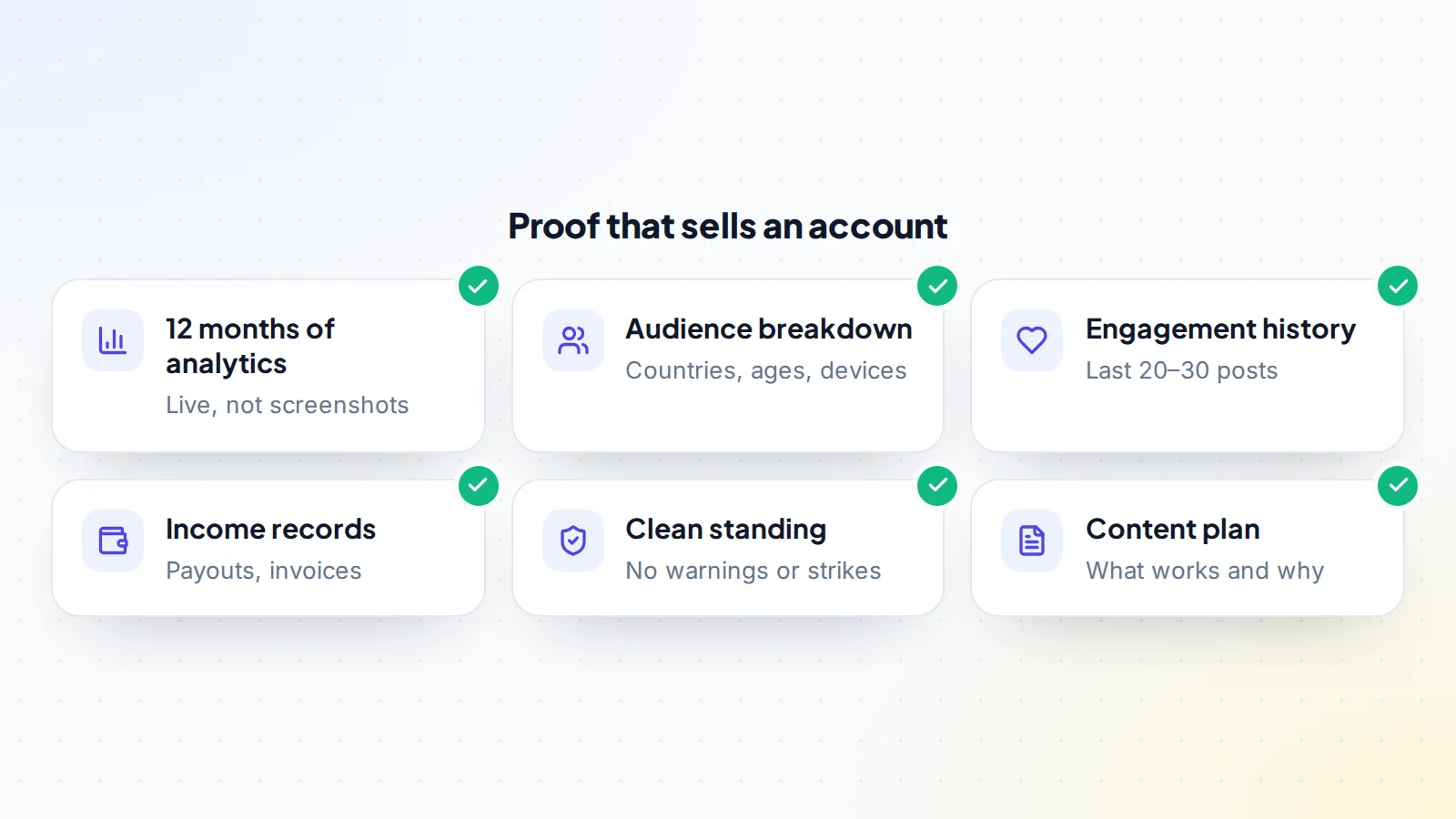
- Analytics for the last 12 months: reach, views, follower growth and engagement, in the platform’s own dashboard (YouTube Studio, Instagram or TikTok professional dashboards, Meta Business Suite).
- Audience breakdown: top countries, age ranges and gender split. Buyers and advertisers care a lot about where the audience is. See why audience demographics affect value.
- Engagement history: how the last 20 or 30 posts performed. Our guide to engagement rate shows how buyers calculate it.
- Income records: platform payouts, sponsor invoices and affiliate reports, with the matching payments.
- A short content guide: what you post, how often, which formats work best and where you get ideas.
On digiflippers.com, you can connect your account with read-only access so buyers see a verified badge next to your numbers. See how verification works.
Step 2: Work out what your account is worth
Accounts that earn money are usually valued as a multiple of their average monthly net profit over the last 6 to 12 months. Accounts that don’t earn yet are valued on audience size and quality, engagement, niche and the content library.
Things that raise the price:
- Steady, organic growth over a long period.
- Strong engagement for the account’s size.
- An audience in countries and age groups advertisers pay for.
- Several income sources that don’t depend on you personally.
- A large library of content that keeps getting views.
Things that lower it: falling engagement, a recent drop in reach, sponsors who only want to work with you, unclear income and any problems with the account’s standing. Our guides to YouTube channel value and Instagram account value go deeper, and the free valuation tool gives you a quick range.
Step 3: Raise the value before you list
A few weeks of focused work can noticeably improve what buyers see:
- Post consistently. A steady schedule in the months before a sale shows the account is alive and healthy.
- Add an income source if you have none, such as affiliate links relevant to your niche, so buyers can see the audience converts. Read monetising an Instagram account or YouTube income streams for ideas.
- Tidy the profile: a clear bio, organised highlights or playlists, and no old links to dead pages.
- Remove anything you’ll keep, such as links to your personal projects or a shop that isn’t part of the sale.
Our guides to growing an Instagram account and TikTok monetisation have more ideas.
Step 4: Write a listing that attracts serious buyers
A good listing answers the questions buyers would otherwise ask one by one:
- The platform, niche and what kind of content the account posts.
- Followers, average views or reach, and engagement over the last few months.
- Audience: top countries and age ranges.
- Income, by source, for the last 6 to 12 months, if any.
- How much time the account takes each week and what that time is spent on.
- What’s included: the account, content files, templates, email list, linked pages.
- Why you’re selling.
Be honest about weaknesses. A buyer who finds a problem you didn’t mention will doubt everything else; a buyer who reads it in the listing simply prices it in. When you’re ready, you can list your account on digiflippers.com for free, with no success fee.
When is the best time to sell?
Sell while the account is performing well, not after it has started to slide. Buyers study the last few months closely, and a recent dip lowers offers even if the long-term record is strong. If reach has dropped, it’s often worth a few weeks of consistent posting to show the account has recovered before you list. Avoid selling in the middle of a big change, such as a new format or a rebrand: buyers discount anything unfinished. And give yourself time. Rushed sellers accept lower offers and skip steps that protect them.
Step 5: Talk to buyers and spot time-wasters
Serious buyers ask detailed questions, and you should welcome them. Keep every conversation in one place so you have a record, and share analytics through a live screen share or read-only access.
Be careful with buyers who:
- Ask for your login details “to check the analytics”.
- Want you to hand over the account first and pay later.
- Suggest a payment or escrow service you’ve never heard of.
- Push you to decide within hours.
- Send a payment “confirmation” by email instead of a payment you can see in your own account.
A genuine buyer won’t mind proving they’re serious, for example by making a written offer before you share detailed income records.
Step 6: Agree the terms in writing
Once you’ve agreed a price, write down:
- The price and the payment method.
- Exactly what’s included in the sale.
- How the handover works on your platform, step by step, and who does what.
- How long the buyer has to check everything before the money is released.
- Any help you’ll give afterwards, such as introductions to sponsors or a few weeks of answering questions.
On digiflippers.com, these terms live in a free Deal Room where both sides confirm each step, so nothing relies on memory.
Step 7: Get paid safely
Start the handover only once the payment is secured. With escrow, the buyer pays a licensed escrow company, you see that the money is held, you hand over the account, the buyer checks it, and then the money is released to you. A trusted middleman can do the same job. Read how escrow works for the details.
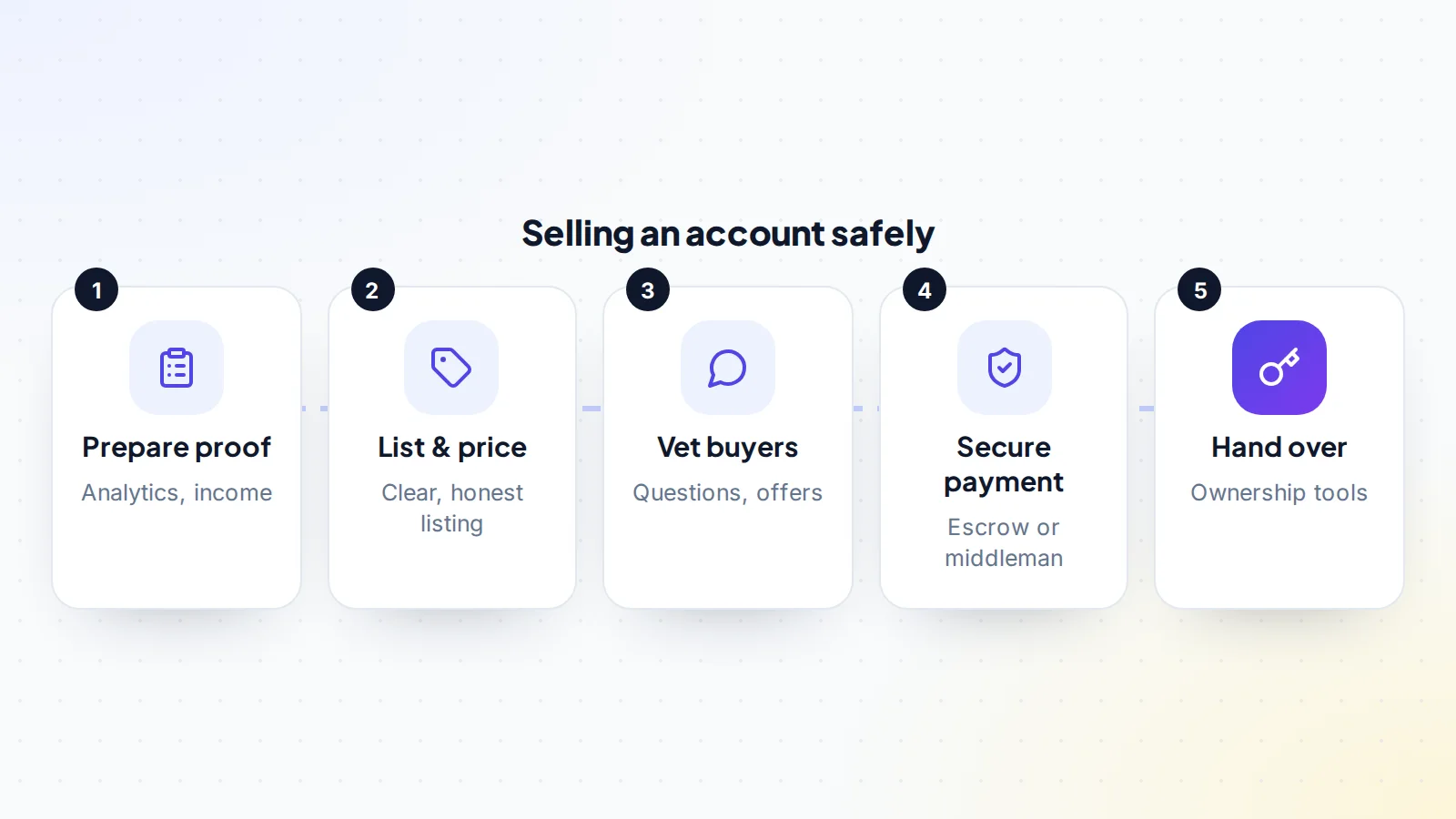
On digiflippers.com, the ways to pay in a deal are: directly to the seller, through escrow. The platform never holds the money itself.
Step 8: Hand over the account
Use the platform’s own tools wherever they exist. They’re designed for exactly this, and they leave a clear record.
- YouTube: if your channel is on a Brand Account, add the buyer as an owner. YouTube’s help explains that someone must have been an owner for at least 7 days before they can become primary owner, so plan the handover around that week. See transferring YouTube channel ownership and our seller’s guide to selling a YouTube channel.
- Facebook Pages: give the buyer Facebook access with full control from your Page settings or Meta Business Suite. Once they confirm, they can remove your access. See Facebook Page transfers.
- Facebook Groups: make the buyer an admin, then step down. See Group admin transfers.
- Accounts handed over with their login (common for Instagram and TikTok): change the email to the buyer’s, hand over the password, help them set their own phone number and two-factor authentication, and remove your recovery details. Platform-specific steps are in selling an Instagram account and selling a TikTok account.
Before you start, download anything you want to keep, disconnect payout accounts that are yours, and remove links to your other projects. Our guide to social media account transfers has a full checklist for each platform. When the buyer confirms they’re in control, the payment is released.
What changes from platform to platform
The steps above apply everywhere, but each platform has its own details worth knowing before you sell a social media account there:
- YouTube buyers look hardest at watch time, audience retention and income from the Partner Program, which YouTube’s help explains is shared through the payout account linked to the channel. Expect questions about which videos still bring views years later.
- Instagram buyers focus on reach, saves and shares, story views and the audience’s location. Brand deal history is often the main source of value.
- TikTok buyers care about recent performance more than anywhere else, because reach can change quickly. Show the last 90 days in detail.
- Facebook Pages and Groups are valued on active members and engagement rather than total likes. Groups with real conversations are worth more than Pages with large, quiet audiences.
- Pinterest buyers want to see outbound clicks, because most Pinterest value comes from sending traffic to websites and stores. See Pinterest accounts for sale.
After the sale
Keep your promises: answer the buyer’s questions during the agreed support period and make the introductions you said you would. A smooth handover protects your reputation, which matters if you plan to sell again or work with brands in the same niche. Then tidy up on your side: remove the account from any third-party tools you used, update your own links and bios elsewhere, and keep a copy of the agreement and payment records. Selling an account can have tax consequences, so keep the paperwork for your accountant.
Finally, think about what you’ll build next. Many sellers use what they learned to grow a new account faster the second time, with a sale in mind from the start.
How to sell a social media account: the checklist
- Account built around a topic, in good standing, with healthy recent engagement.
- 12 months of analytics, audience data and income records ready.
- Numbers verified through a read-only connection where possible.
- A fair price based on profit or audience quality.
- An honest listing with audience, income, effort and what’s included.
- Analytics shared live or read-only; no passwords before payment.
- Terms agreed in writing, including the handover steps.
- Payment secured through escrow or a trusted middleman.
- Handover done with platform tools, or email, password, phone and 2FA moved to the buyer.
- Your payout accounts, links and personal data removed.
Ready to sell?
List it on digiflippers.com with verified numbers, answer buyers in one place and agree every step in a free Deal Room. No success fee.
Frequently asked questions
How much can I sell my social media account for?
Earning accounts are usually priced as a multiple of average monthly profit. Accounts without income are priced on audience size and quality, engagement, niche and content. Location and age of the audience matter a lot to buyers.
Which accounts are easiest to sell?
Theme accounts with steady growth, strong engagement, an audience advertisers value and a clear content format that someone else can continue.
How do I prove my account’s numbers?
Show the platform’s own analytics live, or give read-only access where the platform supports it. On digiflippers.com, you can also connect the account so buyers see a verified badge.
How long does it take to sell an account?
Finding a buyer can take days or weeks, depending on price, niche and how well you’ve prepared. The handover itself depends on the platform: YouTube Brand Account handovers take at least a week because of the 7-day owner rule.
What if the buyer wants my password before paying?
Say no. Share analytics through a screen share or read-only access, and start the handover only after the payment is secured.
Can I sell an account that doesn’t make money yet?
Yes. Many buyers want an engaged audience they can monetise themselves. Expect the price to reflect audience size, engagement, location and niche rather than income.
Do I pay tax on the sale?
In many countries, yes. Selling an account can count as income or a capital gain depending on your situation. Ask an accountant where you live.